

⚖️ The Opening Question
What happens when a sitting president flirts with authoritarianism—threatening citizens, defying court rulings, and claiming immunity from oversight?
The Constitution offers guardrails. Federal law outlines consequences. So why does accountability feel like a myth?
“No man in this country is so high that he is above the law.” — Justice Samuel Miller, United States v. Lee (1882)
The uncomfortable truth is this: the U.S. legal system has the tools to rein in a lawless president, but those tools are rusting from disuse.
📜 The Laws That Exist—On Paper
The statutes are not ambiguous. Take:
18 U.S. Code § 2384 — Seditious Conspiracy: Designed to punish those who conspire to overthrow or oppose government authority by force. Applied to Oath Keepers and Proud Boys, but rarely—if ever—to officials at the top of the chain.
18 U.S. Code § 242 — Deprivation of Rights Under Color of Law: Criminalizes willful violations of constitutional rights by officials acting under “color of law.”
“In theory, no one is above the law. In practice, the presidency has been treated as an exemption clause.” — Laurence Tribe, Harvard Law Professor
Why? Because the Justice Department and Congress routinely dodge the most obvious application, preferring “political solutions” over legal ones.
🏛️ The Institutional Players (and Their Failures)
Congress has impeachment power, the Constitution’s ultimate check. But impeachments have turned into political theater, not functional accountability.
“Impeachment is not a remedy for private wrongs; it is a method of national inquest into the conduct of public men.” — Alexander Hamilton, Federalist No. 65
The Department of Justice holds prosecutorial authority. Yet, the infamous OLC memos declaring a sitting president “immune” from indictment have frozen action for decades.
The Courts can rule, but enforcement is another story. Andrew Jackson’s defiance of the Supreme Court still echoes in history:
“John Marshall has made his decision; now let him enforce it.” — Attributed to Andrew Jackson on Worcester v. Georgia (1832)
When the president refuses compliance, the judiciary’s words can wither on the page.
📚 History’s Mixed Record
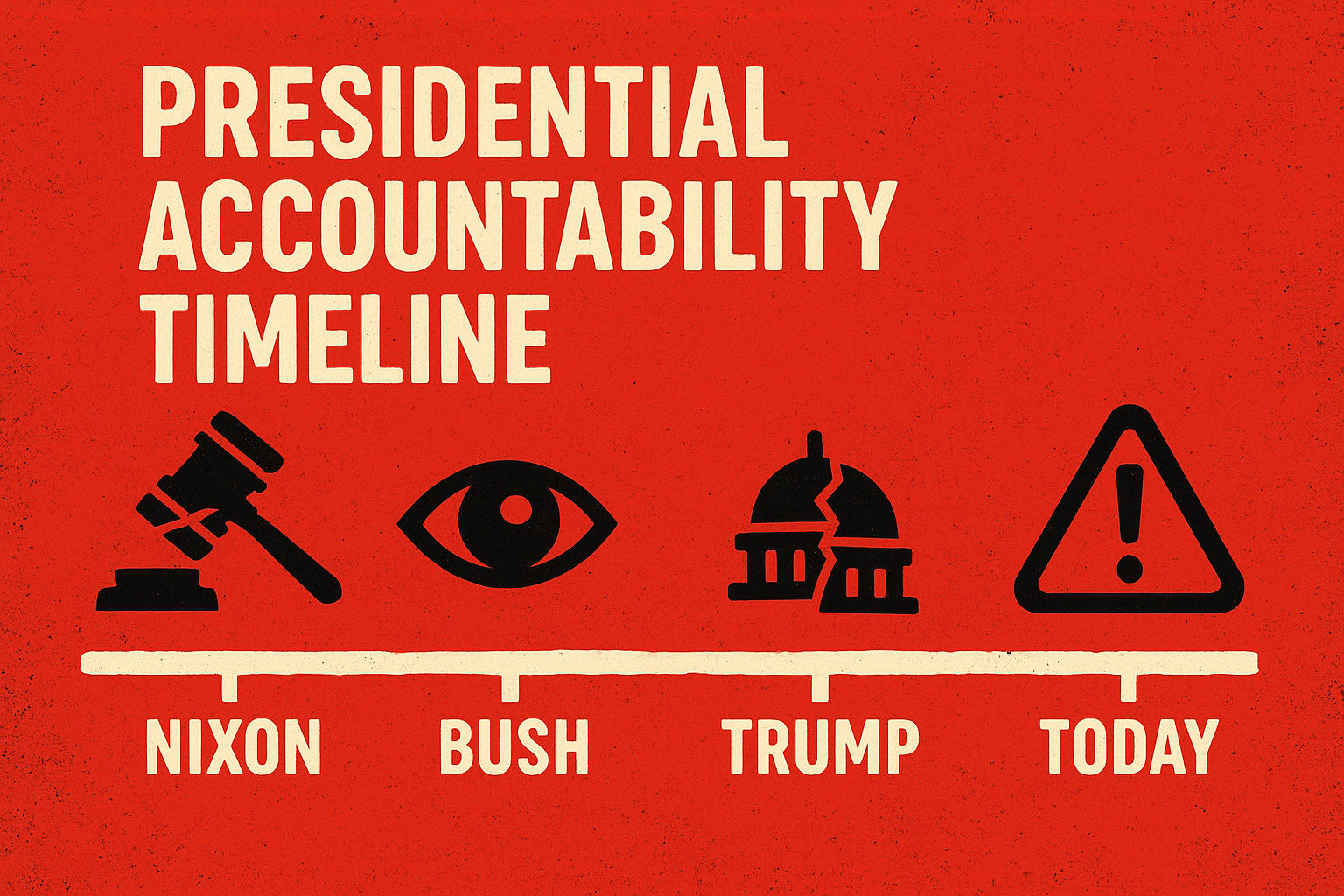
Nixon (1974): Forced out not by prosecution, but by political pressure. He was later pardoned.
Bush-era warrantless surveillance: Declared unconstitutional by many scholars, but never fully punished.
Trump (2017–2021): Defied subpoenas, threatened political opponents, and incited insurrection—all while testing the system’s willingness to enforce its own rules.
“If the President is immune from judicial process, then he is, in fact, above the law.” — Judge John Sirica, U.S. District Court, Watergate trials (1973)📚 History’s Mixed Record
🧩 The Real Problem: Political Will
The laws exist. The precedents are there. The Constitution outlines remedies. But the barrier is not legal—it’s political.
“A judge who must decide whether the President is acting within his powers can neither be loyal to him nor to any political party. His only loyalty must be to the Constitution.” — Justice Robert Jackson, Youngstown Sheet & Tube Co. v. Sawyer (1952)
Prosecutors calculate risks. Lawmakers fear backlash. Judges hesitate to step into “political questions.” And the public, exhausted by endless scandals, often shrugs in resignation.
This fuels a dangerous cycle: presidents push the boundary, see no consequence, then push further. Over time, “executive privilege” morphs into executive impunity.
🪞 Public Perception: Immunity as Power
When citizens believe the president is untouchable, it shapes political behavior. A lawless executive thrives in that belief.
“The accumulation of all powers, legislative, executive, and judiciary, in the same hands … may justly be pronounced the very definition of tyranny.” — James Madison, Federalist No. 47
Supporters excuse violations as “strong leadership.” Opponents despair. Accountability erodes not only in law but in culture.
And culture matters. Without public demand, institutional courage vanishes.
🚨 The Call to Action
If democracy is to endure, accountability must be more than symbolic. That means:
Demanding Congress treat impeachment as a duty, not a partisan stunt.
Pressuring the DOJ to revisit its self-imposed prohibition on indicting sitting presidents.
Supporting judicial independence even when rulings sting politically.
Most importantly, refusing to normalize presidential overreach as “just politics.”
“The President is not above the law. But neither is he beneath it.” — Chief Justice Warren Burger, United States v. Nixon (1974)
The question isn’t whether laws exist—it’s whether we will ever have the courage to use them.
👉 We’re pushing hard to reach 2,000 subscribers by September 1st. If you believe in accountability, transparency, and resisting authoritarian drift, join us. Your voice matters.
Subscribe, share, and stay loud.
#TheInsurgency #AccountabilityNow #NoOneAboveTheLaw