

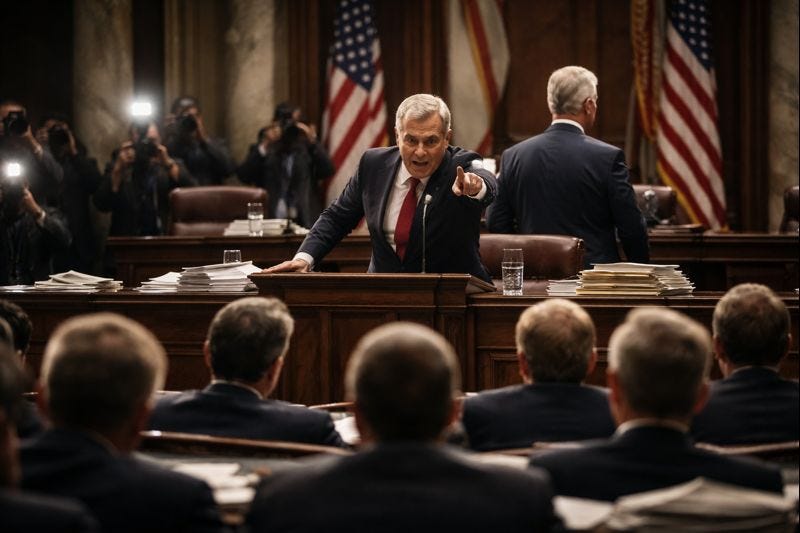
There is a lie so deeply embedded in American political culture that most people no longer recognize it as a lie. It’s treated like background noise. Like gravity. Like the weather.
The lie is this:
No one is really in charge.
That lie is why nothing ever seems to be anyone’s fault.
It’s why failure doesn’t end careers.
It’s why disasters get hearings instead of consequences.
It’s why the same people who created the mess keep asking for another term to fix it.
And it is absolutely, provably false.
Accountability didn’t disappear. It was deliberately dismantled, piece by piece, vote by vote, excuse by excuse, until responsibility became so diffused that it no longer felt assignable.
That wasn’t an accident.
That was strategy.
The First Trick: Turn Power into Fog
Power in this country is not mysterious. It is concentrated, documented, and traceable. But you wouldn’t know that from listening to politicians talk.
They talk about “the system.”
They talk about “forces.”
They talk about “the economy,” “polarization,” “gridlock,” and “complexity.”
They never talk about names.
Because the moment you replace fog with names, accountability becomes unavoidable.
Budgets do not materialize. They are written.
Wars do not drift into existence. They are authorized.
Tax codes do not become predatory by accident. They are designed, amended, and preserved by people who know exactly who they benefit.
Nothing that lasts decades does so unintentionally.
If something continues year after year, it is because the people with authority want it to continue more than they want the backlash for stopping it.
That’s not dysfunction.
That’s cowardice with a retirement plan.
Congress: The Primary Crime Scene
Congress is where accountability goes to die.
Not because members don’t have power, but because they have learned how to avoid owning it.
Members of Congress campaign as if they are locked outside the building, banging on the doors, begging to be let in. Then they get elected and spend the next decade pretending they’re powerless against the institution they now run.
They rage against deficits while voting for bloated budgets they didn’t read.
They rail against waste while protecting earmarks that keep donors happy.
They hold hearings instead of passing laws because hearings create headlines without consequences.
Every time Congress says “we need to study this further,” what they mean is:
We do not want to be held responsible for fixing it.
💣 TRUTH BOMB:
If Congress wanted a balanced budget, we would have one.
If Congress wanted a simpler tax code, we would have one.
If Congress wanted limits on executive overreach, they would enforce them.
They don’t.
So we don’t.
Leadership Isn’t Confused — It’s Calculating
Here’s the part voters are trained not to say out loud:
Congressional leadership understands exactly what they’re doing.
They understand that complexity protects incumbents.
They understand that voters disengage when systems feel unreadable.
They understand that blame works best when it’s collective and abstract.
That’s why the tax code is impenetrable.
That’s why budgets are written behind closed doors.
That’s why major legislation appears overnight, hundreds of pages long, just in time for a vote.
Confusion isn’t a flaw. It’s job security.
A voter who can’t trace cause and effect is a voter who can’t punish failure.
The Executive Branch: Weaponized Helplessness
Presidents love to play the role of frustrated bystander.
They complain about Congress.
They lament gridlock.
They sigh on camera and say their hands are tied.
And then, quietly, they govern through emergency powers, executive orders, selective enforcement, and administrative rulemaking.
Presidents have learned a dangerous lesson:
Temporary fixes face less scrutiny than permanent solutions.
So instead of forcing Congress to legislate clearly, presidents often choose ambiguity. Instead of demanding accountability, they create workarounds. Instead of resolving conflicts, they manage them indefinitely.
That keeps the machine running.
It also keeps responsibility blurred.
💣 TRUTH BOMB:
Every time a president bypasses Congress to “get things done,” Congress learns it doesn’t have to do its job—and voters lose a clear line of accountability.
The Courts: Not the Villains — But Not Innocent
Courts didn’t create the mess, but they’ve helped normalize it.
Faced with vague laws and cowardly legislatures, courts increasingly referee around dysfunction instead of forcing clarity. Ambiguity becomes precedent. Delay becomes policy. Institutional failure gets preserved in the name of stability.
Over time, this trains lawmakers to keep writing sloppy laws—because someone else will clean it up later.
No one pays a price.
Everyone keeps their seat.
The Most Effective Lie in Politics
The most powerful lie in American governance is not corruption.
It’s plausible deniability through complexity.
When something goes wrong, everyone can truthfully say:
“I wasn’t the only one.”
“It required compromise.”
“It’s more complicated than that.”
“That’s not how it works.”
And just like that, accountability evaporates.
No single sentence is false.
But the conclusion is.
Because while responsibility may be shared, authority is not.
Someone always has the power to stop something.
They just choose not to—because the cost to them is higher than the cost to you.
Repeated Failure Is Not an Accident
Let’s stop pretending repeated failure is bad luck.
When warnings are ignored again and again…
When programs fail for decades without reform…
When crises predictably recur under the same leadership…
That’s not ignorance.
That’s tolerance.
💣 TRUTH BOMB:
If failure carried consequences, it wouldn’t repeat this reliably.
But in American politics, failure is survivable—as long as you master the language of excuses.
The Voter Trap
This is where the conversation gets uncomfortable.
Because accountability doesn’t stop with elected officials.
It stops with voters who have been trained to expect disappointment.
Low expectations are power’s greatest shield.
When voters believe nothing can change, politicians stop fearing consequences. When outrage burns hot but briefly, incumbents simply wait it out. When memory resets every election cycle, history stops mattering.
The system doesn’t rely on apathy.
It relies on conditioned resignation.
The Cost of Letting It Continue
Here’s what this accountability vacuum has produced:
A permanent state of crisis without resolution.
A government optimized for managing failure, not preventing it.
An electorate angry enough to scream, but too confused to aim.
And every cycle, the same promise:
This time will be different.
It never is—because nothing structural changes.
Accountability Isn’t Radical
It’s Just Dangerous to the People in Charge
Real accountability would do terrifying things to modern politics.
It would end careers after repeated failure.
It would make “I didn’t know” a firing offense.
It would force lawmakers to own outcomes instead of intentions.
It would make complexity a liability instead of a shield.
Which is why you’re told it’s unrealistic.
It isn’t.
It’s just incompatible with a political class that has never been meaningfully punished for incompetence.
The Question That Changes Everything
There is one question that strips the fog instantly:
Who had the authority to stop this—and didn’t?
Ask it about budgets.
Ask it about wars.
Ask it about tax policy.
Ask it about regulatory collapse.
Ask it relentlessly.
Once you do, the story becomes very simple, very fast.
Final Reality Check
Nothing about this mess is accidental.
Nothing about it is inevitable.
And nothing about it survives without permission.
The system continues because it is tolerated.
The tolerance continues because blame is blurred.
The blame stays blurred because clarity would end careers.
Accountability has an address.
And the people who live there have spent decades convincing you it doesn’t.
Don’t buy it anymore.
💣 PAID UPGRADE: WHY THIS MATTERS
This work is reader-funded, independent, and written by someone who doesn’t answer to advertisers, donors, or political parties. Paid subscribers keep this kind of long-form accountability journalism alive—and get access to deeper dives, bonus posts, archives, and priority Q&A.
If this piece hit home, upgrade and help keep the pressure where it belongs.
🐈 NEED A DIFFERENT KIND OF JUDGMENT?
If you want the elegant, judgmental feline version of human nonsense—served with zero profanity and maximum side-eye—check out Lotus. Same truths. Sharper stare. Less swearing.
LIKE • SHARE • SUBSCRIBE
If this made you angry, good.
If it made you think, better.
If it made you want accountability, share it.
Use the Substack subscribe button. That’s how this spreads.
☕ BUY ME A COFFEE
If you value work that names names, refuses fog, and doesn’t flinch, you can support it directly.
Buy Me A Coffee. I promise to spend it on rage and receipts.
#Hashtags
#Accountability #Congress #PoliticalFailure #Democracy #NoMoreExcuses
#ReceiptsOverRhetoric #UnredactedBastard