
Opening Shot
Every once in a while a country reaches a moment where the normal political vocabulary stops being useful. Words like “policy disagreement,” “partisan fight,” and “Washington drama” start sounding absurdly small compared to what people can see happening right in front of them.
That’s where the United States is sitting right now.
The problem isn’t simply that the Trump administration is controversial. Every presidency produces controversy. The real problem is that the structural machinery of governance—the stuff that keeps a democracy stable even when politicians are acting like caffeinated raccoons in a dumpster—has begun to show visible stress fractures.
You see it in the hollowing out of federal agencies as experienced personnel leave and are replaced by ideological loyalists. You see it in the escalating collision course between executive actions and the courts, where policy is increasingly rolled out like a legal dare instead of a governing strategy. You see it in immigration enforcement becoming a televised spectacle designed for television clips rather than workable policy.
And hovering over all of it is a political culture that increasingly treats access to power like a VIP nightclub. Donors get proximity. Loyalists get influence. Experts get shown the exit.
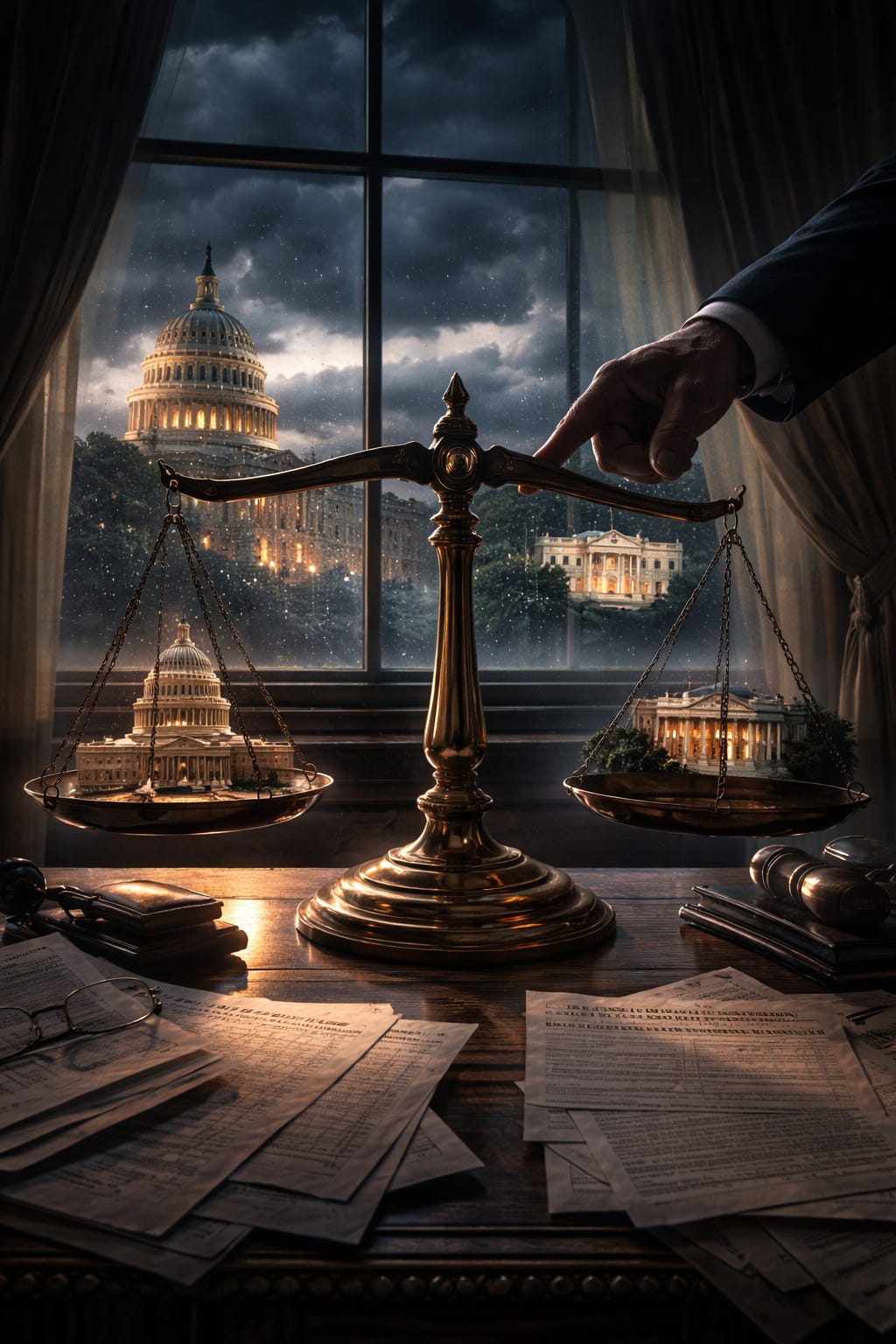
None of those trends by themselves destroys a democratic system. Democracies can survive bad policies, unpopular presidents, and even waves of corruption scandals. What democracies struggle to survive is the gradual weakening of the institutions that are supposed to constrain political power.
Once those institutions begin losing strength, everything else becomes easier to break.
Right now the United States isn’t a failed state, and anyone pretending otherwise is being melodramatic. But it would also be dangerously naïve to pretend the system is functioning normally. The country is entering a phase where the guardrails are bending, and the longer that bending continues, the harder it becomes to restore the system to its original shape.
The most dangerous phase of democratic erosion isn’t the crisis.
It’s the moment people start treating the crisis as normal.
💣 TRUTH BOMB
Democracies rarely collapse in one dramatic explosion.
They erode the way cliffs erode—grain by grain until gravity does the rest.
Reality Mechanism
Understanding why the system feels unstable requires stepping back from the daily outrage cycle and looking at how democratic institutions actually operate. Governments are complex machines that rely on expertise, continuity, and professional administration to function effectively. Career civil servants maintain programs across administrations, agencies preserve institutional memory, and legal guardrails ensure that the executive branch cannot simply operate on impulse.
When those stabilizers are working, political leadership can swing from one ideological direction to another without the entire structure collapsing. The professionals inside the system keep the machinery running while elected officials argue about policy.
When those stabilizers weaken, the entire system becomes more volatile.
That volatility becomes visible when experienced government personnel begin leaving in large numbers, taking decades of institutional knowledge with them. It becomes visible when executive actions are launched aggressively and repeatedly collide with judicial review. It becomes visible when governance begins to resemble a permanent legal knife fight between branches of government rather than a coordinated administrative process.
The public experiences that volatility as chaos, but the underlying issue is structural fragility.
Layer on top of that the growing perception that proximity to power can be purchased through political donations or insider networks, and the erosion of public trust accelerates quickly. Even when no explicit corruption occurs, the optics of transactional politics undermine the legitimacy of the institutions themselves.
Trust, once lost, is extraordinarily difficult to rebuild.
And here’s the quiet part nobody wants to say out loud:
If institutions lose public trust long enough, the public eventually stops defending them.
Who Benefits
Institutional instability always produces winners and losers. The losers are usually ordinary citizens who depend on stable government to enforce rules fairly and predictably. The winners tend to be actors who thrive in environments where influence matters more than process.
Political loyalists gain power when expertise is devalued. Donors gain leverage when access becomes more important than institutional procedure. Lobbyists become more effective when regulatory systems weaken and oversight capacity shrinks.
The result is a system that begins to resemble a marketplace rather than a democratic institution.
That transformation doesn’t happen overnight. It happens gradually, through a series of small shifts that concentrate influence among people who already possess proximity to power.
Once those shifts accumulate, reversing them becomes extremely difficult.
Gaslight Zone
At this point the national conversation splits into two camps that are equally detached from reality.
One camp insists that everything is normal and that critics are exaggerating routine political conflict. The other camp has adopted a kind of apocalyptic fatalism where every headline is treated as proof that democracy has already collapsed.
Both reactions miss the point entirely.
The “everything is fine” crowd ignores clear warning signs that institutional stress is increasing. Meanwhile the “everything is doomed” crowd gravitates toward dramatic rhetoric about overthrowing the system or pursuing vague fantasies of “regime change.”
That phrase gets thrown around with the enthusiasm of people who have watched too many political thrillers and not enough civics lessons.
Because in a constitutional democracy, abandoning the constitutional system in the name of saving it is about the dumbest possible strategy.
If democracy is bending, the answer isn’t to burn the rules down.
The answer is to use those rules like weapons.
Democracy Damage Report
The myth of democratic collapse usually involves tanks in the streets and dramatic declarations of martial law. In reality, democratic erosion tends to look far less theatrical and far more bureaucratic. Agencies lose expertise, oversight weakens, legal norms stretch, and public trust slowly drains away.
Each individual development may appear manageable on its own, but together they create a cumulative effect that destabilizes the system over time.
This slow transformation is why the current moment feels so strange. The outward appearance of democratic governance still exists, yet the internal dynamics of power are shifting in ways that make the system more fragile.
And that fragility raises the question most pundits keep dancing around.
If the system is sliding…
what actually stops the slide?
🔒 Upgrade to Read the War Room Briefing
The next section breaks down the fastest lawful path to forcing a course correction, including the political choke points capable of changing the balance of power far sooner than most analysts expect.
Free readers see the diagnosis.
Paid subscribers see the strategy.
If you want the full War Room briefing on how democratic guardrails get forced back into place, tap the upgrade button below.
Because the uncomfortable truth is this:
The path out of democratic free fall exists.
Most people simply don’t understand where it runs.
