

By Tom Hicks | September 18, 2026
Editorial Note:
This article is based on public statements, official European Union materials, and reporting available as of September 17, 2026.
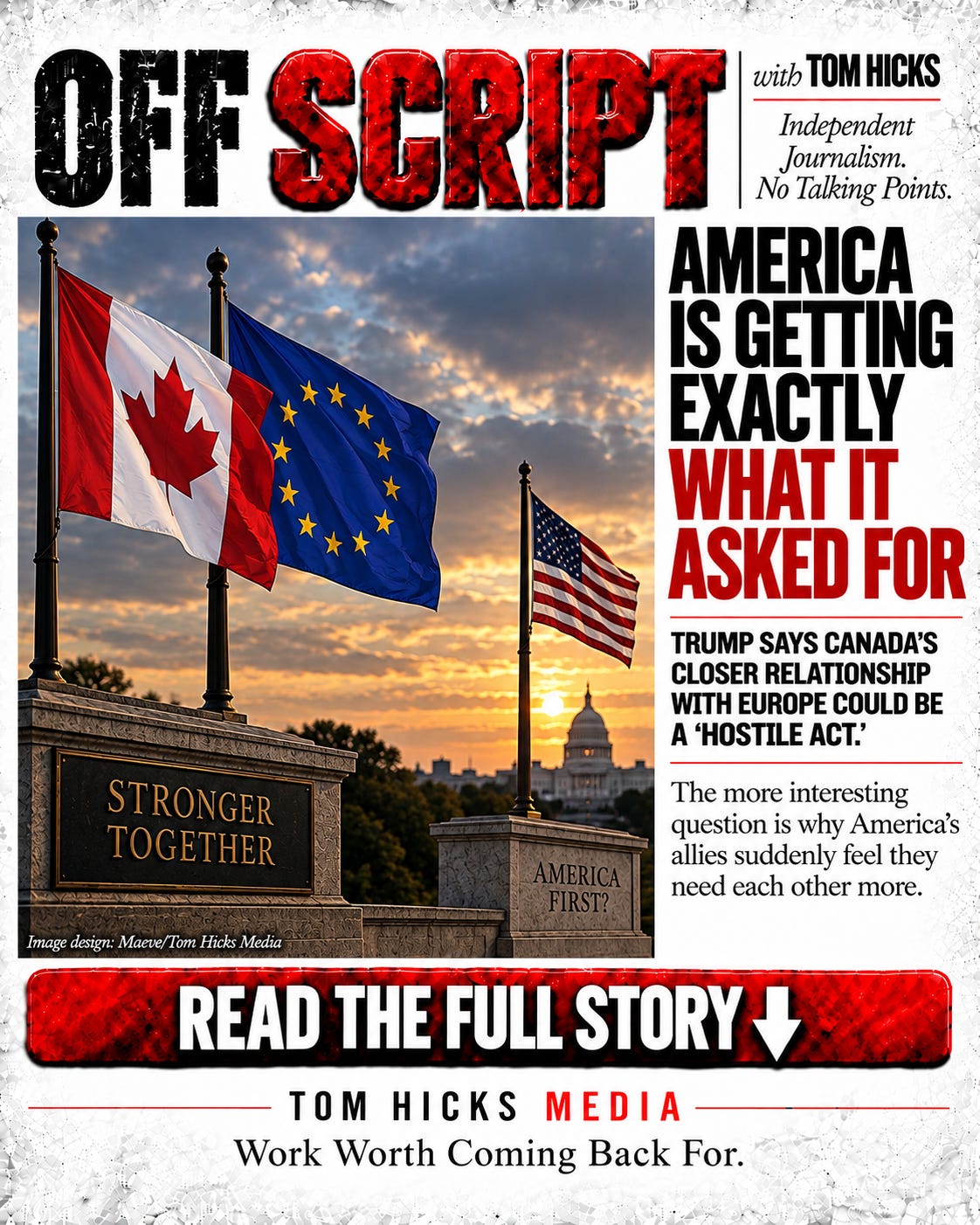
European Commission President Ursula von der Leyen stood before the European Parliament Wednesday and proposed something unprecedented: making Canada the European Union’s first “associate member.” Nobody quite knows what that would mean because the EU treaties have no associate-member category. What von der Leyen described, though, was considerably more important than the label: a deeper relationship between Canada and Europe covering trade, defense, energy, critical minerals, technology, artificial intelligence, cybersecurity and the Arctic. European Commission
Your subscription helps fund reporting, research, publishing, new features, and the continued growth of every Tom Hicks Media publication.
Then Donald Trump heard about it.
The president called the proposal “laughable,” described Canada as a terrible trading partner, and suggested that allowing Canada to become an EU associate member might constitute a “hostile act” against the United States. If he decides the arrangement was made with bad intentions toward America, Trump said, he could respond with substantial tariffs against Europe or stop trading with Europe in certain areas. In other words, Canada and Europe can deepen their relationship, provided the president of the United States approves of why they’re doing it. Associated Press
That’s a remarkable position when you strip away all the noise surrounding it. Canada and the countries of the European Union are sovereign. They aren’t proposing a military alliance against the United States, imposing sanctions on Washington or building some giant economic wall around North America. They’re talking about doing more business with each other and making themselves less vulnerable to economic and geopolitical pressure.
And Trump is threatening to punish them for it.
The part Trump left out
This didn’t happen in a vacuum. Roughly 70 percent of Canadian exports go to the United States, leaving Canada extraordinarily dependent on one market. Under Prime Minister Mark Carney, Ottawa has been deliberately trying to reduce that vulnerability as its relationship with Washington has deteriorated under tariffs, demands for economic concessions and Trump’s repeated talk of making Canada the 51st state. Associated Press
Europe sees something in Canada that Canada increasingly sees in Europe: another option. Von der Leyen proposed an “Alliance for the Future” connecting Canadian and European manufacturing, defense industries, energy, critical minerals, batteries, artificial intelligence, quantum technology and cybersecurity. Canada has already become the first non-European country to join the EU’s €150 billion SAFE defense procurement program, so this relationship didn’t suddenly materialize Wednesday morning. Associated Press
Von der Leyen was also unusually explicit about what she believes is driving the relationship. She said democracies should have the freedom to choose whom they work with and described the proposed partnership as being “not against anyone else, but for our common strength.” Whatever eventually emerges from these negotiations, that’s a pretty straightforward statement of intent. European Commission
Trump’s response was essentially: We’ll decide that.
America doesn’t have to leave the room
We’ve spent years arguing about whether Trump is an isolationist, and I’m increasingly convinced that’s the wrong question. The United States doesn’t have to withdraw from NATO, abandon every trade agreement, and pull up the drawbridge to become more isolated. There’s another route, and it may be more consequential because you don’t control it yourself: make your allies less certain they can depend on you.
Use tariffs against them as leverage. Question security arrangements they’ve relied upon for decades. Treat their independent economic decisions as tests of loyalty, then threaten more punishment when they respond by reducing their dependence on Washington. Eventually those countries start making other arrangements, not because America formally withdrew from the world, but because relying too heavily on America began looking like a risk they needed to manage.
That isn’t theoretical anymore. Reuters reported Thursday that at least eight NATO countries are exploring ways to reduce their dependence on American weapons, technology and defense companies. The group includes the European countries Poland, Denmark, Spain, Norway, Turkey, France and Germany, along with Canada, which is pursuing its own effort to diversify military procurement away from the United States. None of this amounts to a clean break with Washington, and decades of military integration couldn’t be unwound quickly even if these countries wanted to. But European, American and Canadian officials told Reuters that dependence on American technology, supply chains and political leadership is increasingly being viewed as a strategic risk. Reuters
There’s an irony buried in there. Trump has spent years demanding that European NATO members spend more on their own defense, and European defense spending has indeed surged. But some of the additional money may increasingly be spent building European capacity and buying non-American equipment, which means a policy designed partly to make allies carry more of the burden may also make them less dependent on the United States. Reuters
Now Canada and Europe are talking about doing something similar across a much wider range of relationships. Defense is part of it, but so are trade, energy, technology, critical minerals, space and financial services. Those aren’t ceremonial partnerships. They’re the things countries depend upon when the world gets ugly.
Carney didn’t blink
If Trump’s warning was supposed to make Canada reconsider, Thursday brought little evidence that it worked. Speaking before the European Parliament, Carney welcomed von der Leyen’s ambition while making clear that the details of “associate membership” remain to be negotiated. He argued for much deeper cooperation in critical minerals, defense, AI, energy, space and payments, with the broader goal of making Canada and Europe less vulnerable to outside pressure. Reuters
Then reporters asked him about Trump. Carney’s answer was about as subtle as a brick through a window: “Canadians are united that nobody is going to tell us what language we speak. No one is going to dictate our culture or with whom we can strike agreements internationally.” Reuters
There are plenty of reasons not to get ahead of ourselves here. Von der Leyen’s proposal doesn’t have a defined legal structure; it would require approval from EU member states, and some European diplomats reportedly were surprised by the announcement and aren’t sure what an associate member would actually be. This isn’t Canada joining the EU next Tuesday. Reuters
But the uncertainty over the final arrangement doesn’t erase what’s already happened. The president of the European Commission publicly proposed bringing Canada into an unprecedented relationship with Europe. Canada welcomed the conversation and outlined an enormous range of areas where it wants deeper cooperation. The president of the United States responded by threatening economic retaliation if he decides their intentions are hostile.
That sequence matters.
The self-inflicted part
For generations, American power wasn’t measured only in aircraft carriers, GDP, or nuclear warheads. A large part of it came from something harder to put on a spreadsheet: other countries wanted to be inside the American orbit. They wanted access to our market, bought American weapons, built security relationships around American power and accepted enormous dependence on the United States because that dependence generally seemed safer than the alternatives.
That’s an asset, and unlike a tariff rate, it can’t be restored with a signature.
If Canada and Europe decide they need stronger economic and security ties because relying too heavily on Washington has become risky, threatening them for reaching that conclusion doesn’t solve the problem. It gives them another reason to believe they were right.
That’s where the isolationism argument gets turned on its head. America doesn’t have to announce that it’s withdrawing from the world. Keep making relationships with the United States more conditional, more transactional, and more unpredictable, and eventually other countries start doing the withdrawing for us.
America hasn’t been thrown out of the club.
We’re making everybody else wonder whether they need another one.
BULLSHIT DETECTOR
The claim: Trump’s Republican midterm convention beat the NFL in audience.
Bullshit.
Trump boasted that the Republican convention’s “overall numbers beat the NFL.” Nielsen television figures tell a considerably different story. The NFL opener drew 25.1 million viewers while the three channels carrying Trump’s first-night speech averaged roughly 3 million combined, with streaming adding only a fraction of the difference. The White House pointed instead to tens of millions of TikTok impressions, but an impression can mean little more than something appearing in somebody’s feed while they’re busy swiping past it. Comparing that with people actually watching an NFL game is ratings math performed with a chainsaw. PolitiFact
The claim: John Roberts and Amy Coney Barrett disclosed gifts from the George Soros Foundation.
Bullshit.
A viral post claimed that Chief Justice John Roberts and Justice Amy Coney Barrett had both disclosed gifts from a George Soros foundation. The source was a Facebook page that labels its material satire and literally warns readers that nothing on the page is real. There is no credible evidence of either justice making such a disclosure. Apparently we’ve reached the stage where even the disclaimer saying THIS ISN’T REAL isn’t enough to slow the bullshit down. Lead Stories
The claim: Gavin Newsom’s winery received a California state wildfire payout.
Bullshit.
Another circulating claim says California Gov. Gavin Newsom’s PlumpJack winery received state wildfire money after a 2025 fire. What actually happened was a private settlement with Hundred Acre winery, where the fire originated. Newsom’s office denied that state wildfire funds were involved, and the evidence reviewed by fact-checkers supports a private settlement rather than a government payout. There’s plenty in politics worth getting pissed off about without manufacturing the receipt. Lead Stories
One Question Before You Go
If America’s allies decide they need alternatives because depending on Washington has become too risky, who exactly is isolating whom?
#Trump #Canada #EuropeanUnion #ForeignPolicy #Trade #NATO #OffScript
Nice piece of writing, Tom. Canada is being uber savvy. And I like seeing TrumPUS regime outplayed on such a grand scale. IMO all this points to efforts at isolation backfiring. Still wish it was feasible for me to move to Canada. As a Minnesotan, we are the next best thing. Early voting starts today! Hanging onto some Blue hope!