

Editorial Note
There are enough strange, documented facts in this story that we don’t need to invent any.
President Trump has not identified the countries that will supply the beef in his newly announced import plan. Argentina is an obvious country to ask about because Trump already expanded its access to the U.S. market this year, and USDA says Argentine exporters have been prioritizing American buyers. China also really did reject a 22-ton Argentine beef shipment in March after detecting a prohibited antibiotic.
What we cannot say is that Trump’s new mystery beef is Argentine, or that the United States is buying the same beef China rejected. There is no evidence proving either claim.
Keep that distinction in mind, because the facts that remain are plenty weird all by themselves.
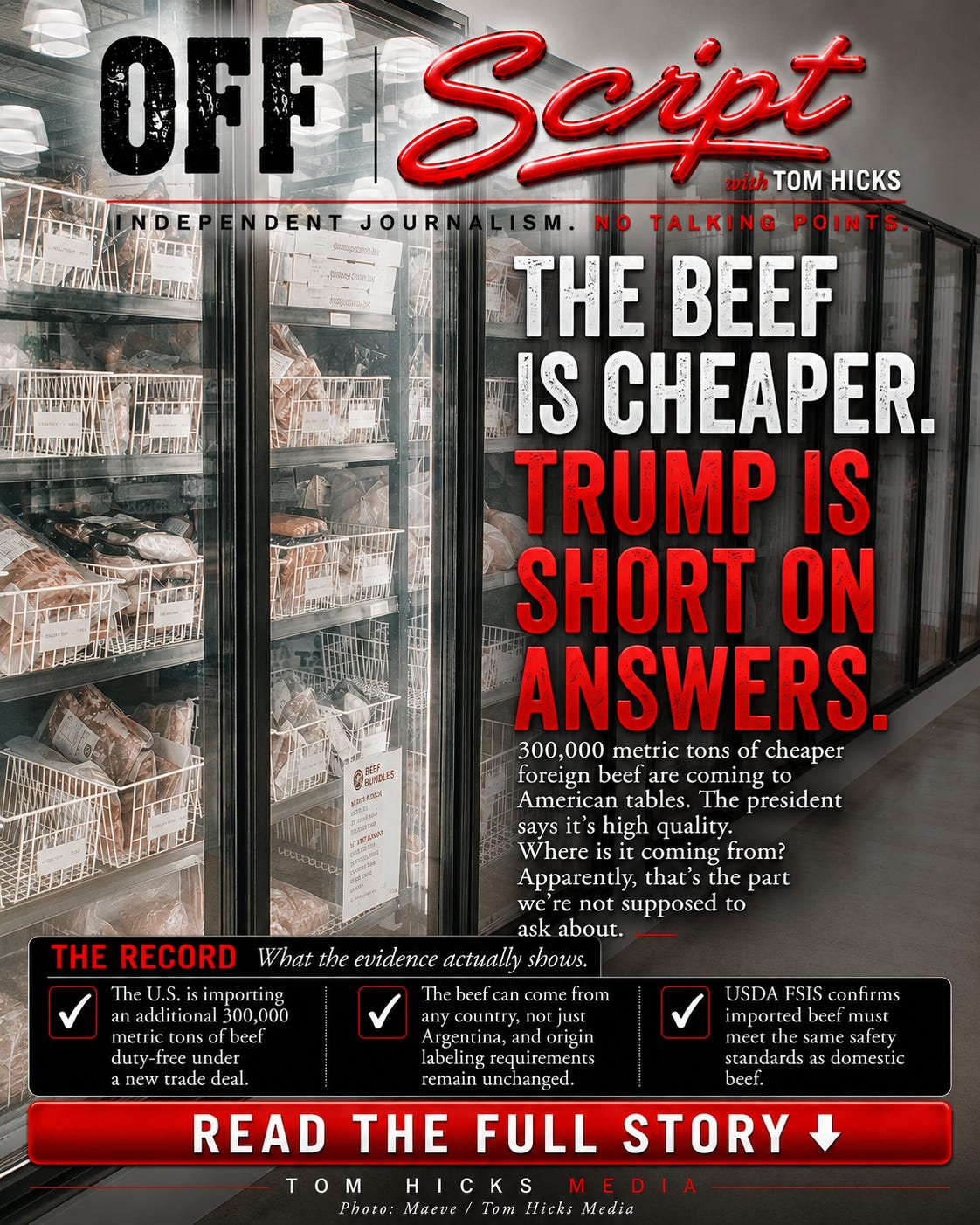
There was a time when buying hamburger didn’t require investigative journalism.
You went to the store, stared at the price for a few seconds, wondered when ground beef became a luxury item, and tossed it in the cart. Maybe you checked whether it was 80/20 or 90/10. Nobody expected you to conduct an international trade investigation before making meatloaf.
Apparently those days are over.
President Trump says the United States is preparing to open the door to as much as 300,000 metric tons of imported product for ground beef over 90 days, at lower tariffs. He says there is a commitment to sell that beef at 25% below current market prices.
Then a reporter asked Trump himself which countries were involved.
“I don’t want to say which countries,” he replied. There are “a few countries,” he added, and they’ll be sending the “highest quality beef.”
That would be a perfectly reasonable answer if he were discussing submarine locations.
He’s discussing hamburger.
First, We Really Are Running Out of Cattle
The beef shortage is not some manufactured political crisis. USDA counted 86.2 million cattle and calves on American farms on January 1, 2026, with just 27.6 million beef cows, down another 1% from the previous year. The national cattle inventory is now at its lowest level in roughly 75 years.
July didn’t suddenly fix it. USDA’s midyear count found 28.5 million beef cows, still 1% below the previous July, with the projected calf crop down 2%. A cattle herd cannot be rebuilt because somebody in Washington announces that it would be politically convenient for steaks to cost less by Labor Day.
Years of drought burned up grazing land and drove feed costs higher. Ranchers liquidated animals because keeping them became too expensive, imports of Mexican cattle were disrupted by the New World screwworm threat, and meatpackers have been closing plants because the available cattle are so expensive.
Consumers have been getting the bill.
In July, beef and veal prices were 9.4% higher than a year earlier. Ground beef was up 9%, steaks 9.6%, and roasts a lovely 13.5%. Overall food prices were up 3%.
So yes, beef is expensive.
The question is whether the cure is going to make the disease worse.
We’re Also Losing the People Who Raise It
This is the part of the story that bothers me more than the price of hamburger.
The 2017 Census of Agriculture counted 729,046 American farms with beef cows. By the 2022 census, there were 622,162. That means the country lost 106,884 beef-cow operations in five years, a decline of 14.7%.
Spread across that five-year census period, that works out to roughly 59 beef-cow operations disappearing every day.
To be precise, that does not mean USDA has somebody sitting in an office clicking a counter every time another ranch closes in 2026. It is the average decline between the two most recent complete agricultural censuses. But if your comforting rebuttal is that America didn’t literally lose exactly 59 ranches every Tuesday, I think you may be missing the larger problem.
Look at every operation with cattle and calves, and it gets uglier. America went from 882,692 cattle operations in 2017 to 732,123 in 2022. That’s more than 150,000 operations gone in five years.
Meanwhile, the cattle herd kept shrinking.
That is how you end up where we are now. We spent years watching producers disappear, animals disappear, and the domestic supply tighten, and now everybody is standing in the supermarket acting stunned that hamburger costs too much.
We didn’t wake up one morning and discover that somebody stole the cows.
We watched them leave.
Your subscription helps fund reporting, research, publishing, new features, and the continued growth of every Tom Hicks Media publication.
And Here Comes the Emergency Beef
Trump’s answer is to temporarily expand the amount of imported ground-beef product that can enter the country at lower tariff rates by 300,000 metric tons over 90 days. The White House says an executive order is coming, and Trump says exporters have agreed to sell the beef 25% below current market prices.
There are a few problems.
Economists and commodity traders have questioned whether the additional amount is large enough compared with total American beef consumption to make much difference at the grocery store. Cattle futures, on the other hand, didn’t find it insignificant at all. They dropped sharply after the announcement.
And American ranchers immediately started yelling.
The National Cattlemen’s Beef Association warned that flooding the market with government-subsidized, below-market foreign beef could discourage producers from rebuilding the American herd. The United States Cattlemen’s Association was even less diplomatic:
“You don’t put America first by putting U.S. cattle producers last.”
This is where the policy begins eating its own tail.
The United States needs ranchers to retain breeding animals, grow their herds and accept the financial risk of producing more cattle. That takes time. It also requires some confidence that Washington isn’t going to pull the rug out from under them by opening the import spigot whenever consumers get angry about supermarket prices.
You cannot tell American cattle producers, “Please grow more beef,” while simultaneously telling foreign producers, “Come on in, we need cheaper beef.”
Well, obviously you can.
We’re watching it happen.
Where Is It Coming From?
This should be the easiest part of the story.
The president announces hundreds of thousands of tons of imported food. Somebody asks which countries are supplying it. The president names the countries.
End of mystery.
Instead, Trump said he didn’t want to say. The White House has also declined to publicly identify the suppliers or explain how the promised discount would be arranged.
Why?
We don’t know.
And I’m not interested in filling that hole with a conspiracy theory just because the administration has conveniently dug one.
Maybe these are perfectly ordinary suppliers already approved to ship beef into the United States. Maybe every pound will pass every required inspection and arrive wrapped in a little patriotic bow. Maybe there is an entirely innocent explanation for withholding information that should be boring enough to appear in the third paragraph of a USDA press release.
Then give us the boring explanation.
Because “Trust me, it’s the highest quality” is not traceability.
It’s something a guy says while selling speakers out of the back of a van.
Now We Get to Argentina
Argentina keeps showing up around the edges of this story for very good reasons.
Earlier this year, the United States granted Argentina an additional 80,000 metric tons of low-tariff access for boneless lean beef used largely in processing. USDA’s Foreign Agricultural Service subsequently reported that Argentine exporters were prioritizing the American market because prices were higher here, tariffs were lower, and shipping times were shorter.
That doesn’t make Argentina guilty of anything.
It makes Argentina relevant.
Trump has already dramatically expanded Argentine access to the American beef market. Argentine exporters have an economic incentive to send more beef here. Now Trump announces another enormous temporary import opening involving several countries he declines to identify.
Asking whether Argentina is one of those countries is not a conspiracy theory.
It is what reporters are supposed to ask when the president won’t answer a painfully simple question.
And Yes, China Really Did Reject Argentine Beef
This is where we need to keep both feet on the ground, because the internet loves nothing more than finding two suspicious facts and immediately marrying them.
In March, Chinese authorities suspended imports from the Argentine processor ArreBeef after reporting the detection of chloramphenicol, an antibiotic prohibited in food animals, in a 22-ton shipment of beef. Argentina’s government subsequently investigated 12 cattle operations connected to the shipment.
According to Argentina’s official response to lawmakers, investigators found no chloramphenicol products, no records showing its use, and no evidence during those inspections that the farms had used the prohibited drug. Argentina challenged the finding, while China’s broader beef trade with Argentina remained open and operational.
That is the story.
It is not evidence that China rejected the entire Argentine beef supply. It is not evidence that Trump bought China’s rejected meat. It is not evidence that the beef headed to your supermarket came from that plant, that shipment or even Argentina.
But once again, the government could make a lot of wild speculation disappear very quickly.
Tell people where the 300,000 metric tons are coming from.
There’s a radical idea.
Then the Horses Walk Into the Story
As if the beef story needed help becoming unsettling, the federal government is simultaneously dealing with another livestock controversy where nobody seems terribly interested in answering a basic question about where the animals went.
A New York Times investigation found that federal sales of wild horses surged in 2025. BLM’s own figures show it sold 3,718 wild horses and burros, up from 1,509 the year before.
The Times traced federally sold mustangs through livestock records into a pipeline that led toward Canadian slaughter plants. In one case, an Ohio livestock trader bought scores of mustangs for $25 each, resold them quickly, denied selling them for slaughter, and refused to say where they went.
BLM says its policy is not to sell wild horses and burros to slaughterhouses or “kill buyers.” That is important, and we should be fair enough to say it. The problem exposed by the Times is what can happen once the government sells an animal into private hands, federal protections fall away, and subsequent buyers enter the picture.
There is also an enormous financial incentive to get animals out of federal holding.
BLM says it had 58,025 horses and burros in off-range holding as of May, and off-range holding consumed $101 million in fiscal 2024, roughly two-thirds of the program’s expenditures. The Times reported that the government estimated selling the 3,700 horses in 2025 would save about $56 million in future care.
Now, before somebody screenshots three sentences and announces that Off Script claims Trump is putting Mustang burgers in the meat case:
No.
There is no evidence connecting those wild horses to Trump’s beef-import plan. There is no evidence that horse meat is being slipped into American hamburger. That would be a completely different story, and we do not have it.
What we do have is one federal food-and-livestock story where we’re asking where the meat is coming from, and another where we’re asking where did the animals go?
You have to admit Washington has developed a strange allergy to the word where.
The Soylent Green Problem
Nobody is saying USDA has started consulting Soylent Green for menu ideas.
But the whole thing has acquired just enough dystopian supermarket energy to make that joke work.
The American cattle herd is at a 75-year low. More than 100,000 beef-cow operations disappeared between the last two agricultural censuses. Beef prices are hammering families, and the ranchers we need to rebuild the herd say Trump’s solution could make rebuilding it harder.
Then Washington announces hundreds of thousands of tons of discounted foreign beef.
“Where’s it coming from?”
“I don’t want to say.”
Jesus Christ.
Nobody needs to invent the creepy part. The creepy part is the transcript.
Food origin is not some nosy detail consumers have no business asking about. We have inspection systems, labeling requirements, and international agreements precisely because knowing where food comes from matters. If the president is so confident this is the “highest quality beef,” identifying the countries providing it should be the least interesting part of the announcement.
Instead, it became the most interesting part.
That was entirely his choice.
Cheap Hamburger Is Not a Cattle Policy
Here’s what keeps getting lost in the scramble to shave a few bucks off the grocery bill.
America has a cattle-production problem.
We have fewer animals. We have lost tens of thousands of producers. It takes years to rebuild breeding herds. Ranchers have been squeezed by drought, feed costs and volatile markets, while Mexican cattle imports have been interrupted by a livestock pest.
Those problems will still exist on Day 91.
The imported beef may provide some additional supply. Maybe it nudges prices down a little. If it does, consumers deserve the break.
But if the same policy knocks cattle prices down enough to convince another round of American producers that rebuilding isn’t worth the risk, we will have performed one hell of a magic trick.
We will have “solved” the beef shortage by making ourselves more dependent on foreign beef.
And the next time prices explode, Washington can announce another emergency shipment.
Perhaps by then they’ll even tell us where it came from.
THE RECORD
86.2 million — Cattle and calves on U.S. farms on January 1, 2026. The national herd is at roughly a 75-year low.
27.6 million — Beef cows on January 1, down 1% from the year before. The July beef-cow count remained down 1% year over year.
106,884 — Fewer farms with beef cows in the 2022 Census of Agriculture than in 2017. That averages roughly 59 disappearing operations per day across the five-year census period.
150,569 — Decline in the total number of farms with cattle and calves from 2017 to 2022.
9.4% — Year-over-year increase in beef and veal prices in July. Ground beef was up 9%.
300,000 metric tons — Additional imported product for ground beef Trump says will receive lower tariff treatment for 90 days.
25% — Trump’s claimed discount from current market prices.
Countries supplying it — Trump: “I don’t want to say.”
80,000 metric tons — Additional low-tariff access granted to Argentine beef earlier this year. USDA says Argentine exporters have been prioritizing the U.S. market.
22 tons — Argentine beef shipment rejected by China in March after chloramphenicol was detected. Argentina’s follow-up investigation said it found no evidence that the prohibited drug had been used on the 12 cattle operations it inspected.
Those are the facts.
The herd shortage is real. The disappearing cattle operations are real. Trump’s expanded Argentine beef access is real. China’s rejection of one Argentine shipment is real. The new 300,000-ton import announcement is real.
The thing we still don’t know is embarrassingly simple.
Where is the beef coming from?
That shouldn’t require a security clearance.
THE BULLSHIT DETECTOR
1. “Obesity dropped 3% this year because our health policies are working.”
Bullshit: There appears to be a real decline. Kennedy just moved the starting line so he could take credit for it.
Why: RFK Jr. said Monday that obesity fell about 3% “this year” and pointed to healthier eating and administration policies. The Gallup data he appears to be citing actually show a 3.5-point decline since 2022, with roughly two-thirds of it occurring before Trump returned to office. Researchers also say there’s little evidence Americans suddenly transformed their diets, while soaring use of GLP-1 weight-loss drugs may be playing a role. Good news doesn’t need a fake birthday.
2. “Zohran Mamdani is requiring ID to shop at New York City’s government grocery stores.”
Bullshit: No, he isn’t. Apparently voter-ID arguments weren’t producing enough fundraising emails, so somebody moved them to the produce aisle.
Why: Florida Republican Randy Fine claimed Mamdani was “requiring ID” to shop at city-run grocery stores. PolitiFact found the claim false. Whatever arguments people want to have about Mamdani’s grocery-store proposal, a requirement that shoppers present identification isn’t part of it. This is what happens when an ordinary policy disagreement isn’t scary enough and somebody decides it needs a fake detail.
3. “Angie Nixon wants to defund the police, stop funding the military, open the border and let noncitizens vote.”
Bullshit: Joining an organization does not magically download every sentence of its platform into your brain.
Why: Republican Sen. Ashley Moody used Florida Democratic Senate nominee Angie Nixon’s membership in the Democratic Socialists of America to attribute a string of DSA positions directly to Nixon. Nixon does belong to the organization, but it hasn’t endorsed her; she has explicitly said she does not agree with its entire platform, and her own stated positions include supporting public safety and securing the border while creating legal paths to citizenship. There’s plenty to argue about without renting somebody else’s platform and pretending she wrote it.
4. “My law lets families sue Google and YouTube when their children are harmed.”
Bullshit: Sen. Ed Markey wrote the children’s privacy law. He apparently forgot what remedies he put in it.
Why: During the Massachusetts Democratic Senate debate, Markey pointed to the Children’s Online Privacy Protection Act and said families can sue companies such as Google and YouTube if their kids are harmed. They cannot sue under COPPA itself. Enforcement belongs to federal regulators and state attorneys general. Parents may sometimes sue under separate state laws, but that is a different legal animal. When politicians start taking credit for legislation they actually wrote, asking them to remember what’s in it doesn’t seem overly demanding.
Want your own Bullshit Detector? The full Bullshit Detector guide is free to Off Script subscribers, or available for $4.95 through the Tom Hicks Media Store.
Elsewhere at Tom Hicks Media
Tom’s Number Ones
Six charts. One date. The songs that were actually sitting at No. 1 while the rest of the world was busy making history.
Lotus Purrspective
Life, furniture ownership, and the inexplicable behavior of humans, explained by a tuxedo cat who remains convinced the house would run considerably better if everyone simply followed instructions.
Panic Room Sports
A new issue drops today with NFL and fantasy football coverage for people who would rather check the evidence before pulling the fire alarm. Everybody reacts. We check the tape first.
Rabbit Ears Classic TV
The shows everybody remembers, the ones they forgot, and the strange stories hiding behind both. New issues Mondays and Thursdays.
The Backlot Ghost
Classic movies leave things behind. The Backlot Ghost goes looking for them after the studio lights go out. A new issue arrives tomorrow.
Buy Me a Cup of Tea
Off Script doesn’t have a corporate parent, billionaire owner, or committee deciding which questions are impolite.
If you appreciate independent reporting that checks the numbers before throwing the punch, you can help keep it going by buying me a cup of tea. It helps cover research, publishing costs, and the increasingly necessary caffeine required when the president announces 300,000 metric tons of mystery beef and somehow “Where is it from?” becomes the difficult question.
One Question Before You Go
If the government promised you foreign beef was 25% cheaper and perfectly safe but refused to tell you which country it came from, would you put it in your cart?
And if the answer is no, what would you need to know before you changed your mind?
#OffScript #TomHicksMedia #BeefPrices #AmericanRanchers #FoodSupply #Agriculture #Trump #BullshitDetector
Hey, Tom. Thanks for putting in the research on this topic. Very succinct reporting on the facts. Project 2025 lists "food insecurity" as part of its grand plans to destroy our Democratic values. You probably already know that...I am someone raised on eating beef. I love it! One of my dear Somali friends and I had a great conversation about Halal protein preparation last week, i.e. the humane slaughter of animals. Before the situation with food insecurity gets worse, I am considering eating goat meat bought from Halal grocery stores. Or go back to being vegetarian...