

🧨LET’S CUT THE CRAP
Sit down. Get comfortable. Maybe loosen your jaw so it doesn’t lock when it drops. We’re about to dissect one of the most quietly consequential financial moves of the year — the United States quietly funneling nearly $840–$870 million of IMF reserve power into Argentina’s accounts, just in time for Argentina to make its IMF payment and avoid an immediate international financial faceplant.
And before you ask: No, this wasn’t some spontaneous act of charity. This was coordinated, intentional, and executed with the calm, dead-eyed confidence of someone deleting browser history.
This is the kind of move administrations do when they want to help an ally but also want plausible deniability. The kind of move you do when you’re hoping Americans are too busy rage-scrolling Instagram to notice that their reserves just took a haircut.
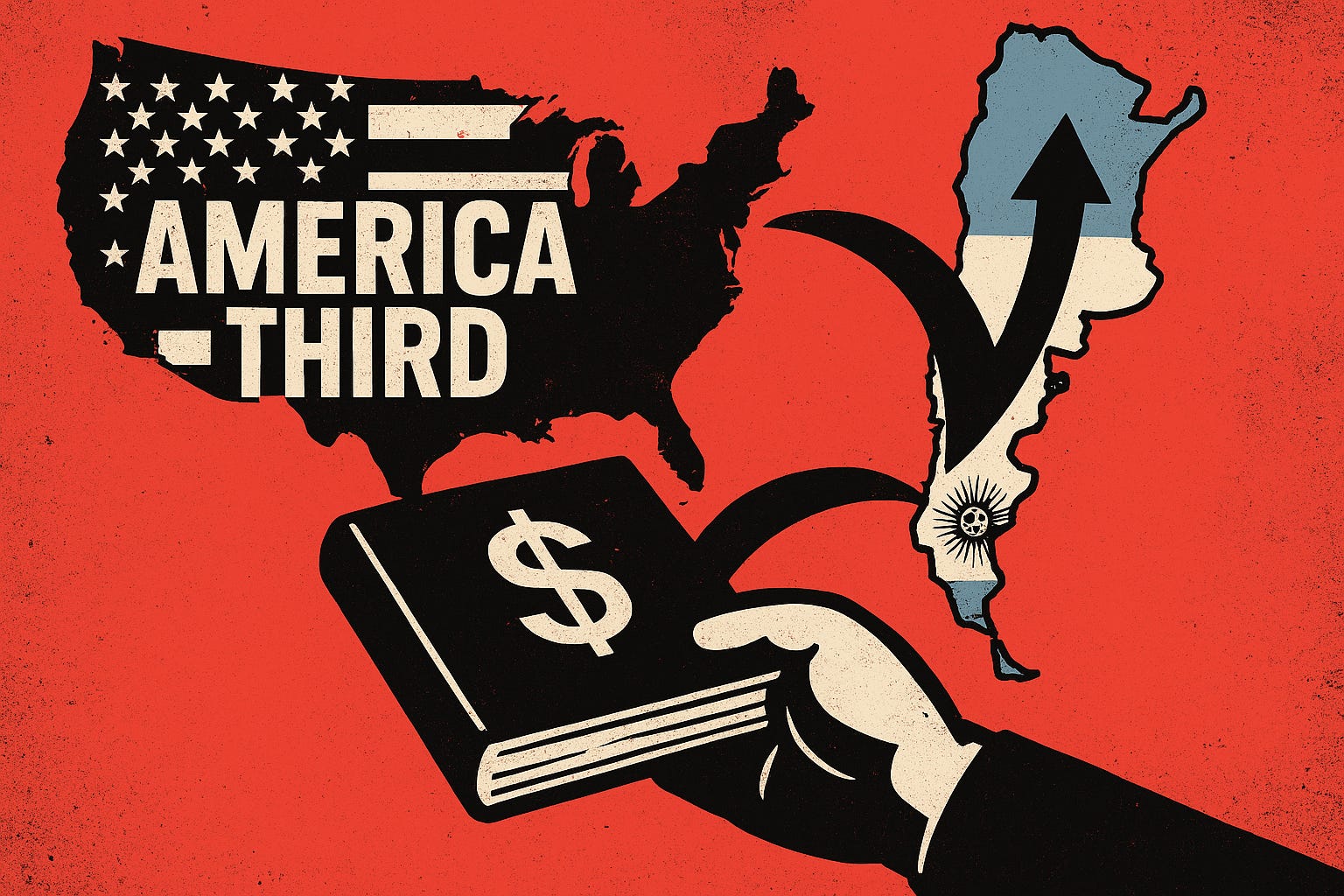
This isn’t America First. It isn’t even America Second. This, my friend, is America Third — again.
And you deserve to understand exactly how this shit works.
💣 Truth Bomb: If this operation were any more choreographed, it would come with a fog machine and backup dancers.
🔎 SECTION 1 — THE LEDGER DOESN’T LIE
Financial bullshitters can spin narratives. But money? Money’s a snitch. It keeps receipts, timestamps, and a perfect memory.
Here’s the sequence:
The U.S. SDR (Special Drawing Rights) account at the IMF drops by roughly 640–650 million SDRs, which is about $840–$870 million depending on the valuation date.
Argentina’s SDR account rises by damn near the same amount.
Argentina uses a massive chunk of that increase to make an ~$840 million IMF debt payment it absolutely could not make otherwise.
The timing? Within days.
The effect? Argentina avoids default-level chaos, buys breathing room, and earns a gold star for “meeting obligations.”
This isn’t subtle. It’s not even discreet. It’s blatant — but because it uses the abstruse language of international monetary policy, it sounds boring.
💣 Truth Bomb: The more boring the terminology, the more fucked you probably are.
Let’s humanize the math for a second:
Imagine you owe the bank $840 million by Friday.
You can’t pay.
You’re panicking.
Then your friend — wealthy, reckless, and politically invested in you looking competent — quietly moves the exact amount of liquid credit into your account.
You pay the bank.
Everyone claps.
And you pretend the money fairy handled it.
That’s the U.S.–Argentina SDR shuffle.
🧾 SECTION 2 — WHAT THE FUCK ARE SDRs AND WHY SHOULD YOU CARE?
Let me give you the crash course they don’t teach in school because apparently the curriculum is too full of worksheets about parallelograms.
SDRs (Special Drawing Rights) are reserve assets created by the IMF. They aren’t a currency, but they can become currency when exchanged with other countries or used to settle IMF debts.
Think of SDRs as the IMF equivalent of:
store credit with global liquidity
Monopoly money that can be traded in for real cash
the world’s least sexy gift card
Countries don’t “spend” SDRs like cash. Instead, they exchange them for dollars, euros, yen, etc.
So when the U.S. transfers SDR value, it’s effectively transferring internationally liquid financial power. It’s providing a lifeline — the kind that lets a struggling country pay off its creditors instead of collapsing like a folding chair at a family barbecue.
💣 Truth Bomb: Any time a government tells you “SDRs aren’t real money,” put your hand over your wallet.
🏦 SECTION 3 — THE $20 BILLION SWAP LINE: THE OTHER SHOE DROPS
But here’s the real plot twist:
The SDR shift is only one part of a much larger $20 billion swap line agreement between the U.S. Treasury and Argentina’s central bank.
This isn’t a small swap line. This isn’t even a medium swap line.
This is a holy shit swap line.
It allows Argentina to hand over pesos and walk away with dollars — a currency they desperately need to service external debts, stabilize their financial system, and convince foreign investors not to flee screaming into the Andes.
The U.S. doesn’t offer swap lines like this casually. This is not a “coupon for your next purchase.” This is massive.
And for Argentina, it’s like getting a credit card with a limit so high it makes you wonder if the bank is okay.
Why would the U.S. do that?
Simple:
Trump and Milei are ideological soulmates in the “burn it down, rebuild it with vibes” genre of governance.
A collapsing Argentina destabilizes commodities markets.
Regional instability creates power vacuums — the kind China and Russia love filling.
Propping up an ally scores geopolitical points.
But also:
5. Trump freaking loves a high-stakes, high-drama business deal. This is exactly his aesthetic.
💣 Truth Bomb: This wasn’t a financial intervention — it was a geopolitical booty call.
🗣️ SECTION 4 — WHAT THE “ADULTS IN THE ROOM” SAID (AND WHAT THEY REALLY MEANT)
Let’s break down the greatest hits from public statements with the translations they deserve.
“The U.S. drew nearly $900 million from its IMF account as Argentina’s debt payment loomed.”
Translation:
We saw our buddy drowning and tossed him a life raft made of American taxpayer-backed assets.
“It’s extremely unusual for the United States to sell or transfer its SDRs to another member country.”
Translation:
We basically never do this unless something big — or stupid — is happening.
“In most bailouts, you don’t make money. The U.S. government made money.”
Translation:
We’re hoping you focus on this vague claim instead of asking for documentation.
“This is a bilateral matter between governments.”
Translation:
Stop asking questions. No, seriously. Stop.
💣 Truth Bomb: If they won’t show you the math, the math probably looks like shit.
🌍 SECTION 5 — WHY ARGENTINA, AND WHY NOW?
Argentina’s economy is like a telenovela — dramatic, unstable, and entering its fourth decade of “THIS time it’ll be different!” plot arcs.
Inflation regularly eats triple-digit percentages for breakfast.
The peso is about as stable as a toddler with a Red Bull.
And public debt is already beyond “high” and entering “call a priest” territory.
So why help them?
Because instability has a global ripple effect:
Commodity prices go nuts
Regional markets panic
Capital flight spreads
Investors start googling “safe havens” like they’re shopping for fire extinguishers
And Trump?
He doesn’t want a crisis on his watch — at least not one he didn’t personally manufacture.
So the White House and Treasury acted fast to keep Milei’s reformist, chainsaw-wielding government from imploding.
💣 Truth Bomb: The U.S. didn’t bail out Argentina; it bailed out its own geopolitical narrative.
⚖️ SECTION 6 — WHO BENEFITS AND WHO GETS SCREWED
🇦🇷 Winner: Argentina (for now)
They stay solvent. They avoid IMF penalties. They stabilize short-term liquidity.
But without structural reforms?
This is putting a tourniquet on a severed limb and calling it physical therapy.
🇺🇸 Mixed Bag: The United States
Best case:
Treasury earns interest, Argentina recovers, and the administration looks like geniuses.
Worst case:
Argentina tanks again, the swap line sits underwater, and U.S. taxpayers eat the loss like a stale gas-station sandwich.
🏦 Winner: International markets
Panic avoided.
Bond traders exhale.
Commodity markets don’t explode.
Investors keep their yachts.
🗳️ Loser: Anyone who still believes in fiscal transparency
Because none of this — NONE OF IT — is being fully disclosed.
💣 Truth Bomb: When governments move hundreds of millions with zero public explanation, you’re not a citizen — you’re collateral.
🤔 SECTION 7 — THE ACCOUNTABILITY VOID
Here’s the part that should make your jaw tighten:
The Exchange Stabilization Fund, which enabled a lot of this, is basically the Treasury’s “trust us, we got it” slush pool. Congress doesn’t sign off on most ESF operations. There’s no real-time oversight. It’s one of the most opaque tools in global finance.
Combine ESF power with IMF SDR transfers and swap lines, and you get a mechanism that can shift billions internationally with minimal scrutiny.
It’s legal.
But it’s also fucking wild.
This is the kind of discretionary power the founders would have thrown their powdered wigs at.
🧭 SECTION 8 — THE REAL RISK: PRECEDENT
Once you establish that:
the U.S. can move SDR reserve value like pocket change,
secretly backstop international allies,
use swap lines to quietly prop up foreign regimes,
all without clear oversight or disclosure,
…you have created a blueprint for future administrations — of any political flavor — to play global sugar daddy with taxpayer-backed assets.
This isn’t about Argentina.
This is about the institutionalization of financial shadow diplomacy.
💣 Truth Bomb: If you think this is the last country to get this treatment, I have a bridge to sell you.
🔥 SECTION 9 — FINAL VERDICT: THIS WAS A BAILOUT WITH BETTER MARKETING
There’s no need to dress it up. Here’s the blunt, profanity-spiked truth:
The U.S. moved IMF reserve assets in a coordinated way that let Argentina make its payment.
It supported a much larger $20 billion swap line.
It did so quietly, intentionally, and with strategic motives.
And it told the public almost nothing.
This was a bailout.
Call it “liquidity assistance” if that helps you sleep, but the functional reality doesn’t change.
This was America Third — another episode in the long-running series of “We’ll handle our allies first, markets second, and taxpayers whenever we get around to it.”
Argentina gets a life raft.
The administration gets a political win.
Markets get calm seas.
And Americans get the bill if shit goes sideways.
💣 Truth Bomb: A bailout by any other name still smells like bullshit.
👉 CALL TO ACTION
If you want journalism that tears the mask off government secrecy — and sets the mask on fire — subscribe. Do it now. The powerful are counting on you being too tired, too busy, or too overwhelmed to pay attention.
Prove them wrong.
☕ BUY ME A COFFEE
If you want more deep dives that follow money trails into the dark corners where the nice people don’t go, Buy Me A Coffee. I’ll turn caffeine into accountability.
🔖 HASHTAGS
#AmericaThird #FollowTheMoney #Argentina #IMF #UnredactedBastard #FinancialWTF #SwapLine #SDRs #EconomicAutopsy #Subscribe