

By Tom Hicks | September 27, 2026
Editor’s Note: Blind Spot looks past the argument everyone is having and asks what we’re missing while we’re busy yelling at each other.
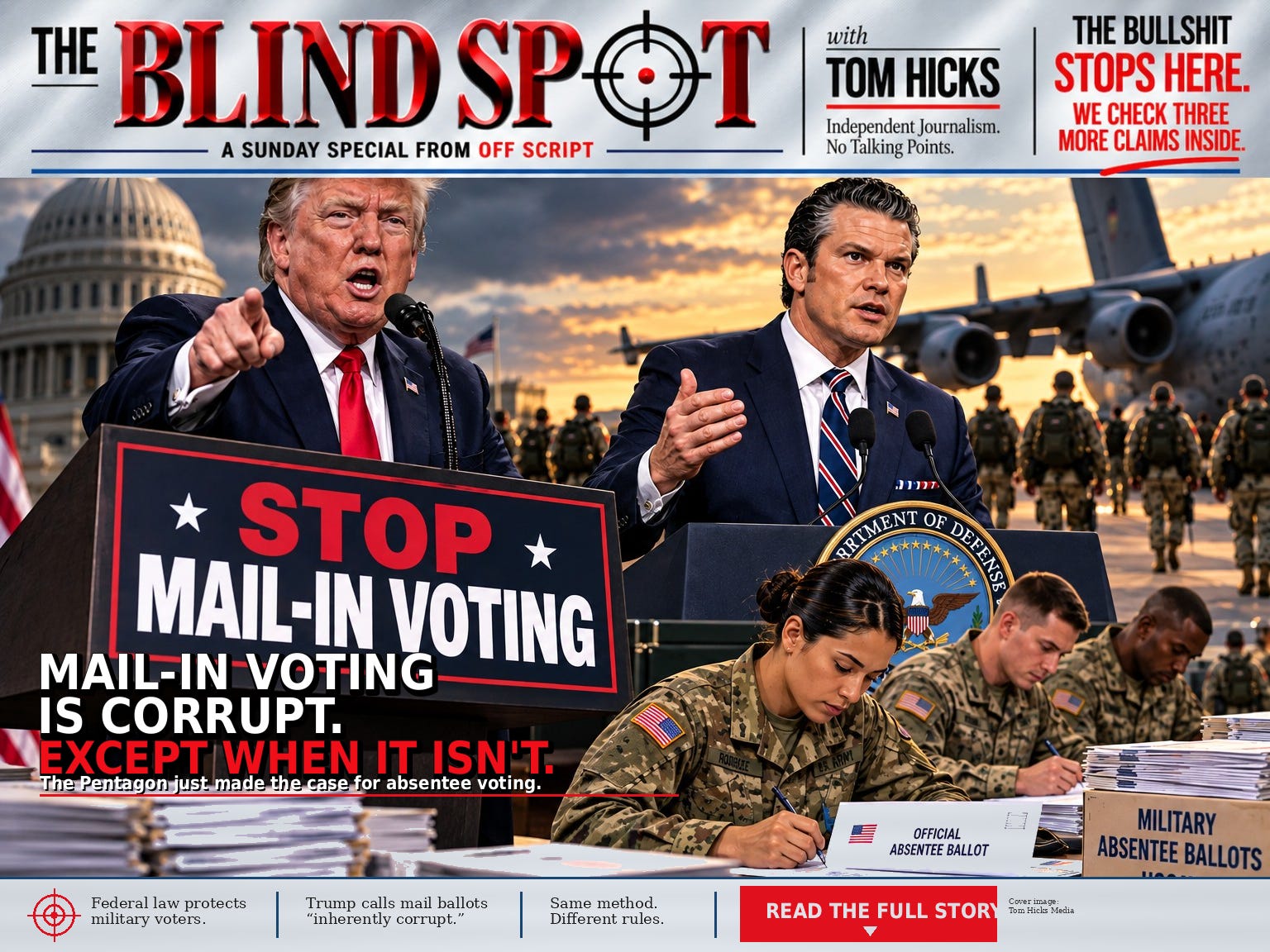
Pete Hegseth would like you to know that voting by mail is straightforward, protected by federal law, and something Americans should be confident using.
There is, apparently, some fine print.
On Friday, the Defense Secretary released a video urging service members and their families to register and vote in the November midterms. For troops away from home, Hegseth specifically promoted the Federal Post Card Application, which can be used to register and request an absentee ballot. If a regular ballot doesn’t arrive in time, he reminded deployed troops that they can use the Federal Write-In Absentee Ballot instead. “All of these processes are straightforward and protected by law,” Hegseth said. The Hill
He went further. “Every warrior deserves an opportunity to cast his or her ballot, and be confident that it will be counted,” Hegseth said. His instructions to commanders were equally direct: “You’re not telling them who to vote for. You’re just telling them to vote.” The Independent
Good.
Seriously. He’s right.
This Is Exactly Why the Law Exists
Military absentee voting isn’t some loophole somebody discovered last Tuesday. Congress enacted the Uniformed and Overseas Citizens Absentee Voting Act in 1986, guaranteeing eligible military personnel, their families and Americans living overseas the ability to register and vote absentee in federal elections. Congress strengthened those protections with the MOVE Act in 2009. U.S. Department of Justice
The system is deliberately designed around an obvious problem. A sailor aboard a ship in the Pacific can’t swing by the neighborhood elementary school after work. An airman stationed in Germany can’t pop into a precinct in Ohio. A soldier deployed thousands of miles from home still gets a vote.
So federal law provides a solution. States must make absentee voting available to eligible military and overseas voters. Ballots requested early enough generally must be transmitted at least 45 days before a federal election. There is even a backup federal write-in ballot when the regular one doesn’t arrive in time. U.S. Department of Justice
None of this is controversial.
At least it wasn’t until we started talking about everybody else.
The Other Message From Washington
President Trump has spent years attacking voting by mail, and he hasn’t exactly softened the message in 2026. In July, he called mail ballots “inherently corrupt” while supporting restrictions that would generally limit their use to illness, disability, military deployment, or travel. Election experts cited by FactCheck.org said fraud is somewhat more common with mail ballots than with in-person voting but remains rare, with no evidence supporting claims of widespread mail-ballot fraud. FactCheck.org
His administration didn’t stop at rhetoric. In March, Trump ordered changes intended to tighten federal procedures surrounding mail and absentee ballots. The Postal Service eventually issued rules requiring special ballot-envelope features, unique voter barcodes, and voter information uploaded through a federal portal before certain election mail could be processed. White House
Then, on September 14, the Supreme Court refused to let those Postal Service rules take effect for the 2026 election. Justice Brett Kavanaugh agreed that implementing them this close to Election Day would be “arbitrary and capricious” because state and local election officials didn’t have enough time to reasonably comply. The Court did not decide that tighter postal rules could never be imposed later. United States Postal Service v. California
Eleven days later, Hegseth appeared on camera and told America’s troops how easy and legally protected absentee voting is.
You couldn’t design the timing better if you tried.
The Contradiction Is the Easy Part
It’s tempting to stop here. Hegseth says absentee voting is straightforward and protected by law. Trump says mail ballots are inherently corrupt. Roll credits.
But that misses the Blind Spot.
Because Trump does make an exception for military voters. And once you ask why that exception makes sense, the argument gets much harder to contain. The same reasoning that makes absentee voting necessary for a soldier doesn’t suddenly disappear when the voter is a civilian.
That’s where this story gets interesting.
Keep Reading Blind Spot
The contradiction is sitting in plain sight. The bigger question is what happens when we follow it to its logical conclusion: What makes a mailed ballot trustworthy when it comes from a soldier, but inherently suspect when it comes from everyone else?
Upgrade to continue reading Blind Spot and get the full argument, including what military absentee voting inadvertently tells us about the larger fight over voting by mail.
