

EDITORIAL NOTE
There has been plenty of gossip this week about Donald Trump and Natalie Harp, and I’m not interested in adding to it. Whatever their personal relationship may or may not be has nothing to do with the question sitting in front of us. This is about access, security, judgment, and a White House that apparently tolerated something from one of Trump’s most trusted aides that would get most federal employees shown the door.
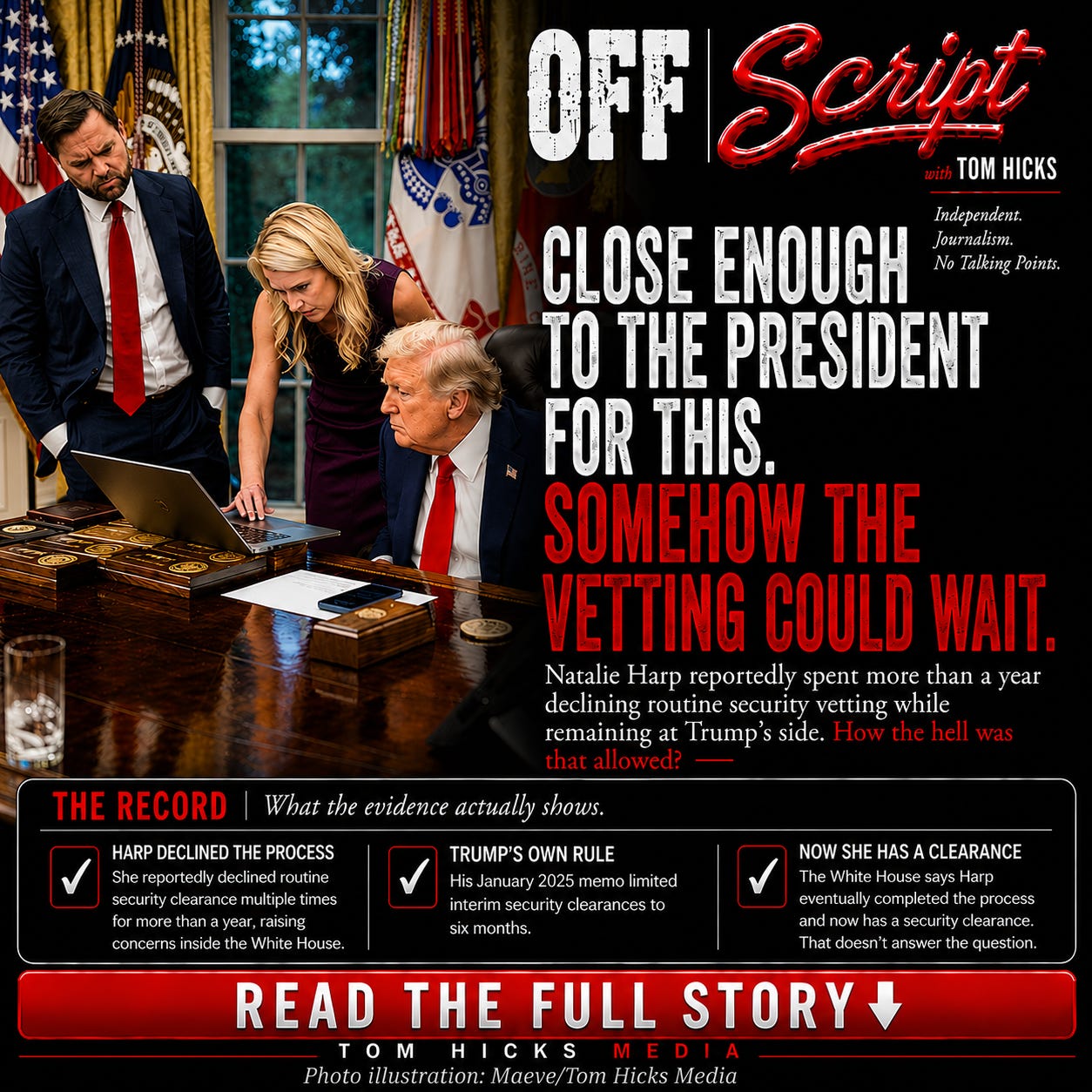
Natalie Harp is not some obscure White House employee whose badge gets her into the cafeteria and maybe the good bathroom. She is Trump’s special assistant and executive assistant, routinely at his side, handling information headed his way, helping with his social media, and functioning as one of the gatekeepers around the president. Forbes, citing reporting by MS NOW, says Harp repeatedly declined to complete the routine security-clearance process for more than a year.
Read that again, because the wording matters. She didn’t simply submit the paperwork and get stuck for months in some bureaucratic pile while investigators tried to locate her sophomore-year roommate. According to the reporting, Harp declined the process multiple times for reasons that remain unknown; concerns grew inside the White House counsel’s office and among security officials, and Trump eventually became personally involved before Harp completed the forms for a federal background investigation. She has since received a security clearance.
That’s where this stops being Washington gossip and becomes a legitimate question about how this White House operates. If you work around sensitive government information, the vetting isn’t supposed to depend on whether the boss trusts you, likes you or thinks you make excellent printouts. The entire point of having a security process is that personal loyalty isn’t the security process.
Your subscription helps fund reporting, research, publishing, new features, and the continued growth of every Tom Hicks Media publication.
If you value independent work that checks the record before joining the screaming, consider subscribing. Free readers help this publication grow, and paid subscriptions are what allow me to keep doing more of this work.
THIS WASN’T SOME RULE TRUMP INHERITED
Here’s where the story gets even harder to dismiss.
On January 20, 2025, Trump issued his own memorandum addressing a backlog in White House security clearances. That memorandum explicitly said Executive Office personnel who had not received the appropriate clearances were ineligible for access to the White House complex, infrastructure, and technology necessary to perform their jobs. Trump responded by authorizing interim Top Secret/Sensitive Compartmented Information clearances, but those interim clearances were limited to six months.
So the administration understood the problem from Day One. It understood that people working inside the Executive Office needed to be vetted, understood that clearance delays could interfere with their jobs, and created a specific temporary mechanism to deal with those delays. What it did not announce was a new policy called “Just keep saying no until everybody gets tired of asking.”
The broader rules aren’t particularly mysterious, either. Access to classified information normally requires an eligibility determination following an appropriate investigation, a demonstrated need to know, and a signed nondisclosure agreement. Simply holding a government job or possessing an impressive title doesn’t automatically create a right to classified information.
That doesn’t establish that Harp improperly saw classified documents, and I’m not going to pretend it does. There is no solid public reporting I’ve seen establishing that she read a particular classified document, attended a specific classified briefing without authorization, or committed some criminal security violation. The facts are strange enough without stapling accusations onto them that we can’t prove.
LOOK AT WHERE SHE WAS
The access question gets harder to ignore when you look at Harp’s actual proximity to the president.
Last month, the Secret Service secretly moved Trump from Air Force One in Turkey using a catering truck because of a potential Iranian assassination threat. The tiny group moved with Trump included Harp, deputy White House chief of staff Dan Scavino, and Oval Office operations director Walt Nauta. Secretary of State Marco Rubio and Treasury Secretary Scott Bessent stayed aboard the decoy aircraft, while Defense Secretary Pete Hegseth later joined Trump’s secret flight.
Think about what that tells us without inventing anything beyond the facts. When the president’s protective detail decided it needed to quietly move him during a potential national-security threat, Harp was considered important enough, or at least close enough, to move with him. That’s a hell of a lot closer to the center of government than somebody whose clearance status can reasonably be treated as an administrative afterthought.
Former Bush White House ethics lawyer Richard Painter actually supplied the useful caution here. Not every White House employee needs the same security clearance simply because they work in the building, he noted, but somebody traveling close enough to the president to overhear classified conversations on Air Force One could absolutely need one. That’s precisely why the unanswered questions matter more than the gossip.
“SHE HAS A SECURITY CLEARANCE”
The White House response has been technically true and spectacularly unhelpful.
Outgoing White House press secretary Karoline Leavitt told MS NOW that Harp “has a security clearance like everyone else” and called her a loyal and hardworking member of Trump’s team. Fine. Nobody is disputing that she has one now.
The story is about what happened before now.
Why did she reportedly decline to complete the process repeatedly? Who approved allowing that situation to continue? What access did she have while it was unresolved, what restrictions were placed on her, and why did the president himself apparently have to become involved before one of his closest aides finally completed paperwork every other person requiring a clearance is expected to complete?
Those aren’t gotcha questions. They’re the questions you ask when the government gives enormous access to somebody before the government has finished determining whether that person should have enormous access. If the answers are completely innocent, terrific — release them and make this story boring.
LOYALTY ISN’T A BACKGROUND CHECK
There’s a pattern beneath all of this that bothers me far more than Natalie Harp herself.
Trump places enormous value on personal loyalty. Every president wants trusted people around him, and anyone pretending otherwise hasn’t watched a White House operate since Washington was trying to find somebody to polish his wooden teeth. But government systems exist precisely because “I trust this person” and “this person has been independently vetted” are two very different sentences.
A security clearance isn’t supposed to tell the president whether somebody loves him. It’s supposed to identify vulnerabilities, conflicts, foreign contacts, financial concerns, coercion risks, and other issues that could matter when someone is exposed to sensitive information. Personal devotion doesn’t answer any of those questions.
And that may be what makes the Harp story worth paying attention to. The issue isn’t whether Natalie Harp is loyal to Donald Trump; by every available account, that’s probably the least disputed fact in Washington. The issue is whether loyalty to Donald Trump once again became a substitute for a system whose entire purpose is to protect the presidency from relying solely on personal loyalty.
That’s a much bigger story than who’s sitting next to whom on Air Force One.
THE RECORD
The reporting: MS NOW, citing two people familiar with the matter, reported that Harp declined several times over more than a year to pursue the routine security clearance normally obtained by West Wing staff. White House counsel and security officials eventually became concerned, Trump reportedly intervened, and Harp later completed the paperwork and received clearance. The White House has confirmed her current clearance but has not publicly provided a detailed rebuttal to that reported timeline.
The access: Harp serves as Trump’s special assistant and executive assistant and has become a highly visible gatekeeper around him. A national-security official quoted by MS NOW expressed concern that her proximity to Trump and his residence could expose her to more sensitive information than some more senior officials receive. Her inclusion in Trump’s secret security move out of Turkey last month further demonstrates just how close to the president she operates.
What we do not know: We do not currently have evidence that Harp improperly accessed a particular classified document or deliberately mishandled classified information. We also don’t know why she reportedly resisted completing the clearance process, exactly what interim access she had, or who authorized it. Those missing answers are reasons to keep asking questions, not invitations to invent our own.
THE BULLSHIT DETECTOR
“TRUMP’S POLICIES CAUSED THE HISTORIC DROP IN CRIME.”
The FBI’s 2025 numbers really are excellent: violent crime fell 9.7 percent and the murder rate dropped 18.5 percent. The bullshit begins when Trump turns that into proof that his policies caused it, because crime had already been falling for several years and researchers say the reasons behind the latest decline are still unclear. Trump also called the Biden years a violent-crime disaster even though violent crime was lower in Biden’s final year than in Trump’s final year of his first term. Funny how FBI statistics become trustworthy right around the moment they become flattering.
“THE CENSUS BUREAU PROVED 24,000 NONCITIZENS VOTED ILLEGALLY IN 2020.”
Trump says a new Census Bureau analysis “proves” more than 24,000 noncitizens voted in 2020. The seven-page report is unauthored; experts have raised serious methodological problems, and NPR found the analysis wasn’t conducted by the bureau’s career civil servants and involved people affiliated with the Trump-aligned America First Policy Institute. Even Georgia Republican Secretary of State Brad Raffensperger has asked the bureau for the underlying information behind its claims. Finding possible data matches isn’t the same thing as proving 24,000 crimes, no matter how many capital letters you put around it.
“CANADA AND THE UNITED STATES HAVE A DEAL.”
Trump announced that Canada and the United States “have a DEAL,” then postponed threatened 50 percent tariffs for three days while everybody apparently continued negotiating the deal they supposedly already had. Canadian Prime Minister Mark Carney said substantial progress had been made, but important work remained, and Canada’s trade minister said Thursday the countries were “very close” to an agreement. Maybe they ultimately get there. Until the unfinished thing is finished, though, calling it finished is bullshit with a tariff schedule attached.
“TRUMP SAID THE U.S. WILL USE INDIA’S VOTING MACHINES IN 2028.”
A viral screenshot circulating online purports to show Trump announcing talks with India’s election chief about bringing Indian electronic voting machines to the United States for the 2028 election. He didn’t post it. Fact-checkers found the screenshot had been edited, which means nobody needs to spend the weekend arguing about Trump’s secret plan to import Indian voting machines because there isn’t one. Sometimes bullshit isn’t complicated; somebody just made a picture and waited for the internet to do what the internet does.
The Bullshit Detector is free to Off Script subscribers and available separately for $4.95 in the Tom Hicks Media Store.
AROUND TOM HICKS MEDIA
Tom’s Number Ones: Music history without pretending every old record was a masterpiece. Daily charts, forgotten hits, arguments waiting to happen and the occasional song you haven’t thought about in forty years.
Lotus Purrspective: The world as explained by a tuxedo cat who has watched humans for quite some time and remains unconvinced. Lotus has opinions, and unfortunately for the rest of us, she is frequently correct.
Panic Room Sports: Everybody reacts. We check the tape first. NFL, fantasy football, bad decisions, excessive panic, and occasional evidence that football fans should not be left unsupervised.
Rabbit Ears TV: The newest member of Tom Hicks Media is here to have some fun with classic television. From flying WKRP turkeys to the shows, characters and moments we still remember decades later, Rabbit Ears is what happens when somebody finally admits old television deserves its own magazine.
Blind Spot: Every Sunday inside Off Script, we look at the story hiding behind the story everybody else spent the week yelling about. Sometimes the most important part is the part that barely made the headline.
BUY ME A CUP OF TEA
If you like what I’m doing here but another subscription isn’t in the cards, you can always buy me a cup of tea. It helps cover the boring little expenses that somehow accompany supposedly free speech — research tools, publishing costs, and all the other things nobody puts on the glamorous writer brochure. Mostly, it tells me somebody thought the work was worth keeping around.
ONE QUESTION BEFORE YOU GO
Forget Natalie Harp’s name for a minute and make this about any president and any aide. If someone with extraordinary access to the president repeatedly declined routine security vetting for more than a year, should that person have been allowed to keep the same level of access while the issue remained unresolved? I’m genuinely curious where you draw that line.
#OffScriptWithTomHicks #IndependentJournalism #NatalieHarp #DonaldTrump #WhiteHouse #SecurityClearance #NationalSecurity #GovernmentAccountability #BullshitDetector #TomHicksMedia