

EDITORIAL NOTE
This isn’t an accusation that every retailer has secretly assigned you a personal price. The evidence doesn’t support that, and I’m not going to scare the shit out of you just because it makes a better headline. What the evidence does show is that companies now have the technology to use personal information in pricing decisions, and regulators are increasingly asking what happens when the price of something depends partly on who’s looking at it. FTC
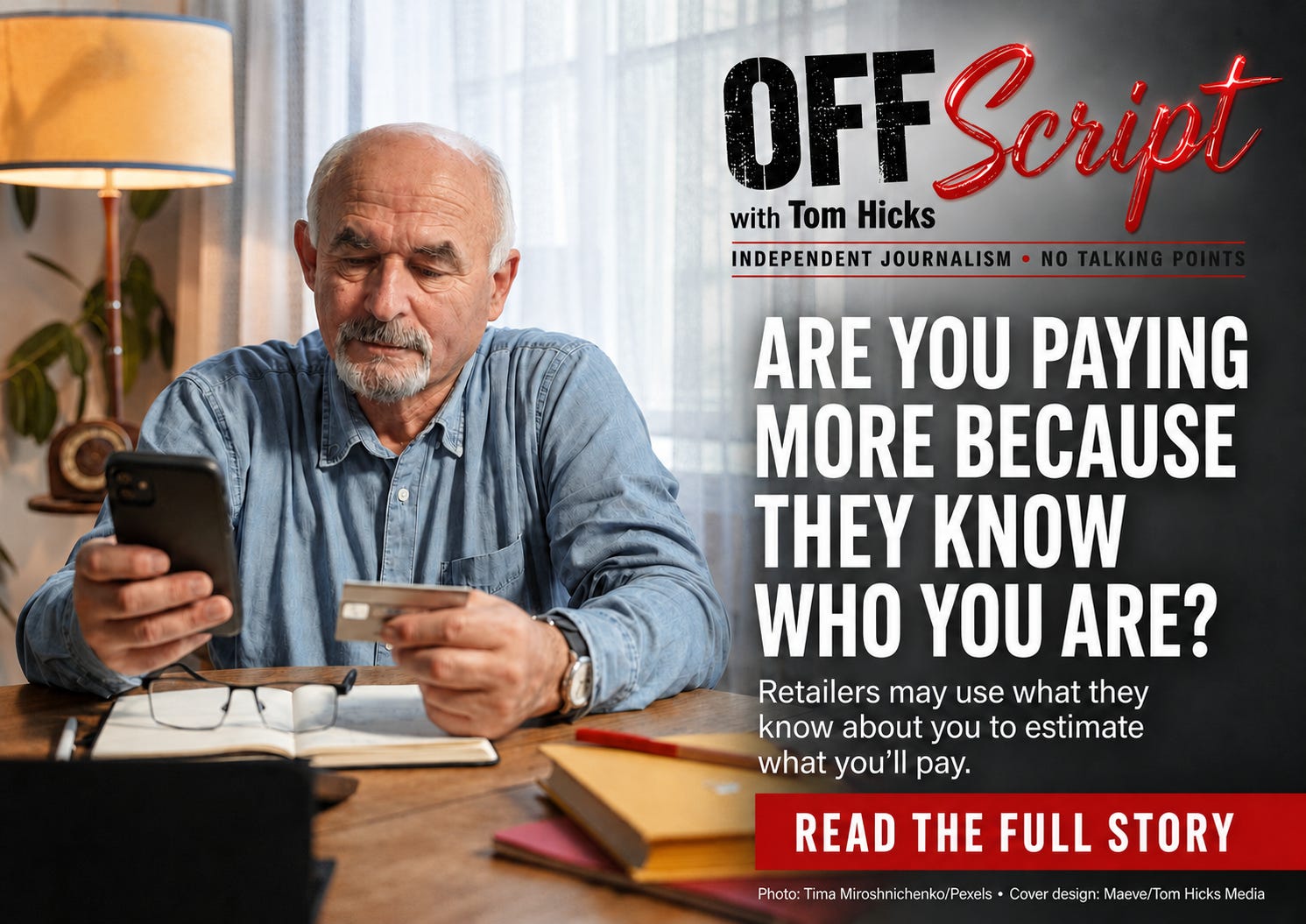
We’ve spent years worrying about what companies know about us. We may need to start asking what that knowledge is worth at the checkout.
I’m retired. I pay attention to what things cost because I fucking have to.
That doesn’t make me cheap, and it doesn’t make me unusual. I’ve got a finite amount of money coming in, so I notice when groceries creep up again or when something I bought six months ago suddenly costs five dollars more. There are millions of retirees, working families, and people trying to stretch a paycheck who know exactly what I mean.
I shop around. I’ll leave something sitting in an online cart if I think the price is too high, and I’ll come back later to see whether it dropped. I’ve always thought of that as using the internet the way it was supposed to be used.
Then I started looking at personalized pricing.
And now I’m wondering whether some of those same habits that help me save money can also help a company figure out exactly how much money it can get out of me.
WHEN THE PRICE TAG STARTS STUDYING YOU
The Federal Trade Commission calls the practice personalized pricing when personal data is used to set a price according to what a business thinks an individual consumer will pay. That can include estimates about whether somebody is likely to comparison-shop instead of simply swallowing the number on the screen. The agency is now considering an enforcement policy aimed at undisclosed or deceptive uses of the practice. FTC
Think about how fundamentally weird that is.
For most of my life, the store decided what something cost. Maybe the price changed tomorrow, maybe another store sold it cheaper, and maybe there was a sale next week that made me wish I’d waited. The price was attached to the thing.
Personalized pricing creates the possibility that part of the price is attached to me. The FTC’s proposed policy specifically addresses the use of personal data to estimate what an individual consumer is willing to pay or whether that consumer is likely to shop around. That’s a very different bargain. FTC
If an airline raises fares because half the seats disappeared overnight, I understand what happened even if I don’t like it. If a hotel charges more during a convention because every room in town is filling up, that’s supply and demand doing what supply and demand does. I may swear at the screen, but at least I know the game I’m playing.
The game gets considerably shadier if my browsing history, shopping behavior or other information about me helps determine the number I’m shown.
The FTC’s earlier surveillance-pricing study found that intermediaries working with retailers can use information including precise location, browsing patterns and shopping history. The agency also found that behavior as specific as mouse movements and products left behind in an online cart can be tracked and used by retailers to tailor consumer pricing. That study examined documents from companies including Mastercard, Accenture, McKinsey, PROS, Bloomreach and Revionics. FTC
That abandoned cart part landed a little differently for me.
I abandon carts because sometimes the responsible answer is, “Nope, not today.” Maybe I’m hoping the price drops or I’ve decided I can live without whatever shiny object caught my eye. That’s budgeting.
But from the other side of the screen, it’s also data.
Your subscription helps fund reporting, research, publishing, new features, and the continued growth of every Tom Hicks Media publication.
BEING CAREFUL WITH MONEY LEAVES CLUES
This is the part of the story I think gets lost when personalized pricing is discussed as some abstract technology issue.
People who have to watch their money behave differently from people who don’t. We check prices more carefully, wait longer, and sometimes come back to the same product several times before deciding whether we can justify buying it. Those are sensible habits when ten or twenty dollars actually matters.
They’re also clues.
A sufficiently sophisticated system doesn’t have to know that I’m sitting here thinking, Can I really afford this right now? It only has to recognize patterns in what I do and make predictions from them. That’s exactly why the FTC’s proposed policy specifically mentions estimates of a consumer’s willingness to pay and likelihood of comparison-shopping. FTC
That’s where my tolerance for clever technology begins to run out.
If an algorithm helps a store figure out which product I might like, fine. Recommend the damn toaster. If the same machinery starts working out how much extra Tom might grudgingly pay because he’s returned to the page four times, we’re getting into territory where I’d like somebody to explain the rules before reaching into my wallet.
And people on fixed incomes have more at stake than some Silicon Valley discussion about “price optimization” makes it sound.
An extra dollar on something you buy once a year is irritating. A few extra dollars scattered across groceries and household necessities can become real money when it happens week after week. Anybody who’s ever stood in a grocery aisle doing mental arithmetic already understands that without needing an algorithm to explain it.
WE ALREADY KNOW DIFFERENT PEOPLE CAN SEE DIFFERENT PRICES
A Consumer Reports investigation last year provides a useful example, with one very important distinction.
Researchers working with Groundwork Collaborative and More Perfect Union recruited 437 shoppers for simultaneous Instacart tests across four cities. They found that 74 percent of the grocery items examined appeared at multiple price points, with identical items at the same store and time sometimes differing substantially from one shopper to another. The largest difference recorded for an identical item was 23 percent. Consumer Reports research data
That sounds exactly like surveillance pricing until you look more carefully, which is why looking more carefully matters.
Instacart said the tests didn’t use personal, demographic or individual behavioral information to determine which prices shoppers received. The company said shoppers were randomly assigned to testing groups and that retailers controlled the pricing experiments. Instacart subsequently ended its item-price testing program after the Consumer Reports investigation. Consumer Reports
So I’m not calling the Instacart experiment surveillance pricing.
What it demonstrates is something almost as important for this discussion: two people can sit down at the same time, shop the same store for the same shit, and see different numbers without either one having any obvious way of knowing that’s happening. Consumer Reports’ testing documented as many as five different prices for the exact same grocery item in the same store at the same time. Consumer Reports research data
That transparency problem gets considerably uglier if personal information ever becomes part of determining who gets which number.
If I’m being charged a different price because I’m me, I want to fucking know it.
STATES ARE STARTING TO DRAW LINES
New York decided disclosure was the minimum.
A law that took effect November 10, 2025, requires covered businesses using personal data to set algorithmic prices to prominently disclose that fact near the price. The mandated language is about as subtle as a brick through a window: “THIS PRICE WAS SET BY AN ALGORITHM USING YOUR PERSONAL DATA.” Businesses can face penalties for violations. New York Attorney General
I like that.
You want to charge me a Tom Price? Fine. Put a big sign next to it telling me exactly what you’re doing and give me the opportunity to take my money somewhere else.
New Jersey went further in July. Its Fair Price Protection Act prohibits retailers from using shoppers’ personal data to set individualized prices for groceries and other necessities based on what an algorithm predicts somebody is willing or able to pay. The law specifically includes information such as online activity, location and purchasing history, while leaving loyalty programs and discounts intact. State of New Jersey
California is looking at the issue through privacy law.
The state attorney general launched an investigative sweep in January focused on businesses using personal information to set targeted, individualized prices. The attorney general’s office said those practices can trigger obligations under the California Consumer Privacy Act and may violate the law when data is used in ways consumers wouldn’t reasonably expect. California Attorney General
That’s enough activity in enough different places to tell me this isn’t a hypothetical problem somebody dreamed up after smoking too much weed at an AI conference.
Government officials are looking at it because the capability exists.
I DON’T WANT A “TOM PRICE”
Businesses have been trying to make money from me for seventy years, and I’m strangely at peace with that.
I’m trying to keep as much of mine as possible. They want some of it. Somewhere between those two positions sits most of American commerce.
What changes the deal is when one side knows vastly more about the other than the other realizes.
A retailer may have access to information about what I looked at, what I bought before, my location, and whether I left something sitting in a cart. The FTC’s surveillance-pricing study found that pricing intermediaries can draw on consumer characteristics, behaviors, and shopping patterns to help retailers target prices and promotions. I know the store wants my money. FTC
I’m considerably less comfortable with the store conducting a psychological assessment first.
There’s also something perverse about a system that could make being careful with money work against the person trying to be careful.
The guy with unlimited disposable income doesn’t need to spend forty minutes hunting for the cheapest version of something. The retiree, single parent or family watching every paycheck is much more likely to comparison-shop and hesitate over a purchase. Those behaviors can produce exactly the sort of information sophisticated pricing systems are designed to analyze.
So the people working hardest to find the best price could be helping teach the machine how badly they want one.
That’s fucked up.
THE RECORD
Personalized pricing is real, although its use varies and the evidence doesn’t support claims that every retailer is doing it. The FTC defines the practice as using personal data to set prices according to what a company believes an individual consumer will pay, and its market study documented the breadth of consumer information available to pricing intermediaries. FTC
It also isn’t the same thing as ordinary dynamic pricing. Prices can change because of supply, demand, or other market conditions without anybody using a shopper’s personal information. The privacy issue appears when information about the individual becomes part of determining or tailoring the price or offer. FTC
The FTC isn’t proposing a nationwide ban on personalized pricing. The commission explicitly says Congress hasn’t given it authority to prohibit the practice in every circumstance, so its current proposal focuses on deceptive or unfair practices that may violate laws the agency already enforces. FTC proposed policy
And that seems like an awfully low bar to me.
If you’re using what you know about me to decide what I should pay, tell me.
Then let me decide whether you’ll ever see another fucking dime.
THE BULLSHIT DETECTOR
There’s always more bullshit than there is room to print it. Here are four fresh ones making the rounds.
ROY COOPER’S PRISON RELEASES LED TO A SOUTH CAROLINA MURDER
Bullshit: False.
Why: A Republican super PAC ad attacking Democratic Senate candidate Roy Cooper strongly implies that a man accused of murdering 22-year-old Logan Federico was among prisoners released while Cooper was governor of North Carolina. The accused man was released from prison in South Carolina, not North Carolina, and Cooper had nothing to do with that decision. There are legitimate questions surrounding the suspect’s criminal history, but blaming a governor in another state for releasing him requires leaving out the one fact that destroys the entire argument. FactCheck.org
NANCY MACE LOST HER SHIT ON CAMERA
Bullshit: Fake video.
Why: A viral clip appears to show Republican Rep. Nancy Mace dancing, grimacing, and generally behaving like somebody replaced her coffee with something considerably stronger. The original video was posted by comedian Sydney Smith, and the circulating version was doctored to add Mace’s face and arm tattoos. You can dislike Nancy Mace for any number of things she’s actually done, but manufacturing new ones is still bullshit. Lead Stories
HAKEEM JEFFRIES WAS PHOTOGRAPHED HAVING A MEAL WITH JEFFREY EPSTEIN
Bullshit: Fake image.
Why: An image circulating online appears to show House Democratic leader Hakeem Jeffries sitting at a table with Jeffrey Epstein. Lead Stories found no evidence that Jeffries ever met or ate with Epstein, and two image-analysis systems identified the picture as likely synthetic or AI-generated. We’ve reached the point where seeing a photograph isn’t proof that the photographed event ever fucking happened, which ought to bother everybody regardless of politics. Lead Stories
TRUMP POSTED A PICTURE OF HIMSELF WALKING ON WATER
Bullshit: He didn’t.
Why: A circulating image showed Donald Trump walking across water carrying a Bible beneath the words “Pastor. President. Protector.” Social-media users claimed Trump himself had posted it to Truth Social, but a review of his account and archived posts found no such post. The image instead originated from a Trump-friendly Facebook account, which means there’s no need to assign him bullshit he didn’t actually post when the internet provides plenty of real material every day. Lead Stories
WANT YOUR OWN BULLSHIT DETECTOR?
The Bullshit Detector guide is for those moments when a headline, political claim, viral post, or suspiciously perfect statistic makes something in the back of your brain say, Hang on a fucking minute. It walks through the same basic habits I use here to check where a claim came from and whether the evidence actually says what somebody insists it says.
Off Script subscribers get the Bullshit Detector free. Everyone else can pick it up for $4.95 in the Tom Hicks Media Store.
AROUND TOM HICKS MEDIA
Tom’s Number Ones goes back through the charts every morning to find out what America was actually listening to on this date in another year. The records may be old, but some of the surprises have aged considerably better than we have.
Lotus Purrspective continues one tuxedo cat’s daily investigation into the deeply questionable behavior of the humans she’s been forced to supervise. Lotus remains confident that most of our problems could be solved if we’d listen to the cat the first time.
Rabbit Ears Classic TV is back today with another trip into the television that turned ordinary evenings in front of the set into memories people carried for decades. Some shows entertained us, while a handful managed to become part of the furniture in our heads. Check out today’s issue.
Panic Room Sports is getting ready for the point in football season when actual evidence begins replacing preseason bullshit. That won’t stop everybody from panicking, which is fortunate because we’ve built an entire publication around checking whether they should.
The Backlot Ghost walks through classic Hollywood looking for what stayed behind after everybody else went home. The movies are familiar, but some of the stories lurking behind them decidedly aren’t.
Blind Spot returns Sunday inside Off Script with the story that deserves more room than a daily article can give it. That’s where we take the extra time, follow the record, and find out what got missed while everybody was chasing the same headline.
BUY ME A CUP OF TEA
Off Script is free to read, and I’d like to keep as much of it that way as possible. If this morning’s piece made you look at that innocent little price on your screen differently, you can help support the reporting and research that goes into doing this every day.
Buy me a cup of tea, and I’ll keep looking under rocks.
ONE QUESTION BEFORE YOU GO
If you discovered a company had charged you more because an algorithm decided you personally would probably pay it, would you ever shop there again?
Tell me below. I have a feeling people are going to have some fairly strong opinions about this one.
#OffScript #PersonalizedPricing #SurveillancePricing #ConsumerProtection #Privacy #CostOfLiving