

By Tom Hicks | September 20, 2026
Editorial Note:
Blind Spot is the Sunday premium edition of Off Script with Tom Hicks, where we go past the daily headlines and look at the part of the story that isn’t getting enough attention.
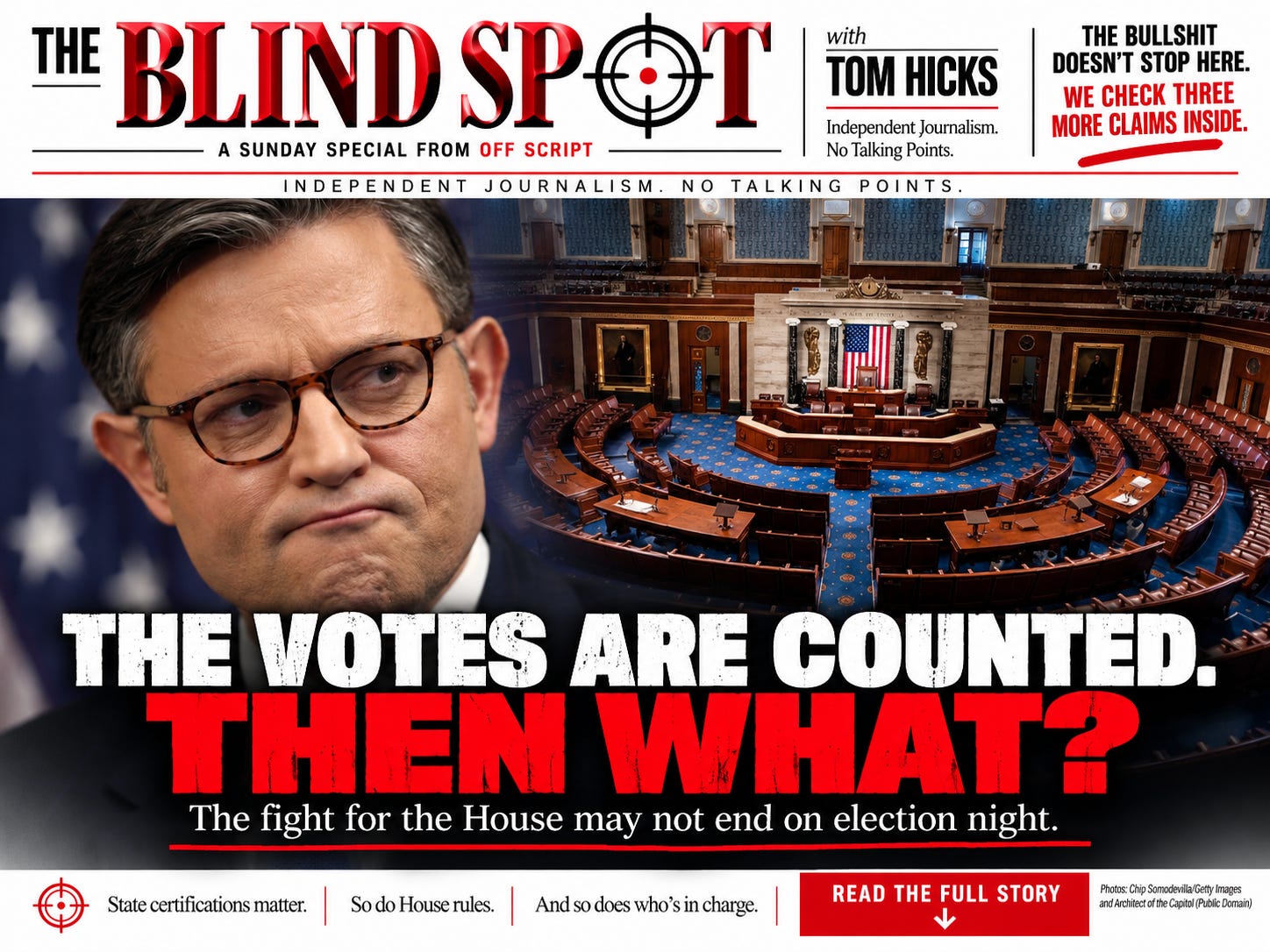
Most of us have a pretty simple understanding of how the midterms work. We vote on November 3, the votes are counted, somebody gets to 218 seats, and that party controls the House. We spend billions of dollars on campaigns, endure months of political commercials, and occasionally stop speaking to relatives over this stuff because the basic bargain is supposed to be pretty straightforward.
The people vote. Somebody wins. The winners take office.
House Speaker Mike Johnson said something at the Republican midterm convention in Dallas last week that made that third sentence worth examining a little more closely. After describing Democratic control of Congress in dire terms, Johnson told the crowd, “We cannot, and we will not, allow them to take the majority in Congress.” In the context of a campaign speech, the obvious interpretation is that Republicans need to win enough races to keep Democrats from taking the House. Politicians have been saying some version of that since we invented politicians. Johnson’s remarks at the Republican midterm convention
The problem isn’t simply what Johnson said. It’s the office he occupies and the power that comes with it.
Raw Story columnist Ray Richmond raised the darker possibility this week: What if Democrats win enough seats to take control of the House, Republicans challenge enough Democratic victories to muddy the majority, and the outgoing Republican leadership uses the peculiar mechanics of organizing a new House to keep some of those winners from participating? Richmond went considerably further, arguing that Johnson had effectively revealed the intention to do it. There’s no public evidence establishing that, and we’re not going to turn suspicion into fact because it makes for a scarier headline. Raw Story commentary
But Richmond asked a question worth answering: Could the machinery actually be used that way?
I expected the answer to be some variation of, “No, because obviously there are rules preventing that.” Instead, after going through federal law, House rules, congressional precedent, and the history of disputed House elections, I found something considerably less comforting. There are rules, all right. They’re also complicated, dependent on people behaving in good faith and, in a sufficiently close election, potentially vulnerable to a fight over who gets to participate before the new House has even elected its Speaker.
That’s where this story starts.
November 3 Isn’t the End of the Process
Before getting anywhere near the mechanics, there’s an important distinction to make. Nothing uncovered here proves Johnson is preparing to overturn the midterm results. There is no evidence that he plans to fire the Clerk of the House, no evidence that the current Clerk intends to manipulate anything, and no evidence of some secret Republican blueprint to manufacture a House majority after losing one at the polls.
Johnson’s history does, however, give us a perfectly legitimate reason to take questions about disputed election results seriously. After the 2020 presidential election, he rallied House Republicans behind an amicus brief supporting Texas’s attempt to challenge the results in Pennsylvania, Georgia, Michigan and Wisconsin. The Supreme Court docket shows Johnson and 125 other House members ultimately joined that filing before the Court rejected Texas’s case. Supreme Court docket, Texas v. Pennsylvania
The current environment doesn’t exactly encourage complacency either. Reuters reported this week that more than 50 state and local election officials, including Republicans and Democrats, are preparing for possible disruptions surrounding the midterms. Among the scenarios officials have considered are federal agents appearing at polling places, attempts to obtain election records or equipment, litigation, cyberattacks, misinformation and threats against election workers. That isn’t evidence any of those things will happen, but election administrators don’t usually spend September gaming out what to do if federal agents show up looking for voting equipment. Reuters
All of which brings us to a man almost nobody outside Washington has ever heard of.
Meet Kevin McCumber
Kevin McCumber is the Clerk of the United States House of Representatives. He isn’t a member of Congress, and the House historian lists his party affiliation as “none.” He’s a career House official who worked his way through the Clerk’s office, became deputy clerk in 2021, served as acting clerk beginning in 2023, and was sworn in as Clerk on January 3, 2025. Office of the Clerk
Most of the time, that’s exactly the kind of Washington job that allows you to walk through an airport without anybody bothering you for a selfie. But the Clerk has one responsibility that becomes extraordinarily important every two years. Before a newly elected House can organize itself, somebody has to prepare the roll identifying the people entitled to participate in that process.
Under 2 U.S.C. §26, that somebody is the Clerk of the outgoing House. The law directs the Clerk to place on the roll the names of representatives-elect whose credentials show they were regularly elected under state or federal law. When the new Congress convenes, those representatives-elect use that roll to begin organizing the House and electing a Speaker.
That’s normally a ministerial piece of housekeeping. States certify their winners, the credentials arrive, the Clerk prepares the roll, and everybody moves on to the televised food fight over who gets the Speaker’s gavel.
Then you read the House rules.
The Clerk “may be removed by the House or by the Speaker.”
Mike Johnson is the Speaker.
Now the Raw Story question doesn’t sound quite so easy to dismiss.
Johnson having the authority to remove McCumber doesn’t mean he’s going to use it. It certainly doesn’t mean McCumber has done anything wrong. His career stretches across leadership from both parties, and nothing I found gives me any reason to portray him as anything other than a longtime institutional official doing his job. House history: Kevin F. McCumber
But we’re no longer dealing with somebody’s fever dream about a Speaker simply refusing to accept an election. We have an actual federal statute assigning the outgoing Clerk responsibility for the opening roll, an actual House rule allowing the Speaker to remove that Clerk, and an actual Speaker who previously participated in an effort challenging presidential election results.
That’s enough to keep digging.
Before We Do
Your subscription helps fund reporting, research, publishing, new features, and the continued growth of every Tom Hicks Media publication.
What comes next is the part almost nobody talks about: what happens if the Clerk is removed, who takes over, whether a certified election winner can actually be kept from taking a seat, and what one of the ugliest House election fights in modern history tells us about all of it.
Upgrade to continue reading this week’s Blind Spot.
