

By Tom Hicks | September 29, 2026
Editorial Note:
Off Script with Tom Hicks is independent commentary built on reported facts. The funding trail below comes from the law, federal budget and contract records described by news organizations, and a letter from two Senate appropriators. Those records raise serious questions. They do not, by themselves, establish that anyone broke the law.
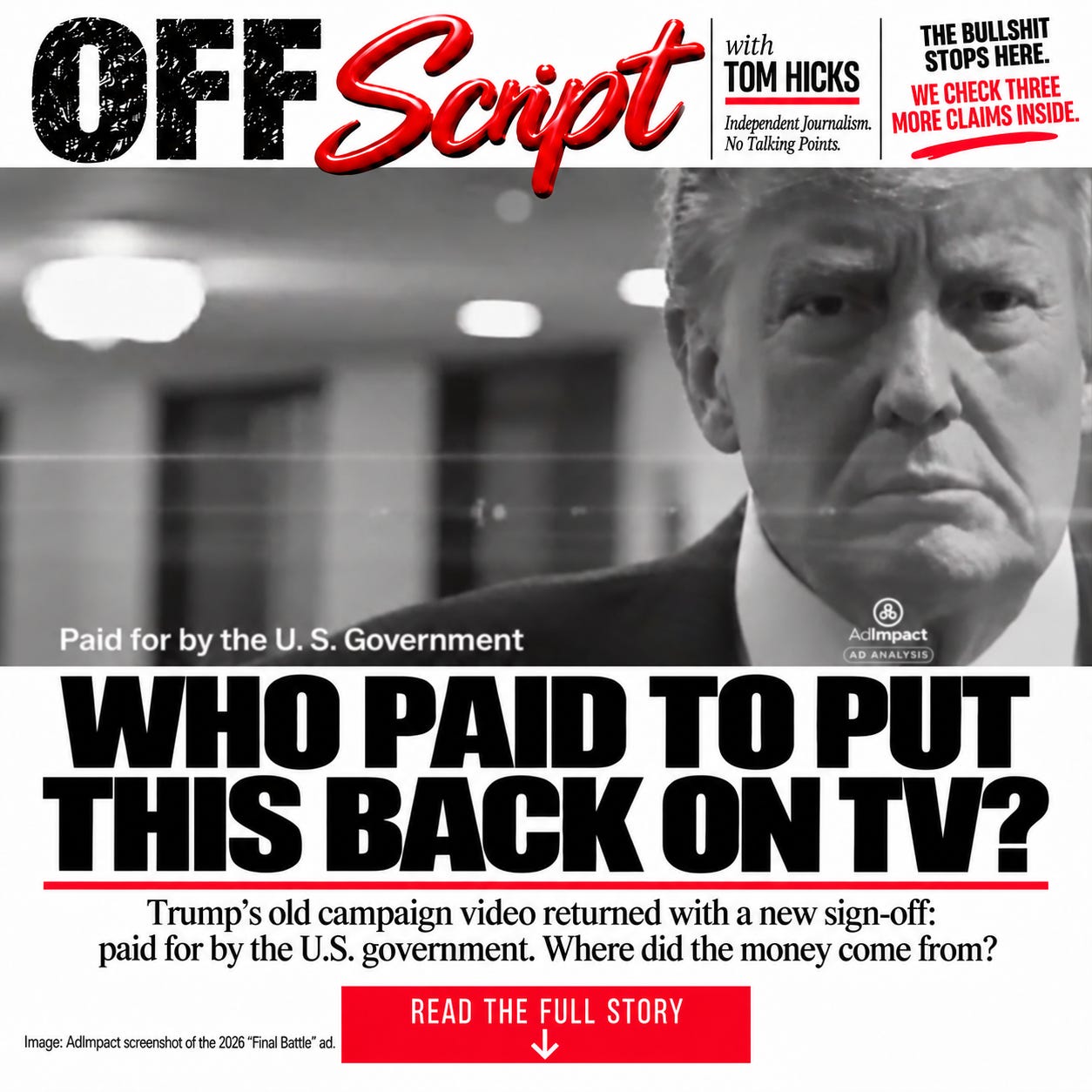
Donald Trump is on television telling Americans about Donald Trump. At the end of the ads, a message supplies the detail his campaign commercials never had: “Paid for by the U.S. Government.”
For days, the White House called these public service announcements without saying which part of the government was paying. On Tuesday, The Wall Street Journal reported that the money came from Customs and Border Protection, an agency inside the Department of Homeland Security. Trump personally pushed for the ads and took part in creating them, according to a person familiar with the matter who spoke to the Journal. That gives us a better question than whether the spots look political. Who decided CBP had the authority to buy them?
Follow the dates
Congress gave CBP $6.168 billion in a 2025 law for a list of border-related purposes. Most involve equipment, technology, screening, and drug interdiction. The last item permits spending on “commemorating efforts and events related to border security.” The law does not say that the entire $6.168 billion was set aside for commemorations. That distinction matters.
ABC News reports that federal budget records show money moved into a CBP account for “commemorative events” on September 19. Federal contract data then show a $20 million award to Maryland-based LMD Agency on September 20 for a “National Media Campaign.” The Trump ads began airing days later. Senators Patty Murray and Chris Murphy say it appears DHS has dedicated that $20 million to the ads, and they have demanded the contracts and an exact accounting.
Those are three points on a timeline. They are compelling points, but the public still needs the documents connecting every dollar between them.
If you want us to keep pulling on questions like this, subscribe to Off Script.
It’s free, or you can help fund the research and tools we use to report every day.
What did the public buy?
CBP can communicate with the public. It has run ads about immigration and self-deportation. The administration could argue that an advertisement about border-security efforts falls within the authority Congress provided. We should hear that argument, along with the spending records and the legal reasoning behind it.
Then somebody should put the argument next to the actual commercials.
One spot praises Trump and his record. Another uses footage of him at Mount Rushmore. A third is virtually identical to an ad from his 2024 presidential campaign, with a new ending that says the U.S. government paid for it. The campaign version urged viewers to join Trump’s fight. The government version drops that invitation, but keeps the candidate, the imagery, and much of the message. That is a hell of a thing for a border agency to purchase.
The White House says the spots promote patriotism and has compared them with earlier government ads about Medicare benefits and health-insurance enrollment. Its defense deserves to be stated accurately. It also invites a straightforward comparison: those ads told people about programs they could use. What does a CBP-funded replay of a Trump campaign video tell the public about a border-security service or commemorative event?
The legal question has two parts
Federal law says appropriated money must be used for the purposes Congress specified. Another provision bars spending federal funds on unauthorized domestic “publicity or propaganda.” That second prohibition has limits: the Government Accountability Office has allowed government messages with a political tone when they have a genuine connection to an agency’s work. It has also recognized restrictions on material that is purely partisan, covert, or aimed at glorifying the agency. The funding disclosure at the end of these ads means the covert-propaganda category is unlikely to be the central issue. The purpose of the spending and the content of the ads deserve the closest scrutiny.
Murray and Murphy have given DHS 48 hours to answer the questions that matter. Which account paid? What does the contract cover? Who directed the campaign? Did anyone at DHS, the White House or the Office of Management and Budget issue a legal opinion? Did ethics officials review it? The senators call the spending illegal. Their letter is a demand for answers, not a legal finding.
The $20 million figure is the reported contract and amount apparently committed to the campaign. It is not the amount already aired on television. Ad-tracking firm AdImpact estimated spending on the three ads at more than $2.5 million as of Tuesday, according to the Associated Press. Those figures measure different things, and the government still owes the public its own accounting.
I have an opinion about the ads. They look like political promotion paid for by people who never volunteered to join the campaign. But my opinion is the easy part. The administration has records that could show exactly how this purchase was justified, and taxpayers have a right to see them.
Congress wrote a border-security funding provision. On September 19, money showed up in a commemorative-events account. On September 20, an agency got a $20 million media contract. Soon afterward, a Trump campaign video was back on television with the government picking up the tab.
Show us the authorization. Show us the legal review. Show us the invoices. Then explain what any of it has to do with securing the border.
The Bullshit Detector
Claim 1: A video shows Trump getting into a big fight with Secret Service agents at the Presidents Cup.
Bullshit 💩💩💩
The man with Trump is PGA Tour CEO Brian Rolapp, not a Secret Service agent. The circulating description gets the other person’s identity wrong and turns a golf-event conversation into a security confrontation.
Why: The footage is real; the story attached to it is false. That’s a three-pile job: enough deception to spread, but easier to check than a fabricated image. Lead Stories fact-check
Claim 2: Viral pictures of Israeli passports prove that Volodymyr Zelenskyy and his wife, Olena Zelenska, hold Israeli citizenship.
Bullshit 💩💩💩💩💩
The images are fabricated. One purported passport says it was issued in “Moscow, USSR” in 2023. The Soviet Union ceased to exist more than three decades earlier, and the supposed documents contain other inconsistencies.
Why: These are fake documents being offered as proof of a consequential claim about a wartime leader. Five piles for manufacturing the evidence itself. Lead Stories fact check
Claim 3: Italian Prime Minister Giorgia Meloni wore a Palestinian flag as a cape at the United Nations and confronted Benjamin Netanyahu.
Bullshit 💩💩💩💩💩
The video is fabricated. The figures move unnaturally, the flag’s design is wrong, and the U.N. emblem does not match the real one.
Why: This is another invented event presented as footage. Agreeing with the sentiment doesn’t make the video real. Five piles, whatever side of the argument you’re on. Lead Stories fact-check
Ferret Out the Bullshit
The Bullshit Detector helps you test a claim, find what was left out, and spot the trick before you share it. It’s $4.95 at the Tom Hicks Media Store and free for paid subscribers.
More from Tom Hicks Media
Panic Room Sports: Smart coverage with attitude. Everyone reacts. We’ll check the tape first.
Tom’s Number Ones: Six charts, one date, and the records that ruled the airwaves.
Lotus Purrspective: Our resident cat investigates human behavior and finds plenty to work with.
Rabbit Ears Classic TV: The shows you remember, and the arguments you may have missed.
The Backlot Ghost: Old movies still have stories left to tell.
Buy Me a Cup of Tea: If you value independent work that asks to see the paperwork, you can help keep it going.
One Question Before You Go
What document would you want DHS to release first: the contract, the legal opinion, or the invoices?
#OffScript #GovernmentSpending #DHS #CBP #Accountability