

By Tom Hicks
Every once in a while I run across a story that refuses to leave me alone. Not because it’s the biggest story of the day, but because there’s a sentence buried somewhere in the middle that quietly changes the way I look at everything around it.
This is one of those stories.
I’ve used Ctrl+F more times than I could count—as a DJ digging through liner notes, as a paralegal buried in discovery, and now as a guy trying to get a newsletter out before the coffee gets cold. It’s one of the best inventions we’ve ever stumbled into. It’s also completely useless for the one job we keep asking it to do, and that gap between what we ask of it and what it can actually give us is what pulled me into this story.
Not the lawsuit itself.
The habit underneath it.
If you’ve seen the headlines, you’ve probably already filed this one away.
California. Minnesota. Research grants. Trump. DEI. Universities.
By now you know the drill. Before anyone reads the underlying documents, the story gets sorted into political buckets, everybody picks a side, and social media fills up with people arguing over headlines they didn’t write about court filings they sure as hell didn’t read. That’s become so normal we barely notice we’re doing it anymore.
I thought that’s what I was about to read, too.
Then I got to one paragraph and just stopped.
Not because it was dramatic. It wasn’t. There wasn’t a shocking confession or a smoking gun hiding in the filing. What actually happened is almost dumber than that, which is probably why I nearly read right past it.
It wasn’t buried in some obscure exhibit. It wasn’t hidden behind legal jargon. It was sitting there in signed court filings.
In Thakur v. Trump, federal agencies stipulated they used general criteria rather than assessing individual research grants one by one. The lawsuit involves grants awarded to institutions in California and Minnesota, and the plaintiffs argue the government relied on the same review process to terminate funding across both states. They’re now asking the judge to rule that the process itself violated the law rather than proceed to a full trial. Whether that process was lawful is still for the court to decide, but the fact that keyword-based screening was part of the review is no longer speculation—it’s in the court record.
I sat there for a minute thinking, okay...and?
Of course they searched the grants.
Why the hell wouldn’t they?
If someone handed me ten thousand grant applications and said, “Find every proposal that mentions a particular subject,” I’d search them too.
So would you.
So would every lawyer I know, every reporter, every auditor, every poor bastard who’s ever spent an afternoon trapped inside a six-hundred-page government PDF reaching for Ctrl+F like it’s oxygen.
Somewhere out there is a programmer who has no idea they collectively gave humanity back millions of hours of its life.
I’ve used Ctrl+F on everything from discovery productions to DJ liner notes to draft newsletters like this one. Every single time it did exactly what I asked it to do.
Not once did it tell me what any of it meant.
That part was always waiting for me.
So the searching wasn’t the story.
The story was what my brain did next.
Without even realizing it, I slid from they searched for these words to they found the thing they were looking for.
Those aren’t the same statement.
Not even close.
Ctrl+F doesn’t know what it’s looking at. It doesn’t know whether those words appear because a researcher is defending an idea, criticizing it, measuring it, quoting somebody else’s work, or explaining why the whole premise is wrong. It doesn’t know whether the phrase shows up once in a bibliography or fifty times because it’s the entire point of the grant. It doesn’t know if it’s sitting in the title or buried in a footnote nobody ever reads.
It can’t know.
All it knows is that you asked it to find a sequence of letters, and it faithfully points to every place they show up. Honestly, that’s one of the things I admire about it. Ctrl+F never pretends it understood a goddamn thing it found.
We do.
That’s the thought that wouldn’t leave me alone after I closed the filing.
Somewhere along the way we’ve become so impressed with retrieval that we’ve started giving it credit for judgment, and I don’t think we even noticed we were doing it. A search narrows the pile. That’s genuinely useful. But narrowing the pile isn’t deciding what belongs in it, what matters, or what happens next.
That’s where the human being is supposed to show up.
If this is the kind of journalism you enjoy, I’d love to have you join me every morning. Off Script is free to read, and paid subscribers get Point Blank, where I take one story and dig into it without the constraints of a daily newsletter. No advertisers. No corporate owners. Just independent journalism supported by readers.
Subscribe today and join me every weekday morning for Off Script.
Maybe that’s what keeps bothering me.
The software finished its job the instant it handed the information back.
Everything after that belonged to us.
And somewhere along the way we’ve started acting like the software finished that job too.
Maybe that’s why I couldn’t let this go. The lawsuit is important, and whatever the judge ultimately decides will matter. A hearing on whether the court should rule on the existing record is scheduled for October. But I suspect the bigger story isn’t California or Minnesota. It isn’t this administration. It isn’t even these particular research grants. I think it’s a habit we’ve all picked up without realizing it. We’ve become so accustomed to computers finding things that we’re forgetting finding was never the hard part. Deciding what those things mean always was.
I kept wondering if I was making too much of it. After all, it’s one lawsuit. Maybe the court decides the government’s review process was perfectly lawful. Maybe it decides it was a load of horseshit dressed up in legal paperwork. That’s what courts are for. Judges examine evidence the rest of us don’t have, witnesses testify, lawyers make their arguments, and eventually somebody in a black robe tells everyone which claims survived contact with reality.
My job isn’t to decide that case. My job is noticing the question the lawsuit accidentally raised, because I don’t think it belongs only to lawyers. I think it belongs to all of us.
The more I thought about it, the more I started seeing the same mistake everywhere. Somebody searches an email archive and finds the word bonus.
Now what?
Did they uncover fraud? A perfectly legitimate compensation plan? A complaint from an employee? A joke that reads completely differently once you see the rest of the thread? A draft that was never sent?
Nobody knows yet. All anybody knows is that the word exists, and somewhere along the way we’ve started acting like finding the word solved the whole damn mystery. It didn’t. It just told you where to start looking.
The software did exactly what we asked it to do. The mistake belongs to us. We’ve started expecting tools to make judgment calls they were never designed to make.
A hammer doesn’t care whether you’re building a house or knocking one down. A calculator doesn’t care whether the numbers describe a family’s grocery budget or a money-laundering operation. Google Maps doesn’t care whether you’re driving to your grandmother’s house or the scene of a robbery. The tools don’t know, and they were never supposed to. Their job ends the moment they hand the information back. Ours begins there, whether we feel like showing up for it or not.
The more I thought about it, the less interested I became in this administration and the more interested I became in government itself. Governments are allowed to make bad decisions. They’re allowed to make unpopular decisions. They’re even allowed to make decisions courts eventually overturn. That’s part of living in a constitutional republic.
What they’re not allowed to do is pretend a search box did the thinking for them.
Government isn’t special because it has access to information. Most of us carry more searchable information in our pockets than entire federal agencies possessed a generation ago. What’s supposed to make government different is that somebody has to own the decision after the information has been gathered.
That’s what due process protects.
Not perfection.
Accountability.
Someone has to explain why a decision was made, defend it if a court asks, and own it if it turns out they got it wrong. A search box can’t do any of that shit. It can’t raise its right hand and swear to tell the truth. It can’t explain why one grant deserved another look while another didn’t. It can’t answer a judge’s questions or be cross-examined by opposing counsel. It can’t even tell you why it highlighted one sentence instead of another, because it didn’t. You told it what to look for, and it faithfully returned every match.
If the plaintiffs are right, that process unlawfully terminated research funding awarded to institutions in California and Minnesota. If the government is right, the court will say so. Either way, responsibility belongs to people, not software.
Which brings me back to the title.
I wasn’t trying to be clever.
I was reminding myself of something so obvious we’ve nearly stopped saying it out loud.
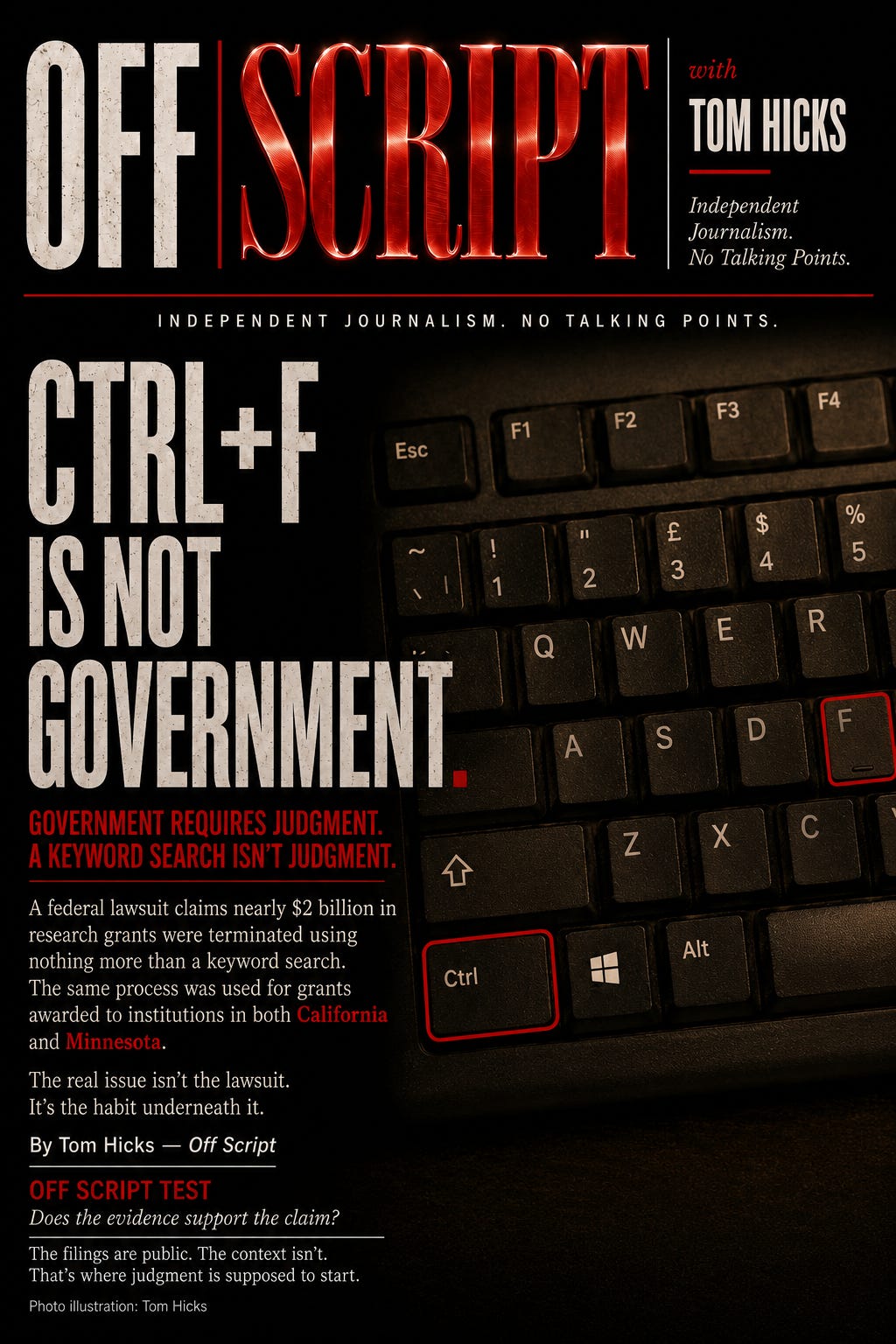
Ctrl+F is not government.
Neither is artificial intelligence, a spreadsheet, or an algorithm. They’re remarkable tools. I use them every day, and I’ll probably hit Ctrl+F three more times before this newsletter goes out. But none of them relieve me of the responsibility to think. They don’t relieve you of it either. And they sure as hell don’t relieve a government of it.
Maybe the plaintiffs in Thakur v. Trump prove their case. Maybe the government proves theirs. I’ll read the opinion when it comes out.
But I hope that’s not the only thing people remember from this lawsuit.
Long after this case is over, long after this administration is replaced by another one, and that one by another, we’ll still be surrounded by tools that retrieve information faster than any generation in history could have imagined. That’s an incredible thing. It also makes judgment more valuable, not less. The easier it becomes to find something, the more important it becomes to understand what you actually found.
Finding the answer has never been the hard part.
Recognizing it when you’re looking straight at it always has.
Before You Go
I put together a short field guide called the Off Script Bullshit Detector—the framework I use to separate information from interpretation before I write a single word. Paid subscribers get it free. Everyone else can pick it up at the Tom Hicks Media Store for $4.95.
If Off Script has become part of your morning routine, you can also buy me a cup of tea. No guilt. No paywall games. Just another way to help keep this publication reader-funded.
One Question Before You Go
What’s one place in your own work—or your own life—where you’ve caught yourself mistaking a search result for an answer?
I’d genuinely like to hear it.
One Last Thing
I still think about the programmer who built Ctrl+F.
They probably thought they were solving a navigation problem.
I doubt they imagined they were also giving the rest of us one more opportunity to confuse finding information with understanding it.
#CtrlF #Government #DueProcess #ThakurVTrump #CriticalThinking #OffScript