

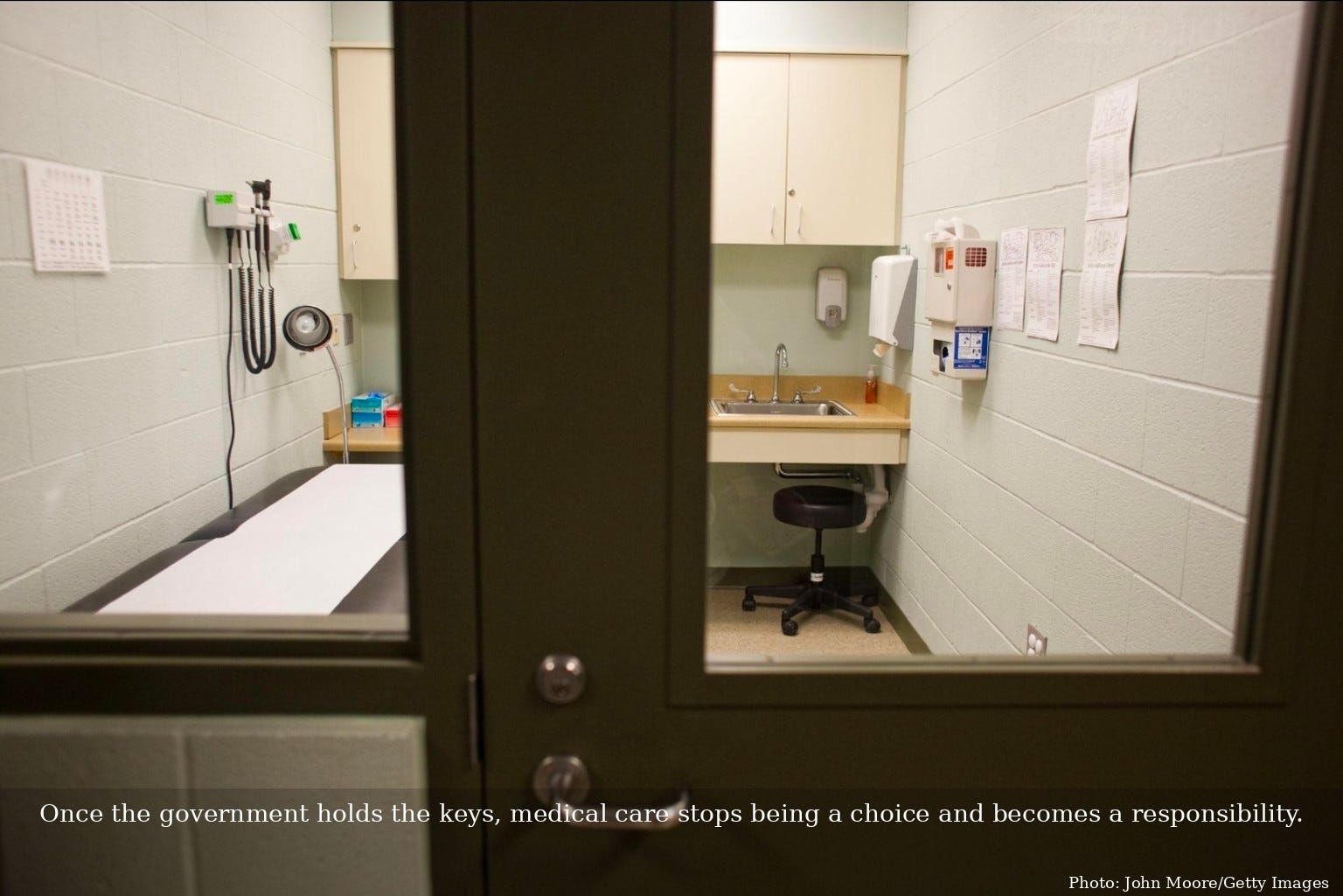

Untreated cancer. Serious infections. Allegations involving interrupted HIV medications, delayed specialist care, epilepsy, Parkinson’s disease, diabetes, glaucoma, and heart disease.
That’s the picture painted by a recent Associated Press and KFF Health News investigation into medical care inside ICE detention facilities across the United States. According to the reporting, which examined thousands of court filings, detainees and their attorneys raised repeated concerns about delayed treatment, interrupted medications, worsening conditions, and serious illnesses allegedly deteriorating while people remained in government custody.
Federal officials dispute some allegations and point to medical standards that are supposed to govern detention facilities. Fine. Allegations deserve scrutiny. Facts matter. Investigations exist for a reason.
What I can’t get past is something much simpler.
How the fuck did we get to a place where “people in government custody should receive medical care” became an argument?
Before everybody runs to their favorite corner of the immigration debate, let’s acknowledge something that should be blindingly obvious. Once the government takes control of a person’s life, it takes responsibility for that life. Not partial responsibility. Not political responsibility. Responsibility. If the government locks the gate behind somebody, controls where they sleep, controls where they go, controls their access to doctors, medications, transportation, and treatment, then the government owns obligations that come with that power. That’s the bargain. That’s always been the bargain.
If this kind of accountability journalism matters to you, hit subscribe before the politicians, billionaires, and professional bullshit artists convince everyone that oversight is optional.
Look, you can support stricter immigration enforcement. You can oppose it. You can spend your evening arguing border policy with strangers online until your phone battery dies and your blood pressure hits escape velocity. None of that changes the question sitting at the center of this story.
What responsibility does the government have once somebody is in its custody?
Because that’s where I start losing patience with the conversation.
The second the letters I-C-E enter the discussion, a whole lot of otherwise reasonable people suddenly forget principles they apply everywhere else. If you heard about a nursing home resident being denied necessary medical care, you’d be furious. If you heard about a veteran trapped in a bureaucratic maze while a serious illness worsened, you’d be furious. If you heard about a prisoner waiting months for treatment while a condition deteriorated, you’d be furious.
Change the label to “ICE detainee,” and suddenly people start looking for exceptions. That’s the part I don’t understand. The underlying principle hasn’t changed. The only thing that changed is who the problem is happening to.
Once a detainee can’t choose another doctor, can’t drive themselves to an emergency room, can’t seek a second opinion, can’t refill a prescription independently, and can’t simply walk away from a bad situation, the responsibility equation changes. The government isn’t just enforcing a law anymore. It’s become the gatekeeper for virtually everything that happens next.
That’s not politics.
That’s custody.

One reason this story resonates beyond immigration is that almost everybody understands medical vulnerability. Most of us have waited for test results that took too long. Most of us have watched somebody we love fight with insurance companies, specialists, referrals, scheduling offices, or hospital systems that seemed determined to test the limits of human patience. We’ve sat beside hospital beds. We’ve stared at silent phones waiting for a call. We’ve spent sleepless nights wondering whether a problem was getting worse while paperwork moved from one desk to another.
That experience is miserable enough when you still have options.
Now imagine all those options disappear.
Imagine somebody else controls the appointments, the transportation, the referrals, the medications, and every other decision connected to your care. Imagine believing something is seriously wrong while your only real option is filling out another request and hoping somebody pays attention.
That’s what makes allegations like these so disturbing.
The AP reporting includes detainees suffering from illnesses that don’t politely wait for bureaucracies to get their act together. Cancer doesn’t care about staffing shortages. Diabetes doesn’t pause because paperwork is delayed. Serious infections don’t become less dangerous because forms are sitting in a stack somewhere.
That’s why these allegations deserve attention regardless of where you stand on immigration policy.
The deeper issue isn’t border security.
The deeper issue is responsibility.
Too many people seem willing to abandon principles the moment a politically controversial label enters the conversation. Standards that apply everywhere else suddenly become negotiable. Expectations become optional. Responsibility becomes conditional.
That’s bullshit.
Either institutions have obligations to people under their control or they don’t.
If the answer changes depending on whether we personally approve of the people involved, then we’re not defending principles anymore. We’re defending tribes. And tribes have a nasty habit of excusing behavior they’d condemn in a heartbeat if the jerseys were reversed.
The thing that worries me most about stories like this isn’t any single allegation. It’s the dodge. It’s the way people immediately try to change the subject. Maybe it’s immigration. Maybe it’s crime. Maybe it’s politics. Maybe it’s something else entirely. The topic changes. The dodge doesn’t.
Instead of asking whether an institution met its obligations, people start arguing about whether the people affected deserved those obligations in the first place.
That’s a dangerous shift.
Because once responsibility becomes conditional, power becomes a lot easier to abuse.
Power without responsibility is one of the oldest scams in human history. Everybody wants authority. Everybody wants control. Everybody wants the ability to make decisions that affect other people. Responsibility is the part they keep trying to leave behind when the bill comes due.
That’s why this story reaches far beyond immigration detention facilities.
Every institution eventually reveals what it values, and it rarely happens during a press conference. Institutions reveal themselves through what they tolerate. When delays become normal, when complaints disappear into bureaucratic black holes, and when serious concerns stop creating urgency, those things eventually stop being isolated failures and start becoming part of the culture.
Nobody announces that process while it’s happening.
It usually arrives disguised as routine dysfunction.
A complaint gets ignored. A referral takes longer than it should. A problem gets pushed to next week. Then next week becomes next month, and somebody else pays the price.
History is full of examples where suffering became background noise because the people experiencing it lacked power, influence, or public sympathy. That’s why this story should concern people who have never set foot near an immigration detention facility. The institution involved today may be ICE. Tomorrow it could be another government system responsible for people who can’t simply walk away.
The names change.
The mechanism doesn’t.
One of the easiest mistakes people make is believing rights and responsibilities only apply to people they like. The moment standards of treatment become dependent on popularity, citizenship status, ideology, ethnicity, religion, or political convenience, we’ve already abandoned the principle we’re pretending to defend. At that point we’re just picking favorites and calling it morality.
That’s not how a functioning society works.
A functioning society doesn’t determine whether people deserve medical care based on whether they’re popular. A functioning society doesn’t decide responsibility is optional whenever a topic becomes politically inconvenient. A functioning society understands that when institutions exercise extraordinary power over human beings, extraordinary responsibility comes with it.
That’s the entire point.
The AP investigation may ultimately validate some allegations, reject others, and leave still more unresolved. That’s how serious reporting and serious investigations work.
What shouldn’t be unresolved is the principle underneath the story.
If the government takes control over a person’s life, it inherits obligations that extend beyond enforcement, detention, and paperwork. Those obligations exist whether the person involved is sympathetic, unpopular, citizen, noncitizen, rich, poor, conservative, liberal, or anything else.
Power doesn’t get to keep the authority and abandon the obligation. A government that wants the ability to control people’s lives also inherits responsibility for what happens to those lives. The moment those two things separate, accountability starts dying, and people start paying the price.
If you’re tired of watching accountability get treated like an optional feature, consider upgrading.
Reader support keeps The Unredacted Bastard independent, sponsor-free, and answering to readers instead of corporate owners.
For a slightly less profanity-filled examination of human behavior, check out my wiser counterpart, Lotus.
If this piece resonated with you, give it a like and share it.
☕ Keep Me A Fueled: Gotta keep the synapses firing somehow.
#Politics #ICE #Immigration #GovernmentAccountability #HumanRights #Democracy #TheUnredactedBastard