

Tom Hicks | October 12, 2026
Editorial Note:
With the midterm elections approaching, we’re looking at something that happens well beyond any one state or political party: what happens when voters make a choice that doesn’t fit the plans of the people who believe they know how elections should be won?
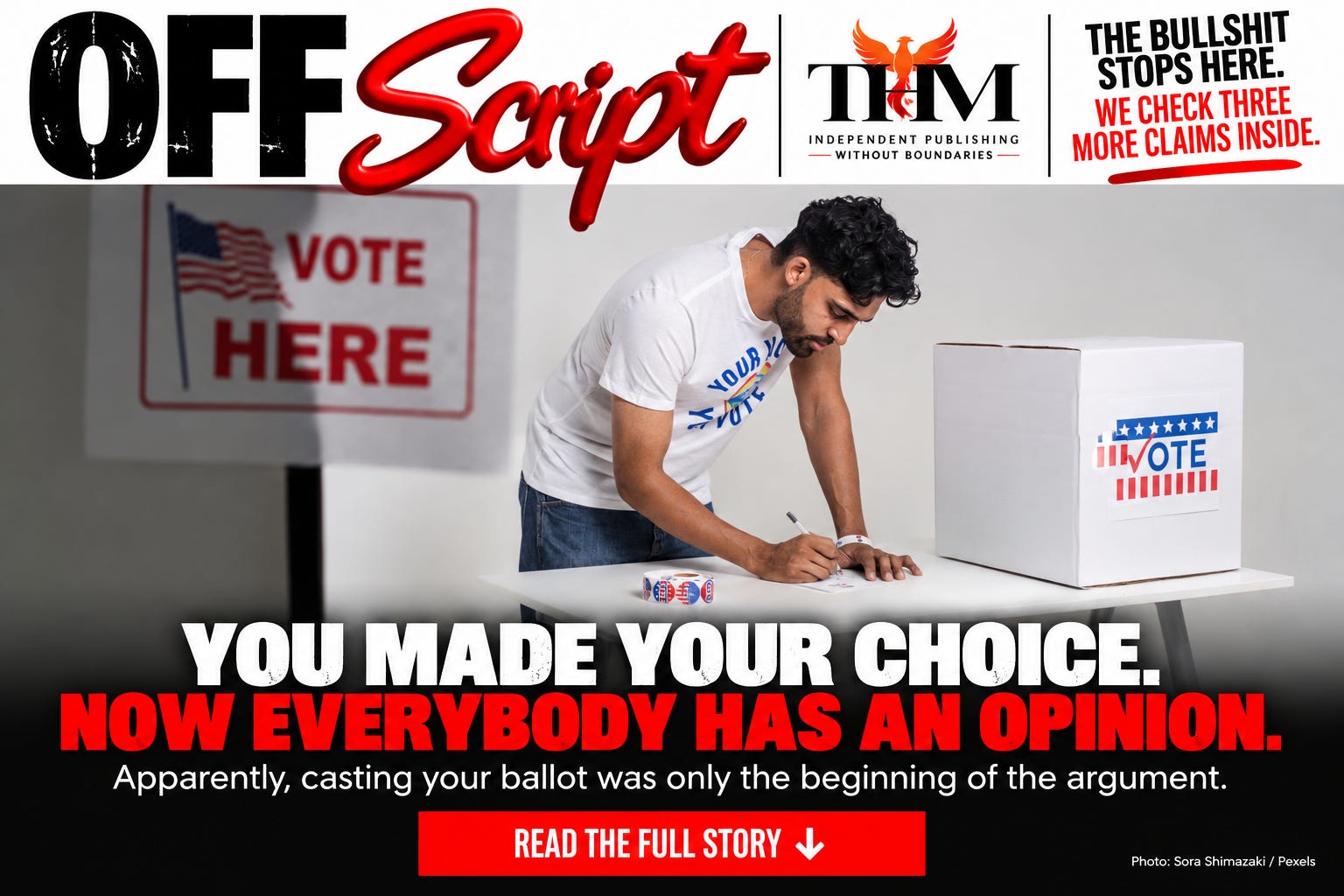
I’ve been thinking about something that probably shouldn’t be as complicated as we’ve managed to make it.
We hold elections so people can choose who represents them. That’s the basic arrangement, anyway. Candidates run, voters consider their options, somebody wins, somebody loses, and everybody spends the next several months arguing about whether the voters knew what the hell they were doing.
But there’s another election that takes place around the one we actually vote in. It involves party officials, campaign consultants, wealthy donors, political action committees, and people whose job descriptions seem to consist largely of explaining why the candidate voters want isn’t the candidate voters should have.
Sometimes they’re right, which is what makes this interesting. Political professionals spend their lives looking at polling, fundraising, voter registration, turnout patterns, and electoral arithmetic. They have information most of us don’t, and I wouldn’t dismiss that expertise simply because I don’t always like what they do with it. They also have interests of their own, which don’t necessarily line up with ours. When those interests collide with an actual election result, things can get uncomfortable, especially when the candidate refuses to cooperate.
There’s a difference between winning an election and being considered capable of winning the next one. We tend to treat those as the same thing, but they aren’t. A primary election tells us which candidate received the most votes among the people who participated under that party’s rules. It doesn’t necessarily tell us who can attract independents, win over disaffected voters from the other party, or persuade people who ordinarily stay home to get off the couch.
That’s a legitimate distinction. I’d be suspicious of any political analyst who pretended otherwise. But here’s where I start getting uncomfortable. Once the voters have made their choice, how much authority should political professionals have to pressure that choice out of existence? And what happens when the candidate they’re trying to clear the field for isn’t even a member of their party?
Consider what’s happening in Montana. Before anybody outside Montana decides this is somebody else’s problem, bear with me. The state is providing a particularly useful example of something that reaches considerably farther than its borders.
Alani Bankhead won Montana’s Democratic U.S. Senate primary in June with nearly 49,000 votes, about 43.6 percent of the ballots cast in a five-candidate contest. She entered the primary, competed under the established rules, and won the nomination. Whatever anybody thinks of her candidacy, that part isn’t in dispute. Montana Free Press
But another candidate, independent Seth Bodnar, was already running for the same Senate seat. Bodnar, a former president of the University of Montana, attracted support from Democrats who believed an independent might appeal to voters unwilling to support somebody carrying the Democratic label. That created a problem for people trying to prevent Republican Kurt Alme from winning the seat.
Some prominent Democrats wanted Bankhead to withdraw, leaving Bodnar as the principal alternative. Bankhead refused. Bodnar wasn’t going anywhere either, and when the August 10 withdrawal deadline passed, both remained on the November ballot. Montana Free Press
Now, I can understand the argument being made by Bodnar’s supporters. If an independent candidate can attract people who would never consider voting for a Democrat, and the Democratic nominee has limited money and little evidence of broader support, there’s a rational case for trying something different. Political parties are supposed to win elections. That’s hardly a shocking revelation.
But I can understand Bankhead’s objection, too. She entered the Democratic primary, and voters selected her. Now some people who presumably believe in respecting elections would prefer that she step aside for somebody who didn’t compete in that primary at all. There’s something awkward about that, even if the strategic argument makes sense.
Bankhead has argued that Democrats won’t rebuild their standing in difficult states by abandoning their own candidates in favor of independents. That’s a longer-term argument about party identity, and it’s different from the immediate question of who can assemble the broadest coalition in November. Both deserve consideration. You can make a reasonable case that a particular strategy might help win an election without necessarily proving it’s good for the party, or for voters, over the next ten years. Alani Bankhead, The Washington Post, October 9
And here’s something else that complicates the picture considerably.
Bankhead’s primary victory wasn’t simply an uprising of ordinary voters against a party establishment. Two outside political committees spent heavily to influence the Democratic primary. According to Montana Free Press, the conservative More Jobs, Less Government PAC spent more than $900,000 promoting Bankhead and more than $1 million opposing one of her Democratic opponents, Reilly Neill. Another group, Progressive Vet PAC, reported spending roughly $2.3 million supporting Bankhead and nearly $195,000 opposing Neill.
The Progressive Vet PAC’s funding was particularly murky, with much of its money attributed to a newly created Delaware corporation. Its treasurer, former Democratic legislator Moffie Funk, subsequently supported Bodnar. There has been speculation about whether some of the spending was intended to shape the field for Bodnar, but speculation isn’t proof, and the PAC denied the accusation that it had supported Bankhead with that objective. Montana Free Press, October 8 | Montana Public Radio, September 24
That’s an important distinction, because otherwise we’re in danger of turning this into a convenient little morality play. The voters made the final choice, but the information reaching those voters had already been shaped by organizations spending considerably more money than most candidates could hope to raise themselves. Whatever those organizations intended, their spending helped determine which candidates voters heard about and how those candidates were presented.
The pressure doesn’t necessarily begin after an election. Sometimes it begins long before anybody gets a ballot.
And Montana isn’t an isolated experiment. Independent candidates have attracted substantial outside support in several 2026 Senate contests, particularly in states where Democrats have struggled to win statewide elections. The details vary, and they matter. A Democrat voluntarily stepping aside because an independent appears to offer a broader coalition isn’t the same thing as a nominee resisting calls to quit. But the calculation behind these arrangements is familiar: perhaps a candidate without the party label can attract voters who wouldn’t otherwise consider crossing the aisle. Inside Elections
That raises an uncomfortable question for the party itself. If voters are willing to consider your policies but reluctant to vote for your candidates, is changing the label a solution to the problem or a way of avoiding it?
Maybe it’s both, and if that sounds like an unusually complicated way to run an election, American politics has been making this particular mess for a very long time.
We’ve been arguing about third-party candidates for generations. The argument usually becomes particularly heated when somebody loses an election they expected to win. Then comes the search for someone to blame, and the candidate who finished third suddenly becomes more important to the conversation than the candidates who finished first and second.
I remember the 1992 presidential election, when Ross Perot managed to make life miserable for both major parties. He was wealthy, unconventional, obsessed with the federal deficit, and apparently immune to the normal political advice about how presidential candidates were supposed to behave. Perot received roughly 19.7 million votes, almost 19 percent of the national popular vote.
Bill Clinton won. George H. W. Bush lost, and one explanation became familiar almost immediately: Perot had taken enough votes from Bush to hand Clinton the presidency.
Except the evidence wasn’t nearly that tidy.
Contemporary exit-poll analysis suggested Clinton still would have won without Perot in the race. Some Perot voters preferred Bush, some preferred Clinton, and others said they wouldn’t have voted at all. That doesn’t mean Perot had no effect. His candidacy changed the conversation, influenced campaign strategies, and brought the deficit into sharper focus. But changing an election isn’t necessarily the same as changing who wins it. The Washington Post, November 8, 1992
Eight years later, Ralph Nader became the political villain in a different story. In Florida’s 2000 presidential election, George W. Bush finished 537 votes ahead of Al Gore after the recount and litigation. Nader received 97,488 votes.
You don’t need a calculator to understand why Democrats were furious. But you do need something more than arithmetic to understand what actually happened.
Those 97,488 people weren’t all Gore voters who temporarily wandered away from the Democratic Party. Some preferred Bush. Some wouldn’t have voted at all if Nader hadn’t been running. Evidence that Nader attracted more potential Gore voters than Bush voters makes the spoiler argument substantial, and there’s no reason to pretend otherwise. It still doesn’t mean every Nader ballot can simply be transferred into Gore’s column.
And Florida involved ballot-design problems, recount disputes, and other controversies that shouldn’t disappear just because blaming one third-party candidate makes for a cleaner story. Florida Division of Elections, official results
Here’s the part of this debate I’ve always found peculiar.
When a third-party candidate attracts voters, we immediately start discussing whose votes those people were supposed to be. We talk about taking votes from Democrats or Republicans as though those votes were already sitting in somebody’s account, waiting to be deposited on Election Day.
But nobody owns those votes.
A voter who chooses an independent candidate hasn’t necessarily stolen anything from either major party. They may be expressing a preference neither party has managed to earn. They might dislike both major-party candidates. They might care about an issue the major parties have ignored. Or they might simply have reached the conclusion that voting for somebody they don’t want, in order to prevent somebody else they don’t want, isn’t much of a choice.
I understand that argument. I also understand why it drives political strategists up the wall.
In a plurality election, where the candidate with the most votes can prevail without receiving a majority, splitting a politically similar electorate can have serious consequences. A voter can sincerely support a third-party candidate and still help produce an outcome they dislike. That’s the strongest argument for strategic voting, and dismissing it as mere establishment manipulation would be foolish.
The difficulty is that strategic voting asks people to make two different decisions at once: whom they want to represent them, and whom they believe has the best chance of defeating somebody else. Those answers aren’t always the same, and I don’t think we do voters any favors by pretending the conflict doesn’t exist.
This is where the distinction between persuasion and pressure becomes important. Political parties, donors, and campaign organizations have every right to make their case. They can endorse a different candidate, explain their electoral calculations, and ask people to reconsider. Candidates also have the right to stay in a race when the rules permit it, and voters have the right to reject the advice of everybody involved.
In Montana, the pressure became especially contentious. Bankhead has reported harassment and threats involving her family. Those allegations deserve serious attention, although responsibility for specific conduct shouldn’t be assigned without evidence. Disagreement over a candidacy is ordinary politics. Threatening somebody or their family is something else entirely. Montana Public Radio
What interests me most, though, is how quickly the language changes when a candidate becomes inconvenient. A primary winner can go from being the legitimate choice of the party’s voters to being described as an obstacle to the party’s success. An independent can go from being an exciting alternative to being accused of dividing the electorate. And depending on which candidate somebody supports, the same principle can suddenly mean something entirely different.
Respect the voters, unless respecting them creates a problem. Support independent voices, unless those voices threaten the outcome you want.
I don’t think there’s a neat answer here, and I’m suspicious of anyone who claims there is. A political party has every reason to consider how to win. Candidates have every reason to defend their right to compete. Voters have every reason to resent being told that their preferred candidate is an irresponsible choice. Those positions can all be understandable, even when they collide spectacularly.
There’s another question hiding underneath all of this. When a party concludes that its own candidate can’t win, what exactly is it measuring? Fundraising? Name recognition? Favorability? Polling? The ability to attract voters outside the party?
Those are useful measures, but they can also become self-reinforcing. A candidate who can’t attract financial backing struggles to become known. A candidate who isn’t known polls poorly. A candidate who polls poorly has trouble attracting financial backing. Eventually somebody points to the numbers and declares the candidate hopeless.
Maybe they’re right. But sometimes the numbers are describing a political environment that donors and party organizations helped create.
That doesn’t mean every underfunded candidate is secretly capable of winning. It means we ought to distinguish between evidence that a candidate lacks support and evidence that powerful organizations have decided not to provide it. Those are different things, even when they produce the same result.
And there’s a final complication that I think deserves more attention than it usually gets.
The right to run doesn’t come with a guarantee that other people must support you. Bankhead’s primary victory establishes that she won the Democratic nomination. It doesn’t establish that Democrats must abandon their judgment about the general election. Likewise, Bodnar’s independent candidacy doesn’t give him a superior claim to voters who might otherwise support Bankhead.
Neither candidate owns the electorate.
Which brings us back to the question we started with. If political professionals believe voters are making a mistake, they have every right to explain why. They may even have compelling evidence. But the voters get to decide whether to listen, and perhaps that’s what makes democracy so frustrating to people who spend their lives trying to manage it.
Sometimes the voters refuse to follow the plan.
I don’t know who will win Montana’s Senate race in November, and I’m not interested in pretending that the outcome is already written. What I do know is that the argument unfolding there isn’t really confined to Montana. It’s about the uneasy relationship between political choice and political strategy, between what people want and what professionals believe is possible, and between respecting an election result and trying to shape the next one.
There’s room for legitimate disagreement about all of that. There should be. But before we accuse somebody of stealing votes, wasting votes, splitting votes, or refusing to get out of the way, maybe we ought to ask one fairly basic question.
When did we decide that a vote belongs to anybody other than the person casting it?
If this was worth your time, hit Like, Restack or share it. That’s how independent work like this finds new readers.
The Bullshit Detector
Three more claims that didn’t survive a little fact-checking.
1. CLAIM: A video shows a Muslim passenger being removed from a Southwest Airlines flight after threatening to blow it up in October 2026.
BULLSHIT: 💩💩💩💩💩 5/5
WHY: The video is real. The October incident isn’t. The footage came from a March 6 flight diversion to Atlanta, where authorities investigated a possible security threat that was ultimately determined not to be credible. Southwest confirmed that no new incident had occurred. Somebody recycled the video, attached an inflammatory story, and apparently figured nobody would notice the seven-month difference. Lead Stories, October 9
2. CLAIM: A viral video shows Princess Leonor of Spain wearing a revealing yellow minidress during a public appearance.
BULLSHIT: 💩💩💩💩💩 5/5
WHY: The circulating video was AI-manipulated. The original footage, from a July 2024 meeting with Spain’s national football team, shows the princess wearing a red football jersey and white jeans. An AI-detection tool also rated the altered video as 99.9 percent likely AI-generated. Apparently, reality wasn’t sufficiently scandalous, so somebody ordered a replacement. Lead Stories, October 9
3. CLAIM: Iran announced that it would release recordings of Donald Trump begging officials to reopen the Strait of Hormuz to lower gasoline prices before the midterms.
BULLSHIT: 💩💩💩💩💩 5/5
WHY: The claim originated with The Halfway Post, an account that openly identifies its material as satire. Another account reproduced the story without that context, and the joke began masquerading as news. The supposed Iranian announcement wasn’t real. Once again, the internet demonstrated that removing the punchline doesn’t magically turn a joke into journalism. Lead Stories, October 8
More From Tom Hicks Media
Blind Spot / Off Script looks beyond the daily political argument to examine the institutions, rules, and decisions shaping American life. Our current Sunday election series, The Election Before the Election, follows the forces influencing November’s results before voters even reach the polls.
What the Hell? explores genuine absurdities of history, human behavior, and spectacularly questionable decisions. Lotus Purrspective offers daily observations about human foolishness from a tuxedo cat who has seen quite enough of it.
Chart Collision revisits the music, memories, chart battles, and forgotten records that shaped our lives. Rabbit Ears Classic TV returns to television’s most memorable shows, characters, and behind-the-scenes stories.
The Backlot Ghost goes behind the movies to find the stories that survived long after the cameras stopped rolling. Panic Room Sports takes a skeptical, occasionally exasperated look at the games, personalities, and decisions that keep sports fans talking.
Buy Me a Cup of Tea
Independent journalism takes time, research, and tools that aren’t free. You can subscribe for free and keep reading, or become a paid subscriber to help support the work that goes into every edition. Either way, I’m glad you’re here.
One Question Before You Go
When your preferred candidate has little chance of winning, what matters more?
Voting strategically to influence the outcome
Voting for the candidate who best represents your views
It depends on the election and the stakes
Hashtags: #OffScript #IndependentJournalism #Elections2026 #ThirdPartyCandidates #Democracy #PoliticalAccountability #THM