

Tom Hicks | November 4, 2026

I’ve been watching elections for more than half a century, and I’ve seen enough political bullshit to fertilize most of the Midwest. I’ve watched candidates declare victory while the votes were still being counted, losers explain how they actually won, and television analysts spend three hours telling us why something couldn’t possibly happen before spending another three hours explaining why it was inevitable.
But Tuesday night was something else. Democrats took back the House and Senate, won governorships in places where Republicans had practically installed permanent forwarding addresses at the governor’s mansion, and captured congressional districts that Republican mapmakers had carefully redesigned to keep Democrats out. By the time the returns started settling down, some of those supposedly safe Republican seats looked about as secure as a screen door on a submarine.
Somewhere in America, a Republican political consultant is staring at a spreadsheet and wondering why the goddamn thing didn’t work. Meanwhile, a Democratic consultant is probably preparing a presentation explaining how his brilliant strategy single-handedly saved American democracy. That second asshole is the one I’d worry about, because Democrats have every reason to celebrate what happened Tuesday, but they’d better be careful about what they think it means.
America just handed Democrats a landslide. That doesn’t mean America has fallen in love with the Democratic Party. Reuters — Democrats seize Congress in sweeping midterm repudiation of Trump
First, Holy Shit. Look at That Map.
Let’s give the results their due, because pretending Tuesday was just another midterm election would be ridiculous. Democrats captured both chambers of Congress, flipped at least seven Republican-held Senate seats, and won House races across the country, including places Republicans had every reason to believe would remain safely in their column. Kansas, Iowa, Texas, Ohio, Maine, North Carolina and South Carolina all contributed to a Senate map that would have sounded like Democratic wishful thinking not very long ago.
And then there’s Texas.
James Talarico defeated Ken Paxton for the Senate, while Gina Hinojosa defeated Greg Abbott for governor. Democrats also captured the lieutenant governorship and attorney general’s office. For decades, Texas Republicans have treated statewide Democratic victories as something you read about in history books, usually while explaining why they’d never happen again.
Well, history just kicked in the fucking door.

Gina Hinojosa celebrates her victory at her Austin watch party. Photo: Leila Saidane / The Texas Tribune.
The implications extend well beyond who gets the nicer office in Washington. When the new Congress convenes in January, Democrats will control committees, investigations, and the confirmation process in the Senate. Trump will still occupy the White House, still have his veto, and still possess considerable executive authority, but congressional Republicans will no longer have the luxury of treating oversight as something that only applies when a Democrat is president.
For two years, too many of them have behaved as though Congress existed to provide a standing ovation whenever Trump entered the room. Now they’ll have to remember that the legislative branch has a job of its own. Judging from recent experience, that may require a refresher course.
If you enjoy political coverage that doesn’t require pretending either party walks on water, subscribe to Off Script. Around here, politicians don’t get a free pass just because they’re wearing the jersey you happen to like. And the profanity comes at no additional charge.
And the Wave Didn’t Stop at Washington
Four Republican-held governorships flipped Democratic. Keisha Lance Bottoms won Georgia, becoming the first Black woman elected governor in American history. Amy Acton won Ohio, Rob Sand won Iowa, and Gina Hinojosa ended the long Republican run in Texas. That’s a pretty remarkable collection of victories, particularly when you consider how different those states are politically.
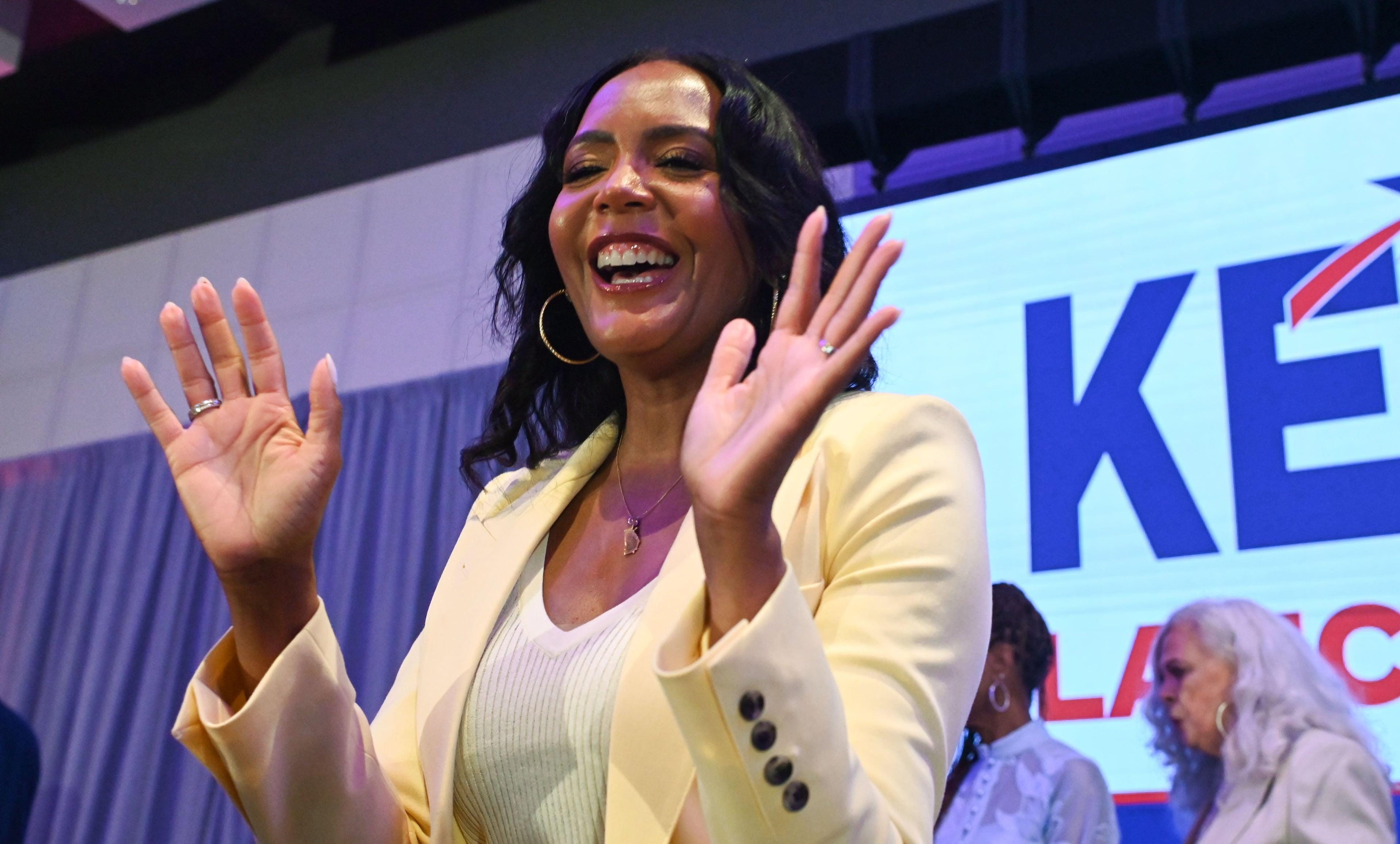
A supporter reacts to Keisha Lance Bottoms’ gubernatorial victory in Atlanta. Photo: Carlos Barría / Reuters.
The legislative results were significant, too. Democrats captured Wisconsin’s legislature and flipped North Carolina’s House, while making gains elsewhere. These aren’t consolation prizes handed out after the important elections are finished. Governors and state legislators make decisions about education, healthcare, budgets, voting laws and all sorts of things that affect ordinary people far more directly than whatever argument is dominating cable television on a particular afternoon.
Republicans have understood the importance of state-level power for years. Democrats sometimes seem to rediscover it every time they lose a statehouse. Tuesday’s results suggest the party may finally be getting a more serious grip on the political machinery outside Washington, and that could matter long after the election-night confetti has been swept up.
But there’s a catch. Winning those offices gives Democrats responsibility for what happens next. They won’t be able to blame every problem on the people who occupied the offices before them forever, although I have considerable confidence that some will try. AP — Election results and historic firsts
They Redrew the Maps. The Voters Had Other Ideas.
This may be my favorite piece of political irony from the entire election. Republicans spent an enormous amount of time and political capital redrawing congressional districts to give themselves an advantage. In some states, they didn’t even wait for the next census. They went back to the drawing board in the middle of the decade, moving voters around like pieces on a chessboard and creating districts that were supposed to protect Republican incumbents.
And then the voters showed up and fucked up the calculations.
In Florida and Texas, the new maps failed to produce many of the Republican gains their architects expected. Democrats also survived in targeted districts in Ohio, Alabama and North Carolina. The boundaries were more favorable to Republicans, but apparently nobody had bothered to inform the people living inside them that they were supposed to cooperate.

Rep. Kathy Castor celebrates her victory in Tampa, Florida. Photo: Douglas R. Clifford / Tampa Bay Times.
Now, this doesn’t mean gerrymandering suddenly stopped working. It remains one of the more effective ways politicians choose their voters instead of allowing voters to choose their politicians. But there are limits to what even the cleverest mapmaker can accomplish when enough people decide they’ve had it with the party the map was designed to protect.
You can carve a congressional district into something resembling a drunken octopus. You can divide neighborhoods, shift boundaries and spend millions defending the resulting monstrosity in court. What you can’t do is guarantee that the people inside those lines will vote the way you want.
Republicans got a rather expensive reminder of that Tuesday night. And Democrats ought to remember it, too, before they start congratulating themselves on being the only people who understand how elections work. Axios — Republican redistricting strategy battered by Democratic gains
Did MAGA Just Get Its Ass Kicked? Absolutely. Is It Dead? Hold the Funeral.
Let’s talk about the elephant in the room, although after Tuesday night the elephant may be hiding under the couch.
The election was a substantial rebuke of Trump and the movement built around him. Exit polling put his approval rating at roughly 38 percent, and about six in ten voters said Trump influenced their House vote. Reuters also reported widespread demand for stronger congressional checks on the president. Those aren’t particularly encouraging numbers for an administration that has spent so much time telling Americans how wonderfully everything is going.
Apparently, a substantial number of voters didn’t get the memo.
But does that mean MAGA is finished? I wouldn’t order the flowers just yet. Political movements have an irritating habit of surviving their own obituaries, and MAGA still has committed supporters, elected officials, organizations and enormous influence inside the Republican Party. Losing an election, even one this substantial, doesn’t automatically make all those people disappear.
What it does is raise a question Republicans can no longer comfortably ignore: can MAGA remain the party’s dominant political identity if its association with Trump becomes a liability in places Republicans previously considered safe?
Some Republicans may decide it’s time to move away from Trump. Others will undoubtedly insist that the problem wasn’t too much Trump, but that their candidates weren’t sufficiently devoted to him. There’s a special kind of political genius involved in driving your car into a telephone pole and deciding the solution is to accelerate harder next time.
We’ll find out which argument gains traction. But if Tuesday was the beginning of MAGA’s decline, the movement’s supporters may be the last people willing to admit it. CBS News — 2026 midterm exit polls
Michigan: Apparently Losing a Primary Doesn’t Mean You Have to Accept It
Michigan supplied its own special contribution to the evening’s festivities. Democrat Haley Stevens lost her Senate primary to Abdul El-Sayed, then endorsed Republican Mike Rogers rather than supporting the man Democratic voters had chosen. Other Democrats also broke ranks, and for a while there were legitimate questions about whether those defections might help Republicans capture the seat.
Think about that for a moment. You run for your party’s nomination, your party’s voters choose somebody else, and your response is to support the candidate from the opposing party. Apparently, party loyalty comes with an expiration date, and losing a primary is enough to make some people check the label.
Then El-Sayed won.

Abdul El-Sayed in Detroit. Photo: Brian Snyder / Reuters.
He also became the first Muslim elected to the United States Senate, an achievement that deserves recognition in its own right. His victory doesn’t make the Democratic Party’s internal disagreements disappear, and the disputes over Israel, ideology and the party’s direction remain very real. But Michigan’s voters made their choice, and they didn’t appear particularly interested in having disappointed primary candidates make it for them.
There’s a lesson here for both parties. Voters sometimes have the nerve to make up their own goddamn minds. Reuters — Abdul El-Sayed’s Michigan Senate victory
What Happens When Republicans Start Looking for the Lifeboats?
Here’s a question I haven’t heard nearly enough people asking: what happens to the Republicans who survived Tuesday?
For the last two years, congressional Republicans have generally had the luxury of letting Trump set the agenda. Executive overreach? Apparently fine when their guy does it. Congressional oversight? Suddenly an unnecessary inconvenience. Presidential accountability? Don’t be ridiculous; there’s a fundraising dinner to attend.
But elections have a remarkable ability to improve a politician’s hearing, and Tuesday was loud enough to wake the dead.
Democrats will control both chambers, but they won’t have enough votes to override a presidential veto on their own. That takes two-thirds of the members voting in each chamber—290 in the House and 67 in the Senate if every seat is filled and everyone votes. Ordinary legislation also generally faces the Senate’s 60-vote threshold for ending debate, so anybody expecting Democrats to wave a magic wand and enact their entire agenda is in for a disappointment.
But here’s where things could get interesting.
What happens if some Republican lawmakers look at Tuesday’s results and decide that kissing Trump’s ass isn’t quite the career strategy it used to be? What if they discover that their constituents have opinions about healthcare, prices, infrastructure and government spending that don’t always line up with the latest instructions from Mar-a-Lago?
I’m not suggesting Republicans are about to form a conga line across the aisle. Plenty still represent constituencies strongly supportive of Trump, and the political pressure inside their party isn’t going away overnight. But the calculations may change for some of them, particularly on legislation with broad public support.
And Democrats ought to be smart enough to recognize the opportunity.
If a Republican wants to help pass something useful, take the goddamn vote. You don’t have to invite him to Thanksgiving dinner, nominate him for sainthood or pretend you’ve suddenly become best friends. You just have to remember that Congress was designed to govern a country, not audition for a spot on the president’s Christmas card list.
Trump can threaten to veto whatever he likes. That’s his constitutional prerogative. But Congress has constitutional powers of its own, and a veto-proof coalition on a particular issue is possible when enough members of both parties decide to exercise them.
Whether that actually happens remains to be seen. But after Tuesday, some Republicans may have a little more incentive to remember who sent them to Washington in the first place. Congressional Research Service — The presidential veto and congressional override process
Democrats, Wipe Those Shit-Eating Grins Off Your Faces for a Minute
Here’s where I’m going to piss off some Democrats. Which is fine. I’ve spent years pissing off Republicans, and I believe in equal opportunity.
Tuesday’s results were remarkable, and nobody should diminish what Democratic candidates, volunteers and campaign workers accomplished. I’ve worked around enough campaigns to know how much effort goes into getting people elected. The volunteers who knocked on doors, made calls, and spent months wondering whether any of it would make a difference have every right to celebrate.
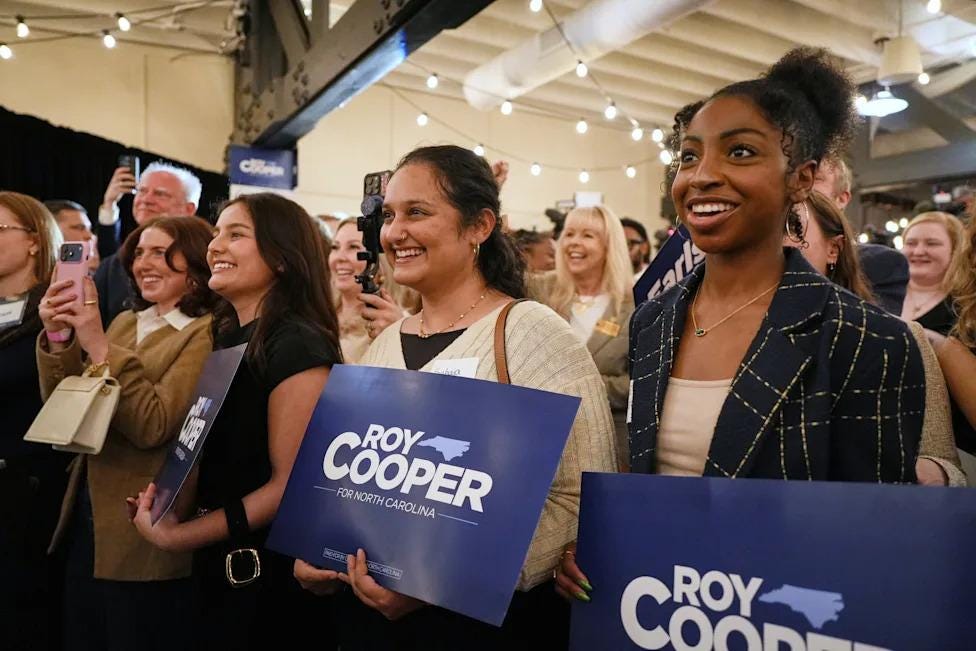
Supporters celebrate Roy Cooper’s Senate victory in Raleigh, North Carolina. Photo: Jonathan Drake / Reuters.
But a victory this large creates a temptation that political parties have never been particularly good at resisting. Everybody starts convincing themselves that the voters have endorsed not just their candidates, but their entire worldview, their preferred policies and whatever brilliant strategy they happened to be selling before Election Day.
And that’s where the bullshit starts.
Voters were angry about the cost of living, the direction of the country, the war with Iran and the behavior of the administration. Some voted Democratic because they genuinely liked Democratic candidates and policies. Others voted Democratic because they’d had enough of Trump and the Republicans. Still others probably had a mixture of reasons that wouldn’t fit neatly into anybody’s favorite political theory.
I’ve been a registered Independent since 1974. I’ve voted for candidates from both parties, and I’ve even worked on a Republican state Senate campaign. So when somebody tells me an election proves Americans have finally embraced one party’s entire philosophy, my first instinct is to check whether that person has been drinking.
My second is to ask what the voters actually said.
Because there’s a hell of a difference between “I want you to govern” and “For the love of God, get those other assholes out of there.”
Tuesday’s results may contain plenty of both. And if Democrats aren’t careful, they’ll hear only the part that flatters them.
Everybody Will Take Credit. That’s When the Real Bullshit Starts.
By lunchtime, I expect we’ll have enough political consultants claiming responsibility for Tuesday’s results to fill a medium-sized football stadium.
Progressives will say the election proves Democrats need to move left. Moderates will say it proves they need to move toward the center. Party leaders will point to their leadership, campaign strategists will point to their strategies, and somebody who spent six months advising candidates to avoid answering questions will send out invoices for another six months of expert guidance.
Everybody gets a trophy, and everybody gets to explain why they were right all along.
The problem is that a Democratic voter in Wisconsin may have had very different priorities from one in Texas. A suburban independent who voted against Trump may have little in common politically with a progressive who enthusiastically supported Abdul El-Sayed. They can vote for the same party without agreeing on what that party should become.
That’s how coalitions work. The hard part comes afterward, when all those people expect something in return.
Democrats have a chance to demonstrate that they understand what voters are struggling with, but they’ll have to do more than point to election returns and congratulate themselves. A landslide is an opportunity to earn trust. It isn’t proof that you’ve already earned it for life.
[LEAVE A COMMENT]
If you voted Democratic Tuesday, was it because you genuinely support the party’s direction, because you wanted to stop Trump and the Republicans, or some combination of the two? I’m particularly interested in hearing from independents and people who don’t ordinarily vote Democratic.
What the Hell Happens When Trump Is Gone?
This is the question that ought to keep Democratic leaders awake at night.
For more than a decade, Trump has dominated American politics. He’s shaped Republican identity, Democratic opposition, campaign messaging, fundraising and approximately seventeen billion arguments at Thanksgiving dinner. He’s been the political figure both parties organize themselves around, whether they love him or can’t stand the sight of him.
But eventually, Trump won’t be the center of American politics anymore. And when that happens, Democrats are going to need something more substantial than a collection of speeches explaining why people shouldn’t vote for him.
What holds their coalition together when its various factions no longer have one common opponent standing across the street screaming at them? What does the party offer working people struggling to pay their bills, younger voters wondering whether they’ll ever afford a house, and independents who are sick of being told they have to choose between two different varieties of bullshit?
And can Democratic leaders explain any of it without sounding like somebody reading the executive summary of a 200-page policy proposal?
Because people don’t wake up in the morning thinking about congressional procedure. They wake up wondering whether they can afford groceries, whether their insurance will cover the doctor, whether their kids will have a better life than they did, and whether the people running the government have the slightest fucking idea what ordinary life costs.
If Democrats want lasting support, they need answers that connect with those realities. They need a reason for people to vote for them when Trump is no longer the primary reason to vote against somebody else.
And they need to start building that case now, while the victory is fresh, rather than waiting until the next election is six weeks away and suddenly discovering that voters have questions.
The Voters Handed Them the Keys. They Didn’t Sign Over the Deed.
Tuesday was a political earthquake. It changed Congress, changed state governments, embarrassed Republican mapmakers and raised serious questions about MAGA’s future. It also gave Democrats an opportunity to demonstrate what they can accomplish with power.

Voters gather outside the Texas Capitol to celebrate the Democratic victories. Photo: Eli Hartman / The Texas Tribune.
But it didn’t settle every argument about what Americans want, and it sure as hell didn’t guarantee that the people who voted Democratic Tuesday will still be voting Democratic two years from now.
Republicans need to figure out whether their loyalty belongs to Trump, their party or the people who elected them. Democrats need to figure out whether they can build something that lasts beyond opposition to Trump. And the rest of us need to keep watching both of them, because politicians have a remarkable talent for hearing whatever they wanted to hear in the first place.
I’m glad voters showed up and made themselves heard. But elections aren’t marriage proposals. They’re job interviews.
Tuesday, Democrats got hired.
Now let’s see whether the bastards can do the job.
THE BULLSHIT DETECTOR
Three claims. Three reality checks. No election results, no political consultants, and no requirement that you keep a straight face.
THE OFFICIAL STINK SCALE
Rating
What it means
💩 A Little Whiff
There’s a little bullshit in the air.
💩💩 Something Smells
This claim isn’t passing the sniff test.
💩💩💩 Steaming Pile
A substantial deposit of bullshit.
💩💩💩💩 Full-Blown Bullshit
Somebody really committed to this nonsense.
💩💩💩💩💩 Weapons-Grade Bullshit
Industrial-strength bullshit. Handle with protective equipment.
1. The Great Wall of China Is Visible From the Moon
CLAIM: The Great Wall is the only human-made structure visible from the Moon.
BULLSHIT: 💩💩💩
STINK SCALE: Steaming Pile
WHY: The Great Wall is far too narrow to distinguish with the naked eye from the Moon. Even from low Earth orbit, seeing it can be difficult. Apparently, somebody decided that building a really long wall automatically made it visible from a quarter-million miles away.
That’s not how eyesight works, genius. Scientific American — Can the Great Wall be seen from space?
2. Antibiotics Cure the Common Cold
CLAIM: Antibiotics will knock out a cold if you take enough of them.
BULLSHIT: 💩💩💩💩
STINK SCALE: Full-Blown Bullshit
WHY: The common cold is caused by viruses. Antibiotics treat bacterial infections. Taking them unnecessarily can cause side effects and contribute to antibiotic resistance. Taking antibiotics for a cold is like calling an electrician because your toilet is clogged.
Wrong tool. Wrong problem. And now everybody’s annoyed. CDC — Antibiotic use
3. Lightning Never Strikes the Same Place Twice
CLAIM: Once lightning hits something, that location is safe from another strike.
BULLSHIT: 💩💩💩
STINK SCALE: Steaming Pile
WHY: Lightning routinely strikes tall structures repeatedly. The Empire State Building is a famous example. Lightning doesn’t keep a checklist of places it’s already visited.
It isn’t delivering fucking mail. National Weather Service — Lightning myths
One Last Question
Did Tuesday mark the beginning of the end for MAGA, the beginning of something better for Democrats, or simply another chapter in America’s habit of firing one bunch of politicians and hoping the replacements aren’t quite as bad?
I’d love to hear what you think. And if you disagree with me, that’s fine, too. Just bring an argument. I’ve already got plenty of bullshit.
Before You Go
If you’ve enjoyed this excursion through America’s latest political nervous breakdown, there’s plenty more where it came from.
Off Script / Blind Spot keeps digging into politics, power and the things people in government would prefer we didn’t notice. Panic Room Sports covers the sporting world with analysis, attitude and the occasional well-earned profanity. And What the Hell? explores the strange, ridiculous, and occasionally unbelievable things human beings have managed to do throughout history.
You can find every edition of every publication in one place at Tom Hicks Media — The Complete Collection. It’s updated daily, so bookmark it and come back whenever you’re in the mood for more.
There’s also the Tom Hicks Media Discord, where the conversation doesn’t have to end when the article does.
And if you feel like tossing a few bucks into the coffee jar to support independent writing, I’d appreciate it. Keeping an eye on these people requires caffeine, and the bastards aren’t getting any less exhausting.
If you know somebody who thinks Tuesday proves their favorite political party has achieved permanent enlightenment, send them this article. They may not appreciate it, but some people need to hear things twice.
#2026Midterms #Election2026 #Democrats #Congress #DonaldTrump #MAGA #PoliticalAnalysis #IndependentVoters #OffScript #TomHicksMedia