

By Tom Hicks | September 29, 2026
Editorial Note
Off Script with Tom Hicks is independent commentary built on reported facts. Justice Samuel Alito has not publicly explained why he stepped aside from Suncor Energy v. County Commissioners of Boulder County. This article does not claim his stock holdings legally required his recusal or caused his decision. The question here is simpler: after the Supreme Court publicly explained why Alito could participate, why did he change course?
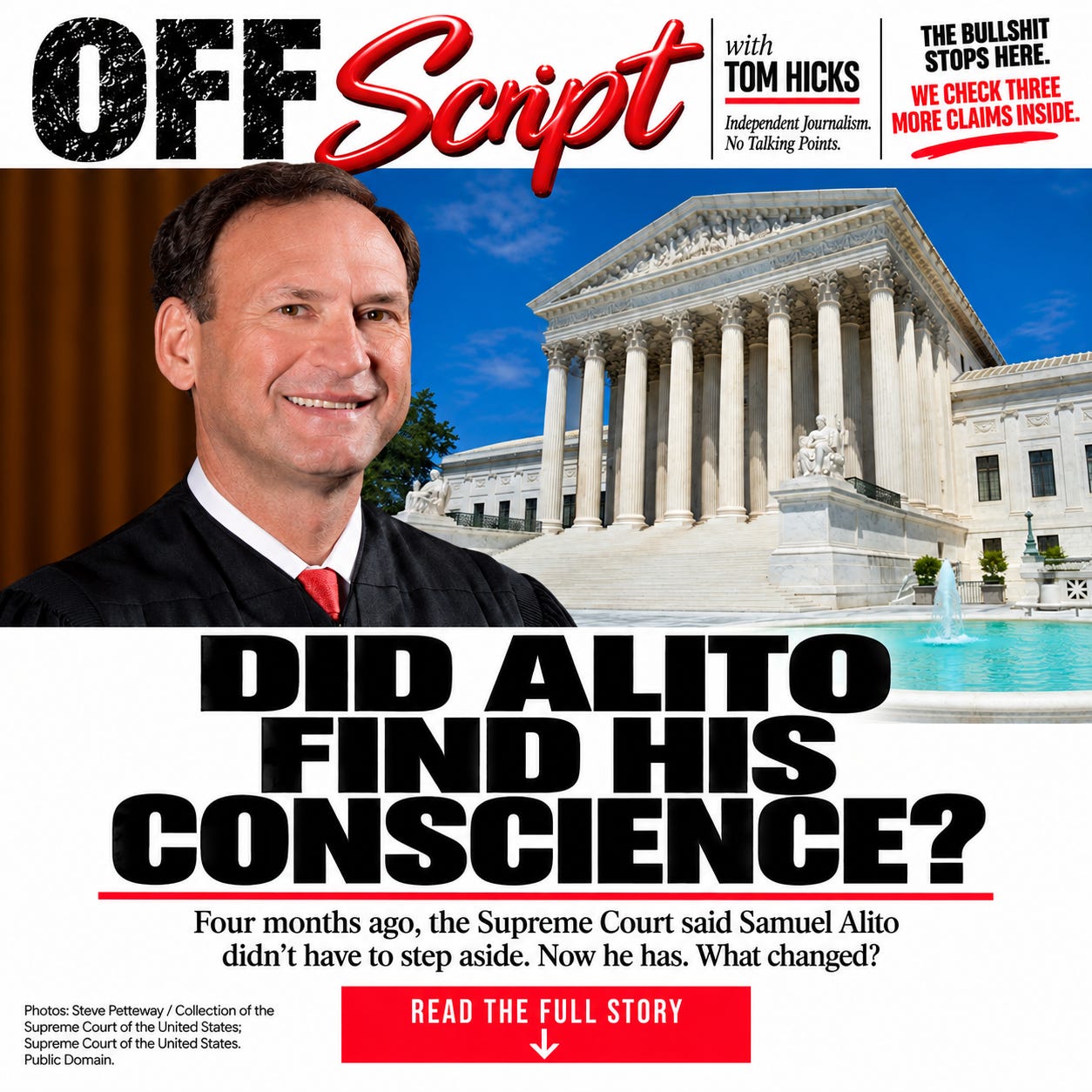
Maybe Samuel Alito woke up Monday morning, looked in the mirror, and discovered an ethics code.
I’m not betting the house on it.
But something considerably less amusing happened September 28. Supreme Court Clerk Scott Harris informed the parties in Suncor Energy v. County Commissioners of Boulder County that Alito “has determined that he will not continue to participate in this case.” That’s it. No explanation accompanied the announcement.
Normally, that wouldn’t be especially remarkable. Supreme Court justices routinely recuse without explaining why, and they aren’t required to provide a reason. Bloomberg Law examined more than 750 recusals over several years and found that virtually all came without an explanation.
This one has a wrinkle big enough to drive an oil tanker through.
The Supreme Court had already explained why Alito didn’t need to recuse.
Four Months Ago, Everything Was Fine
The Court granted review in Suncor on February 23. Its docket also shows something important that got muddled in the earlier draft: the justices themselves added a second question for argument, asking whether the Supreme Court has statutory and Article III jurisdiction to hear the case. Oral argument is scheduled for October 5.
Alito was participating.
That drew attention because his financial disclosures showed holdings in ConocoPhillips and Phillips 66. Neither company is Suncor. Neither is ExxonMobil. Those are the oil companies actually before the Court.
But ConocoPhillips and Phillips 66 aren’t innocent bystanders to climate litigation either.
Their own SEC filings say so.
ConocoPhillips told investors in its 2025 annual report that cities, counties, governments and other entities have filed climate lawsuits against oil and gas companies including ConocoPhillips since 2017. It warned that the company expects substantial legal costs defending those cases and similar ones in the future.
Phillips 66’s filing is equally plain. It says cities, counties, and other governmental entities have sued energy companies including Phillips 66, seeking damages associated with climate change. It also warns that such litigation could create legal costs and potentially hurt the company’s business and financial condition.
Those aren’t accusations from environmental activists.
Those are companies talking to their investors.
That distinction matters.
What the Court Said in May
Questions about Alito’s participation were already being raised by May, and the Supreme Court didn’t hide behind its usual silence.
A Court spokesperson told E&E News that Alito did not own stock in either party to the case and therefore did not have a financial interest in either party. The spokesperson said Alito had consulted the Court’s legal office and had been advised that recusal “is not required.”
The Court also addressed something particularly odd. Alito had stayed out when an earlier version of the Boulder litigation reached the Supreme Court in 2023. According to the Court’s May explanation, that earlier recusal had been inadvertent.
So let’s get the sequence straight.
In 2023, Alito didn’t participate. The Court later said that was inadvertent. In February 2026, he participated when the Court agreed to hear the new case. In May, after questions were raised, the Supreme Court publicly said he’d consulted its lawyers and didn’t have to recuse.
Now he’s recused.
That doesn’t prove wrongdoing.
It does justify one pretty obvious question.
What the hell changed?
Like journalism that brings receipts before throwing punches?
Subscribe to Off Script with Tom Hicks.
It’s free, or help fund the research and tools we use to report this every day.
Here’s What the Law Actually Says
This is where we need to be careful, because “Alito owns oil stocks” makes a terrific social-media post and a lousy legal analysis.
Federal recusal law, 28 U.S.C. §455, says a justice must disqualify himself when his impartiality might reasonably be questioned. It also addresses financial interests in a party or the subject matter of a case, along with other interests that could be substantially affected by the outcome.
That does not automatically mean Alito’s holdings in ConocoPhillips and Phillips 66 required him to leave Suncor.
The companies aren’t parties to this case. We also don’t have evidence establishing that whatever the Supreme Court ultimately decides would substantially affect the value of Alito’s holdings. If I told you the statute proves a financial conflict, I’d be doing exactly the kind of shit I spend the Bullshit Detector complaining about.
It doesn’t.
But the law also shows why asking about the holdings wasn’t crazy. The recusal statute isn’t written as “check the names on the lawsuit and stop reading.” It contemplates financial interests beyond simple ownership of stock in a named party when an interest could be substantially affected by the outcome.
Whether Alito’s investments crossed that line is precisely what we don’t know.
In May, the Court said no recusal was required.
On Monday, Alito recused anyway.
And Then the Companies Made the Question Harder to Ignore
There’s another reason the question didn’t disappear after May.
The financial connection became easier to describe without waving your arms around and yelling BIG OIL.
ConocoPhillips’ own annual report says climate litigation can increase its costs and adversely affect its business. Phillips 66 says it faces climate lawsuits too and warns investors about litigation risk.
That doesn’t tell us how Alito should have ruled on recusal. It does tell us that climate litigation isn’t some abstract subject with no connection to the companies in his portfolio.
And here’s the line I don’t want us crossing: we have no evidence that Alito stayed in the case to protect his investments. We don’t know how he would have voted. We don’t know whether his recusal had anything to do with the stocks at all.
In fact, his absence could complicate matters for the oil companies before the Court.
With Alito out, eight justices remain. If they divide 4-4, there is no five-justice Supreme Court majority establishing a nationwide precedent. The lower-court result would stand.
So if you’re looking for me to tell you Alito got caught protecting his portfolio and bailed out, you’re reading the wrong publication.
I can’t prove that.
Neither can anybody else I’ve seen.
What I can prove is that the Court gave one answer in May and Alito has now made a different decision.
That’s enough of a story without making shit up.
The Silence Isn’t Unusual. This Situation Is.
This distinction matters.
Justices usually don’t explain recusals. Bloomberg Law found that virtually all of more than 750 recusals it examined came without reasons. So Alito’s one-sentence exit isn’t some shocking breach of Supreme Court procedure.
If this were the entire story, I’d have considerably less to write about.
But the Court didn’t follow its normal practice in May.
It talked.
It explained that Alito didn’t own stock in the parties. It said he had consulted the Court’s legal office. It told the public he’d been advised that recusal wasn’t required. It even explained away the 2023 nonparticipation as inadvertent.
Once you’ve gone that far, silence four months later becomes harder to shrug off.
The Supreme Court was willing to tell us why Alito could stay.
Why can’t it tell us why he left?
The Case Is Bigger Than One Justice’s Stock Portfolio
The underlying case deserves better than becoming scenery in another Supreme Court ethics fight.
Boulder County and the city of Boulder sued Suncor and ExxonMobil over alleged climate-related harms, using Colorado state law. The oil companies argue that state-law claims seeking relief for injuries allegedly caused by interstate and international greenhouse-gas emissions are precluded by federal law.
That’s the question the companies brought to the Supreme Court.
Then the justices added one of their own: whether the Court has statutory and constitutional jurisdiction to hear the case at all.
The answer could matter beyond Colorado because similar climate cases are being fought around the country. ConocoPhillips and Phillips 66 themselves acknowledge in federal filings that they are defendants in climate litigation.
That still doesn’t tell us what effect Suncor would have on either company’s stock price. Anyone pretending otherwise is getting ahead of the evidence.
It does tell us why people noticed Alito’s investments.
There’s a legitimate question here.
There just isn’t yet a proven scandal.
Alito May Have Done Exactly the Right Thing
And here’s the funny part.
Alito may deserve credit for Monday’s decision.
If he reconsidered and decided there was enough of an appearance problem to step aside, good. If the legal office reconsidered its earlier advice, fine. If some completely different conflict emerged that we know nothing about, that’s possible too.
Judges should be allowed to reconsider things without having their change of mind treated as an admission of guilt.
Hell, I’d like to encourage the practice.
The problem is that we’re filling in blanks because the Court left one sitting there.
Four months ago, it chose to explain Alito’s participation. That explanation gave the public a clear answer: he didn’t own stock in the parties, he consulted the legal office, and recusal wasn’t required.
Now he’s gone.
Maybe there’s an excellent explanation.
I’d genuinely like to hear it.
Trust Us Is Still a Shitty Ethics Policy
The Supreme Court’s recusal system is unusual because each justice essentially makes the final call about his or her own participation. There isn’t a higher court waiting upstairs to review Samuel Alito’s decision about Samuel Alito.
That’s one reason transparency matters.
It doesn’t mean every justice owes us a detailed explanation every time a distant relative works for a law firm or an investment creates a technical conflict. There are legitimate privacy concerns, and Justice Amy Coney Barrett has publicly explained why providing reasons for every recusal can create problems of its own.
Fair enough, but this isn’t every recusal.
The Court already opened the door. It told us why Alito could participate. Now he’s decided not to participate, days before one of the first arguments of the new term.
Maybe Samuel Alito finally grew a conscience, or simply took another look at the law, or, just maybe, there’s a perfectly boring explanation sitting somewhere inside One First Street.
I don’t know, and that’s the point.
The Supreme Court went out of its way to explain the first decision. Now, it can explain the second one.
THE BULLSHIT DETECTOR
1. Roy Cooper “let 16,000 untested rape kits sit on the shelf.”
Claim: A Republican super PAC ad attacking North Carolina Senate candidate Roy Cooper says that while Cooper was state attorney general, he “let 16,000 untested rape kits sit on the shelf.”
Bullshit Level: 💩💩💩💩
Why: North Carolina really did have a massive backlog of untested rape kits. The misleading part is assigning all 16,000 directly to Cooper. FactCheck.org found that the kits were held by hundreds of local law-enforcement agencies and had not been submitted to the state crime laboratory. The statewide inventory that exposed the scale of the backlog came later. There are fair questions about what state leaders did or didn’t do about the problem. Pretending Cooper personally had 16,000 kits gathering dust in his office isn’t one of them.
2. Ken Paxton said the Uvalde massacre was part of God’s “plan.”
Claim: Democratic campaign material circulated a short clip of Ken Paxton saying after the Uvalde school massacre that “there’s always a plan. I believe God always has a plan.”
Bullshit Level: 💩💩
Why: Paxton said it. The problem is the clip removes the rest of an answer in which he was responding to a pastor asking what comfort he could offer grieving families, described the killings as senseless, and talked about people holding onto their faith.
You can hear the full answer and still think it was tone-deaf as hell. That’s an opinion voters can reach without help from the editing room.
If the whole quote is bad enough, show the whole quote.
3. Democratic public-option proposals would close dozens of rural hospitals.
Claim: Republican campaign ads have warned that Democratic candidates’ support for a government-backed health-insurance option could force dozens of rural hospitals to close.
Bullshit Level: 💩💩💩
Why: The hospital-closure numbers trace back to modeling based on a particular public-option design and assumptions about reimbursement rates. FactCheck.org found that the candidates being attacked had not necessarily proposed the plan used to generate those projections.
There is a legitimate argument about what lower reimbursement rates could do to financially fragile rural hospitals. Have that argument.
Taking the ugliest projection from one model and stapling it onto candidates who haven’t proposed the underlying plan is campaign advertising doing what campaign advertising does best: scaring the piss out of you first and explaining the fine print never.
Elsewhere at Tom Hicks Media
Tom’s Number Ones
Six charts. One date. Music history without pretending every old record was a masterpiece.
Panic Room Sports
Smart coverage with attitude. Everyone reacts. We’ll check the tape first.
Lotus Purrspective
Life, humans, and assorted nonsense judged by the only member of the household clearly qualified to do it.
Rabbit Ears Classic TV
The shows you remember, the stories behind them and the things you probably missed the first time.
The Backlot Ghost
Movies don’t die when the credits roll. Sometimes that’s when the interesting stuff starts.
Put Your Bullshit Detector to Work
If you’d like something slightly more portable than today’s three examples, The Bullshit Detector is available from the Tom Hicks Media Store for $4.95.
Subscribers get it free.
Buy Me a Cup of Tea
Off Script is free to read. If independent reporting, research, and the occasional properly aimed profanity are worth keeping around, you can help fund the work with a cup of tea.
One Last Thing
A justice changing his mind isn’t the scandal.
A Court that asks for public trust while treating the reason for that change like none of our damn business is a much more interesting problem.
One Question Before You Go
If the Supreme Court publicly explains why a justice doesn’t need to recuse, should it explain when he later does?
#SCOTUS #SamuelAlito #JudicialEthics #ClimateLitigation #SupremeCourt