

Tom Hicks | November 3, 2026
Well, here we are. Election Day.
That wonderful American tradition where millions of people cast their ballots and then spend the evening watching television personalities point at giant electronic maps as though they’re trying to locate a missing nuclear submarine.
Some of us will vote enthusiastically. Some will hold our noses. And some will stare at the ballot wondering how a country with hundreds of millions of people keeps coming up with some of these candidates.
I’ve been a registered Independent since 1974. I’ve voted for both parties, worked on a Republican state Senate campaign, and spent enough time around politics to know that the bullshit doesn’t come with an exclusive party membership.
But this year, I’ve been paying particular attention to the lawyers.
And holy shit, have they been busy.
While the rest of us have been getting ready to vote, the Justice Department has been fighting over thousands of California ballots, an unusual Senate race in Alaska, and what federal officials can demand of the people responsible for counting votes.
On Monday, the Supreme Court rejected the Trump administration’s emergency request to set aside more than 20,000 California ballots. On Sunday, a federal judge dismissed the administration’s attempt to delay certification of Alaska’s Senate race under specified circumstances. And on Friday, another federal judge issued an emergency order restricting federal threats and demands directed at election workers. CBS News — Supreme Court ruling · Alaska Public Media — Alaska ruling · CNN — Election-worker order
All of that before Election Day.
I was going to suggest waiting until somebody actually lost before fighting over the results, but apparently that’s hopelessly old-fashioned.
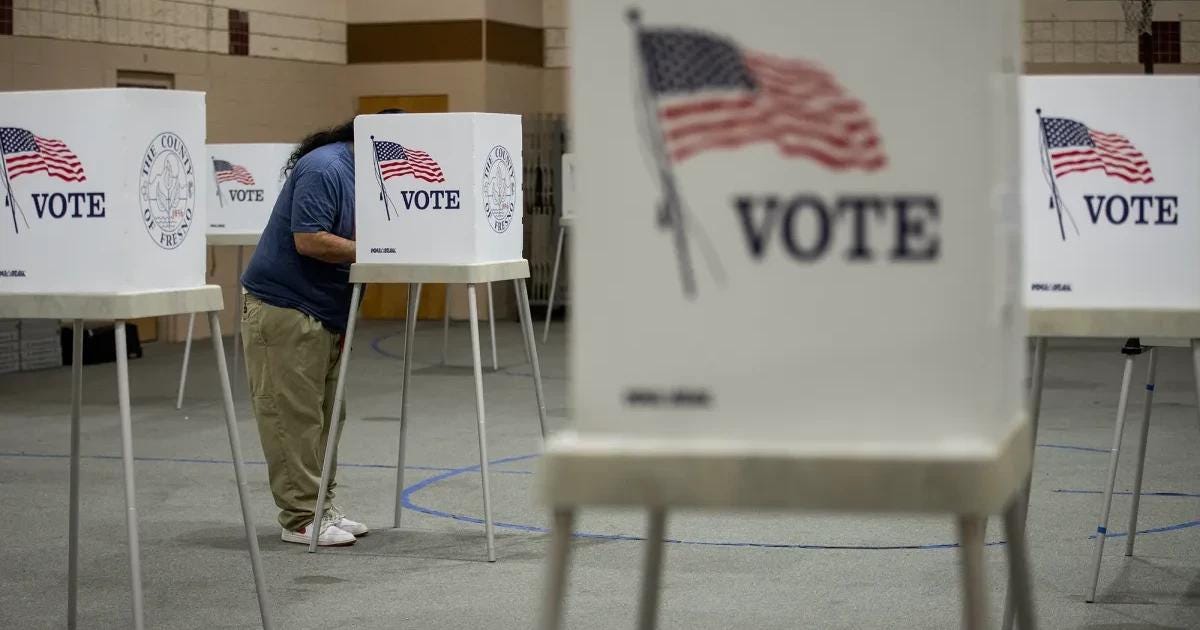
Voters are doing their part. The courts are already sorting through disputes about how some ballots should be handled.
California: Twenty Thousand Voters and One Very Big Argument
Let’s start with Monday’s news, because this is where things get particularly interesting.
The Justice Department asked the Supreme Court to intervene in California’s handling of mail ballots associated with more than 20,000 registered voters whose citizenship the federal government questions.
The administration wanted the ballots separated while eligibility was examined. California disputed the reliability of the government’s information and warned that the requested intervention could prevent legitimate votes from being counted. Lower courts rejected the emergency relief. Reuters — November 2, 2026
Now, before somebody warms up the keyboard, let’s establish something.
Noncitizens generally cannot vote in federal elections. It’s illegal. If somebody knowingly does it, investigate, prove the violation, and apply the law.
Fine by me.
But suspecting somebody might be ineligible and proving that person is ineligible are two entirely different things.
I spent about twenty years working in criminal defense. One thing you learn rather quickly is that an allegation doesn’t magically become evidence because somebody from the government says it with sufficient confidence.
And there’s another problem.
Once ballots have been processed and separated from identifying information to preserve the secret ballot, how exactly do you retrieve one particular person’s vote?
Do we dump several million ballots on the floor and start sorting through them like somebody looking for a missing CVS receipt?
The government argued that separating ballots immediately was necessary because they might be impossible to retrieve later. California said the government’s underlying data might include eligible citizens and that the proposed intervention could cause serious harm. Reuters — California ballot dispute
Federal Judge David Carter rejected the emergency request, and the Ninth Circuit declined to grant the government the relief it sought. Reuters — Court proceedings
So on Monday, the Justice Department went to the Supreme Court.
And the Supreme Court said no.
In a one-line, unsigned order, the justices denied the administration’s emergency application. No dissents were publicly noted, and the Court offered no explanation for its decision. That means California can continue handling the disputed ballots under its existing procedures while the underlying litigation proceeds. CBS News — Supreme Court rejects emergency request · Associated Press — Supreme Court ruling
Now, let’s be precise about what happened, because this is where political commentary tends to go flying off the rails.
The Supreme Court did not conduct a trial, determine the citizenship of 20,000 people, or issue a final judgment on every allegation in the case. It denied the emergency relief the administration wanted before Election Day.
That’s still a consequential decision. The government asked the nation’s highest court to intervene immediately in how California handles those ballots, and the justices declined.
And Monday brought another development. A federal judge in Washington separately ruled that the administration’s last-minute demands directed at California election officials violated the Constitution’s Elections Clause. That ruling addresses federal authority over election administration, rather than the Supreme Court’s narrower decision on emergency ballot relief.
Two separate court decisions, two separate legal questions, and neither one should be confused with a final determination that every disputed voter is eligible or ineligible.
The distinction matters.
You don’t get to announce that the Supreme Court vindicated your position simply because you filed an emergency application. And once the Court denies that application, you don’t get to pretend the denial never happened.
Alaska Has Two Dan Sullivans. Because Apparently One Wasn’t Confusing Enough.
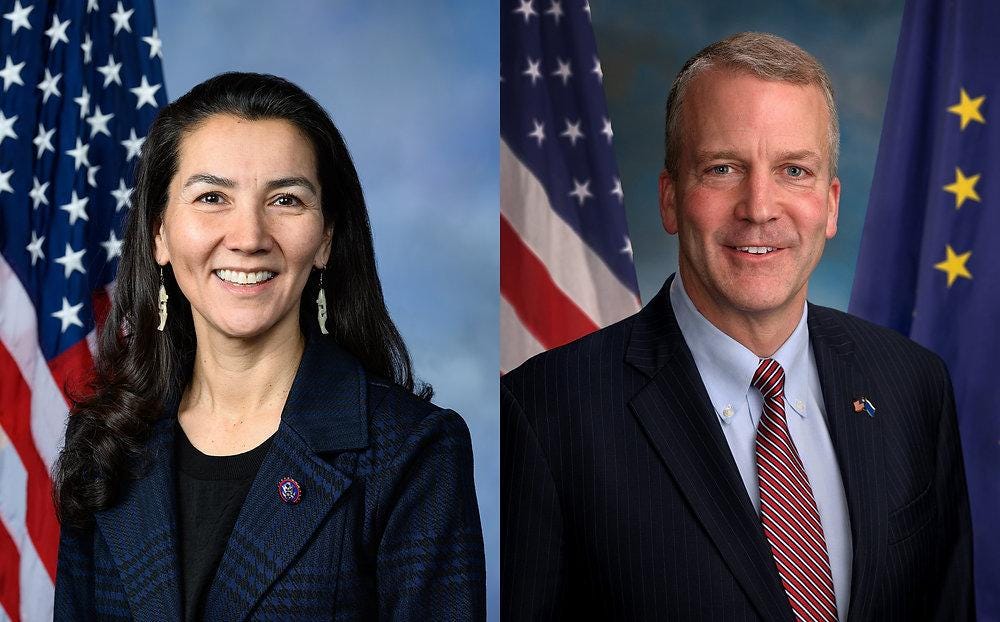
Alaska’s Senate contest has produced a separate fight over an additional candidate with the same ballot name as the incumbent.
You couldn’t invent this next one without somebody accusing you of writing a particularly ridiculous political sitcom.
Alaska’s Senate race includes Republican incumbent Dan Sullivan, Democratic challenger Mary Peltola, and another candidate named Daniel J. Sullivan.
Two Sullivans.
Apparently somebody looked at an already complicated election and decided it needed a little more seasoning.
The Justice Department alleges that the second Sullivan’s candidacy was intended to confuse voters and potentially divert votes from the incumbent. Federal prosecutors are investigating the circumstances. Nobody in the race had been charged with a crime in the latest reporting I reviewed. Alaska Public Media — November 1
If somebody deliberately organized a scheme to deceive voters, investigate it. That’s a legitimate question.
But the administration also went to federal court seeking to block certification if the incumbent lost under circumstances connected to the disputed candidacy.
On Sunday, Judge Sharon Gleason dismissed the lawsuit because the government hadn’t established the necessary standing to obtain the requested remedy.
She also identified a rather substantial practical problem: the government hadn’t explained how it could isolate the second Sullivan’s ballots and investigate them while preserving voter secrecy. Alaska Public Media — Judge Gleason’s ruling
That’s not a minor technicality.
The secret ballot is one of those things Americans have grown rather fond of. We generally prefer voting without having somebody from the government peer over our shoulder and ask us to explain ourselves.
The judge’s dismissal doesn’t establish that the allegations are false. It means the government hadn’t demonstrated that the court could lawfully provide the remedy it requested.
That’s a distinction worth making.
Because one of the things that drives me absolutely nuts about political coverage is the way every courtroom development becomes either complete vindication or the end of civilization.
Sometimes a judge is simply saying, “You haven’t established that I have the authority to give you what you’re asking for.”
A little less exciting than the television version, but considerably more accurate.
If you enjoy Off Script, subscribe and pull up a chair. We spend a lot of time sorting through political claims, legal arguments, and the occasional spectacular pile of bullshit. The conversation is better when more people join it.
When Counting Votes Requires a Lawyer
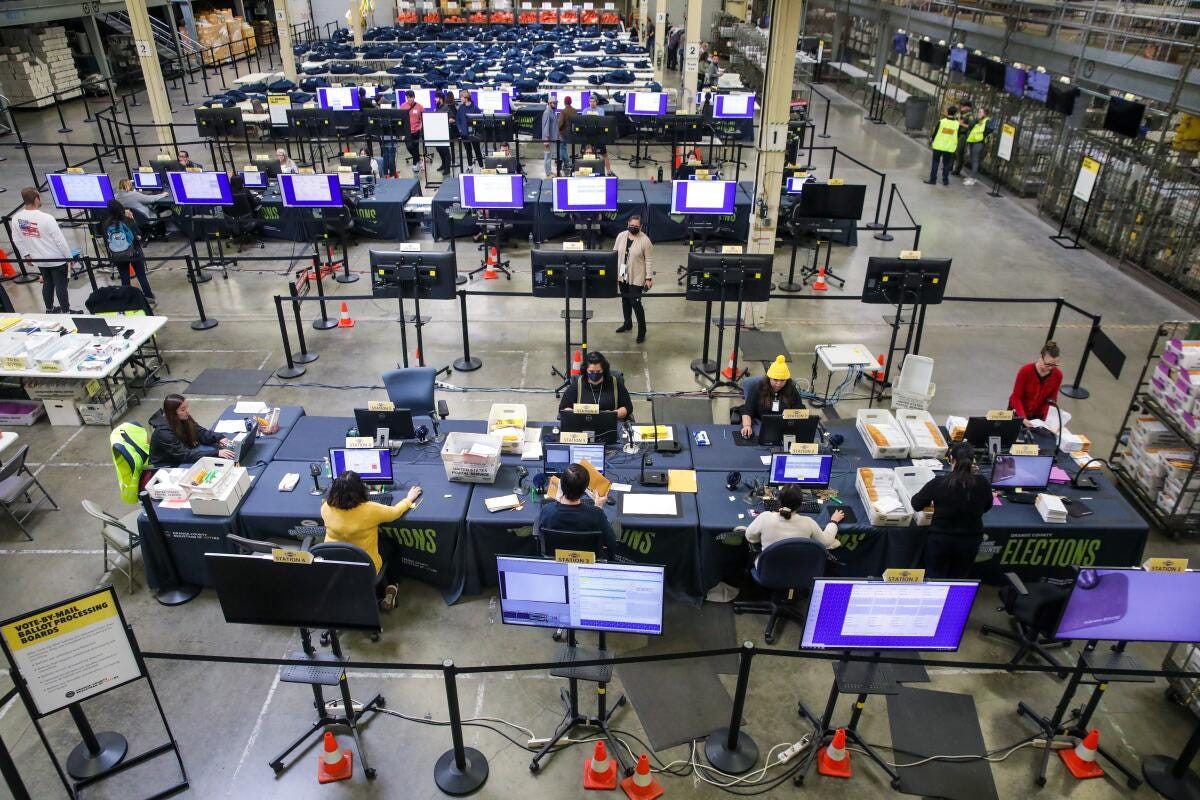
Election workers processing ballots in California, where federal demands and threats have become the subject of emergency litigation.
Here’s the development that really made me sit up.
On Friday, federal Judge Trina Thompson issued a temporary restraining order prohibiting the Justice Department and Department of Homeland Security from using certain threats and demands to pressure election officials into changing how they process ballots.
The judge found that the plaintiffs had shown the government’s conduct likely violated federal protections against voter intimidation. The administration appealed Saturday. The temporary order is scheduled to remain in effect through November 16 unless modified. Federal court order — October 30 · Notice of appeal — October 31
Think about that.
We have people whose job is to count votes, and a federal court has had to issue an emergency order addressing threats against them for carrying out their lawful duties.
These aren’t people who signed up to participate in a constitutional showdown.
They’re the people dealing with ballot envelopes, voter signatures, malfunctioning machines, and the occasional citizen who apparently believes yelling at a poll worker will make the line move faster.
Most of them would probably appreciate being allowed to do their jobs without wondering whether somebody in Washington is preparing a criminal referral.
The administration maintains that its actions are intended to enforce election laws. The unions and civil rights groups challenging those actions argue that the pressure threatens lawful election administration.
The order doesn’t prevent legitimate investigations or excuse actual misconduct. It restricts specified coercive demands and threats based solely on federal allegations that registered voters are ineligible. CNN — Emergency election-worker order
And the concerns aren’t theoretical.
California election officials have described the effect of federal threats on their staffs, including anxiety, disrupted preparations, and the need for additional safety planning. CNN — Election administration dispute
Imagine trying to run an election while wondering whether somebody with a federal badge is going to show up and demand that you stop doing your job.
That’s a hell of a working environment.
And Then There’s Mike Johnson
Now we get to something I’ve been wondering about.
What happens if Democrats win enough House seats to change control of Congress, but some of those races are disputed?
Can Mike Johnson simply refuse to swear in the winners?
The short answer is that the Speaker doesn’t possess an unlimited personal veto over elected members.
Article I, Section 5 of the Constitution gives each chamber authority to judge the elections, returns, and qualifications of its members. There are procedures for contested elections, and the incoming House elects its own Speaker.
Johnson cannot simply announce that he doesn’t like a particular result and therefore the winner doesn’t get a seat.
He’s Speaker of the House, not the guy who owns the building.
But here’s where things get complicated.
If control of the chamber comes down to a handful of contested seats, disputes over certification, credentials, and the House’s constitutional authority could become enormously consequential.
A state certification isn’t the same thing as a television projection. A contested election isn’t automatically a stolen election. And the Speaker’s responsibilities aren’t the same thing as the House’s constitutional power to judge membership disputes.
It’s the kind of subject that makes people’s eyes glaze over until suddenly their entire government is arguing about it.
Then everybody becomes a constitutional scholar overnight.
Usually on Facebook.
There’s a Difference Between a Recount and a Temper Tantrum
Before anybody gets the wrong idea, I have no objection to legitimate election challenges.
If a race is close enough to trigger a recount, count the damn votes again.
If somebody has credible evidence of fraud, investigate it.
If an election official violated the law, deal with it.
That’s why we have courts, election statutes, recount procedures, and certification requirements.
But filing a lawsuit doesn’t prove the allegations in it. And a politician declaring that an election was stolen isn’t evidence that it was.
I’ve spent enough time around courtrooms to know that anybody can make an accusation.
Proving it is where things get interesting.
And that standard applies regardless of which party is complaining.
I don’t care whether the candidate is a Republican, Democrat, Independent, or somebody running on a platform of replacing Congress with twelve reasonably intelligent golden retrievers.
Show me the evidence.
If the facts support the claim, follow them. If they don’t, stop pretending that repeating the accusation more loudly somehow makes it true.
Tonight, Everybody Becomes an Election Expert
You know what’s coming.
The networks will begin their wall-to-wall coverage. Somebody will announce that a county in Pennsylvania has suddenly become the center of the known universe. Somebody else will be waving at a touchscreen map as though they’re directing aircraft onto a carrier deck.
And at some point, a television analyst will explain that we won’t know who won until we know who won.
Thank you, professor.
But there is something important underneath all that theater.
Network projections aren’t official results. Some close races take days to count. Recounts can take longer. Legal challenges have procedures, deadlines, and standards of proof.
None of that automatically means something suspicious is happening.
It means elections involve millions of people, thousands of election officials, and an enormous amount of paperwork.
And yes, sometimes mistakes.
The next Congress convenes January 3, 2027. Between now and then, close races could produce disputes over counting, certification, and congressional membership.
That’s why the legal decisions coming down right now deserve attention.
Knowing what a court actually ordered is considerably more useful than listening to somebody on television scream about what they wish it had ordered.
So Where Does That Leave Us?
I’ll tell you where it leaves me.
Watching the courts.
Watching the people responsible for counting the ballots.
And watching very carefully whenever somebody announces that a legal filing, an investigation, or an allegation somehow proves an election result is illegitimate.
I’ve been around long enough to remember when Election Night meant waiting for results, complaining about the television coverage, and eventually going to bed.
Now we apparently need a legal correspondent, a constitutional scholar, and somebody who can explain what the hell an emergency stay is before we’ve even finished dinner.
I don’t expect everybody to agree about these lawsuits.
But I do think we ought to be able to agree on something fairly basic.
An allegation is not proof. A lawsuit is not a verdict. And the rules governing elections don’t become optional because somebody dislikes the outcome.
Americans are voting today.
The courts have already been busy.
And depending on what happens tonight, they may have considerably more work ahead of them.
Personally, I’d prefer to let the voters finish speaking before anybody starts telling them what they meant.
THE BULLSHIT DETECTOR
Three claims that have absolutely nothing to do with today’s election. Because bullshit is an equal-opportunity employer.
THE OFFICIAL STINK SCALE
💩 — A Little Whiff
💩💩 — Something Smells
💩💩💩 — Steaming Pile
💩💩💩💩 — Full-Blown Bullshit
💩💩💩💩💩 — Weapons-Grade Bullshit
1. Bulls See Red and Lose Their Minds
CLAIM: Bulls become enraged by the color red.
BULLSHIT: 💩💩💩
STINK SCALE: Steaming Pile — 3/5
WHY: Bulls respond primarily to the movement of a matador’s cape, not its red color. Cattle have different color vision from humans, and red doesn’t possess some magical bull-enraging property.
The bull isn’t offended by the color scheme. He’s probably more concerned about the idiot waving fabric in his face.
2. Blind as a Bat
CLAIM: Bats are blind.
BULLSHIT: 💩💩💩💩💩
STINK SCALE: Weapons-Grade Bullshit — 5/5
WHY: Bats can see. Many species also use echolocation to navigate and hunt, but their eyes aren’t decorative. Some fruit bats have excellent vision.
Which means a bat flying around your attic may have a better idea where he’s going than you do trying to find the light switch.
3. Stop Cracking Those Knuckles!
CLAIM: Cracking your knuckles causes arthritis.
BULLSHIT: 💩💩
STINK SCALE: Something Smells — 2/5
WHY: Research hasn’t established that habitual knuckle cracking causes arthritis. The popping sound is associated with changes in gas-filled cavities within joint fluid, rather than bones grinding together.
It might annoy everybody within earshot, but that’s a different medical condition. Usually affecting the people who have to listen to you.
Elsewhere Around Tom Hicks Media
If today’s election leaves you wondering what happens behind the political curtain, Blind Spot digs deeper into the machinery of elections, government, and power.
If you’d rather spend a few minutes with someone who considers humans an endlessly disappointing species, Lotus Purrspective offers daily observations from the world’s wisest and most judgmental feline.
Meanwhile, over at Just Lucy, our resident four-and-a-half-year-old has decided there’s something seriously wrong with the name her parents gave her. Naturally, she has some thoughts about fixing it. Meet Lucy in her debut adventure, I Want Another Name. Fair warning: reasoning with a four-year-old is rarely a winning strategy.
Everything lives under one roof at Tom Hicks Media — The Complete Collection. Every edition of every publication is there, and the collection is updated daily. Bookmark it. There’s always something new to find.
You can also join the conversation on Tom Hicks Media’s Discord. Bring an opinion. A sense of humor wouldn’t hurt.
One Last Question
Suppose your preferred candidate loses a close election and immediately claims fraud. What would you need to see before believing it?
An investigation? Actual evidence presented in court? A judicial finding?
Or would the candidate’s word be enough?
I’m genuinely interested in where people draw that line.
#ElectionDay2026 #Midterms2026 #ElectionLaw #VotingRights #SupremeCourt #DOJ #Congress #PoliticalAccountability #BullshitDetector #OffScript #TomHicksMedia
All I want from this election is that registered voters get to cast their votes safely and unimpeded. The poll workers get to do their long and difficult jobs without interference. The totals are tabulated free of electronic fuckery. The winners make their acceptance speeches and the losers gracefully give their concession speeches and thanks to their supporters.
Given that my state of NC set the record in 2024 for a disputed count in the NC Supreme Court, I’m not overly confident that this election will be different. There are also a lot of unsavory characters that seem hellbent on causing disruption nationally. Ridiculous sums of money have spent for their desired outcome.