

EDITORIAL NOTE: This article is based on reporting by Reuters, Stateline and The Associated Press, supplemented by federal law, court rulings and public statements from election officials and the Trump administration. Where officials are preparing for possible events that have not occurred, those scenarios are identified as preparations, not predictions. That distinction matters.
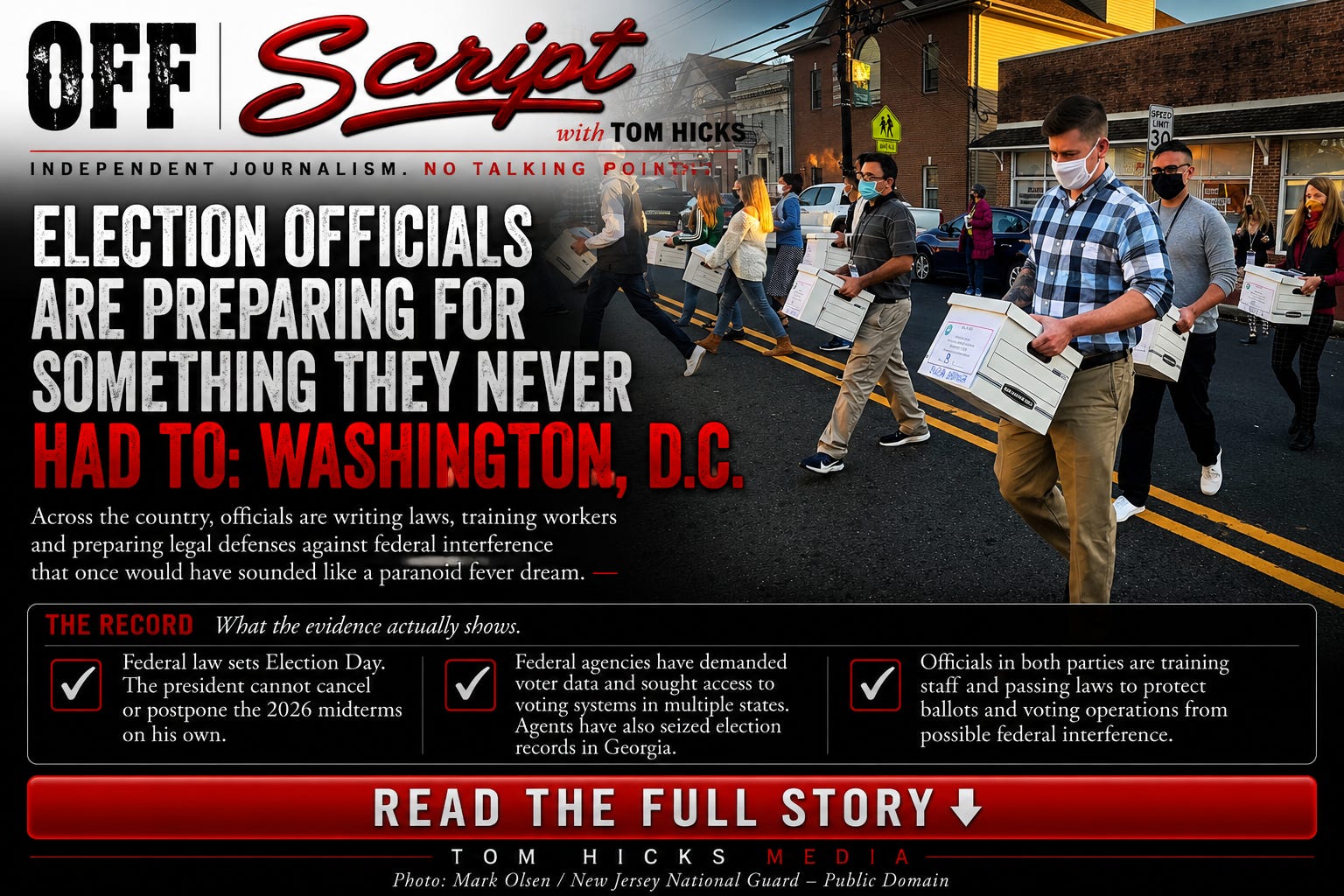
There was a time when election officials worried about malfunctioning machines, long lines, bad weather, and whether enough poll workers would show up. Washington was more likely to be the place they called for help than something they needed a contingency plan for. Election security meant protecting the machinery of democracy from hackers, fraud, threats and human error.
Now some election officials are preparing for Washington itself.
Across the country, officials are discussing what to do if federal agents arrive unannounced, how to recognize a legitimate federal subpoena, who gets called if someone demands access to voting equipment, and how to respond if federal law enforcement attempts to seize ballots or other election material. In Colorado alone, Reuters found that at least 63 county clerks were consulting through their statewide association about possible federal subpoenas and agents at polling places, while officials from more than 40 South Carolina counties planned training around similar scenarios. That sentence would have sounded insane a few years ago. Now it describes preparation for the November election. Sources: Reuters | Stateline
SUPPORT INDEPENDENT JOURNALISM
Your subscription helps fund reporting, research, publishing, new features, and the continued growth of every Tom Hicks Media publication.
Washington Used to Be the Backup
The easiest way to dismiss this story is to call it Democratic hysteria. That gets harder when you meet Carly Koppes, the Republican clerk and recorder in conservative Weld County, Colorado. Koppes has trained her staff to recognize FBI credentials, understand what a legitimate federal subpoena looks like, and know whom to call if federal agents arrive without warning. She has also discussed with the county attorney what her office should do if federal law enforcement tries to seize ballots, machines or other voting materials. Source: Reuters
Koppes is not alone, and this is not a room full of activists inventing scenarios about what Donald Trump might theoretically do. Reuters interviewed election administrators from both parties and independents who described changing how they prepare for November because of federal activity they have already seen. Nine administrators interviewed by Reuters—including five Republicans—said they feared the administration’s actions could lead to intensified federal scrutiny of election results this fall. Source: Reuters
Their concern did not appear out of nowhere. Reuters documented federal efforts involving election systems or records in at least eight states, including demands for voter information, attempts to gain access to voting equipment and renewed investigations into allegations surrounding elections whose fraud claims had already been rejected by courts or bipartisan reviews. Federal agents also seized ballots and other election records from Fulton County, Georgia, in January as part of an investigation reviving claims about the 2020 election. Source: Reuters
The administration says its purpose is election integrity. The White House told Reuters that Trump wants accurate voter rolls and enforcement against illegal voting, while the Department of Homeland Security said its personnel are protecting election infrastructure and investigating fraud where it exists. Those are legitimate government responsibilities. The problem begins when legitimate federal responsibilities start bumping into powers the Constitution leaves to the states. Source: Reuters
And that boundary is getting crowded.
The Federal Government Keeps Testing the Fence
Trump has been unusually open about wanting a larger federal role in elections. Earlier this year, he called on Republicans to “take over” voting and “nationalize” elections in multiple places. His administration has sued 30 states—including nine with Republican leadership—seeking voter-roll information that states have refused to provide, often citing their own privacy laws and constitutional authority over elections. Source: Reuters
That last part matters because the resistance is not strictly partisan. West Virginia Secretary of State Kris Warner is a Republican, a Trump supporter and a veteran of Trump’s first administration. He told Reuters he had campaigned against federal overreach but never imagined the Justice Department would be the federal agency he found himself fighting over voter files. Source: Reuters
In Colorado, Republican El Paso County Clerk Steve Schleiker said a caller identifying himself as a senior federal cybersecurity official sought access to Dominion voting machines after a Trump-connected lobbyist contacted his office. Schleiker refused because he said providing that access would violate Colorado law. DHS would not confirm that one of its officials made the call, and the lobbyist disputed parts of the clerks’ accounts, but the episode was serious enough to become part of the larger Reuters investigation into federal efforts to reach inside local election systems. Source: Reuters
This is what makes the current argument different from the usual Washington-versus-the-states fight. The federal government has always had a role in enforcing voting-rights law and protecting election infrastructure, and states have always challenged federal power when they believed it went too far. What is new is the degree to which local election administrators are preparing their employees for confrontations with federal authorities while an incumbent president openly argues for expanding federal control over voting.
Some States Aren’t Waiting to Find Out
California has already put new protections into law. Gov. Gavin Newsom signed legislation in May prohibiting anyone—including federal agents—from accessing voter rolls or election technology without a court order and restricting law enforcement from disrupting election workers except during public-safety emergencies. The law took effect immediately. Source: Associated Press
The administration has said it has no plans to send immigration agents to polling places, one of the scenarios Democratic officials have raised. That assurance belongs in this story because preparation for something does not mean it is going to happen. But the larger point remains: state and local officials are making plans they once would have considered unnecessary because recent federal actions have convinced them that simply assuming Washington will stay within familiar boundaries is no longer enough. Sources: Associated Press | Reuters
Maybe every one of those contingency plans sits untouched on Election Day. I hope they do. A good emergency plan is often one you spend months preparing and never have to use, and nobody should mistake preparation for evidence that the emergency is inevitable.
The disturbing part is that the plan had to be written at all.
Then There’s the Question Nobody Wants to Ask
Can Donald Trump cancel the 2026 midterm elections?
No—and that answer needs to be stated without winking, hedging or scaring people for clicks. Federal law establishes Election Day, and changing it would require Congress. The president does not possess some hidden emergency switch that allows him to announce that the November election has been postponed because he considers conditions unfavorable. Sources: Protect Democracy | Constitution Annotated
Unfortunately, Trump is the one who made the question worth asking.
Speaking to House Republicans in January, Trump toyed publicly with the idea of canceling the election while complaining about having to run against Democrats. A week later, he told Reuters that his administration had accomplished so much that, “when you think of it, we shouldn’t even have an election.” The White House later characterized the remarks as joking, and no joke can manufacture presidential authority that does not exist. Sources: Reuters | Brennan Center for Justice
But “Trump cannot legally cancel the election” is not the end of the discussion. It answers the easiest version of the question while leaving the harder one sitting on the table: Could federal action make it more difficult to conduct part of an election normally somewhere in the country? That is a different question, and some of the people actually responsible for running elections are preparing as though the answer could be yes. Sources: Reuters | Stateline
Consider what happens if federal agents arrive at an election office seeking ballots or machines, or if a federal directive changes the rules surrounding mail ballots days or weeks before voting. The election has not been “canceled,” yet administrators can suddenly be dealing with seized equipment, confused voters, emergency litigation and questions about who has lawful custody of election materials. You do not need tanks surrounding a polling place to disrupt an election. Sometimes a subpoena, a court filing and a deadline can create plenty of chaos on their own.
That possibility is no longer entirely theoretical because some pieces of it have already happened. Federal authorities seized ballots and records in Fulton County. Election offices elsewhere have received demands for voter records or voting-machine access, and local officials are now drawing up procedures for what they will do if those encounters occur again. Source: Reuters
There is an enormous difference between saying Trump can cancel the election and saying federal action could interfere with the ability to conduct an election normally in particular places. The first statement is false. The second is serious enough that Republican, Democratic and independent election officials are discussing it with lawyers before November.
That distinction is where the real story lives.
The Fight Is Already in Court
Trump’s administration is not waiting until Election Day to test federal authority. A March executive order directed federal agencies to take a larger role in determining voter eligibility and imposed new requirements involving mail ballots. Multiple provisions have been challenged in court on the grounds that the president is attempting to exercise election powers the Constitution gives to states and Congress. Source: Reuters
This week, U.S. District Judge Indira Talwani blocked the Postal Service nationwide from implementing part of Trump’s order. The directive would have required the Postal Service to deliver mail ballots only to voters on state-approved lists, and Talwani concluded that the executive branch lacked authority to regulate elections in that manner. The administration immediately went back to the Supreme Court asking the justices to allow the restrictions to take effect before November. Source: Reuters
The administration argues that the lawsuits are premature and that federal agencies have not yet taken concrete actions harming the plaintiffs. That is a legal argument the Supreme Court will have to resolve. But from an election administrator’s perspective, waiting until every disputed federal action is fully implemented before developing a response plan would be a spectacularly bad way to run an election. Source: Reuters
Elections run on clocks. Ballots have to be printed, mailed, received, secured and counted according to deadlines that do not politely stop while constitutional arguments spend six months moving through federal court. Winning a lawsuit after an election is not always the same thing as preventing disruption before one.
That is why “the courts will stop him” is not an election-security plan. Courts are part of the plan.
So is being ready before you need them.
THE RECORD
Trump has publicly called for Republicans to “take over” voting and “nationalize” elections in multiple places. The Constitution gives states primary responsibility for conducting congressional elections and gives Congress authority to alter those rules. The president does not get a comparable power simply because he wants one. Sources: Reuters | Constitution Annotated
The Trump administration has sued 30 states seeking voter-roll information. Nine of those states have Republican leadership, which makes this considerably harder to wave away as blue-state resistance to a Republican president. Some Republican election officials are invoking the same states’-rights arguments Democrats are using. Source: Reuters
Republican election officials are among those preparing for possible federal intervention. Weld County, Colorado, has trained staff on FBI credentials and subpoenas, and election administrators elsewhere have been developing plans involving agents, warrants and voting equipment. This is not merely a Democratic talking point being passed around cable news. Source: Reuters
Trump cannot unilaterally cancel or postpone the November 3 midterm election. Changing the federal Election Day would require Congress. Whatever else happens between now and November, that fact should not be blurred by either the president or the people warning about him. Source: Protect Democracy
What Changed
Washington has always fought with states over voting law. Congress has passed national voting protections, Justice Departments have sued states, and federal courts have spent generations deciding where one level of government’s authority stops and another begins. Federal involvement in elections, by itself, is neither new nor inherently sinister.
What is different is an election clerk teaching employees what an FBI credential looks like because federal agents might show up. It is county officials calling lawyers in advance about possible attempts to seize voting machines. It is states writing new protections around their election systems while the president talks about nationalizing voting and tells Reuters America “shouldn’t even have an election.”
Maybe none of the worst scenarios happen. I would love for election officials to wake up on November 4 wondering why they spent so much time preparing for federal interference. A boring election would be a beautiful thing.
But the preparations themselves tell us something has changed. Serious people responsible for administering American elections no longer believe they can simply assume Washington will stay on its traditional side of the line. They are making plans for what happens if it does not.
For the first time in modern American election planning, one of the things some election officials are preparing to protect the election from is the federal government itself.
That is one hell of a sentence to have to write.
FROM OFF SCRIPT: THE BULLSHIT DETECTOR
No, Dan Sullivan Didn’t Cast “The Deciding Vote” to Hide the Epstein Files
A new ad from Democrat Mary Peltola accuses Alaska Republican Sen. Dan Sullivan of casting “the deciding vote” to keep the Epstein files hidden. Sullivan did vote with the majority to table an earlier amendment that would have forced a release, but the vote was 51–49—not one magical Sullivan vote holding the vault shut—and he later joined the rest of the Senate in supporting the Epstein Files Transparency Act. There is plenty to criticize politicians for without giving arithmetic the night off. Source: FactCheck.org
The Energy Department Says Politics Didn’t Decide Which Grants Were Cut. Its Own Court Filing Says Otherwise.
Energy Secretary Chris Wright has repeatedly denied that politics drove the cancellation of more than 280 clean-energy grants. A government court filing says that after 624 projects in red and blue states were identified for possible termination, the grants selected for the October cancellation notices were chosen solely according to whether they were located in blue states; all but one of the 284 notified grants were in those states, with the lone exception in Canada. Calling that something other than political requires a level of hairsplitting usually performed under a microscope. Source: FactCheck.org
No, HAARP Did Not Cause the Deadly Earthquake in Colombia
After a magnitude 7.4 earthquake struck western Colombia this week, the internet dusted off an old conspiracy theory claiming HAARP, an atmospheric research program in Alaska, caused it. The U.S. Geological Survey says the quake resulted from natural fault movement in Colombia’s seismically active Pacific region, and scientists note that it occurred about 110 kilometers underground—far deeper than earthquakes associated with human activity. Apparently plate tectonics was not interesting enough, so Alaska got dragged into it. Source: Associated Press
THE OFF SCRIPT BULLSHIT DETECTOR
Political bullshit usually works because somebody is counting on you not to notice the missing context, loaded language, or convenient little piece of the story left outside the frame. The Off Script Bullshit Detector is a practical field guide for spotting those tricks before they work.
Normally $4.95 through the Tom Hicks Media Store. Free for Off Script subscribers.
MORE FROM TOM HICKS MEDIA
Tom’s Number Ones
Six charts, one date, and a trip through what America was actually listening to. The songs may be familiar, but where they were sitting on the charts—and what was happening around them—can still surprise you.
Lotus Purrspective
A tuxedo cat studies the human species and reports back on what she finds. Lotus handles everything from memory and luck to doors, dinner and the strange customs of the people who believe they own the house.
Panic Room Sports
Everyone reacts. We check the tape first. Panic Room Sports sorts real trouble from manufactured panic, with NFL analysis, fantasy football and the occasional reminder that one bad practice in August is not yet a federal emergency.
Independent reporting requires subscriptions, research tools and a fairly unreasonable amount of tea. If Off Script is worth something to you and you’d like to help keep it going, you can Buy Me a Cup of Tea.
ONE QUESTION BEFORE YOU GO
Election officials are preparing for federal interference even though many of the actions they fear would face immediate legal challenges.
Does knowing they have plans in place make you feel safer about November—or does the fact that they need those plans worry you more?
#OffScriptWithTomHicks #Election2026 #Midterms2026 #ElectionSecurity #VotingRights #DonaldTrump #Democracy #IndependentJournalism #TomHicksMedia
Given how we here in Minnesota fared in the Primary Elections, I have more than a pocketful of hope we will kick GOP ass in November. I am a Permanent Absentee Voter since the last time I voted for the brilliant, genial Obama. Voter fraud is as mythical as a unicorn with the grand exceptions when that child rapist, Russian asset was elected twice. He had help to skew the results. By now Hilary and Kamala would have won if there had not been intentional interference. I am proud of my chosen Soul Sister in Ohio whose Resistance to this fuckedupness was to be recently employed as an Election Official. I also trust my Governor Walz. I am not thrilled with Amy but my personal experience is that she listens to her constituents. I predict First Nation Peggy will prevail in the November. The soggy brained MAGGAs are being drowned out here. So yeah, I trust public outcry. And can we talk about the murderous gloves being deployed to ICE? What is going to stop them?!?!?