

Tom Hicks | November 12, 2026

There’s something unsettling about watching an entire continent prepare for a war that its leaders keep insisting isn’t about to happen.
In Finland, they’re testing bomb shelters. In Sweden, citizens are being told how to survive a national emergency. Across Eastern Europe, governments are reviewing evacuation routes, reinforcing defenses, and figuring out what happens when the power goes out, communications fail, and thousands of frightened people suddenly need somewhere to go.
Meanwhile, NATO Secretary General Mark Rutte says the alliance sees no imminent threat of a Russian attack.
So everybody can relax.
Apparently, the bomb shelters are just getting their annual tune-up.
Except this isn’t some overexcited television pundit announcing World War III between pharmaceutical commercials. These are governments spending real money, changing real policies, and preparing their populations for circumstances most Europeans hoped their grandparents had seen for the last time.
And here’s where Americans ought to start paying attention: We have troops stationed in Europe, billions invested in its security, and treaty obligations that don’t disappear just because somebody in Washington gets annoyed with the Europeans. Sources: Le Monde | NATO, October 14
WHEN THE GOVERNMENT STARTS PLANNING WHERE TO PUT THE BODIES
One of the more revealing documents I’ve read lately isn’t a classified intelligence report or some dramatic warning from a general standing in front of fifty flags.
It’s NATO’s September 2026 civilian-resilience requirements.
The document lays out how member countries should prepare for mass casualties, civilian evacuations, disruptions to energy supplies, food and water shortages, failures in transportation and communications, and attacks against critical infrastructure.
It even addresses what happens when fleeing civilians and military reinforcements need to use the same roads.
Think about that for a moment. These governments are planning how to get families out of danger without blocking the tanks coming in to defend them. Source: NATO’s 2026 Resilience Baseline Requirements
If independent reporting that follows the evidence interests you, subscribe to Off Script. These are the stories worth examining before they become tomorrow’s emergency.

Finland resumed explosive testing of its shelters this September after 34 years. Poland has been working on shelter capacity, while countries along Russia’s border have stepped up evacuation planning. Sweden’s government has distributed guidance explaining what citizens should do in a crisis or war.
None of this proves that a Russian invasion of NATO territory is imminent. It does establish that European governments are treating a wider conflict as a possibility they cannot afford to ignore.
And there’s an important difference between preparing because you’re certain something will happen and preparing because the consequences of being wrong would be catastrophic. Sources: Le Monde | Swedish Civil Defence and Resilience Agency
ONE QUESTION
Before we go any further, I’m curious about something.
If Russia attacked a NATO country tomorrow, would you support the United States helping defend it—even if that meant American troops entering the conflict?
I’d genuinely like to hear where readers stand on that. Especially those who believe America has already done more than its share.
THE WAR BEFORE THE WAR
The frightening part is that Europe doesn’t necessarily need another full-scale invasion to find itself in serious trouble.
A November 4 briefing from Britain’s House of Commons Library describes an alleged Russian campaign involving sabotage, cyberattacks, interference with infrastructure, intimidation, and increasingly aggressive military activity. European intelligence agencies and NATO officials have warned about the growing threat.
Russia denies conducting the campaign and accuses Western governments of exaggerating the danger.
But the briefing illustrates why Europe’s governments are worried about more than tanks rolling across a border. A damaged power grid, sabotaged railway, or disrupted communications network can cause tremendous damage without anyone formally declaring war. Source: UK House of Commons Library, November 4, 2026
Russia’s war against Ukraine has also demonstrated something military planners have understood for generations: wars consume weapons, manpower, equipment, industrial capacity, and money at a breathtaking pace.
Europe’s response has been expensive. The European Defence Agency reports that EU defense spending reached €418 billion in 2025 and projects €454 billion this year. The European Commission’s Readiness 2030 initiative aims to make as much as €800 billion in additional defense financing possible, including through national spending flexibility and European loans.
That €800 billion is a financing ambition, incidentally, not a pile of cash somebody has already stacked in a warehouse.
Still, the scale tells you something.
European governments are preparing for a security environment in which promises alone may no longer be sufficient. Sources: European Defence Agency | European Commission
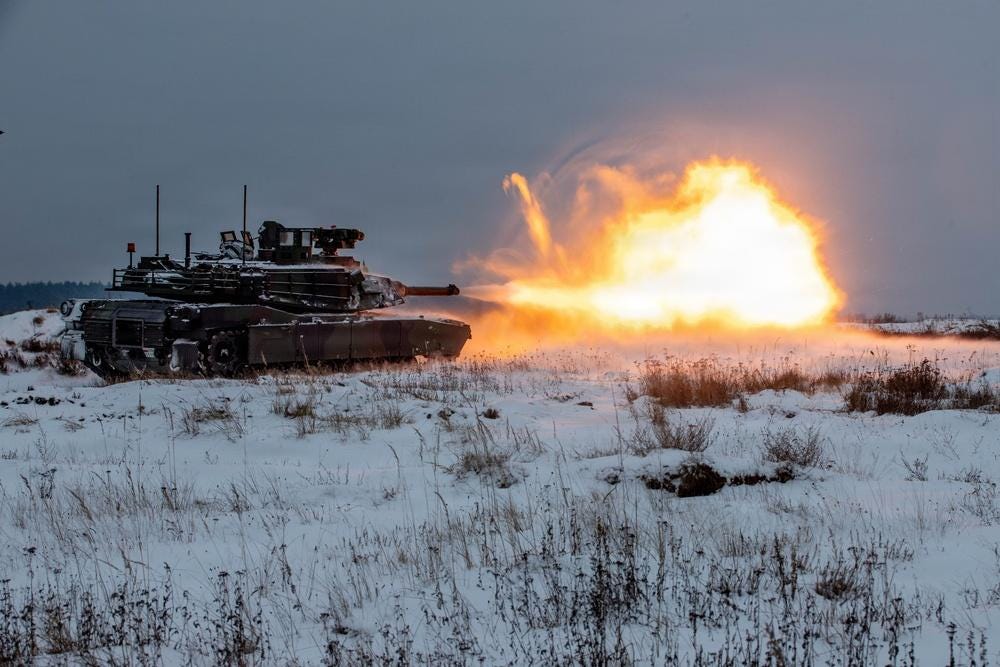
AND THEN THERE’S DONALD TRUMP
This is where the American side of the story gets particularly complicated.
Trump has spent years arguing that European countries rely too heavily on American military protection while failing to contribute enough to their own defense.
That criticism has substance. European defense spending has risen substantially, and NATO leaders themselves acknowledge that the burden needs to be shared more evenly.
But Trump has gone considerably further than demanding that allies write bigger checks.
In April, after European allies declined to support American military operations involving Iran, Trump openly discussed leaving NATO. He described the alliance as a “paper tiger,” and Defense Secretary Pete Hegseth declined at the time to clearly reaffirm America’s collective-defense commitment.
The United States hasn’t withdrawn from NATO, and Trump subsequently expressed support for remaining in it. Yet his statements have added uncertainty to an alliance whose effectiveness depends heavily on whether potential adversaries believe its promises. Sources: Reuters, April 1 | Reuters, July 8
Now, wanting European nations to pay more for their defense is a legitimate policy position. Frankly, it’s an argument NATO has been having for decades.
The harder question is what happens when demanding more responsibility starts sounding like a warning that America might not show up when somebody needs help.
Deterrence depends on convincing an adversary that attacking would cost more than it’s worth. Uncertainty about whether the most powerful member of an alliance would respond becomes part of that calculation.
And while European governments are increasing their military investments, many capabilities still depend heavily on the United States. Source: Reuters, November 6, 2026
CAN AMERICA JUST WALK AWAY?
Here’s something that doesn’t get nearly enough attention.
Trump cannot simply announce that America is leaving NATO and make it legally so.
Congress enacted legislation requiring either a two-thirds Senate vote or an act of Congress to authorize withdrawal from the North Atlantic Treaty. There remains a constitutional dispute about presidential treaty-withdrawal powers, but the statutory restriction is currently in place.
There’s a catch, of course.
A president doesn’t have to formally abandon an alliance to change troop deployments, adjust defense priorities, or create uncertainty about how the United States might respond to a crisis. Those decisions can have serious consequences while the treaty remains perfectly intact. Sources: U.S. Code, 22 USC §1928f | Congressional Research Service
The Pentagon is conducting a review of America’s military presence in Europe, potentially affecting the deployment and basing arrangements of roughly 80,000 personnel. The administration says European allies must assume greater responsibility, while the review considers multiple options. That does not mean 80,000 troops are being withdrawn.
But if you’re a European government trying to plan national defense five or ten years into the future, even the possibility of substantial American reductions matters. Source: Reuters, August 27, 2026
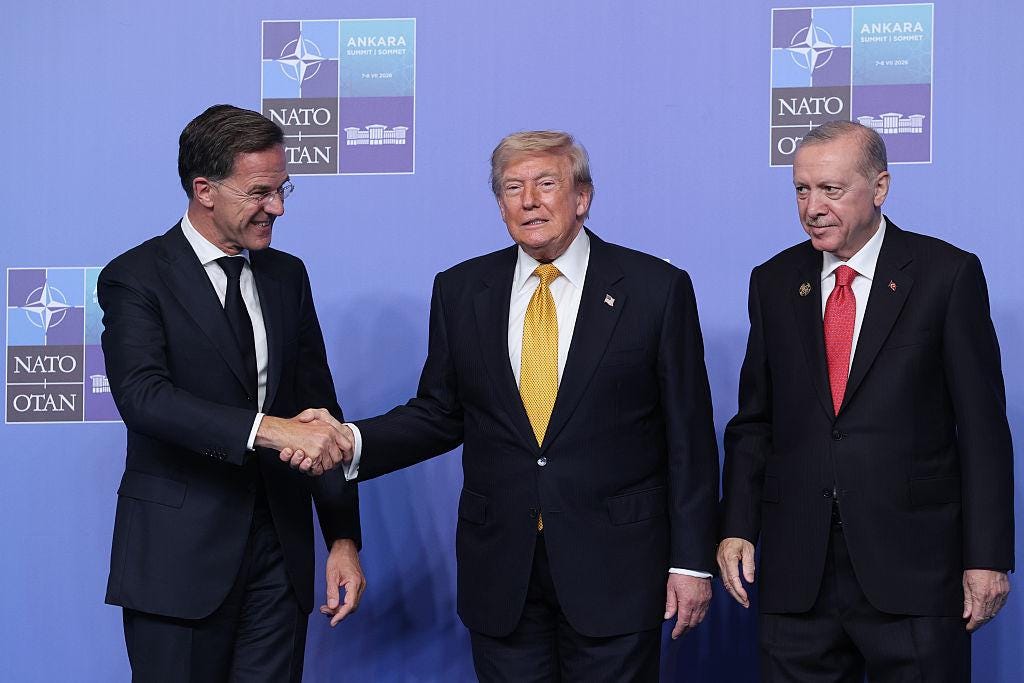
WHEN THE MAN YOU’RE WORRIED ABOUT GETS A SEAT AT THE TABLE
This week’s diplomatic developments deserve particular attention.
American negotiators have been participating in renewed peace talks involving Russia and Ukraine in Abu Dhabi. According to Reuters, Moscow wants discussions about ending the war in Ukraine to include a broader restructuring of Europe’s security arrangements.
Russian representatives have signaled that they see limited value in direct European participation in those negotiations. European representatives are present for consultations with American and Ukrainian officials, but Russia has resisted bringing them into its own negotiations.
That raises an obvious concern: How much influence should Moscow have over the future security decisions of countries that consider Russia their principal military threat? Sources: Reuters, November 10 | Reuters, November 11
The White House argues that diplomacy is necessary to end a devastating war and establish a more durable peace. That’s a serious argument. Negotiating with an adversary does not automatically mean endorsing that adversary’s conduct.
But European governments have understandable concerns about arrangements that could restrict their security choices or give Russia leverage over neighboring countries.
The distinction matters. A peace settlement can reduce the danger of war. A settlement that leaves countries uncertain about their independence or defense guarantees can create future problems of its own.
And Americans deserve to know exactly what commitments Washington is negotiating. Source: Reuters, November 2
WHAT HAPPENS IF SOMEBODY ACTUALLY ATTACKS?
This is where NATO’s famous Article 5 enters the picture.
Under the treaty, an armed attack against one member is considered an attack against all. Each ally is obligated to assist, taking whatever action it considers necessary, potentially including military force.
That doesn’t automatically mean an American president must declare war the moment a Russian soldier crosses a NATO border. The treaty leaves member countries discretion over their responses.
But it does mean that an attack on a NATO ally would create an immediate international crisis involving the United States.
And, considering the speed at which modern military conflicts can escalate, that is not something I’d want Washington figuring out after the shooting starts. Source: NATO — Collective Defence and Article 5
AND CHINA ISN’T EXACTLY HELPING
One further complication deserves mention without hijacking the entire article.
NATO leaders have expressed concern that a major crisis involving Taiwan could coincide with heightened Russian military pressure in Europe. Rutte has warned publicly that such overlapping crises would strain America’s capacity to respond in both regions.
That is a strategic scenario, not proof that Beijing and Moscow have agreed on a joint timetable for war.
But the possibility underscores the limits of even America’s enormous military resources. Weapons, aircraft, ships, troops, and ammunition cannot all be deployed everywhere simultaneously.
And that’s before Washington considers its commitments and ongoing military operations in the Middle East. Source: NATO Secretary General’s September 10, 2026 address
THE PART WE SHOULDN’T LOSE SIGHT OF
Nobody I’ve cited here is presenting evidence that Russia is about to launch a conventional attack against NATO.
In fact, Rutte said as recently as October 14 that the alliance sees no imminent threat. Putin has repeatedly denied any intention of attacking European countries, although Western governments dispute his explanations for Russia’s military activity and its war against Ukraine.
That uncertainty should inform the discussion, rather than disappear beneath dramatic headlines. Sources: NATO, October 14 | UK House of Commons Library
Still, Europe is preparing for possibilities that would have seemed unthinkable to many of its citizens a decade ago.
The United States remains deeply involved, regardless of whether Americans spend much time thinking about Lithuania, Estonia, Poland, or the eastern flank of NATO.
We can debate how much Europe should spend on defense. We can debate whether America carries too much of the burden. We can question Trump’s diplomacy, his threats to withdraw, and the wisdom of negotiating Europe’s security arrangements with Putin.
Those debates belong in a democracy.
But understanding what we’re committed to—and what might happen if those commitments are tested—ought to come before deciding what America should do about them.
After all, it’s a hell of a time to discover you never read the fine print.
THE BULLSHIT DETECTOR
Three claims making the rounds, none of them having a damn thing to do with NATO.
THE STINK SCALE
💩 A Little Whiff
💩💩 Something Smells
💩💩💩 Steaming Pile
💩💩💩💩 Full-Blown Bullshit
💩💩💩💩💩 Weapons-Grade Bullshit
1. THE FBI FOUND 20,000 FRAUDULENT BALLOTS IN HOUSTON
Claim: An FBI raid uncovered more than 20,000 fraudulent Democratic ballots in a Houston warehouse during the November 3 elections.
Bullshit: The FBI confirmed that no such election-related raid occurred. Harris County officials also rejected the story.
💩 Stink Rating: 💩💩💩💩💩 — Weapons-Grade Bullshit
Why: The viral posts recycled photographs from unrelated events, including an FBI search in Georgia and election materials from California. Apparently, when the evidence doesn’t exist, you can just borrow somebody else’s pictures and hope nobody notices. Source: PolitiFact, November 3
2. GREEN ENERGY IS WHY BLUE STATES PAY 50% MORE FOR ELECTRICITY
Claim: Energy Secretary Chris Wright suggested that renewable-energy requirements explain why electricity prices in some groups of states are roughly 50% higher.
Bullshit: The price differences are broadly accurate, but researchers found that the policies explain only a portion of the difference. Geography, natural gas costs, wildfire expenses, aging infrastructure, and other factors play significant roles.
💩 Stink Rating: 💩💩💩 — Steaming Pile
Why: Comparing two numbers doesn’t establish that one caused the other. Otherwise, we could blame expensive electricity on the number of Democrats living near extension cords. Source: FactCheck.org, November 6
3. TWO OLD PHOTOS PROVE THE OCEAN ISN’T RISING
Claim: Photographs of Whitby, England, taken in 1898 and 2016 show similar water levels, supposedly disproving sea-level rise.
Bullshit: Photographs taken at unknown stages of the tide cannot measure long-term changes in sea level. Actual monitoring shows a measurable rise around the United Kingdom.
💩 Stink Rating: 💩💩💩💩 — Full-Blown Bullshit
Why: Apparently, a couple of photographs now qualify as a century-long oceanographic study.
Somebody should notify the scientists. They’ve been wasting an awful lot of money on instruments when they could have just bought a scrapbook. Source: Reuters Fact Check, November 10
MORE FROM TOM HICKS MEDIA
For a deeper examination of politics, power, and the decisions that rarely fit into a television sound bite, there’s Blind Spot.
If you need a reminder that human beings have been making spectacularly questionable decisions for generations, visit What the Hell?
And for something completely different, Lotus Purrspective offers the daily observations of a cat who has developed a rather unflattering opinion of our species. I’m beginning to understand her point.
Find everything in one place: Tom Hicks Media — The Complete Collection.
#OffScript #NATO #Europe #Russia #Ukraine #NationalSecurity #USForeignPolicy #DonaldTrump #WorldAffairs #TomHicksMedia
Absolutely support NATO.