

Editorial Note
Sometimes the biggest changes in our lives don’t happen because somebody passes a law or invents a new gadget. They happen because millions of people quietly change their behavior, one small habit at a time, until the old way of doing things just disappears.
I don’t think we ever decided this was the world we wanted. I think we just woke up one day and realized we were already living in it.
A few mornings ago I stopped at a coffee shop to kill time before an appointment. Not one of those places that gives you the emotional biography of the bean. Just a normal shop, decent coffee, people coming and going.
The place was packed. Every chair full. And nobody was talking to a goddamn soul.
Before I keep going. Off Script runs on readers, not sponsors. Nobody’s paying me to have an opinion, which means nobody gets to tell me which opinion to have. Free tier gets you the daily piece. Point Blank, the paid tier exclusive, is where I stop being polite about any of it. Join me every morning if that sounds like your kind of thing.
Everyone in that coffee shop had come to a public place to be alone in it: phones out, earbuds in, laptops up like little barricades. Once I noticed it, I couldn’t stop seeing the damn thing everywhere.
Dinner a couple nights later, three generations at the table next to me. Grandma, mom, dad, two kids. Should’ve been loud as hell. Instead everybody was somewhere else. Kid watching videos. Dad checking his phone every sixty seconds like it owed him money. Nobody fighting. Nobody upset. Just sharing a table instead of an evening, which honestly might be sadder than a fight.
Airports are the same circus. Hundreds of people waiting together without being together in any way that counts. Doctor’s office waiting rooms too, more fingers tapping glass than mouths tapping out words. Even hotel lobbies used to be where strangers fell into conversation. Now they’re just charging stations with nice chairs, and nobody’s pissed off about it, which is the part that should scare you.
Nobody got more rude. That’s not what happened here. Hold a door, people smile. Ask a question, they answer. Strike up a conversation with a stranger on a bench, most of the time they’ll talk right back. This isn’t about manners. It’s about availability, and somewhere along the way we all quietly stopped being available to whoever’s standing right in front of us.
I’m not blaming the phone like some old bastard shaking his fist at a cloud. Mine’s sitting six inches from my hand right now. I’ve checked scores mid-dinner. I’ve fallen down the same rabbit holes as everybody else. I let the son of a bitch in myself, same as you did, and pretending otherwise is bullshit.
Here’s what actually changed. We decided that every spare minute of the day needed something to fill it. Waiting on coffee. Standing in the checkout line. Killing fifteen minutes before an appointment. None of it was exciting, but it left room for the world to show up uninvited. Now the phone’s out before you’ve even thought about it. Same email you checked ten minutes ago. Same scroll hoping something worth a damn showed up since the last one.
There’s a name for the places we’re talking about. Sociologist Ray Oldenburg called them “third places” back in his 1989 book The Great Good Place. Home’s the first place, work’s the second, and the third is everything in between: the diner where everybody knows the waitress, the bar the regulars wander into after a shift, the barber shop where the talk outlasts the haircut. Oldenburg’s whole argument was that community doesn’t just come from family and work. It comes from a thousand small run-ins with ordinary people that remind you you’re surrounded by folks instead of just parked next to them.
Those places didn’t vanish. We just changed what we use them for. A laptop in a coffee shop used to mean “I’m working.” Now it means “leave me the hell alone.” Earbuds say the same thing. So does a phone in your hand while you wait on your drink. Nobody voted on these rules. We all just learned to read the signal and back the hell off.
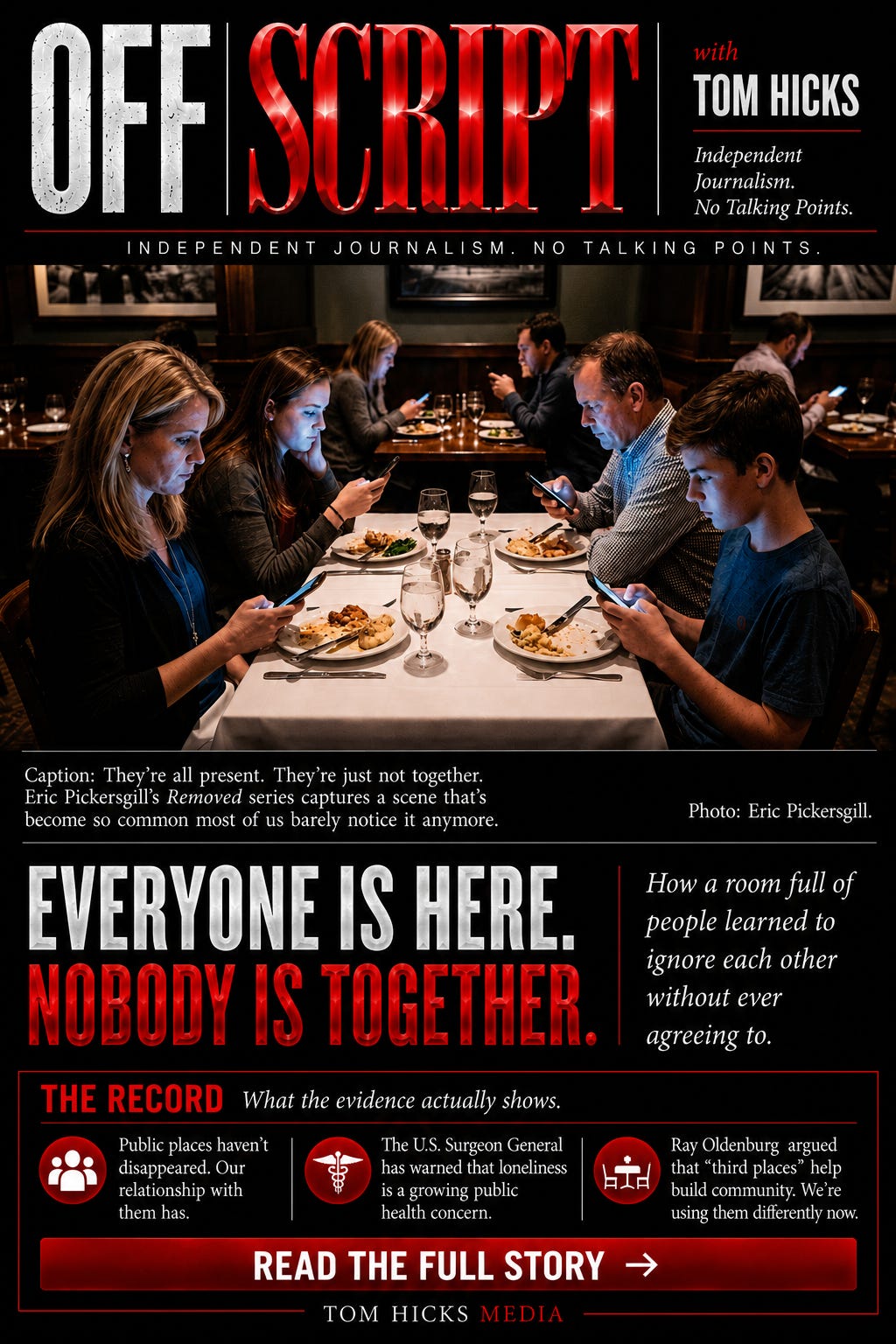
While I was working on this article, I came across a photograph from Eric Pickersgill’s Removed series. It shows a family sitting around a restaurant table, every face lit by a phone. It’s uncomfortable to look at, mostly because it doesn’t feel unusual anymore. It feels normal. That’s probably the most unsettling part.
Pickersgill’s idea was brilliantly simple. He photographed people exactly as they were, then digitally removed the phones from their hands. Once the devices disappear, you’re left looking at the distance between people who are physically together but mentally somewhere else. The first time I saw the series I thought it was clever. Looking at it again while I was writing this, it didn’t strike me as clever nearly as much as familiar.
And nobody complains while it’s happening. We save that for the surveys. In 2023 the U.S. Surgeon General put out an advisory naming loneliness and isolation a serious public health problem, and every few months another poll says we’ve got fewer close friends than we used to. We blame politics. We blame the algorithms. Maybe some of that’s fair. But connection rarely dies in one dramatic moment. It dies in a thousand small, forgettable choices, like answering one more notification instead of making small talk, or pulling the phone out before your ass even hits the chair.
None of that makes anyone a bad person. I’ve checked the same headlines three times in ten minutes like the world couldn’t survive without my supervision. I’m not lecturing from some high horse here. Same line, same phone, same guilt.
What worries me is what we stopped noticing. We got so good at staying connected to people who aren’t in the room that we made ourselves unavailable to the ones who are. The stranger two stools down might have a hell of a story. The old couple at the next table might have fifty years on the clock together. The guy behind the counter might remember your name if you ever gave him a shot. None of it’s guaranteed. All of it gets damn near impossible once you’ve told the whole room you’d rather be somewhere else.
I’m not telling anybody to ditch their phone. That’d be a lie, and a stupid one. I like GPS. I like being reachable in an emergency. I like seeing a picture from family five states away the second it’s taken. I just don’t want convenience to keep quietly eating community while every one of us looks the other way.
Next time I’m sitting there with a cup of tea, I’m going to look around before I look down. Maybe nothing comes of it. Maybe somebody tells a story in line, or recommends a book, or starts one of those five-minute conversations that somehow sticks for years. Those moments used to be ordinary as hell. I don’t think they’re gone for good. I think they’re just waiting on us to look up.
The Off Script Bullshit Detector
The world doesn’t need more information. It needs better filters. Subscribers get The Bullshit Detector free. It’s a field guide to spotting weak arguments and manipulation before they waste another minute of your day. Everybody else can grab it for $4.95 through the Tom Hicks Media Store.
More from Tom Hicks Media
Lotus Purrspective — a tuxedo cat’s observations on the strange creatures she allows to live in her house.
Tom’s Number Ones — every day, one week in music history and the songs that topped the charts.
Panic Room Sports — football-first analysis that cuts the noise.
Buy Me a Cup of Tea
If this is worth something to you, buy me a cup of tea. It keeps the lights on, the tea hot, and gives me another excuse to keep asking questions people would rather I didn’t.
One Question Before You Go
What’s the best conversation you’ve ever had with a total stranger, and where did it happen?
One Last Thing
I looked up from my tea this morning, and a guy at the next table caught my eye and nodded. That’s it. That’s the whole damn story. Not much, but more than I’d have gotten staring down.
#Loneliness #ThirdPlaces #Community #TomHicks #OffScript #SocialIsolation
This is part of a story I wrote about just this thing... conversation with a stranger.
"We began talking as we waited for the tram to come and claim us. She was an older woman, like myself; one of those “non-traditional” students. The years weighed rather heavily on her face as if perhaps morning had come too soon for her that day. Her words soon animated her face into a youthful mask as we discussed a flyer about a concert featuring Nelly. We both agreed that Nelly was not a good “live” performer and that Usher would be a much better show. As we extolled the physical attributes of Usher, I was struck by the thought of the picture we would present to a “traditional” student were they to eavesdrop. I imagined the musings that would run through the head of a 22 year old as they listened to these two 40-something students dismiss the talents of Nelly in favor of the merits of Usher. A smile must have exploded onto my face at this thought because the lady returned it in kind...."