

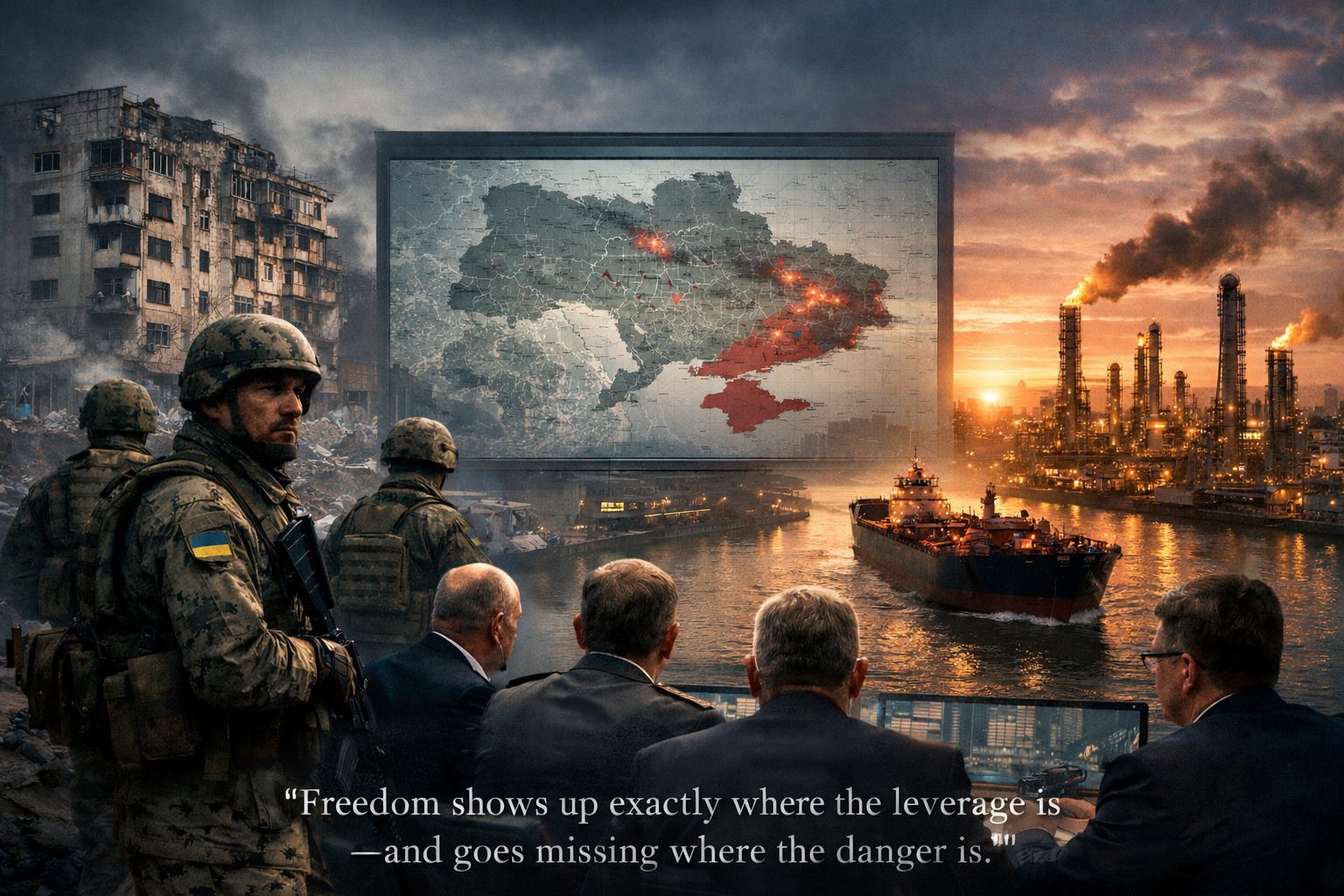
Let’s stop pretending there’s some noble mystery behind why the “liberate Venezuela” and “confront Iran” drumbeat never seems to lose its rhythm, while Ukraine — a democracy being invaded in real time — gets treated like a live grenade nobody wants to pick up. If freedom were the guiding principle, the urgency would be overwhelming and unmistakable. Instead, support arrives cautiously, hedged with caveats and calibrated like someone trying to defuse a bomb with oven mitts on. The contrast isn’t philosophical; it’s strategic, and once you admit that, the whole story stops looking like moral leadership and starts looking like what it really is: risk management wrapped in a nice, bullshit ribbon.
The uncomfortable truth is that Ukraine represents a fight that could spiral into something far uglier than a regional conflict, because helping decisively means confronting a nuclear power that still thinks escalation is a perfectly reasonable way to make a point. That’s not a tidy intervention; it’s a high-stakes gamble where the downside isn’t embarrassment or bad press but catastrophe. Venezuela and Iran, by comparison, sit in a category where pressure can be applied without immediately risking the geopolitical equivalent of lighting a match in a gas leak. One scenario is a knife fight in a dark alley where both sides know someone’s going to bleed. The other is shadowboxing against opponents who can be squeezed without triggering the end of the fucking world.
Once you follow the leverage trail instead of the rhetoric, the pattern becomes painfully obvious. Iran’s reserves and geography influence global trade like a hand on the thermostat of energy markets. At the same time, Venezuela’s oil wealth represents long-term strategic potential that makes policymakers’ eyes light up faster than a slot machine jackpot. Ukraine matters deeply, but defending it preserves the current order rather than reshaping it, and preservation rarely excites power systems that chase advantage the way gamblers chase their next win. Expanding influence feels bold and decisive; maintaining stability feels like doing the dishes after someone else cooked the meal, and nobody ever built a legacy bragging about that shit.
Public messaging smooths over this distinction with language that sounds consistent even when the actions aren’t. Calls to defend democracy and confront oppression get deployed across wildly different contexts, creating the illusion of principle while decisions are quietly guided by leverage and risk tolerance. Oppression in a resource-rich adversarial state becomes an urgent moral crisis, while aggression in a nuclear-risk theater becomes a complex dilemma requiring patience and restraint. The words stay polished even as the calculus shifts underneath them, and that disconnect slowly eats away at trust like rust chewing through steel.
Over time, people notice that freedom seems to appear most loudly where strategic advantage is on the table and fade where escalation risk dominates the equation. That realization breeds skepticism, and skepticism fractures unity. When a genuinely clear democratic struggle emerges, like Ukraine’s, it arrives filtered through years of precedent that blurred the line between humanitarian concern and strategic ambition. The result isn’t outrage but doubt, and doubt weakens collective resolve faster than any propaganda campaign ever could.
There are only two honest ways to deal with this tension. One is to admit that geopolitical decisions are driven by leverage and risk rather than fairy-tale morality, acknowledging that power behaves pragmatically even when it talks idealistically. The other is to keep selling selective intervention as a humanitarian necessity while quietly chasing influence behind the curtain. You can juggle both narratives for a while, but eventually the act falls apart, and credibility hits the floor with a loud, embarrassing thud.
Ukraine exposes the difference between defending an existing democratic order and pursuing influence through pressure on adversarial states. Supporting it fully carries escalation risk that few leaders are eager to embrace, while targeting resource-rich outsiders offers leverage with comparatively manageable danger. One path stabilizes the system; the other reshapes it. History suggests which option power structures tend to favor, regardless of the moral language used to dress it up.
💬 Paid supporters keep this independent.
No sponsors. No corporate leash.
Paid members get:
• Bonus analysis
• Early releases
• Full archive access
• Q&A priority
👉 Upgrade to keep this loud and unfiltered
🐱 For the quieter but equally sharp dissection of human nonsense, check out Lotus Purrspective.
👍 Like. Share. Subscribe.
☕ If this hit where it should:
#Ukraine #Iran #Venezuela #Geopolitics #ForeignPolicy #PowerPolitics #Democracy