

By Tom Hicks — Off Script
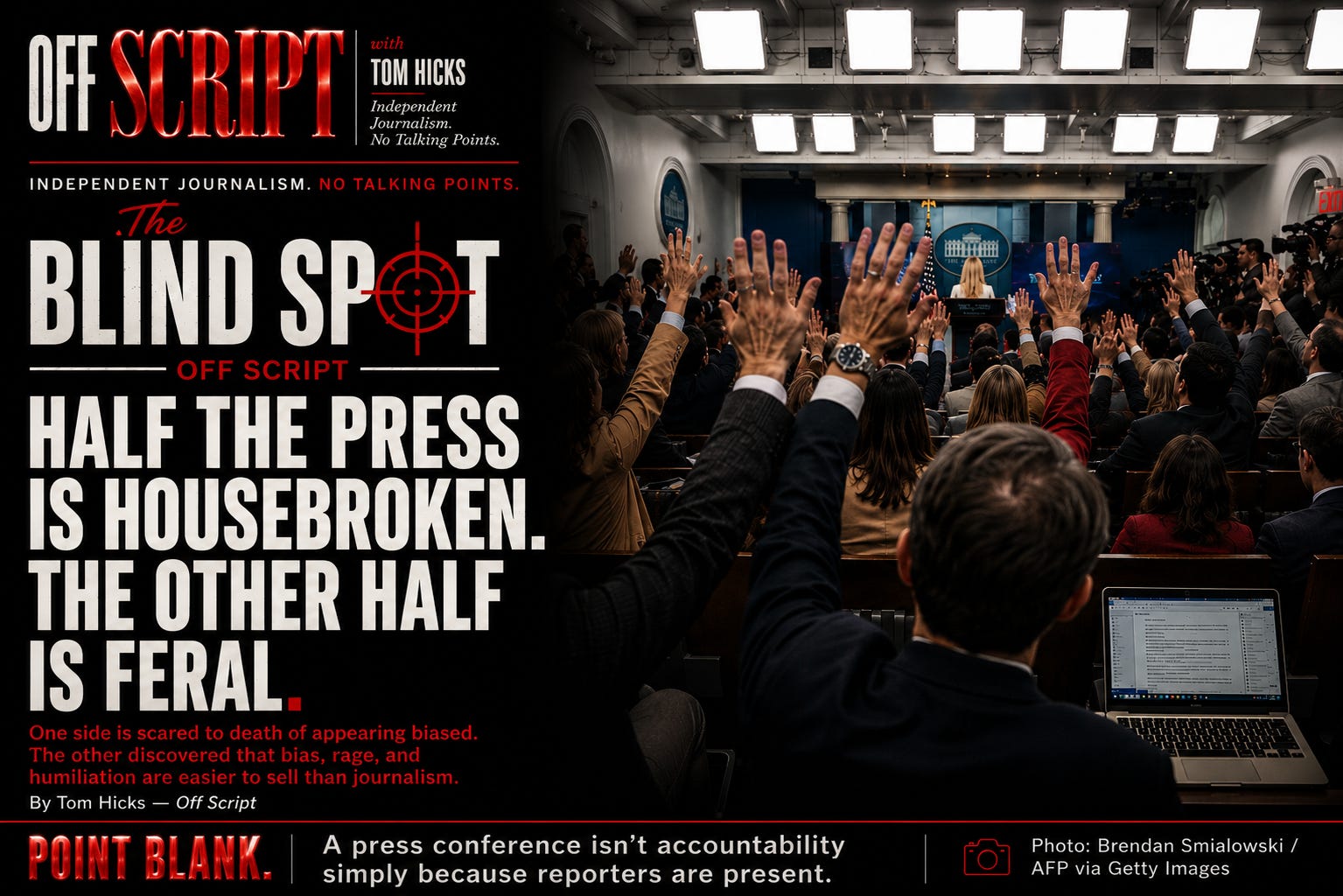
I know what reporters are supposed to ask at a presidential press conference. I also know what I would occasionally have to fight myself not to ask.
What the fuck is wrong with you?
That is not the professional version, obviously. The professional version would contain fewer syllables, no profanity, and considerably less honesty. But watch enough politicians stand behind microphones and say things that are false, absurd, cruel, or completely detached from the known world, and eventually you start wondering whether professionalism has become another word for sitting politely while somebody pisses on your leg and disputes the weather.
The reporter asks a careful question. The politician does not answer it, so the reporter tries again with the apologetic tone of someone asking a restaurant manager whether the kitchen might remove the dead insect from his soup.
The politician talks over the question, insults the reporter, changes the subject, complains about the previous administration, and calls on somebody else. Later, six people around a television desk discuss whether the exchange will help or hurt him with independent women in suburban Pennsylvania.
The lie was apparently not the story.
The reporter’s tone was.
SUBSCRIBE TO OFF SCRIPT
Independent journalism for readers who are tired of press releases, party scripts, and people pretending obvious bullshit requires further study.
Join me every morning.
For a long time, I thought the problem was media bias. Then I blamed cable news, which certainly earned its share. Social media deserves to be dragged into the alley for questioning, and Donald Trump has spent years showing how much nonsense a politician can get away with when he possesses no shame, and the people covering him are still trying to observe rules he abandoned decades ago.
None of those explanations quite got me there. They explained pieces of what I was watching, but not how American media could be timid and hysterical at the same time.
Then it hit me.
I was not looking at one broken media system. I was looking at two.
One part of the press has been housebroken. It knows where the food bowl is, who controls the door, and what happens when it scratches the furniture. It has been trained to value access, decorum, balance, respectable language, and the appearance of neutrality, even when the person standing in front of it is lying through his teeth.
The other part has gone feral. It attacks on command, lives on grievance, and expects to be rewarded whenever the audience enjoys the noise.
One side is terrified of appearing unfair. The other has built a business model around unfairness.
We are left choosing between deference without courage and aggression without discipline.
THE PRESS THAT KNOWS WHERE THE FOOD BOWL IS
The housebroken press is not necessarily dishonest. Most reporters at major news organizations are trying to get the story right, usually under brutal deadlines and with fewer resources than the public realizes.
Some of the finest journalism in the country still comes from those institutions. Reporters expose corruption, uncover abuse, force records into public view, protect confidential sources, and keep digging long after powerful people would prefer that everyone move along.
The problem is not that institutional journalism has no standards. The problem is that it has surrounded itself with so many rules involving tone, access, balance, process, and professional distance that the whole operation can start looking like an extremely expensive obedience school.
You can hear it in the language.
A lie becomes “a disputed claim.” A racist statement becomes “racially charged.” A threat to violate the Constitution becomes “a break with political norms.” An official who refuses to answer a straightforward question is said to have “pushed back.”
Pushed back against what? Reality?
I worked around the law long enough to know the difference between an answer and a response. An answer addresses the question. A response is any collection of words that arrives after it.
Politicians have turned the response into an art form. Ask about the economy and they talk about immigration. Ask about immigration and they talk about crime. Ask about crime and they blame the previous administration. By the time the reporter gets another chance, the room has accepted that words came out of the politician’s mouth, so something must have been answered.
In a courtroom, a lawyer can object when a witness refuses to respond. A judge can tell the witness to stop screwing around and address the question.
At a political press conference, the witness owns the courtroom, controls the microphone, chooses the next lawyer, and can leave whenever he gets bored.
That is not accountability. It is a ceremony honoring the memory of accountability.
POINT BLANK
A press conference is not accountability merely because reporters are present.
If the official controls the room, ignores the question, chooses the next reporter, and leaves without answering, the public has witnessed access, not scrutiny.
Everybody gets something except the truth.
The reporter is allowed to ask. The official is allowed to ignore the question. The television network gets its video, the newspaper gets a quote, and the political operation gets another free opportunity to deliver its message.
Everyone technically completes the assignment.
The public goes home empty-handed.
THE PRESS THAT NO LONGER CARES ABOUT FAIRNESS
The feral side does not have a politeness problem because it does not give a damn whether anyone thinks it is fair.
Its job is not to challenge the audience. Its job is to reassure the audience that it has been right about everything from the beginning.
There is always an enemy, usually several. Every election is the last chance to save the republic. Every disagreement is a betrayal. Every mistake by the opposition proves corruption, while every mistake by an ally was misunderstood, taken out of context, secretly brilliant, or caused by the other side.
That is not reporting. It is emotional room service.
The audience orders outrage, and the host brings it upstairs while it is still hot.
Conservative talk radio perfected much of the model, but it no longer owns the patent. Liberal television, podcasts, websites, newsletters, and social-media personalities have learned the same trick. The language changes, and the villains rotate, but the transaction is almost identical.
The host identifies the tribe’s enemies, explains why those people are evil or stupid, and sends the audience to bed feeling smarter than everyone watching the other channel.
That kind of aggression can feel refreshing after you have watched an institutional reporter politely accept a fourth consecutive non-answer. At least somebody is calling bullshit.
The catch is that the feral host usually calls bullshit only when it comes from the other team.
When an ally lies, the lie becomes exaggeration, strategy, humor, trolling, or one of those remarks we are told not to take literally, despite being expected to treat every flattering promise as sacred.
Aggression backed by evidence is journalism. Aggression governed by audience loyalty is entertainment wearing a press pass.
The housebroken side sometimes lacks courage. The feral side lacks brakes.
HOW THE CAGE DOOR OPENED
You cannot tell this story without talking about the Fairness Doctrine, but you also cannot dump the entire mess in Ronald Reagan’s lap and walk away feeling clever.
For decades, the Federal Communications Commission required licensed radio and television broadcasters covering controversial public issues to provide a reasonable opportunity for contrasting viewpoints. It did not apply to newspapers, and it did not require equal time for every crank who could locate a telephone.
The doctrine rested on the belief that broadcasters were using a limited public resource, the airwaves, and that the privilege came with an obligation to the public.
It was never the golden age some people remember. Giving federal officials a role in deciding whether broadcasters had been sufficiently fair carried obvious dangers. I do not want any administration, Republican or Democratic, grading journalism for ideological balance.
Still, when we threw out the doctrine, we also discarded much of the principle underneath it: using the public airwaves involved a responsibility to someone other than the owner, advertisers, and ratings department.
In 1987, the Reagan-era FCC stopped enforcing the Fairness Doctrine. Congress passed legislation that would have written it into law, and Reagan vetoed it. (Federal Communications Commission)
Reagan did not sign a document ordering broadcasters to lose their minds. The media market was already changing, cable was expanding, and the old doctrine had become increasingly difficult to justify.
But 1987 was a turning point.
Rush Limbaugh entered national syndication the following year and showed station owners that political programming did not have to serve a broad public. It could make very good money serving one large, intensely loyal piece of it.
As an old radio guy, I understand why it worked.
Radio is intimate in a way television rarely manages. A good host does not sound as though he is addressing an audience. He sounds like he is talking directly to you while you drive home, sit in the garage, or pretend to work.
That relationship can inform people, entertain them, or keep somebody company on a rotten day. It can also convince millions of listeners that the voice coming through the dashboard is the only honest person left in America.
Once station owners learned that anger created loyalty and loyalty created ratings, nobody needed a degree in political science to see where this shit was headed.
Cable took the lesson, added pictures, and stretched it across twenty-four hours. The internet removed the cost of entry. Social media handed everyone a microphone and rewarded whoever could make the most people furious before breakfast.
The animal was not merely out of the cage.
It had become the programming strategy.
THIS ARTICLE CONTINUES FOR PAID SUBSCRIBERS
Paid subscribers support independent reporting, deeper analysis, and journalism that does not have to pretend every lie deserves a polite hearing.
Already a paid subscriber? Keep reading.
THE HOUSEBROKEN SIDE RESPONDED BY ROLLING OVER
While partisan media learned how much money could be made by openly choosing a side, the institutional press became increasingly obsessed with proving it had not chosen one.
That sounds responsible until you watch what it does to the reporting.
Objectivity should mean following the evidence wherever it goes. It should mean checking assumptions, correcting mistakes, and refusing to let personal loyalties determine what is true.
It should not mean standing halfway between a fact and a lie because the lie has millions of followers and knows how to complain.
Mainstream news organizations have spent decades being accused of liberal bias. Some of those complaints were legitimate. Newsrooms are run by human beings, and human beings bring assumptions, preferences, blind spots, and bad habits to work.
Other accusations were not criticisms. They were pressure campaigns designed to make reporters treat nonsense more respectfully than it deserved.
The pressure worked.
Politicians learned they did not have to disprove a damaging story. They could attack the reporter, accuse the organization of bias, and turn the entire conversation toward whether the journalist had been sufficiently respectful.
A politician makes a false claim. The reporter challenges it. The politician calls the reporter partisan. The network spends the next hour discussing whether the question was phrased too aggressively.
The politician leaves knowing exactly what to do next time.
Power does not need to censor the press when it can train the press to censor its own tone.
ACCESS IS A POLITE WORD FOR A LEASH
Journalists need access. They need interviews, briefings, records, leaks, sources, invitations, and the ability to stand close enough to powerful people to hear what they say when they do not think they are making news.
There is nothing corrupt about gathering information from the people who possess it. That is reporting.
The trouble begins when access becomes more valuable than the information.
An exclusive interview brings traffic. A reliable White House source can make a correspondent’s career. A seat on the plane or a question at the press conference can separate one organization from its competitors.
The official understands the arrangement perfectly.
Be cooperative, and the calls continue. Become too troublesome and the door may close. The interview goes to somebody friendlier, the leak goes to another outlet, and the reporter who asked the impolite question discovers that the powerful have excellent memories.
Nobody has to tell the journalist to behave.
The leash works even when it hangs loose.
The Trump White House provided a particularly ugly demonstration in 2025 when it restricted Associated Press access after the organization continued using “Gulf of Mexico” rather than adopting the administration’s preferred terminology.
A federal judge initially ruled that the government could not punish the AP for its editorial viewpoint and ordered access restored. An appellate panel later allowed the White House to retain substantial control over access to restricted presidential spaces while the litigation continued. (Reporters Committee for Freedom of the Press)
That episode matters for two reasons. The first is that the White House used access as punishment over a news organization’s choice of words.
The second is that the AP fought back.
Give the press credit where it is due. The AP did not roll over, change its stylebook, and issue a statement thanking the administration for its valuable feedback.
Journalists and news organizations regularly fight subpoenas, protect confidential sources, challenge government secrecy, and take powerful institutions to court.
Some reporters are magnificent pains in the ass.
The problem is that the system increasingly requires individual journalists to become heroes inside institutions that may value continued access, stable revenue, and avoiding retaliation.
Heroism is admirable. It is also a lousy operating plan.
A GUTTED NEWSROOM CANNOT THROW MUCH OF A PUNCH
The money disappeared from journalism, and a great deal of its muscle went with it.
Between 2008 and 2020, newspaper newsroom employment fell by 57 percent, dropping from roughly 71,000 jobs to about 31,000. (Pew Research Center)
Those figures explain more than a shelf full of complaints about media bias.
Investigative reporting takes time. Learning a beat takes time. Developing sources takes time. Knowing enough about a subject to recognize a sophisticated line of bullshit takes time.
Standing up to a mayor, governor, sheriff, police department, president, hospital chain, university, or major advertiser requires more than a brave reporter. It requires an editor willing to back the story, a lawyer willing to defend it, and an owner willing to absorb the blow.
Strip all of that away, and the press release starts looking pretty good.
It arrives already written. The quotes are clean. The photographs are free. The reporter can turn it into a story before the next assignment lands.
That is how institutions begin covering themselves while the news outlet merely supplies punctuation.
Television has its own version. An outrageous claim is cheap, visual, and easy to produce. Play the clip, put two people in boxes, and promise an explosive response after the commercial.
Whether the original statement was true becomes almost beside the point.
Bullshit has excellent production value.
THE PRESS CONFERENCE IS A SET WITH CHAIRS
We continue to describe the political press conference as one of the great rituals of democratic accountability. Maybe it was once. Now it often looks like professional wrestling with worse lighting.
The official decides when to appear, where to stand, what subject to discuss, and frequently which reporters receive questions. The journalist gets one attempt and perhaps a hurried follow-up while three people across the room are already shouting.
The official can ignore the question, challenge the premise, insult the reporter, wander into an unrelated story, or leave.
Then the network tells us the president “took questions.”
No, he stood near questions.
There is a difference.
This is where I part company with people who insist that reporters must never become rude.
I am not asking White House correspondents to start throwing barstools. I don't want questions turned into speeches, and I have no interest in reporters auditioning for their own primetime shows.
But fairness is an obligation. Niceness is not.
Sometimes the honest response to a non-answer is, “You did not answer the question.” Sometimes the required follow-up is, “What evidence do you have?” A reporter should be able to say, “That statement is false,” without the political world clutching its pearls because somebody raised their voice in a building where lies are routinely delivered with a smile.
There are moments when the only sane question really is: What the fuck is wrong with you?
The reporter should probably translate it before asking.
But not too much.
The public has been trained to judge a reporter’s manners more harshly than a politician’s dishonesty. A president can lie, insult the questioner, refuse to answer, and walk away. Let a journalist become visibly angry about it, and suddenly the reporter’s behavior is the controversy.
That arrangement works beautifully for the liar.
WHAT THE TWO SIDES HAVE IN COMMON
The housebroken press and the feral media appear to be opposites, but they share one large and ugly problem.
Neither is especially good at telling its audience something the audience does not want to hear.
The institutional outlet fears losing access, advertisers, subscribers, credibility, or its reputation for neutrality. The partisan outlet fears violating the emotional contract it has made with its tribe.
That contract is simple: We are the honest ones. They are corrupt. You are smarter than the fools watching the other channel.
Break that agreement too often, and the audience finds someone who will honor it.
The result is a media system that can be loud without being courageous and restrained without being responsible. The feral side knows how to confront, but not when to stop. The housebroken side knows exactly when to stop and increasingly seems to have forgotten how to confront.
That is one hell of a choice to offer a country that depends on the press to tell powerful people when they are lying.
WHAT I ACTUALLY WANT FROM THE PRESS
I do not want the Fairness Doctrine brought back and handed to whichever political party controls the FCC. I have watched government officials abuse the powers they already possess without giving them a new one involving acceptable journalism.
I do not want every reporter imitating the loudest cable host either. America has no shortage of people with microphones mistaking volume for courage.
What I want is considerably less complicated.
I want reporters who care whether something is true and are willing to become unpopular when the truth requires it. I want editors who will back them when an official retaliates. I want news organizations to stop treating access to dishonest people as more valuable than honesty with their readers.
I want partisan journalists to apply the same rules to their allies that they apply to their enemies. I want mainstream journalists to understand that a firm question is not proof of bias, and a polite non-answer is not information.
Most of all, I want journalism to remember the difference between being fair and being tame.
The feral media discovered that shamelessness is profitable. The housebroken press learned that obedience can be mistaken for professionalism.
What democracy needs is journalism aggressive enough to confront power, disciplined enough to follow evidence, and rude enough to recognize when politeness has become permission.
That should not be a radical demand.
The fact that it sounds like one is the problem.
THE OFF SCRIPT BULLSHIT DETECTOR
Politicians, pundits, corporations, and professional manipulators all use the same handful of tricks. The Off Script Bullshit Detector helps you recognize them before the argument has a chance to work.
It is free for Off Script subscribers and available for $4.95 through the Tom Hicks Media Store for everyone else.
ONE QUESTION BEFORE YOU GO
Which is more dangerous right now: a press that is too tame to confront power, or media that will say anything its audience wants to hear?
Leave your answer in the comments.
Independent journalism survives because readers decide it should.
#Media #Journalism #PressFreedom #NewsMedia #PoliticalMedia #FairnessDoctrine #MediaCriticism #DonaldTrump #IndependentJournalism #OffScript