

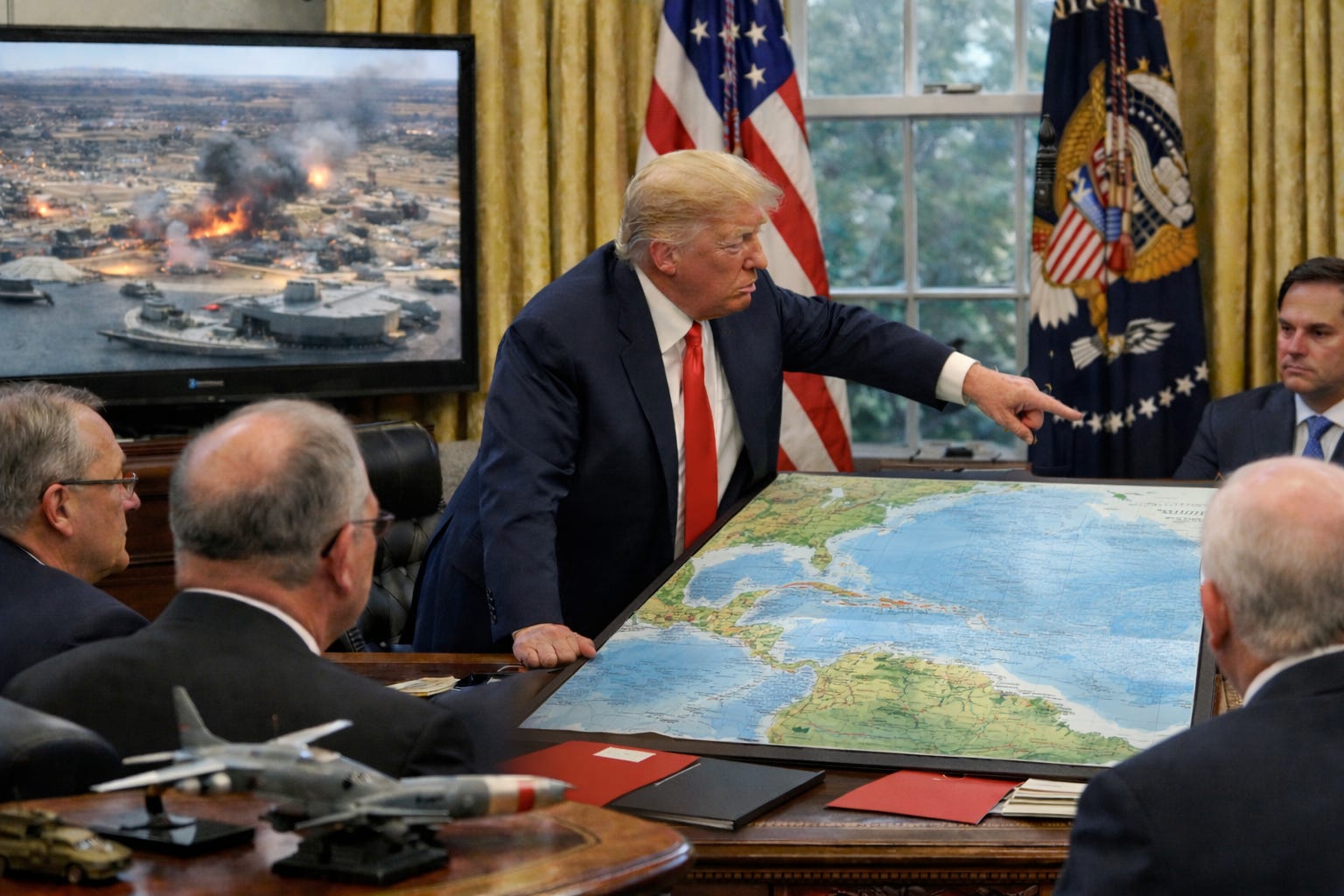
Donald Trump started a war with Iran a week ago. Oil prices are already climbing, the stock market is sliding, and the February jobs report just confirmed the economy is losing momentum at exactly the moment the country entered a new conflict in the Middle East. Under normal circumstances, that alone would dominate the national conversation for weeks.
Instead, the President of the United States spent part of this week publicly discussing which country he might go after next.
Cuba.
Not in the careful language of diplomacy. Not in the cautious language presidents normally use when talking about foreign policy. Trump talked about Cuba the way a developer talks about the next property deal he has lined up while the drywall is still being installed in the last one.
During an interview with CNN’s Dana Bash, Trump casually tossed this into the conversation:
“Cuba is gonna fall pretty soon, by the way… they want to make a deal so badly.”
Then he added something even more revealing.
“I’ve been watching it for 50 years, and it’s fallen right into my lap.”
Right into his lap.
Like a casino.
Like a hotel.
Like the fucking Atlantic City Boardwalk.
The problem, of course, is that Cuba is not a business acquisition. It’s a sovereign nation of eleven million people.
And this wasn’t some one-off remark.
Just one day earlier, during an event celebrating the 2025 Major League Soccer champions Inter Miami CF, Trump wandered into the exact same tangent while talking to Marco Rubio. According to people in the room, he told Rubio that Cuba would be the next “project,” that they just needed to finish Iran first. Then he added that the United States could theoretically handle multiple conflicts at once, but that moving too fast might cause problems.
Think about that framing for a moment. The President of the United States is openly discussing foreign countries the way a contractor talks about scheduling renovation work.
Finish the Iran job first.
Then start Cuba.
Except that those “projects” are wars.
And wars have a nasty habit of costing real people their lives.
Subscribe before we go further
If you want reporting that actually connects the dots between power, money, and the people getting screwed by both, hit the subscribe button. Corporate media will quote the soundbite. They rarely explain the machinery behind it.
What makes this moment so disturbing isn’t just the words. It’s the tone. There is a strange kind of excitement in the way Trump talks about international conflict, as if each new confrontation is another episode in a show he is producing. Iran is the current storyline. Cuba is the next one. Greenland, which he famously tried to buy during his first presidency, still sits on the wish list like a deal that slipped through his fingers and needs to be revisited.
That’s not speculation. Trump never forgot about Greenland. He’s brought it up repeatedly since returning to office.
Because in Trump’s worldview, geopolitics works like real estate: if you want something long enough, eventually it falls into your lap.
The problem with that worldview is that countries are not properties and wars are not transactions. They are chaotic, unpredictable events that destroy lives, destabilize economies, and create consequences that last for decades.
And speaking of the economy, the numbers that came out on March 6 tell a story that should worry every American who isn’t currently sitting on the board of a weapons manufacturer.
The United States lost 92,000 jobs in February. Economists had expected the country to gain at least 50,000. Instead, the labor market moved sharply in the opposite direction. The unemployment rate climbed to 4.4 percent, and earlier job reports quietly got worse once economists looked under the hood. December’s job gain of 48,000 was revised to a loss of 17,000, and January was revised down by another 4,000.
That means the government previously told us roughly 69,000 jobs existed that, in reality, never did.
Manufacturing lost another 12,000 positions. Healthcare shed 28,000 jobs. Transportation and warehousing have lost 157,000 jobs over the past year. At the same time, the administration has slashed the federal workforce by more than 330,000 positions since Trump returned to office, an eleven percent reduction that has rippled through communities that depend on those salaries.
Long-term unemployment has now climbed to 25.7 weeks, the highest level since 2021.
In plain English, the labor market is weakening.
And it’s weakening while the country is entering a war.
Meanwhile, the oil market lit itself on fire.
Crude oil broke $90 a barrel this week, the highest level in years. U.S. crude surged nearly 35 percent in a single week, the largest weekly spike in oil futures trading since records began in 1983. Gas prices jumped thirty-four cents in seven days, reaching $3.32 per gallon, the sharpest weekly increase since the early days of the Ukraine invasion.
Energy analysts are warning that oil could hit $100 within days. Qatar’s energy minister says prices could spike to $150 if the conflict escalates further.
Dana Bash asked Trump the question millions of Americans are asking right now: What about gas prices?
His answer was blunt.
“That’s all right,” he said. “It will be short-term.”
When she pushed back and pointed out that prices are already high, Trump simply denied it.
“No, they’re not.”
That response is particularly rich coming from the man who built his entire 2024 campaign around the promise of lowering prices on groceries. In August of that year he stood behind a table stacked with milk, eggs, and packaged food and promised Americans that prices would fall immediately if he returned to office. At the Republican National Convention, he vowed to make the country affordable again. After winning the election, he told NBC News, “I won on groceries.”
Then reality arrived.
Once sworn in, Trump admitted something economists already knew: prices are very difficult to bring down once they have gone up. Yet the administration continues to pretend the promises were kept even as the economic data keeps drifting in the opposite direction.
And while Americans were digesting the jobs report and watching gas prices spike, Trump held a meeting that tells you everything you need to know about where the administration’s priorities actually lie.
He met with the CEOs of the largest defense manufacturers in the United States.
BAE Systems.
Boeing.
Honeywell Aerospace.
L3Harris Missile Solutions.
Lockheed Martin.
Northrop Grumman.
Raytheon.
After the meeting, Trump proudly announced on Truth Social that these companies had agreed to quadruple production of what he called “exquisite class weaponry.”
On the same day, the administration also announced a twenty-billion-dollar federal reinsurance program for oil tankers operating during the Iran conflict.
In other words, taxpayers are now underwriting oil shipments during a war the public never voted for, and Congress never authorized.
If you’re wondering who benefits from that arrangement, the answer isn’t complicated.
Weapons manufacturers.
Oil companies.
And the political networks are tied to both.
This pattern should look familiar to anyone who has studied authoritarian economies. The leader promises prosperity and national greatness. When the economy begins to wobble, massive public spending gets redirected toward the military and industries closest to the regime. On paper, the economy looks strong because weapons production is booming, but consumer goods stagnate, and the broader public gets squeezed by rising costs and shrinking opportunity.
Historian Adam Tooze famously described the Nazi German version of this system as “the wages of destruction.” By the late 1930s, nearly sixty percent of government spending in Germany was devoted to the military. Wages stagnated, consumer goods became scarce, and the regime survived only by expanding outward and seizing new resources from neighboring territories.
That machine ultimately collapsed under its own weight.
History shows the same pattern over and over again. Promise prosperity. Centralize power. Funnel public money into war industries. Expand outward to sustain the illusion of strength. Blame everyone else when the bill comes due.
Trump is following that script with unsettling precision.
And that leads to a very simple conclusion.
When an economy stops working for ordinary people, authoritarian leaders stop fixing the economy and start expanding the battlefield.
Six American service members have already died in the Iran conflict.
Six families have already received the worst phone call a military family can get.
And while those families are burying their loved ones, the President of the United States is talking about Cuba like it’s the next season of a reality show.
Most Americans didn’t vote for this. They wanted affordable housing, affordable healthcare, and a stable job market. They wanted their kids to grow up in a country focused on innovation and progress, not endless geopolitical spectacle.
Instead, we are watching billions of dollars flow into missiles, tanker insurance, and defense contracts while the cost of living climbs and the labor market begins to crack.
Trump didn’t run for president to stabilize the economy.
He ran to build an empire.
Iran today. Cuba tomorrow. Greenland is still sitting on the wish list.
Because in Trump’s mind, the United States is not a republic.
It’s a brand expanding its territory.
And the American public?
We’re the ones paying the bill.
💣 TRUTH BOMB
Trump isn’t managing a country.
He’s producing a geopolitical reality show where every new war is the next episode — and Americans are stuck financing the fucking production.
Upgrade to Support the Bastard
This publication is fully reader-funded. No corporate sponsors. No billionaire owners. No advertisers whispering in my ear about what stories are “too controversial.”
If you want deeper reporting, War Room briefings, and the kind of independent journalism that calls bullshit when it sees it, consider upgrading to a paid subscription. Paid members make it possible to keep doing this work every single day.
If you’ve been reading for a while and finding value in it, now is a great time to hit the Upgrade button and join the inner circle.
☕ Not ready to subscribe but still want to throw a little fuel into the Bastard engine?
You can always Buy Me A Coffee. It helps cover research time, tools, and the unhealthy amount of caffeine required to keep chasing down the truth.
Every little bit helps keep the Bastard loud, independent, and very much uncensored.
And if you want the deeper, no-holds-barred breakdowns from the feline who judges humanity daily from the couch, check out Lotus Purrspective, where the house cat explains the absurdity of human behavior with considerably more dignity than most politicians manage.
#BuyMeACoffee #IndependentJournalism #Democracy #Politics #Accountability