

Tom Hicks | October 6, 2026
EDITORIAL NOTE
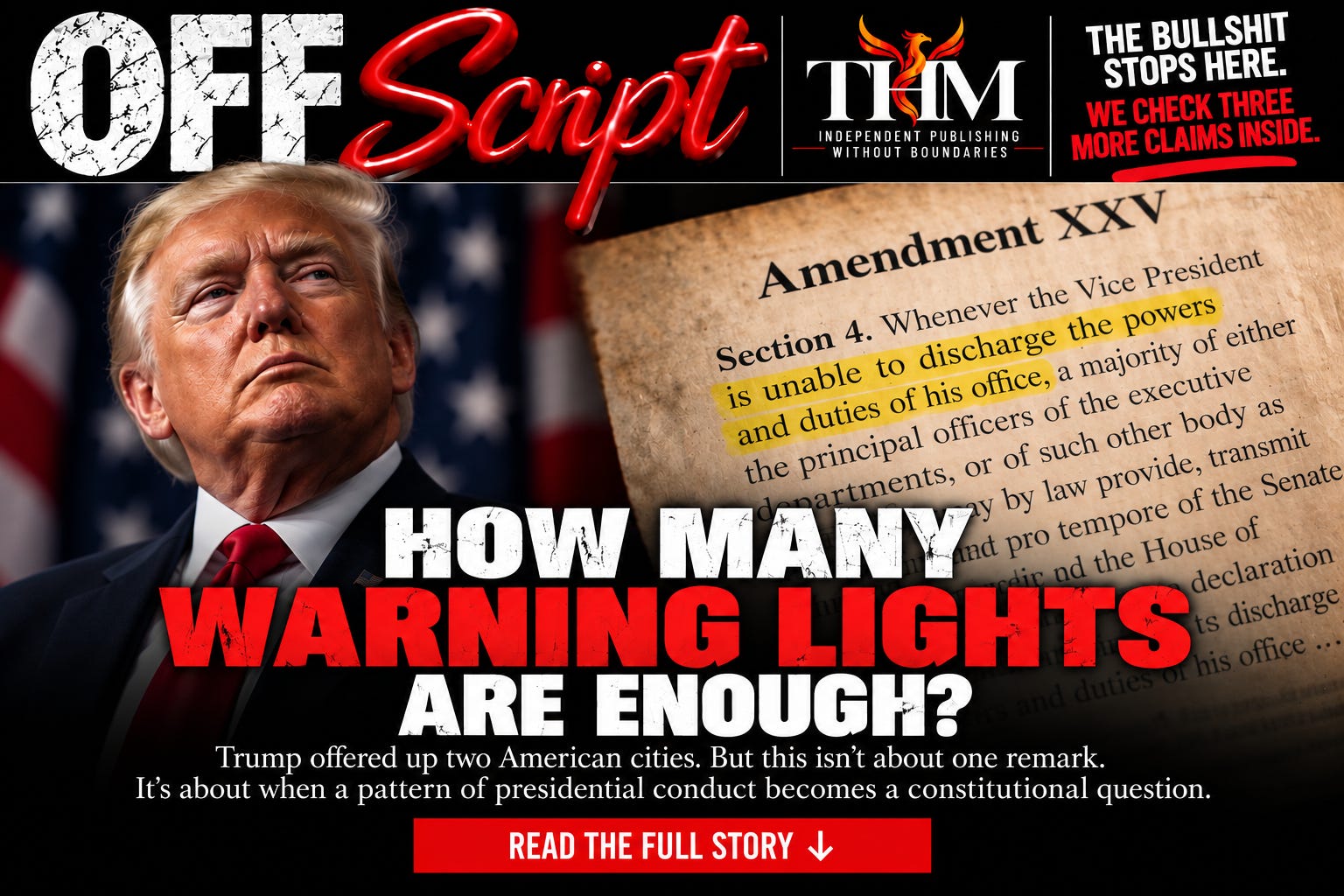
This isn’t a diagnosis of Donald Trump, and I’m not pretending I can determine somebody’s medical condition from a television screen. It’s a question about the Constitution, presidential inability, and what happens when we stop treating every new episode as though nothing happened before it.
I was going to write about Los Angeles and San Diego. Then I made the mistake of thinking about it.
Donald Trump was in Grand Island, Monday night talking about the war with Iran, higher prices, and why Americans should apparently consider those costs worth paying. “It’s a small price to pay for keeping the world safe, keeping our country safe,” Trump said.
Then he kept talking.
“They can take out a city. Let ’em take out Los Angeles. Let ’em take out San Diego.”
And the crowd cheered. (Los Angeles Times)
My first reaction was probably the same one a lot of people had: What the fuck?
My second was more specific. Why Los Angeles and San Diego? Did those cities pop into his head because they’re in California? Because they’re Democratic cities? Because Trump has spent years dividing the country into places and people who are with him and places and people who aren’t?
I don’t know, and neither does anybody else who wasn’t standing inside Donald Trump’s head Monday night, which is a place I have no particular desire to visit.
The White House says everybody is misreading him. The administration’s explanation is that Trump wasn’t advocating an attack on American cities. He was describing what Iran could do if it possessed nuclear weapons and arguing that his actions have prevented exactly that danger. (AP)
Fine. Let’s give them that argument.
It still leaves us with the president of the United States trying to make a point about protecting Americans and somehow arriving at a sentence in which Los Angeles and San Diego get “taken out.” San Diego, by the way, isn’t exactly some distant blue dot populated entirely by Gavin Newsom clones. More than 115,000 active-duty military personnel are stationed in the area. (Reuters)
And I’m not particularly interested in the inevitable argument over whether Trump was joking.
Maybe he was. Fine.
Calling something a joke doesn’t make the words disappear, and it doesn’t make the choice of joke irrelevant. We’re talking about the president of the United States discussing nuclear weapons and reaching for the destruction of Los Angeles and San Diego to make his point. If that’s supposed to be funny, somebody else can explain the joke to me.
Because the longer I sat with this, the less interested I became in why Trump picked those two cities. What bothered me more was why we’re still treating every one of these things as a separate episode.
If Off Script gives you something worth coming back for, subscribe.
It’s free, or help fund the research and tools we use every day.
If this were only about one rally speech, we’d have the usual two-day outrage cycle, everybody would retreat to their assigned corners, and we’d be done with it.
We’ve seen that movie plenty of times.
Trump says or does something extraordinary. His opponents say it’s outrageous. His supporters say it was a joke, exaggeration, taken out of context, political theater, trolling, or simply Trump being Trump. Cable television squeezes a couple of days out of it, social media has its nervous breakdown, and eventually another story arrives, and everybody moves on.
The problem with doing that over and over is that it gives every new incident amnesia. Nothing that happened before it counts.
Which brings us to what, for lack of a more scholarly term, I’m going to call the Litany of Horseshit.
I’m not talking about every offensive remark, ridiculous boast, mangled fact, or social-media tantrum. We’d be here until Christmas. I’m talking about the larger moments from this presidency that make it impossible for me to hear Monday night’s remark in isolation.
There was the war with Iran itself. American forces entered hostilities in February without a declaration of war or specific congressional authorization for the conflict, setting off a War Powers fight in Congress that has continued as the war dragged on. (Congressional Record)
There has been the administration’s running confrontation with the courts, including the extraordinary fight over deportation flights to El Salvador after a federal judge ordered them stopped. A contempt inquiry into whether administration officials defied that order has spent more than a year working its way through the courts. (AP)
There was Trump’s renewed attempt this summer to restrict birthright citizenship by executive order even after the Supreme Court had reaffirmed the constitutional protection. A federal judge blocked the new order in September, writing that “no Presidential Executive Order can undo what the Supreme Court has done.” (Washington Post)
And now, weeks before Americans vote in the midterms, Trump has refused to rule out sending ICE agents to polling places, while again invoking the possibility of using the Insurrection Act. (People)
Those aren’t four versions of Donald Trump saying something weird. They’re four very different exercises, or contemplated exercises, of presidential power involving war, the courts, constitutional citizenship and elections.
None of them, individually or collectively, proves presidential inability. Neither does what happened Monday night in Nebraska.
That’s precisely the point.
If every incident has to establish the entire case by itself, there can never be a pattern, because we’ve defined the pattern out of existence before we’re willing to look at it.
We’ve become very good at examining trees. At some point, somebody probably ought to look at the fucking forest.
And that’s how I wound up reading the 25th Amendment.
I know. I have weird hobbies.
Section 4 is the part everybody vaguely remembers from civics class, assuming their civics teacher managed to get that far before June. When the vice president and a majority of the principal officers of the executive departments determine that a president is “unable to discharge the powers and duties of his office,” they can transmit that declaration to congressional leaders and the vice president assumes those powers as acting president. (Constitution Annotated)
Most of us hear “unable” and picture something obvious: a massive stroke, unconsciousness, catastrophic injury, a president who physically cannot communicate or function.
That’s certainly part of what the amendment was designed to handle. It isn’t all the people who wrote it contemplated.
Senator Birch Bayh, its principal architect, discussed an impairment of presidential faculties serious enough that a president could no longer make or communicate the decisions necessary to perform the job. The framers resisted writing an exhaustive definition because they understood that nobody sitting in Congress in the 1960s could anticipate every possible form presidential inability might take. (National Constitution Center)
Here’s where I need to pump the brakes on my own argument.
I’m not a doctor. I haven’t examined Donald Trump, and saying something reckless, offensive, stupid, or even dangerous doesn’t automatically make a president constitutionally unable to serve. If it did, we’d need a revolving door on the Oval Office.
The 25th Amendment isn’t impeachment with a stethoscope.
The people who wrote it also made Section 4 deliberately difficult to abuse. If a president disputes the declaration and the vice president and Cabinet maintain that the inability continues, Congress eventually decides. Keeping the vice president in charge requires two-thirds of both houses. (Constitution Annotated)
And that’s exactly as it should be. A president shouldn’t lose the powers of the office because half the country thinks he’s an asshole. God knows we’d never finish an election.
But that’s where I keep getting stuck.
If we agree that one bizarre statement doesn’t establish presidential inability, what happens when the concern isn’t one statement? What happens when it’s the accumulation of statements, decisions, and behavior over time?
We almost never have that conversation because it’s much easier to litigate each incident individually. Practically anything can be explained individually. That was a joke. This was hyperbole. That was taken out of context. This was political theater. He was trolling. You just don’t understand Trump.
Maybe any one of those explanations works on any given Tuesday.
But eventually we’re doing something very strange. We’re demanding that every new piece of evidence prove the entire case by itself while refusing to consider whether the pieces mean something when you put them together.
That’s not how we evaluate much of anything else.
If your car’s dashboard lights up like a Christmas tree, you don’t pull out the owner’s manual and explain each warning light separately until you’ve convinced yourself the engine is fine. At least I don’t. Somewhere around the fourth glowing symbol, I start wondering whether pulling the damn car over might be a good idea.
And before somebody starts typing furiously, I’m not saying Los Angeles and San Diego prove Donald Trump is constitutionally unable to serve.
I’m asking something harder.
What would?
Because the Constitution doesn’t give that decision to me. It doesn’t give it to Gavin Newsom, MSNBC, Fox News, CNN, The New York Times, Trump’s supporters, Trump’s opponents, or the guy on Facebook who types entirely in capital letters.
Section 4 initially gives that responsibility to the people standing closest to the president: the vice president and the principal officers of his own administration.
Which changes the question considerably.
We spend an enormous amount of time arguing about whether Donald Trump is fit to be president. Maybe we’re asking the wrong people.
The constitutional question isn’t whether I think he’s fit or whether you do. It’s whether the people who work beside a president every day ever reach a point where their obligation to the Constitution becomes more important than their obligation to the man who appointed them.
And what exactly is that point?
A president being unconscious is easy. A president physically incapable of communicating is easy. Those are the scenarios everybody understands because there’s a clean dividing line between before and after.
Judgment is messier. Decision-making is messier. A gradual deterioration, if one were occurring, would be messier still because there wouldn’t necessarily be one cinematic moment when everybody in the Cabinet looks around the table and realizes something has happened. There might simply be yesterday, today and tomorrow, each close enough to the one before it that nobody feels compelled to pull the alarm.
That’s the uncomfortable territory the amendment’s framers left us. They didn’t give us a checklist.
They gave somebody responsibility.
And perhaps that’s why the 25th Amendment conversation almost always goes nowhere. The mechanism depends on the people whose careers, access, political futures and sometimes entire public identities are tied most closely to a president being willing to decide that protecting the presidency matters more than protecting the president.
Section 4 has never been invoked. (National Constitution Center)
Maybe that’s because we’ve never needed it. Maybe the threshold is exactly as high as its framers intended it to be.
But there’s another possibility worth thinking about.
Maybe the hardest constitutional safeguard to use is the one that requires people inside power to decide that preserving their place inside that power is no longer the most important thing in the room.
That’s what I couldn’t stop thinking about after Los Angeles and San Diego.
The cities themselves started me down this road, but they aren’t really where I ended up. What interests me now is why we keep examining moments like this as though each arrives with no history attached to it. Every new warning light gets its own explanation, its own excuse, and its own argument over context, while the rest of the dashboard somehow disappears.
At some point, the interesting question isn’t why this particular light came on.
It’s how many can be glowing before somebody finally opens the hood.
If this was worth your time, hit Like, Restack or share it. That’s how independent work like this finds new readers.
THE BULLSHIT DETECTOR
CLAIM 1
Trump says Brazil’s rapid election count shows that Detroit, Philadelphia, and California take longer because they’re rigging elections.
BULLSHIT: 💩💩💩💩💩
WHY
Brazil and the United States don’t run remotely comparable election systems. Brazil has a nationally standardized electronic system and doesn’t offer voting by mail. The United States has decentralized elections governed by different state laws, including different rules for receiving, verifying, and counting mail ballots.
No state completes its official count on election night, and taking longer to count votes isn’t evidence that anybody is rigging them.
Different systems take different amounts of time. Apparently that needed saying. (PolitiFact)
CLAIM 2
Trump says his Republican midterm convention drew 107 million views and beat the NFL game airing against it.
BULLSHIT: 💩💩💩💩💩
WHY
The numbers aren’t remotely close.
The NFL season opener between New England and Seattle averaged 25.1 million viewers. Nielsen figures examined after the convention put Trump’s first-night television and major online-video audience at only a fraction of that. Even combining the television audiences identified by media analysts leaves the convention nowhere near the football game.
The White House has pointed instead to social-media “impressions,” which aren’t the same thing as viewers. Somebody scrolling past something on TikTok doesn’t magically become another person sitting through a two-hour speech.
Apparently Nielsen hasn’t yet developed the Trump Conversion Factor. (PolitiFact | TIME)
CLAIM 3
Homeland Security Secretary Markwayne Mullin says there’s “no financial gain” for Trump from being president and that holding the office has actually cost him money.
BULLSHIT: 💩💩💩💩💩
WHY
Trump’s own financial disclosures make that difficult to square with reality.
His businesses and investments have continued producing substantial income while he’s been president, with cryptocurrency becoming an especially lucrative source. Financial reporting based on Trump’s disclosures has documented enormous crypto-related income alone.
You can argue about whether every dollar was earned because he’s president. That’s a legitimate question.
You can’t turn “Trump has made substantial money while president” into “there’s no financial gain.”
Even Trump’s paperwork won’t cooperate with that one. (PolitiFact)
The Bullshit Detector is free to Off Script subscribers and available through the Tom Hicks Media Store. Less bullshit in your life for $4.95 seems like a pretty good deal.
MORE FROM TOM HICKS MEDIA
Off Script / Blind Spot
Independent journalism, no talking points, with Blind Spot taking the deeper Sunday look at the story hiding underneath the story.
Lotus Purrspective
Human behavior explained by the household member least impressed by it.
Chart Collision
Six charts. One moment in music history. Whatever happens when they crash into each other.
Panic Room Sports
Sports analysis with receipts.
Rabbit Ears Classic TV
Classic television and the stories hiding behind the shows we thought we knew.
The Backlot Ghost
Movies leave things behind. We go looking for them.
What the Hell?
Weird stories that really happened, which is unfortunate because making them up would be less disturbing.
BUY ME A CUP OF TEA
Independent journalism doesn’t come with a research department, corporate expense account, or mysterious billionaire quietly paying the electric bill.
If something here made you think, laugh, swear at your phone or send the story to somebody else, you can help keep Off Script independent with a cup of tea.
Mostly tea. Occasionally research. Never a yacht.
ONE QUESTION BEFORE YOU GO
Forget Donald Trump for a second.
What kind of presidential conduct would convince you that the 25th Amendment had stopped being a hypothetical and become something the vice president and Cabinet were obligated to consider?
#OffScript #DonaldTrump #25thAmendment #Constitution #Presidency #Iran #LosAngeles #SanDiego #Politics #BullshitDetector #TomHicksMedia