
They’re calling it a trade story.
It isn’t.
It’s a story about what happens when nobody trusts the people writing the rules.
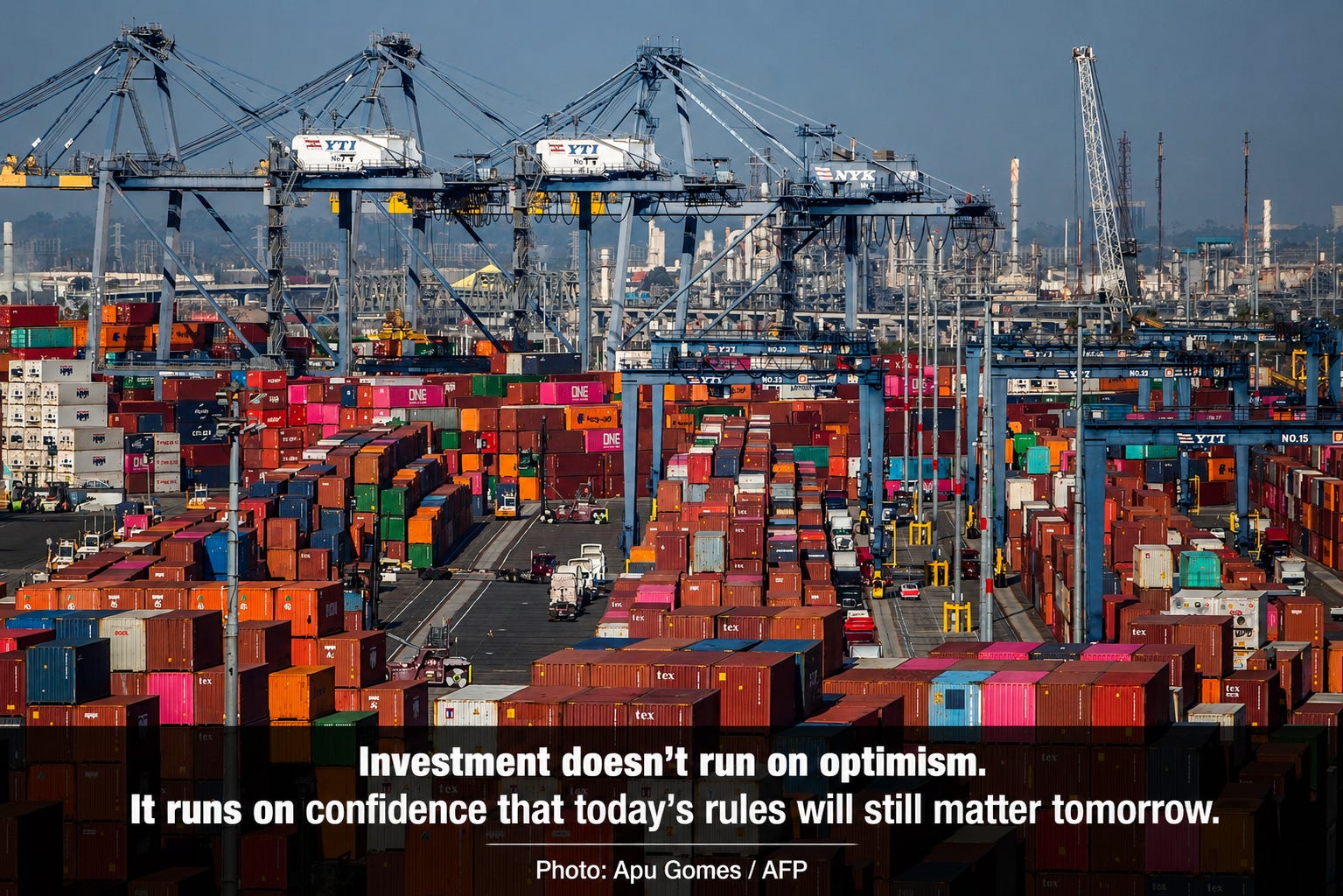
Politicians love talking about confidence.
Consumer confidence.
Business confidence.
Investor confidence.
Every election season, they drag those words onto a stage like they’re prized hunting trophies. They’ll promise to restore confidence, protect confidence, strengthen confidence, and somehow bottle confidence so everybody goes home feeling warm and fuzzy.
Then they get into office and spend the next four years making sure nobody has the faintest idea what the hell tomorrow is going to look like.
It’s one of the dumbest contradictions in American politics.
Everybody understands why certainty matters everywhere else in life. You don’t buy a house unless you’re reasonably sure you’ll still have a paycheck next year. You don’t hire another employee because you had one really good Tuesday. Hell, you don’t volunteer to host Thanksgiving if half the family might decide the night before that somebody else’s house sounds more convenient.
Long-term decisions require one simple thing.
The belief that the ground beneath your feet isn’t going to disappear halfway through the walk.
That’s true for families, businesses, and countries, which is why Washington’s recent addiction to constantly changing the rules is so damn baffling.
Somewhere along the line, our political class started confusing instability with leadership. Every new administration shows up convinced the quickest way to prove it’s serious is to rewrite something. Renegotiate something. Suspend something. Reverse something. Announce something. Delay something. Threaten something.
Then everybody gathers around trying to figure out why business investment suddenly feels like it’s moving through wet cement.
Are you really asking?
Businesses have never demanded perfection. That’s one of the biggest myths in American politics.
Business owners know governments screw things up. They plan for it. They’ve survived recessions, inflation, labor shortages, supply-chain disasters, lawsuits, changing regulations, changing tax rates, and enough bureaucratic stupidity to fill the Library of Congress.
They adapt because adaptation is part of staying alive.
Give them higher taxes, and they’ll sharpen their pencils.
Dump another stack of regulations on their desks, and they’ll complain for a week before figuring out how to make money anyway.
Raise shipping costs, and somebody in accounting starts living on coffee until they find another solution.
Business adapts. It always has.
What it doesn’t do particularly well is commit billions of dollars while the people writing the rules keep reaching for the eraser.
That’s where uncertainty becomes expensive, not because it destroys companies overnight, but because it quietly convinces them to wait.
Wait before expanding. Wait before hiring. Wait before building another factory. Wait before risking the kind of money politicians love claiming credit for after the ribbon-cutting ceremony.
Nobody campaigns on uncertainty, but Washington manufactures it anyway.
If you’re tired of headlines without context and politicians without receipts, you’re in the right place.
JOIN ME EVERY MORNING
That’s why this week’s decision to decline a long-term extension of the U.S.-Canada-Mexico trade agreement caught my attention.
Honestly, I couldn’t care less what acronym we’re supposed to memorize this year. USMCA. CUSMA. Call it Larry if it makes everybody happy. The name isn’t the story. The story is the habit.
Every administration arrives promising certainty while governing through improvisation.
Maybe this agreement gets reopened.
Maybe tariffs change.
Maybe exemptions appear.
Maybe they disappear.
Maybe somebody in Washington decides the entire strategy needs another dramatic makeover because the polling looked ugly over the weekend.
Now, imagine you’re sitting in the boardroom of a manufacturing company about to approve a billion-dollar investment. You’re buying land, hiring workers, ordering equipment, and signing contracts that won’t be finished for years.
Some of the machinery won’t even arrive until after the next election.
Then somebody walks into the room and casually says, “Before everybody signs, just remember...there’s a decent chance the rules will be different before this place even opens.”
How eager are you to write that check?
Exactly!
That’s the part politicians never seem to understand.
Businesses don’t invest in speeches; they invest in stability.
If they believe today’s rules will still exist ten years from now, they’ll build through recessions, inflation, and every other economic headache you can think of. If they believe today’s rules are just tomorrow’s campaign announcement waiting to happen, they’ll do the smart thing: They’ll wait.
And waiting turns out to be one hell of an expensive tax.
The really sneaky thing about uncertainty is that it almost never makes the evening news.
A factory closes, and that’s a headline.
Five hundred layoffs? Cameras show up before the parking lot empties.
But when a board of directors quietly decides not to build a billion-dollar plant because nobody can tell them what trade policy is going to look like two years from now, absolutely nothing happens. No ribbon cutting gets canceled because there wasn’t one to begin with. No reporter stands in front of an empty field saying, “A thousand jobs almost existed here.”
The story dies before anybody even realizes there was supposed to be one.
That’s why uncertainty is so damn expensive. It doesn’t usually wreck an economy in one spectacular explosion. It works like rust. A little here. A little there. One company delays an expansion. Another shelves a hiring plan. Somebody else decides to build a new distribution center somewhere else because, right or wrong, at least they think they know what the rules are going to be.
None of those decisions is dramatic.
Together, they become the economy.
Politicians love standing in front of factories that got built. I’ve never seen one hold a press conference in front of a factory that didn’t. Maybe that’s because invisible failures make lousy campaign commercials.
The irony in this particular story is almost impossible to ignore.
The agreement now headed for another review was negotiated during Donald Trump’s first term as the replacement for NAFTA. At the time it was sold as the durable answer. The better deal. The agreement that would finally give businesses the certainty they’d been asking for.
Six years later, we’re back asking whether it should continue.
Maybe reopening it turns out to be the right decision, or maybe it doesn’t.
That honestly isn’t what interests me. What interests me is the message.If every long-term promise starts looking like a temporary suggestion, businesses eventually stop believing the phrase “long-term” means anything at all.
And before my inbox fills up...
No, this isn’t just a Trump problem.
Democrats have done it. Republicans have done it. Washington has become addicted to governing in pencil.
Every administration arrives convinced that history begins on Inauguration Day and the fastest way to prove it’s serious is by erasing part of what came before it. Sometimes that’s necessary. Sometimes it’s overdue. Sometimes it’s politics wearing a fake mustache and calling itself leadership.
Businesses don’t have the luxury of caring why the rules changed. They just have to decide whether they trust them enough to risk billions of dollars. After a while, the private sector starts treating Washington the same way you treat that friend who’s always “five minutes away.” You stop believing him.
Think about your own life.
If your employer announced every January that your salary, health insurance, retirement plan, and vacation policy might all be completely different by March, would you buy a bigger house? Finance a new truck? Empty your savings account to start a business?
Of course not. You’d wait, keep more cash than you normally would, and you’d postpone every major decision until somebody finally stopped moving the damn goalposts.
Businesses aren’t mysterious creatures. They’re run by people: People who hate making expensive decisions when the ground keeps shifting beneath their feet.
Economists have fancy names for this. Wall Street builds mathematical models around it. Politicians commission studies trying to explain it.
The rest of us learned the lesson before we were old enough to drive.
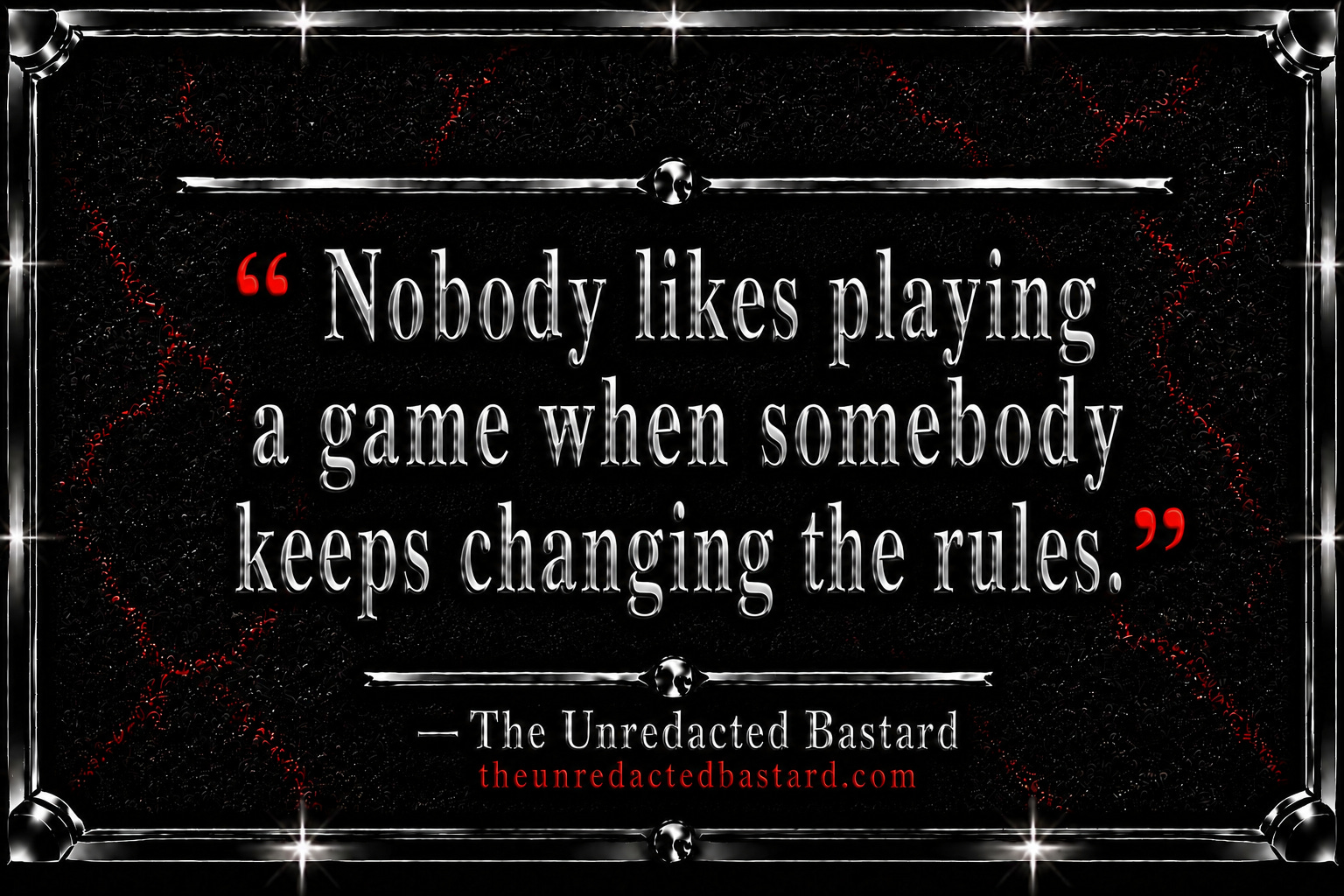
Nobody likes playing a game when somebody keeps changing the rules, and that’s exactly what Washington keeps doing. Then everybody acts surprised when hiring slows down, investment cools off, and companies decide waiting is smarter than guessing.
It’s amazing how often predictable consequences get mistaken for mysterious economic forces.
By the time politicians notice the damage, they’re usually looking in the wrong place.
They start quoting the stock market, or they point to unemployment numbers.
Somebody drags out a GDP chart. Somebody else blames the Federal Reserve. Cable news spends three days arguing over whether the economy is secretly booming or quietly collapsing, depending on which network you’re watching.
Meanwhile, somewhere in America, a company that was ready to build another plant is still sitting on the money because waiting feels smarter than guessing.
That’s the part that drives me crazy.
Washington talks about confidence like it’s something you announce.
It isn’t.
Confidence isn’t a speech.
It isn’t a slogan.
It isn’t a campaign promise.
It’s a reputation.
You earn it by proving that today’s rules will still matter tomorrow. You earn it by giving people a reason to believe a twenty-year investment won’t become collateral damage in next year’s political strategy. Most of all, you earn it by understanding that businesses don’t invest because politicians sound optimistic. They invest because they trust the people writing the rules to stop rewriting them every time the political winds change.
That’s why this trade story matters, not because Canada suddenly became more important,, or because Mexico did something unexpected, and certainly not because one administration made one decision.
It matters because it’s another reminder that we’ve become entirely too comfortable governing through uncertainty and then acting shocked when uncertainty produces hesitation instead of growth.
Businesses don’t need Washington to be perfect.
Lord knows they’ve never had that.
What they need is a government that understands stability isn’t weakness. It’s one of the strongest economic tools a country has.
Keep changing the rules in the middle of the game, and eventually, the smartest people in the room stop playing.
They don’t lose faith in capitalism; They lose faith in the people running it.
KEEP THE RECEIPTS HOT AND THE BULLSHIT DETECTOR FULLY OPERATIONAL.
If today’s article made you think a little differently about the news, consider buying me a tea. Every cup helps keep the receipts coming and the bullshit detector fully operational.
The economy doesn’t run on speeches. It runs on millions of ordinary people making extraordinary bets on tomorrow. The moment they stop believing tomorrow has rules, everybody pays the price.
ONE QUESTION BEFORE YOU GO
If you were investing your own life savings in a business that wouldn’t pay off for twenty years, how much uncertainty from Washington would you tolerate before deciding to wait?
JOIN THE BASTARD EVERY MORNING
If you’re tired of politicians demanding trust while refusing to provide stability, subscribe and join me every morning. We’ll keep following the receipts wherever they lead.
BASTARDONIA FACT
The Bastardonia Ministry of Common Sense has determined that “temporary uncertainty” has remained temporary for so long that it now qualifies as a permanent government program.
#TheUnredactedBastard #Politics #Economy #Trade #Business #USMCA #CUSMA #Tariffs #Government #ReceiptsMatter