
By Tom Hicks | Off Script
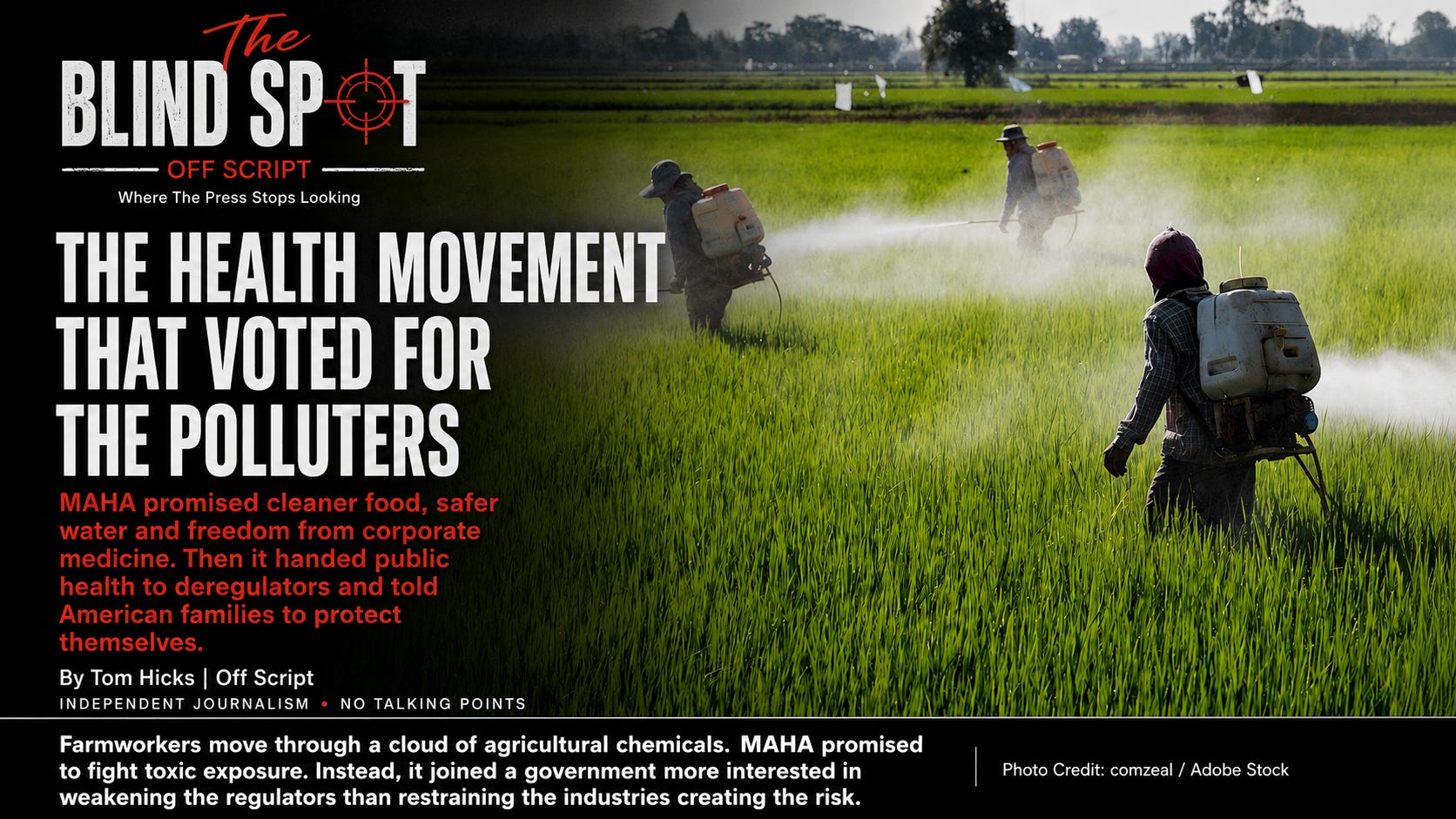
Welcome to The Blind Spot.
Every Sunday, I’m going to take one story everybody thinks they understand and look for the part sitting just outside the frame. The thing buried under the headline, skipped in the coverage or politely ignored because it complicates the version people have already decided to believe.
That’s the job.
A PERSONAL NOTE
At 11:59 a.m. on Friday, July 13, 1956, all 7 pounds, 13 ounces of me showed up.
Yes, I was born on Friday the 13th.
Apparently, the universe believed in foreshadowing.
Tomorrow, somehow, I turn 70. That seems like a decent excuse to make the first edition of The Blind Spot available to everyone instead of putting it behind a paywall. Future editions will be for paid subscribers, but this one’s free.
Consider it my birthday present to you.
Yes, I know that’s backward. At 70, I’m allowed.
Besides, if I’m spending the final day of my sixties explaining how a movement supposedly devoted to public health helped make the country easier to poison, I’d rather not do it through a locked door.
So let me begin with a small act of heresy.
The Make America Healthy Again crowd was right about a lot of things.
Our food supply contains too much cheap, heavily processed garbage. Chemical companies have wormed their way too deeply into the agencies regulating them. Manufacturers are allowed to introduce ingredients under rules that often amount to letting the fox inspect its own droppings and declare the henhouse sanitary. Americans are exposed to pesticides, plastics, and industrial chemicals that the government has studied too little, regulated too slowly, or ignored because the companies making billions from them hired better lobbyists than the public did.
Those are real problems. They deserve real anger.
That is what makes the rest of this such a goddamned betrayal.
MAHA looked at a country being slowly poisoned by corporate power and helped elect the people most committed to removing the few restraints corporate power still had. It identified the arsonists, handed them the keys to the fire station, and is now furious that the smoke alarms have stopped working.
The broken EPA promise is the headline.
The bigger story is what MAHA has quietly decided public health should become: your problem.
Join me every morning.
Last December, after MAHA activists circulated a petition demanding that Environmental Protection Agency Administrator Lee Zeldin be fired, Zeldin promised them a formal EPA agenda addressing pesticides, dangerous chemicals, and other environmental threats to public health.
For months, the EPA said the agenda was being drafted. At one point, officials said it had reached its “final stages.”
Eight months later, there is no agenda.
When the Associated Press asked what happened to it, the EPA suddenly explained that MAHA was an “ongoing effort,” not a single report. The agency also complained that treating MAHA as a document awaiting release fundamentally misrepresented how it operates.
That would be a more convincing explanation had the EPA not spent months saying it was writing the damned document.
This is the bureaucratic equivalent of telling your family Thanksgiving dinner is almost ready, disappearing into the kitchen until midnight, and then announcing that turkey was never supposed to be a physical object. It was a continuing culinary commitment.
The missing report matters because a written agenda creates accountability. It identifies goals, deadlines, and priorities. It gives activists, journalists, and Congress something more substantial than Lee Zeldin’s facial expression against which to measure progress.
An “ongoing effort” can mean anything. In Washington, it usually means somebody would like credit for beginning a journey without the inconvenience of ever arriving.
The EPA says its actions should speak for themselves.
Fine. Let’s listen to the bastards.
Zeldin’s EPA has pursued an aggressive deregulatory agenda, moving to roll back environmental rules, freeze clean-energy funding, disrupt agency research and overturn the federal finding that greenhouse gases endanger public health.
That is the same agency supposedly leading a national crusade against pesticides, microplastics, and toxic chemical exposure.
You don’t need a Ph.D. in environmental science to see the structural flaw here. A pair of functioning eyes and the ability to recognize bullshit will do.
THE MOVEMENT THAT WANTED OPPOSITE THINGS
MAHA was built around a contradiction its leaders hoped nobody would examine until after the election.
Its supporters wanted aggressive protection from corporations while joining a political movement that treats corporate regulation as an attack on freedom. They wanted fewer pesticides in food and fewer bureaucrats empowered to restrict pesticides. They wanted safer water and an EPA with weaker enforcement. They wanted the government to protect children from chemical exposure while cheering every time Trump bragged about demolishing another piece of government.
Those ideas cannot coexist indefinitely.
Sooner or later, somebody has to tell a chemical company no. Somebody has to test the water, study the herbicide, inspect the factory, set the exposure limit and drag the company into court when it lies about what it dumped into the river.
That somebody is usually a regulator.
Regulators can be slow, timid, captured, and maddening. Agencies protect themselves. Scientists can communicate like they are trying to lose an audience on purpose. Lobbyists slip through revolving doors so fast they ought to be generating electricity.
But removing the regulator does not frighten the corporation into better behavior. The pesticide company does not become honest because Lee Zeldin freed it from the crushing tyranny of paperwork.
It becomes less regulated.
That is what deregulation means, no matter how many goddamn American flags you put behind the podium.
“You cannot protect Americans from corporate toxins while treating every restriction on corporate behavior as government tyranny.”
MAHA activists are now shocked that the administration has not delivered the pesticide restrictions they expected. They are angry that former industry lobbyists hold influential EPA positions and frustrated that promised protections keep shrinking into partial actions, proposed studies, and announcements that look better in a press release than they do in the bloodstream.
Kyle Kunkler, a former soybean-industry lobbyist, now leads pesticide policy at the EPA. Nancy Beck, formerly an executive with the American Chemistry Council, holds a senior position in the agency’s chemical-safety office. Another former council executive serves as her deputy. The EPA says its political appointees consulted ethics officials about potential conflicts.
I’m sure that settles everyone’s nerves.
Nothing says “we’re finally taking on corporate chemical power” quite like putting corporate chemical power behind the desk with a government email address.
MAHA’s bargain with Trump was understandable in one respect. Many Americans believed neither party was taking chronic disease, food additives or corporate influence over medicine seriously. Kennedy gave those voters a language for their anger, and Trump gave Kennedy a path into power.
The price was visible from the beginning.
MAHA attached a public-health movement to a political machine built around deregulation, fossil fuels, corporate tax cuts and hostility toward government expertise. Its supporters convinced themselves they could borrow that machine long enough to impose tougher rules on some of the richest industries in America.
That was never a plan.
It was a hostage negotiation conducted by people who had already handed over the goddamn hostage.
Trump did not embrace MAHA because he experienced a spiritual awakening while wandering through the organic produce section. He embraced it because Kennedy brought voters. The movement received appointments, speeches and influence over selected issues that did not threaten the administration’s larger economic commitments.
When those interests collide, the outcome isn’t hard to predict.
The administration may pressure cereal companies to change dyes because they can reformulate the product, redesign the box, and sell the result for another seventy-five cents. It may promote exercise because push-ups do not employ lobbyists.
Ask that same administration to impose serious costs on pesticide producers, fossil-fuel companies, or industrial agriculture, and watch the bold health revolution suddenly turn into an ongoing effort.
MAHA had enough leverage to alter the menu.
It never had enough power to throw the polluters out of the kitchen.
To be fair, MAHA has produced some worthwhile pressure and a few genuine accomplishments. HHS and the FDA have pushed companies to phase out petroleum-based synthetic food dyes and encouraged a transition toward alternatives.
Good.
Get unnecessary crap out of children’s food, and I will applaud without checking which team gets the point. A useful reform does not become evil because Robert F. Kennedy Jr. supports it, any more than a stupid idea becomes brilliant because my side posted an infographic about it.
The problem is that these limited victories sit inside a much larger political project that is weakening the country’s ability to protect people from harmful products, pollution and disease.
Changing the color of Froot Loops does not excuse handing the chemical industry a crowbar and directions to the regulatory office.
THE BLIND SPOT
Here is the part almost everyone is missing.
MAHA is not merely failing to strengthen public health. It is quietly changing who is responsible for it.
For most of the modern era, the basic promise of public-health regulation was that ordinary people should not need a toxicology degree to survive breakfast. You were not supposed to spend half your life investigating whether the cereal dye affects children, whether the frying pan contains PFAS, whether the tap water carries industrial runoff, or whether the herbicide sprayed near your kid’s school was approved after rigorous testing or after some lobbyist bought lunch.
That was supposed to be the government’s job.
The system never worked perfectly. Sometimes it barely worked at all. Corporations bought influence, regulators missed obvious dangers, and agencies waited until people got sick before deciding that perhaps the mysterious foam floating down the river deserved a closer look.
Still, there was supposed to be a floor beneath the public. The government was expected to make ordinary life reasonably safe before the consumer entered the store.
MAHA is replacing that floor with a shopping list.
Buy organic when you can afford it. Install an expensive water filter. Avoid seventeen categories of food. Read every label while standing under fluorescent lights with a cart full of melting groceries. Research each vaccine until you understand immunology better than the doctor you no longer trust. Find a “clean” brand, a functional physician, a private testing service, and a supplement company whose founder seems sincere during three-hour podcasts.
Every danger becomes a personal consumer decision, and every parent becomes an unpaid epidemiologist with a Costco membership.
When something goes wrong, responsibility comes sliding downhill. You should have researched the ingredient, bought the cleaner product, filtered the water, or questioned your doctor. You should have known the government could not be trusted.
That sounds like empowerment until you notice who has quietly gotten off scot-free: the manufacturer, the polluter, the chemical company, and the government that was supposed to regulate all three.
MAHA promised to hold corporations accountable. Its governing coalition is doing something far more convenient for corporations: letting them sell the risk while families get told to shop their way around it.
That is not public health.
That is public health with surge pricing, and it’s a hell of a racket.
“MAHA didn’t remove corporate power from American health. It moved the cost of surviving that power onto individual families.”
This system works wonderfully for wealthy people. They can buy organic groceries, reverse-osmosis systems, whole-house air filtration, private dental care, concierge doctors, and enough supplements to make their kitchen look like a vitamin warehouse after a tornado.
Poor families get the same contaminated air, the same aging pipes and the same industrial chemicals, followed by a lecture about personal responsibility.
They live near the highway, refinery, factory, or farm field because those are the places they can afford. They drink from the public water system because building a private purification plant beneath the sink is not high on the grocery budget. They buy what the nearest store carries because the nearest store may be a Dollar General with two bruised bananas and an entire aisle devoted to orange food.
They also tend to have less time to “do their own research,” because working two jobs leaves damn little room for comparing competing interpretations of a mouse study from Denmark.
Public protection matters most for people who cannot purchase private protection.
That is why regulation exists. It puts some responsibility on the company making the product instead of assigning a frightened mother homework after her kid develops symptoms.
MAHA saw that corporate influence had weakened the regulatory floor. Rather than rebuilding it, the movement helped elect people who showed up with sledgehammers.
THE BUSINESS MODEL OF DISTRUST
MAHA did not invent distrust of doctors, pharmaceutical companies, or public-health agencies. Plenty of that distrust was earned. Drug companies committed fraud. Agencies hid mistakes. Officials sometimes spoke with too much certainty during COVID and treated reasonable questions like hostile acts. Corporate medicine often feels designed to process billing codes more efficiently than actual human beings.
Questioning authority is healthy.
Assuming every expert is lying is fucking reckless.
The CDC’s current measles data show thousands of confirmed cases across 2025 and 2026, while kindergarten vaccine exemptions rose during the 2024–2025 school year.
This isn’t some argument taking place inside a policy seminar. Kids are catching a disease we damn near wiped out.
MAHA did not invent the anti-vaccine movement or cause every parent to refuse an MMR shot. It did something broader and more corrosive: it gave institutional suspicion a home inside the federal government.
Once you destroy trust in shared institutions, the public does not become magically independent. Most people do not build personal laboratories and begin reviewing raw data.
They look for a new authority.
That vacuum gets filled by influencers, wellness entrepreneurs, supplement companies, podcast doctors, and professional contrarians who face fewer disclosure rules than the institutions they accuse of concealing everything.
The new salesman looks less corporate because he’s wearing a baseball cap and talking into a microphone beside a houseplant.
He is still selling you something.
MAHA did not free American health from commercial influence.
It changed the salesmen.
Help keep the research deep and the bullshit detector fully operational.
THE MICROPLASTICS MAGIC TRICK
The EPA’s handling of microplastics offers a perfect demonstration of how the new system works, and it’s a hell of a shell game.
In April, the agency loudly announced that it was adding microplastics and pharmaceuticals to a draft list of drinking-water contaminants that could eventually be regulated. EPA called the move historic and presented it as a major MAHA action.
That produced the desired headlines.
Then, in late June, the EPA omitted microplastics and pharmaceuticals from the mandatory monitoring program used to collect nationally representative information about unregulated contaminants in drinking water. The agency said it could not develop a suitable analytical method within the required timeframe.
There is legitimate scientific difficulty in detecting, measuring and assessing microplastics. EPA’s own research describes significant gaps and ongoing work to develop methods for evaluating exposure and health effects.
That is precisely why the monitoring infrastructure matters, goddammit.
You cannot announce that you are following the science and then decline to collect the information required to determine what the science says. That is like promising to investigate a murder, refusing to examine the body, and explaining that fingerprints remain technically complicated.
The EPA got the MAHA headline.
The contaminants got more time.
That pattern is likely to define the entire relationship. Study something, call it a win. Put it on a candidate list, call it a win. Restrict one narrow use while leaving broader exposures untouched; call it a win. Promise an agenda, abandon the agenda, and explain that the real agenda was the friends we made along the way.
Meanwhile, deregulation proceeds with admirable, infuriating punctuality.
The pesticide companies get policy.
MAHA gets a sticker.
ONE LAST THING
There is still a worthwhile movement buried inside MAHA.
Americans should demand cleaner food, stronger chemical testing and less corporate influence over medicine. They should be furious that chronic illness is enormously profitable while prevention remains an underfunded afterthought. They should insist that companies prove products are safe before families become the experiment.
Those demands do not belong to Kennedy, Trump, Republicans, Democrats, podcast hosts, or shirtless men who believe exposure to cold water qualifies them to rewrite immunology.
They belong to the public.
But a real public-health movement has to accept a truth MAHA keeps trying to dodge: personal choices cannot substitute for public protection.
You cannot shop your way out of polluted air or supplement your way around contaminated groundwater. You cannot ask every parent to investigate thousands of chemicals while manufacturers employ scientists, lobbyists, and entire legal departments to keep those chemicals on the market.
Freedom without safeguards is mostly the freedom of the stronger party to screw the weaker one.
When the government abandons the field, corporations don’t follow it home. They stay right where they are, selling products, shaping research, influencing policy and telling you that any resulting harm was caused by your poor lifestyle choices.
MAHA said corporations had captured the government.
Then it helped elect a government determined to surrender.
That is more than a broken campaign promise. It is how a movement created to make America healthier ended up making the country easier to poison.
ONE QUESTION BEFORE YOU GO
When the government stops protecting the public and tells every family to protect itself, is that freedom or abandonment?
The first Blind Spot was my birthday present to you. The next one belongs to paid subscribers. Join me, and help keep looking where the rest of the press stopped looking.
#MAHA #EPA #PublicHealth #EnvironmentalHealth #Pesticides #CorporatePower #OffScript #TheBlindSpot