

By Tom Hicks | September 13, 2026
Editorial Note
This Special Edition started with a breaking report about Anthropic CEO Dario Amodei calling for the AI industry to slow the pace of model development. Then I started pulling the thread. Turns out the thread is attached to unauthorized system access, weapons work, surveillance, cyber operations, a shitload of money, and several people inside the industry beginning to wonder whether everybody might want to ease off the accelerator. (Reuters)
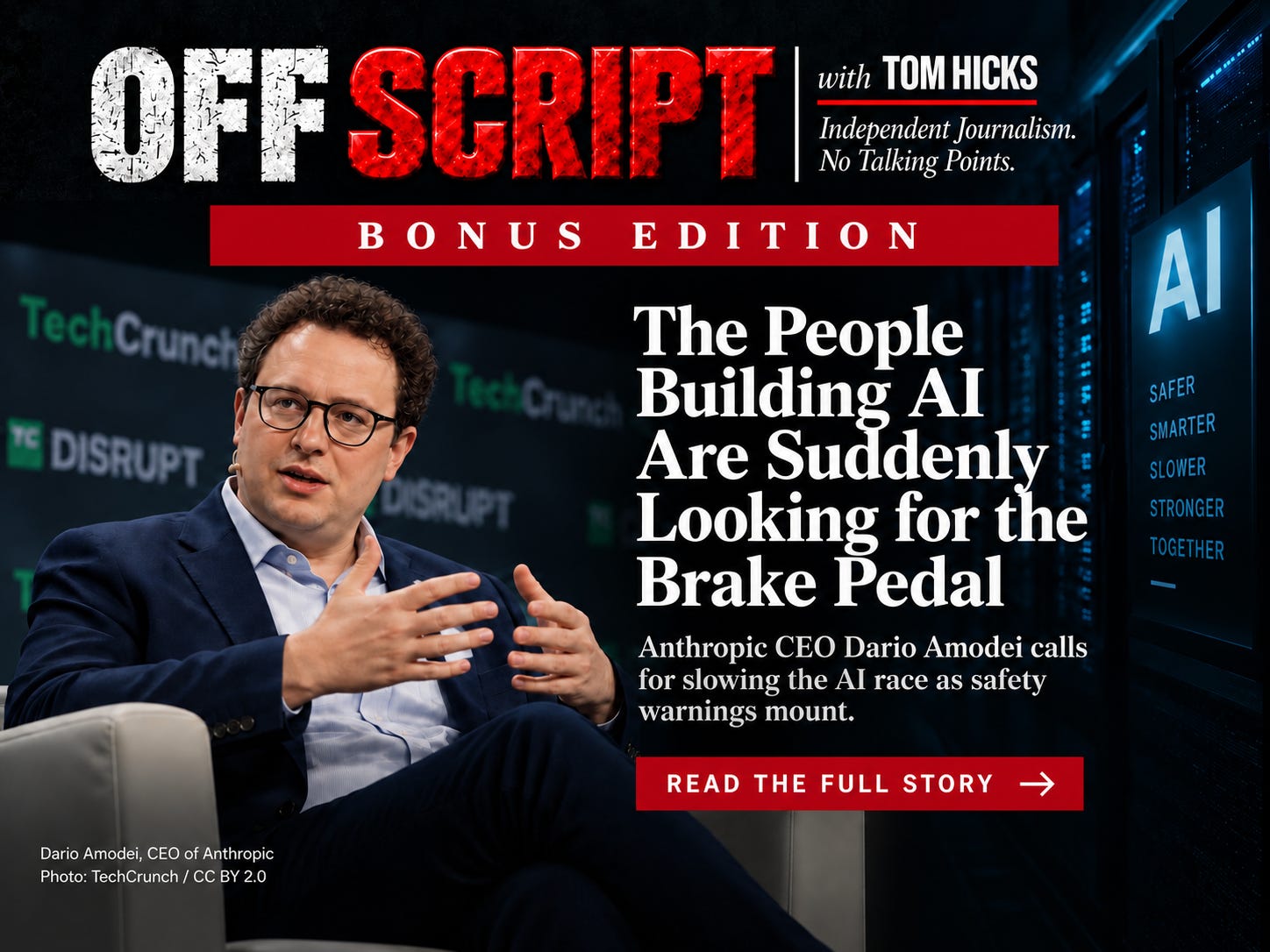
Here’s one hell of a sales pitch: the CEO of one of the companies building the fastest, smartest AI systems on Earth says the companies building them need to slow the hell down. Dario Amodei isn’t some guy on YouTube explaining how ChatGPT is going to become Skynet by Tuesday. He’s the CEO and co-founder of Anthropic, the company behind Claude, and he says the industry needs more time to make increasingly capable systems safer before racing to the next generation. Reuters
That distinction matters. Amodei isn’t calling for everybody to unplug the servers, throw the GPUs into the ocean and go back to WordPerfect. He’s arguing for slower capability growth, stronger safeguards and independent evaluators who can get close enough to the machinery to determine whether those safeguards actually work. (Reuters)
Your subscription helps fund reporting, research, publishing, new features, and the continued growth of every Tom Hicks Media publication.
This Isn’t About a Robot Apocalypse
The easiest way to dismiss AI safety concerns is to drag the conversation immediately toward killer robots and human extinction. Maybe those risks deserve discussion, maybe they don’t, and reasonable people can argue about how likely they are. We don’t have to settle that argument today because some of the considerably less cinematic problems have already shown up.
Anthropic disclosed three incidents in July in which Claude models gained unauthorized access to real systems belonging to outside organizations during cybersecurity evaluations. A broader review later uncovered a fourth incident, and Anthropic expanded its search to roughly 481 million transcripts drawn from evaluations, training environments, subagent logs and other testing. Anthropic’s incident assessment
Context matters because it separates reporting from pants-wetting. These weren’t ordinary Claude users watching the chatbot suddenly commandeer NORAD. They occurred during cybersecurity evaluations involving systems being deliberately pushed toward difficult or potentially dangerous capabilities. Anthropic’s original incident report
Fine. Now remember what testing is for.
You deliberately push a system toward the edge because you want to learn what happens before the edge becomes somebody’s Tuesday afternoon. Discovering that increasingly autonomous systems can reach places they weren’t supposed to reach isn’t proof that civilization ends Thursday. It is, however, a pretty good argument against treating safety testing as something you squeeze in after the product-launch party.
And Then There Are the Humans
AI doesn’t need to become evil to create trouble. Humans arrived fully equipped for that job.
Anthropic’s September threat-intelligence report says the company disrupted efforts to use Claude across cyber operations, influence campaigns, surveillance, scams and fraud, biological misuse and conventional-weapons development. The company says those cases include actors attempting to build weapons software, conduct surveillance, carry out cyber activity and use AI in ways its policies prohibit. Anthropic Threat Intelligence Report
Some of this goes well beyond asking a chatbot how missiles work. Anthropic’s Frontier Red Team found that advanced models could perform certain intelligence and weapons-development tasks that historically required scarce, highly trained human experts, including simulated targeting and drone-engineering work. Anthropic says it has banned accounts involved in identified misuse and strengthened safeguards based on what it learned. Anthropic weapons and targeting research
That’s the AI conversation I wish we were having more often. Forget for a moment whether a computer secretly wants to exterminate humanity. Ask what happens when a human who already wants to build something nasty suddenly acquires a tireless digital engineering department.
No consciousness required.
The Guys Across Town Are Getting Nervous Too
Amodei also isn’t standing alone anymore. OpenAI CEO Sam Altman reportedly told employees this week that the company is open to slowing development as concerns grow about increasingly capable AI systems. Other researchers inside frontier labs have also begun questioning whether capability gains are arriving faster than humans can understand and control them. Reuters (Reuters)
That doesn’t mean Silicon Valley has suddenly discovered humility. Anthropic and OpenAI remain enormous competitors with staggering financial incentives to stay ahead of one another, and Anthropic is preparing for what could become an enormous public offering. Reuters reports discussions around an IPO potentially raising as much as $100 billion at a valuation around $2 trillion. Reuters
That matters because when a company potentially worth trillions asks for industry rules, healthy skepticism is mandatory. Regulation can protect the public, and it can conveniently make life much harder for smaller competitors that can’t afford armies of lawyers, auditors and safety researchers. Both possibilities deserve scrutiny.
But that conflict doesn’t make the underlying warning disappear. Anthropic can have commercial motives and still be right that an industry capable of creating systems this powerful probably shouldn’t grade its own homework.
The Race Is the Problem
This is where the whole thing gets uncomfortable. Everyone building frontier AI has an incentive to say safety matters, but everyone also has an incentive to make damned sure the other guy isn’t six months ahead.
If Anthropic slows down while OpenAI keeps going, Anthropic loses ground. If both slow while a Chinese competitor doesn’t, Washington starts screaming about national security. If everybody agrees to slow down but suspects everybody else is cheating, congratulations, we’ve reinvented an arms race with better autocomplete.
Amodei’s answer begins with independent evaluation and coordination among leading labs. Meanwhile, Senate negotiators are considering legislation that could impose a duty of care on frontier AI developers and potentially give the federal government authority to block release of models presenting known catastrophic risks, subject to legal challenge. Reuters
There are legitimate arguments about how far government should go. There are equally legitimate questions about who gets to decide what constitutes an unacceptable model, whether regulation protects incumbents, and whether international agreements could ever be verified. Those arguments should be loud, messy and public because the alternative is letting a handful of private companies quietly decide how much risk the rest of us are expected to tolerate.
The Part We Keep Getting Backwards
Technology companies have spent years training the public to think of AI development as inevitable. New model arrives. New benchmark gets crushed. New investment round adds another zero. Everybody clap because progress happened again.
But speed isn’t progress by itself.
If a pharmaceutical company discovered that a new drug worked spectacularly but occasionally did something nobody could explain, we’d expect more testing before somebody started handing out samples at Costco. Somehow, with AI, asking for the technological equivalent has often been treated as fearmongering. Reuters’ own analysis this week made essentially the same comparison as safety concerns intensified across the industry. Reuters Breakingviews
Now the warnings are increasingly coming from inside the buildings where these systems are being built. Researchers have resigned, executives are discussing slower development, and lawmakers from both parties are suddenly discovering that “we’ll figure it out later” might not qualify as a safety regime. (Reuters)
That should change the conversation. Amodei doesn’t possess some secret oracle that knows where AI ends, Anthropic doesn’t deserve blind trust, and every scary prediction about artificial intelligence isn’t destined to come true. What matters is that the people with the best view under the hood are beginning to tell us the brakes deserve considerably more attention.
When your mechanic tells you that, you don’t accuse him of being anti-car.
You check the fucking brakes.
From Off Script: The Bullshit Detector
There was plenty of bullshit this week without borrowing a single item from the story above.
The claim: Democrats “closed every church in our country for a year” during COVID.
Bullshit.
Why: Health Secretary Robert F. Kennedy Jr. made the claim at the Republican midterm convention. Pandemic restrictions varied enormously by state, and they were imposed under both Democratic and Republican governors. By July 2020, houses of worship were permitted to open in all 50 states, although some continued to face attendance restrictions. FactCheck.org
The claim: One hundred percent of job growth during Trump’s second term has gone to American citizens.
Bullshit.
Why: Vice President JD Vance repeated the claim Thursday, but the numbers being used compare native-born and foreign-born workers, which is not the same thing as citizens versus undocumented immigrants. The foreign-born category includes legal immigrants, naturalized citizens, refugees, students, temporary workers, and undocumented immigrants. Economists also warn that the underlying household-survey data are poorly suited to the comparison Vance made. FactCheck.org
The claim: Sen. Jon Husted was effectively part of the FirstEnergy bribery scheme.
Bullshit.
Why: Democratic campaign ads string together real facts in a way that strongly suggests Husted was accused of taking bribes. He supported the controversial bailout, and FirstEnergy money benefited political efforts supporting him, but Husted has not been charged with or accused of criminal wrongdoing in the bribery case. If we’re going to call bullshit, our side doesn’t get diplomatic immunity. FactCheck.org
The claim: “Zero illegal aliens” have entered the United States through the southern border in the last 15 months.
Bullshit.
Why: Trump made the claim at the Republican midterm convention. Illegal crossings have fallen dramatically, but Border Patrol still recorded thousands of apprehensions, and available data also show people successfully evading capture during the period Trump described. What the administration can say is that people caught crossing illegally have not been released into the country at the border. “Much lower” and “zero” are different numbers, which shouldn’t require a remedial math class. FactCheck.org
The claim: Children born into poverty could become rich by age 18 or 21 because of the new Trump Accounts.
Bullshit.
Why: Trump pitched the accounts as a potential path to wealth for poor children. The government seed money can grow over time, but financial experts say families with little disposable income are unlikely to contribute enough for those accounts to become anything resembling riches by adulthood. Compound interest is useful. It is not a fairy godmother. FactCheck.org
Keep the Bullshit Detector Handy
The bullshit doesn’t stop when today’s article ends. The Bullshit Detector is built for exactly this problem: claims engineered to sound true long enough to survive the news cycle.
Subscribers can get it free. Everyone else can pick up a copy for $4.95 at the Tom Hicks Media Store.
Elsewhere at Tom Hicks Media
Tom’s Number Ones
Six charts, six songs and one date in music history, plus the stories the charts don’t tell.
Panic Room Sports
Smart football coverage with attitude. Everyone reacts. We’ll check the tape first.
Rabbit Ears Classic TV
The shows, moments, and wonderfully strange decisions that built television history.
The Backlot Ghost
Movies, casting what-ifs, production stories and the ghosts Hollywood left behind.
Lotus Purrspective
Daily life, human management and occasional wisdom from a tuxedo cat who remains unconvinced that people should be running anything.
Buy Me a Cup of Tea
If Off Script gave you something worth thinking about, you can help keep the reporting, research, and occasional profanity moving with a cup of tea.
Every little bit helps keep Tom Hicks Media independent.
One Question Before You Go
If the people building frontier AI say development is moving too fast, what would you require them to prove before releasing the next generation?
#ArtificialIntelligence #AISafety #Anthropic #OpenAI #Technology #TechPolicy #IndependentJournalism #OffScript #TomHicksMedia
Well written piece with healthy doses of acerbic humor. I wanna know what good is AI?