

By Tom Hicks
EDITORIAL NOTE: Off Script is an independent opinion publication. The reporting and public records cited below establish the facts. The conclusions, judgments, and occasional profanity are mine.
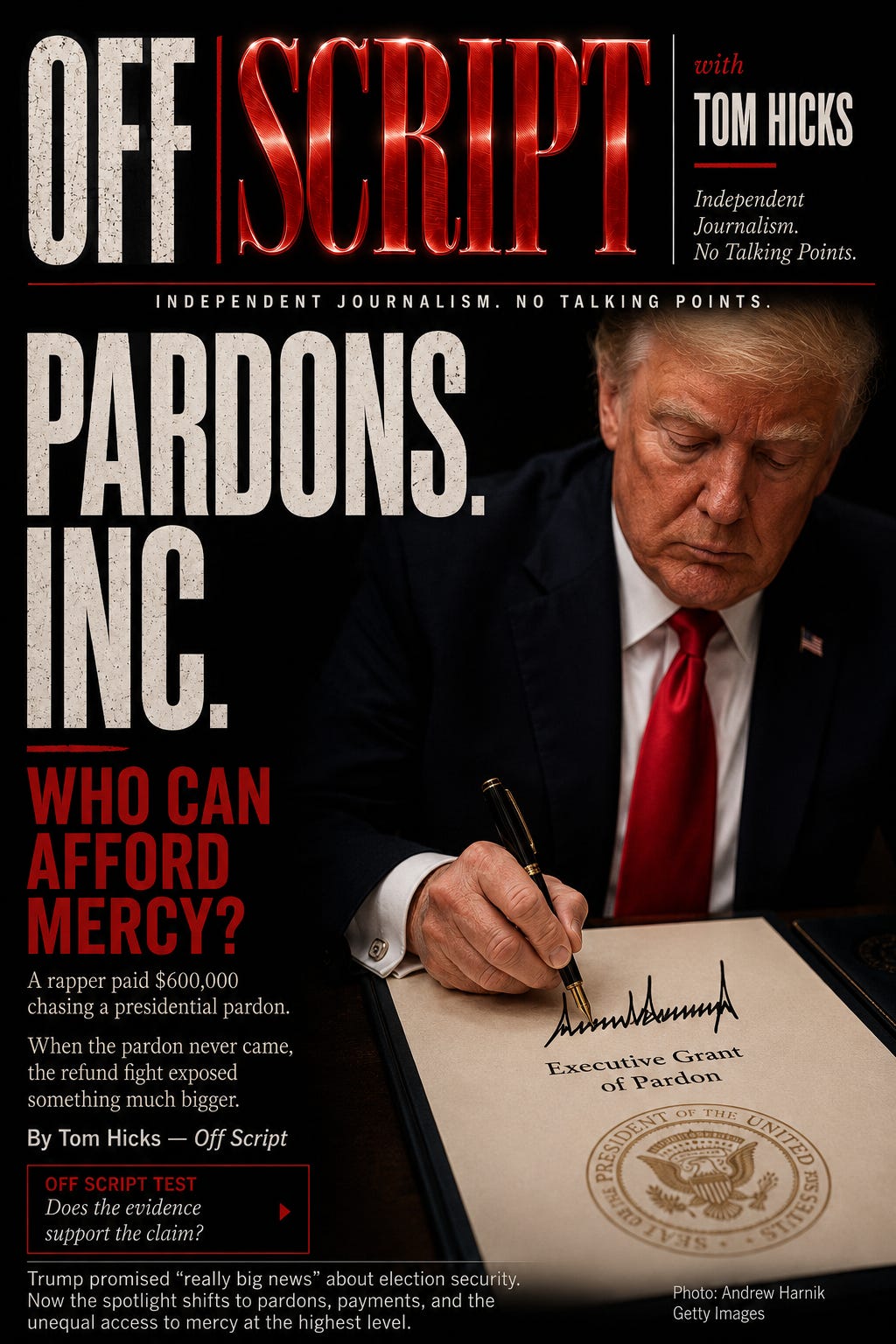
The going price for a presidential pardon is apparently $600,000.
Unless you do not get the pardon. Then, according to the contract at the center of this story, the price is supposed to drop to $300,000.
That is the position rapper Boosie Badazz now finds himself in after paying a Washington lobbying firm to pursue a pardon from Donald Trump. The pardon never arrived, and Boosie, whose legal name is Torence Hatch, has gone to arbitration trying to recover half of what he paid. It would be easy to laugh at the whole thing as a celebrity getting fleeced by a pair of notorious political operators.
That would also miss the point.
Boosie is not the scandal here. He is the customer whose transaction went bad badly enough that the rest of us got to see the receipt.
According to reporting by Jasmine Wright and Taylor Giorno of NOTUS, Hatch paid JM Burkman & Associates $600,000 in September 2025 to lobby for a pardon related to his federal gun conviction. The firm is run by Jack Burkman and Jacob Wohl, two men whose political résumé already included hoaxes, a fraudulent robocall scheme, criminal guilty pleas, and millions of dollars in Federal Communications Commission penalties. Hatch’s lawyers say the agreement required the firm to return $300,000 if no pardon was secured by January 1, 2026. Burkman’s firm disputes that interpretation and says it performed substantial work on Hatch’s behalf. (NOTUS)
The arrangement was not hidden in a back alley or conducted with cash stuffed into a paper bag. Federal lobbying disclosures showed the firm reporting Hatch’s $600,000 payment as part of $3.2 million in lobbying revenue during 2025. This was a documented Washington business transaction, carried out by people who apparently believed presidential clemency could be pursued the same way corporations pursue tax breaks, defense contracts, or favorable regulations. (NOTUS)
That distinction matters. There is no public evidence that Trump personally accepted money from Hatch or agreed to exchange a pardon for payment. Saying Trump sold Boosie a pardon would go beyond the reporting and hand the White House an easy way to dismiss the entire story.
The documented truth is plenty ugly without embellishment.
A lucrative industry has grown around people who claim their political connections, personal relationships, and proximity to Trump can improve a client’s chances of receiving clemency. The product being sold may not be the pardon itself. It is access to the one man who can grant it, and in Trump’s Washington, access has become close enough to a currency that wealthy defendants are apparently willing to spend fortunes trying to buy it.
Hatch says the people he hired did more than promise to advocate for him. Messages described by NOTUS allegedly gave his legal team the impression that the pardon was moving through the White House and was nearly complete. At one point, Burkman reportedly claimed Trump had the pardon document “in hand and is ready to sign.” The pardon never appeared, and the White House later told reporters it had no record of receiving the application the firm supposedly pursued. (NOTUS; The Guardian)
There is a darkly funny version of this story in which Boosie paid six hundred grand to two men with a public history of political scams and then discovered they might not have the influence they claimed. He would hardly be the first rich person to learn that Washington is full of men whose connections grow considerably stronger during a sales pitch.
The funny version stops being funny when you ask why the pitch sounded believable.
Why would any serious lawyer, wealthy defendant, celebrity, or business executive believe that hiring the right Trump-adjacent operator could move a pardon application closer to the president? Why would someone think a visit to Mar-a-Lago, an introduction at a political event, or a well-placed phone call might matter more than a formal petition built on remorse, rehabilitation, proportionality, or justice?
Because Trump has taken Washington’s old access racket and stripped away much of the polite camouflage.
In an NPR interview with Ayesha Rascoe, Wright described a pardon economy in which people seeking clemency are encouraged to use anyone they know near the president, make their interest known to Trump’s circle, and find a way to get physically in front of him. Some are reportedly advised to visit Mar-a-Lago. The strategy is less about navigating a neutral legal process than navigating one man’s social and political orbit. (NPR/WUNC)
That does not automatically make every lawyer or lobbyist working on a pardon corrupt. People facing prison have always hired attorneys to prepare clemency petitions and advocate for relief. A lawyer can investigate the case, gather evidence of rehabilitation, identify sentencing disparities, and present an argument to the Justice Department or White House. There is nothing inherently improper about paying for competent representation.
The problem begins when legal advocacy becomes indistinguishable from purchasing proximity.
NOTUS reported in October that lawyers, lobbyists, longtime Trump allies, and political intermediaries were charging enormous sums to pursue clemency, with some arrangements reaching into the millions. People familiar with the process described competing pardon factions inside and outside the administration, while some figures in Trump’s orbit reportedly worried about the network making money from the business. By January, federal lobbying records showed pardon-related operatives collecting millions, including nearly $1.1 million paid by interests connected to a man Trump eventually pardoned. (NOTUS; NOTUS)
That last fact proves neither bribery nor a direct purchase. A person can spend a million dollars on advocacy, receive a pardon, and still leave no evidence that the president agreed to a transaction.
It does prove that the market exists.
People with money believe expensive political help can change their odds. Lobbyists believe the service is valuable enough to charge staggering fees. The president’s allies, acquaintances, donors, club members, and unofficial emissaries become potential doors into a constitutional process that was never supposed to depend on who could afford the best doorman.
The formal federal process looks very different. The Justice Department’s Office of the Pardon Attorney receives clemency applications, investigates them, and provides recommendations to the president. The department describes a process in which an applicant applies, the government investigates and recommends, and the president makes the final decision. Presidents have relied on the pardon attorney’s neutral advice for more than 130 years, although that advice has never limited the president’s constitutional authority. (U.S. Department of Justice; U.S. Department of Justice)
Trump is legally free to ignore every bit of it.
Article II gives the president the power to grant reprieves and pardons for federal offenses, except in impeachment cases. The Constitution does not require a president to follow Justice Department recommendations, explain his reasoning, consider a petitioner’s remorse, or use any particular standard at all. The power is intentionally broad because the founders believed a rigid justice system needed a human escape valve. (Constitution Annotated)
That breadth is exactly why the character of the person exercising it matters so much.
The pardon power cannot be reduced to an algorithm. It requires judgment. A president may confront an excessive sentence, a prosecution distorted by politics, a defendant who has genuinely changed, or a law that produced an unjust result. Mercy sometimes requires a decision no bureaucracy is brave enough to make.
But mercy and favoritism are neighbors. Without transparency, they can become impossible to tell apart.
When the formal process loses influence and personal access gains it, the public has no reliable way to know whether a pardon was granted because the case deserved another look or because someone found the right millionaire, lobbyist, donor, dinner guest, or golf-club acquaintance. The pardon itself may remain perfectly legal. The suspicion surrounding it does not disappear merely because no criminal statute was broken.
According to NOTUS, Trump and people around him wanted to accelerate the pace of pardons, while pardon attorney Ed Martin lost influence over parts of the process to the president and his inner circle. Internal factions reportedly argued over how clemency should be handled and who should control access to Trump. The result was described by people involved as chaotic, highly personal, and vulnerable to competing influence campaigns. (NOTUS; NOTUS)
Translation: the guardrails were not merely weak. They were treated as optional furniture.
That may be constitutional. It is also reckless.
The president does not own the pardon power. He temporarily holds it on behalf of the country. It is not a loyalty reward, a fundraising tool, a favor for friends, or a luxury concierge service for defendants with enough money to reach Palm Beach. The fact that the Constitution gives the president enormous discretion does not turn every use of that discretion into an honorable one.
Trump’s mass clemency for January 6 defendants showed the other side of the same system. On returning to office, he granted pardons or commutations to more than 1,500 people charged in connection with the attack on the Capitol. Those pardons did not require six-figure lobbyists because political loyalty had already supplied the access. Clemency became a sweeping reward for a group Trump had spent years describing as victims and patriots, including people convicted of assaulting police officers. (Lawfare)
Lawfare reported in June 2026 that at least 97 people who received January 6 clemency had also been arrested, charged, or convicted in separate criminal matters since participating in the riot. The cases ranged widely and do not prove that the pardons caused later misconduct. They do show how little individual scrutiny was involved in a blanket act of political mercy. (Lawfare)
At the expensive end of the system, people pay lobbyists millions hoping to reach Trump.
At the political end, entire groups receive clemency because Trump has adopted their cause as his own.
Different customers. Same governing principle.
The decision flows from personal access, usefulness, loyalty, celebrity, or political identification rather than a process the public can examine and trust. Sometimes the person pays. Sometimes the person has already paid in devotion. Either way, the neutral machinery of justice becomes secondary to the president’s personal judgment and appetite.
That is where the Boosie story lands much harder than a simple tale about a rapper demanding a refund.
Boosie may have been misled. He may prevail in arbitration. The firm may prove it performed exactly the work it promised. None of us has seen all the evidence, and the dispute will have to be resolved on the contract and the facts.
But the central fact is already sitting in public view: a man paid $600,000 because he believed connected Washington operators could help obtain mercy from the president of the United States.
Nobody involved seems to have found the premise absurd.
That is the scandal.
Congress probably cannot place meaningful substantive limits on the president’s pardon power without a constitutional amendment. It could require more disclosure from lobbyists, improve reporting around clemency advocacy, demand publication of pardon applications and recommendations after decisions are made, or expose who received money to influence the process. Any reform would have to respect the president’s Article II authority, but respecting the Constitution does not require keeping the public blind.
Sunlight would not prevent a president from issuing a rotten pardon.
It would make the rot easier to see.
Trump has spent years converting public institutions into extensions of his personal court. Loyalty outranks competence. Proximity outranks procedure. Rules remain in place until they interfere with what he wants, at which point they become somebody else’s problem.
The pardon market is what grows naturally in that soil.
When everyone understands that one man decides and that one man responds to personal relationships, public flattery, political allegiance, celebrity, grievance, and face-to-face appeals, a market will form around reaching him. Washington did not need a written price list. It only needed a president who made access seem more valuable than process.
Boosie paid $600,000 and got nothing.
The country may be paying considerably more.
THE OFF SCRIPT BULLSHIT DETECTOR
Political influence usually hides behind respectable language: advocacy, consulting, relationship management, strategic access. The Off Script Bullshit Detector is a practical guide to spotting the tricks politicians, pundits, and professional bullshit artists use to make corruption sound ordinary.
It is free for paid Off Script subscribers and available to everyone else for $4.95 through the Tom Hicks Media Store.
SUBSCRIBE TO OFF SCRIPT
This publication follows the reporting wherever it leads, including the places political parties would prefer nobody look too closely.
Subscribe to Off Script with Tom Hicks for independent journalism, commentary, and analysis without party scripts or cable-news talking points.
Join me every morning.
ONE QUESTION BEFORE YOU GO
Should every person paid to seek a presidential pardon be required to disclose the client, the amount, the officials contacted, and the arguments made?
Tell me what you think in the comments.
BUY ME A CUP OF TEA
Independent work takes time, research, and a stubborn refusal to pretend obvious bullshit is normal. Buy Me a Cup of Tea. You can help support it by clicking.
ONE LAST THING
The Constitution gave the president the power to forgive.
Trump’s Washington figured out how to send an invoice.
#OffScript #DonaldTrum #TrumpPardons #PresidentialPardons #Clemency #PayForPlay #Corruption #RuleOfLaw #JusticeDepartment #January6 #WashingtonLobbying #IndependentJournalism