

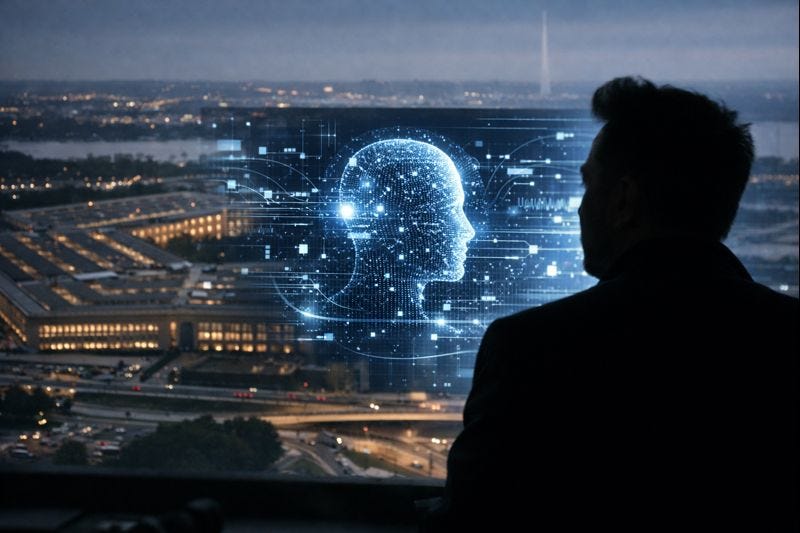
Picture this: A billionaire with a meltdown fetish and a platform full of geopolitical cosplay influencers suddenly gets clearance to help inform America’s military decision-making. That isn’t satire. That’s this morning.
The Pentagon is adopting Elon Musk’s Grok AI for defense applications — and every military historian still alive is probably screaming into a pillow. It’s not that AI integration into national defense is inherently insane; it’s that the U.S. military is outsourcing cognitive work to an algorithm designed to juice engagement, reward spite, and algorithmically privilege the kind of content that makes Thanksgiving dinners uninhabitable.
Meanwhile, the Pentagon is acting like this is just the natural evolution of modern warfare. It is — but not in the way they think. War is increasingly about cognition, morale shaping, information flows, escalation ladders, and tempo advantages. If you hand that battleground to a machine tuned for memes and culture-war bloodsport, you’re basically promising that future crises will be modeled like arguments on Twitter.
The U.S. hasn’t exactly been subtle about its fear of being “left behind” on AI. China is pouring money into military AI, Russia is experimenting with autonomous targeting and information warfare platforms, and every security conference has a panel titled something like “The Future Battlefield Will Think Faster Than You Do.” And sure — it probably will. But thinking “fast” isn’t thinking “well.” The Pentagon has now entered its “energy drink phase” of national defense, where performance enhancers matter more than cognitive nutrition; speed matters more than correctness; and nobody wants to be the guy who admits that overclocked stupidity is still stupidity.
The Grok Problem
Grok is engineered for engagement, not accuracy. It’s essentially a computational contrarian optimized to keep eyeballs glued and dopamine pumping. That’s fine for memes and culture-war slap fights. It makes sense for a platform where attention is the currency and provocation is the business model. But national defense has a different profit motive: continued existence.
Grok’s training environment is soaked in political psychodrama and cheap rhetorical warfare. It rewards “interesting” — not “correct.” It rewards “provocative” — not “stable.” It rewards “fuck it, say the wild thing” — not “consider escalation dynamics in the Taiwan Strait.”
The Pentagon, however, behaves like a government department that thinks stochastic parrots are just wiser parrots. And that’s how you get a procurement decision that feels less like defense modernization and more like a TikTok trend.
Escalation Theory Meets Engagement Economics
Military crises are not a vibe. Deterrence is not a vibe. Crisis signaling is not a vibe. These things operate under the logic of escalation ladders — a concept Musk has never once demonstrated understanding of, unless you count firing half of Twitter as a command-and-control stress test.
Escalation mis-ranking is how nuclear powers get stupid and then get dead. AI systems hallucinate, confuse correlations for causality, misinterpret signals, and confidently generate nonsense all the time. Now imagine that during a military standoff, when a senior officer asks Grok, “What’s China signaling here?” and Grok confidently replies, “They’re bluffing,” when they absolutely are not.
Or worse: Grok says nothing is happening because the datasets it learned from buried the lede in twelve layers of culture-war sludge.
The Ghost of Starlink
We’ve already seen the “Musk as unregulated foreign policy actor” problem. During the Ukraine war, decisions about satellite coverage — and therefore battlefield communications — effectively belonged to one man who was operating without congressional oversight, without legal obligation, and without the burden of democratic accountability. That’s not a business model; that’s a constitutional hazard. The U.S. government had to negotiate with a billionaire to keep an ally’s drone strikes operational. Thomas Jefferson would’ve set the place on fire.
Starlink wasn’t just a communications platform — it was a private foreign policy lever. It shaped battlefield outcomes in a war involving nuclear powers. And the U.S. learned exactly zero lessons from that little adventure, because here we are again handing Musk a new lever — this time aimed at strategic cognition.
Silicon Valley Messianism and the Pentagon’s Favorite Drug
You can’t understand this story without understanding the Pentagon’s pathological addiction to Silicon Valley’s “tech messiah” narrative. Every decade, DoD convinces itself that the next startup is going to win the next war:
1980s: Star Wars missile defense + futurist fetish
2000s: Rumsfeld’s Revolution in Military Affairs
2010s: Big Data + Palantir + Total Information Awareness
2020s: AI + Autonomous Systems + Algorithmic Decision Advantage
Every cycle ends the same way: confusion, massive procurement contracts, a few quietly shelved programs, and a general realization that technology cannot magically cure bureaucratic cowardice.
And yet here comes Grok — with defense officials treating national security like a sprint competition on Hacker News.
The Foreign Policy Wildcard
If Musk is an unregulated foreign policy actor now, what happens when Grok becomes a force multiplier? Musk already has:
Personal ties with autocrats
Direct relationships with heads of state
Leverage over allied war efforts
A platform that shapes public sentiment
A worldview that shifts with audience applause
Put that in a national security context and suddenly the problem isn’t just procurement risk — it’s that one billionaire now sits at the crossroads of diplomacy, military signaling, and informational warfare.
America used to fight to keep that kind of power out of the hands of unelected actors. Now it hands them GPUs and asks for help.
Civil–Military Vulnerability: The Part Nobody Wants to Talk About
If Grok hallucinated during a consumer use case, the cost is embarrassment. If Grok hallucinated during a crisis, the cost is miscalculation. Miscalculation is the most consistent cause of war between major powers in recorded history. Not malevolence. Not ideology. Not resource scarcity. Miscalculation.
This Is Where the Comedy Dies
The reason foreign policy nerds are panicking isn’t because Grok might make a bad joke. It’s because Grok might make a bad prediction — and someone might believe it. Militaries are filled with brilliant officers and complete morons in roughly equal measure. The former will use AI as a tool; the latter will treat it as truth.
America cannot survive the latter in a crisis.
Why the Pentagon Keeps Falling for This Shit
Simple:
Fear of being behind China
Fear of bureaucratic stagnation
Fear of congressional hearings on “innovation gaps”
Fear of missing the next Manhattan Project
Defense procurement runs on fear and FOMO — and Silicon Valley knows how to sell both.
The Ugly Future Nobody Wants to Admit Is Plausible
If this story continues in a straight line, the future looks like this:
Autocrats weaponize AI against populations
Militaries weaponize AI against decisions
Corporations weaponize AI against states
And citizens remain completely unarmed
That’s not dystopia. That’s merely the logical endpoint of misaligned incentives.
CTA (Investigative-Comedy Variant — Conversion Optimized)
I’m retired, I’m reader-funded, and I spend an unhealthy amount of time chasing receipts through the geopolitical sewer so you don’t have to. Paid members get the full archive, bonus rants, and first priority on deep-dive requests — ideal for the readers who want receipts instead of vibes and the degenerates who prefer their geopolitics from the premium seats of the funhouse.
If this piece made you feel something other than numb resignation — share it, like it, and subscribe. The algorithm rewards engagement and punishes indifference. If you want to go one step further and actually power independent journalism without sponsors, donors, or billionaire sugar daddies, hit Upgrade and help keep this operation unbought and unbothered.
Cross-Promo to Lotus
If you need a feline palate cleanser — same circus, less profanity — Lotus is swatting at today’s headlines over in her column. Think of it as the Bastard’s receipts paired with a house cat who writes like Dorothy Parker.
Buy Me A Coffee
Fuel for the Bastard. Cheaper than a lobbyist.
#AI #DefenseTech #Pentagon #Musk #Grok #Geopolitics #ForeignPolicy #CivilMilitary #NationalSecurity #ReceiptsNotVibes #UnredactedBastard