Editorial Note
I think one of the dumbest myths we’ve ever convinced ourselves of is that money problems stay neatly inside your checking account.
As if financial hardship is just numbers.
As if it’s just “making a budget.”
As if the only thing being affected is your credit score.
Bullshit.
Anybody who’s spent years wondering whether the rent check is going to clear knows that’s not how it works. You don’t leave financial stress on the kitchen table when you head to work. You carry that son of a bitch around with you everywhere. It rides shotgun in the car. It sits next to you while you’re trying to watch television. It climbs into bed with you at night and starts whispering around two o’clock in the morning.
Now there’s growing evidence that it may be doing something else while it’s there.
It may be aging your brain.
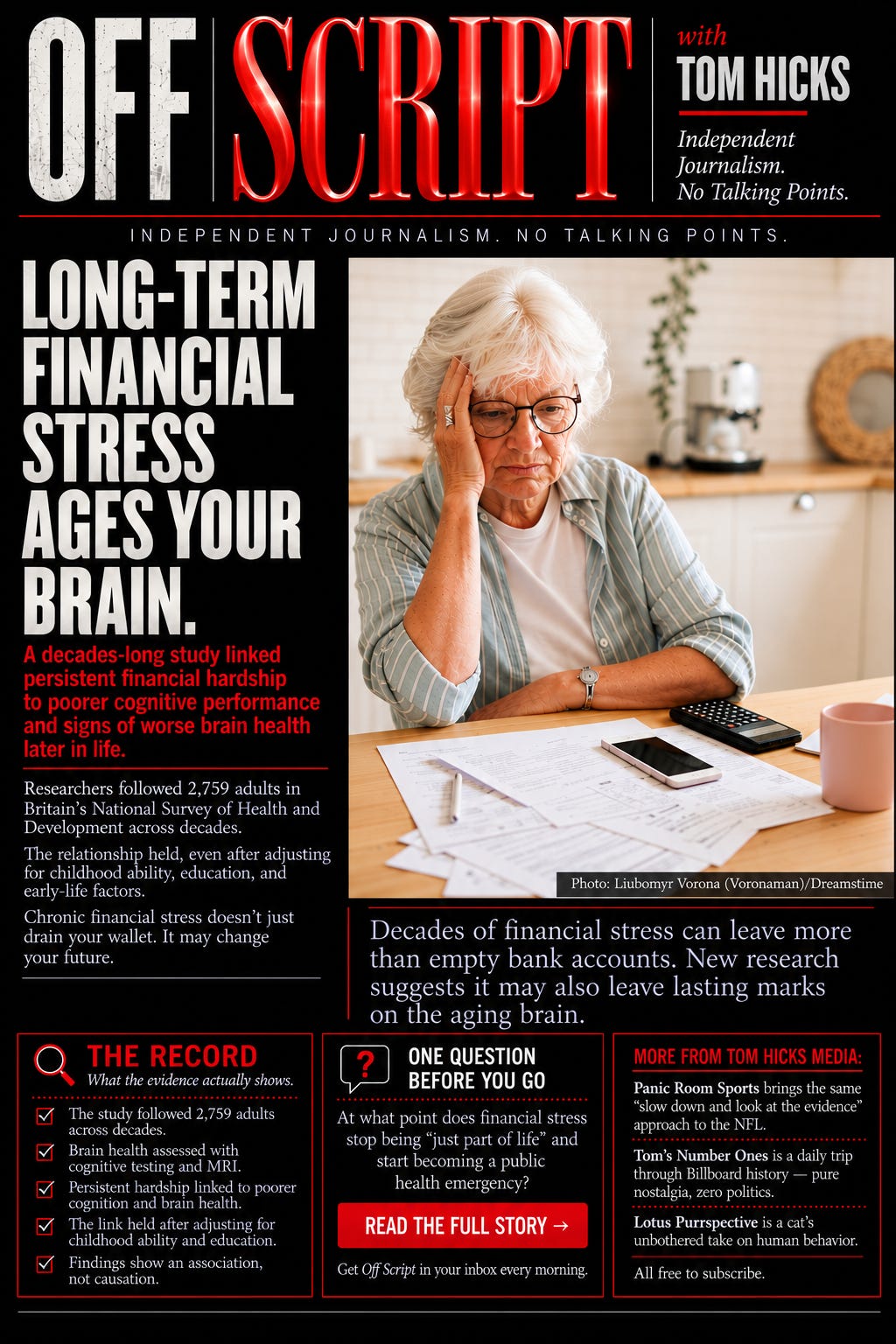
Researchers at University College London recently published findings from one of the longest-running health studies in the world, following more than 2,700 people born in Britain in 1946. Instead of looking at whether someone had a bad financial year or got laid off once, they tracked decades of economic hardship and then compared those experiences with cognitive testing and, for many participants, MRI brain scans later in life. The people who spent years living with persistent financial hardship consistently showed poorer cognitive performance and signs of worse brain health as they reached their late sixties and early seventies. (University College London, Nature Mental Health)
That’s one hell of a finding.
Because we’ve built an entire political culture around the idea that money is mostly a reflection of character. If you’re doing well, you must be smart, disciplined, and hardworking. If you’re struggling, well... maybe you should’ve skipped Starbucks. Maybe you should’ve learned to code. Maybe you should’ve pulled yourself up by those magical bootstraps politicians are always talking about.
Funny thing about bootstraps: they don’t pay for chemotherapy. They don’t replace a transmission. They don’t keep your landlord from raising the rent another four hundred bucks because the market says he can. And they sure as hell don’t stop your brain from spending the next twenty years living in a state of low-grade panic.
Subscribe Before We Go Any Further
If you’re tired of hot takes pretending to be journalism, subscribe to Off Script with Tom Hicks. Every morning we dig into what the evidence actually says, not what somebody’s favorite cable network wishes it said.
Paid subscribers also receive The Bullshit Detector, my guide to spotting propaganda, statistical nonsense, and political sleight of hand before it wastes your time. It’s included with a paid subscription or available separately for $4.95 through the Tom Hicks Media Store.
Here’s what really caught my attention.
The researchers weren’t asking whether people worried about money. Hell, everybody worries about money once in a while. Your furnace dies in January. Your dog decides to eat something that requires an emergency trip to the vet. Life has a sick sense of humor sometimes.
They were looking for something much different: persistence. Not a bad month. Not a rough year. Years of financial hardship. Decades of it. The kind of economic stress that stops being an event and simply becomes the background music of your life.
The people whose lives were marked by chronic financial hardship didn’t just score a little lower on memory and thinking tests. Among those who received MRI scans, they also showed more evidence of brain changes associated with aging, even after researchers accounted for childhood intelligence, education, and other early-life factors that critics usually point to as alternative explanations. (University College London, Nature Mental Health)
Now, before somebody clips one paragraph out of context and starts yelling that I’m claiming poverty directly causes dementia, let’s slow down.
That’s not what this study says.
It’s observational research. It identifies a strong association, not direct proof of cause and effect.
But here’s the thing. When you’ve got decades of data, you’ve controlled for a pile of obvious explanations, your findings line up with what we already know about chronic stress, sleep disruption, cardiovascular disease, and cortisol, and the relationship still hangs around, you don’t just shrug and move on. You start asking why.
And I think most people who’ve actually lived through financial hardship already know the answer. Poverty isn’t just expensive. It’s exhausting. People who’ve never experienced it tend to imagine financial stress as an occasional argument over bills, but it doesn’t work that way. It’s a full-time job you never applied for and can’t quit.
You’re standing in the grocery store doing arithmetic in your head because chicken costs more than it did last week. You’re hoping the debit card doesn’t get declined while pretending to study the candy rack so nobody notices you’re dying inside. You’re putting off going to the doctor because maybe whatever’s wrong will magically fix itself by payday. You’re driving a car that sounds like it’s auditioning for a demolition derby because replacing it isn’t even a fantasy anymore.
Then somebody on television tells you to think positive.
I’d like five minutes alone in a room with that asshole.
The point is that every one of those moments costs mental energy. Not once. Not twice. Every damn day. Every decision becomes a calculation. Every purchase becomes a negotiation. Every unexpected expense feels like somebody just pulled the pin on a grenade and rolled it into your living room.
That’s not simply stress. It’s cognitive workload. Every bill, every grocery trip, every doctor’s appointment you put off, every unexpected expense forces your brain to solve one more problem before it can move on to the next one. If you keep asking a human brain to operate under those conditions for twenty or thirty years, should we really be surprised when it starts showing the wear?
What We Think We’re Measuring
One of the reasons I can’t stop thinking about this study is that it quietly blows a hole in one of America’s favorite myths.
We’ve convinced ourselves that income is basically a report card. If somebody’s doing well financially, we assume they’re disciplined, hardworking, and making all the right decisions. If somebody’s struggling, well, there has to be a reason, right? Maybe they didn’t work hard enough. Maybe they made bad choices. Maybe they bought too much dumb shit. We don’t know the first thing about their lives, but somehow we’re always ready to hand out grades.
And before somebody decides I’m arguing that personal responsibility doesn’t matter, save yourself the keystrokes. Of course it matters. If you blow your paycheck at the casino every Friday night or finance a garage full of toys you can’t afford, those decisions have consequences.
But that’s the easy example.
Life usually isn’t that simple.
Sometimes the factory you’ve worked at for twenty years shuts down. Sometimes your spouse gets sick. Sometimes you get divorced after thirty years and discover that maintaining two households costs a hell of a lot more than maintaining one. Sometimes inflation eats your raise before you ever see it. Sometimes your landlord decides another four hundred dollars a month sounds about right because somebody else will probably pay it if you won’t.
You can make responsible decisions every single day and still spend years trying to catch up to a finish line that keeps moving.
That’s the part people who’ve never lived it don’t always understand.
Financial hardship isn’t just about having less money. It’s about having less room to breathe. Every decision gets heavier because every mistake gets more expensive. A flat tire isn’t an inconvenience anymore. It’s a budget crisis. A trip to the emergency room isn’t just frightening. It’s another bill you’ll still be looking at long after the stitches come out. Before long, you’re not planning next summer’s vacation. You’re trying to figure out whether the checking account survives until payday.
Now ask yourself something.
If your brain spends twenty or thirty years operating like that, constantly triaging one little emergency after another, why would we expect it to come through completely untouched?
We’ve accepted for years that chronic stress tears the hell out of the rest of the body. Nobody argues anymore that years of stress contribute to high blood pressure, heart disease, poor sleep, depression, or diabetes. Those connections have become almost commonplace. But the moment somebody suggests the brain might also pay a price, people suddenly become skeptical.
That has never made much sense to me.
The brain isn’t floating around in your skull under its own set of rules. It’s an organ. It depends on healthy blood vessels, restorative sleep, balanced hormones, decent nutrition, and a body that isn’t spending decades convinced it’s one emergency away from disaster. Chronic stress doesn’t politely stop at your neck. It affects the entire system, and a growing body of evidence suggests the brain is very much part of it.
That’s also why I don’t want anybody walking away from this article with the wrong takeaway. This study isn’t saying poverty guarantees dementia, and it sure as hell isn’t saying everyone who struggles financially will experience cognitive decline. That’s not how observational research works, and it isn’t what the researchers concluded.
What it does say is something both more modest and more important.
When researchers follow people across decades, account for childhood intelligence, education, and other major factors, and the same relationship still shows up, it’s worth paying attention. One study rarely settles anything. But when one study joins a growing pile of evidence pointing in roughly the same direction, dismissing it becomes increasingly difficult to justify.
Maybe that’s the bigger lesson here.
We spend an awful lot of time arguing about whether poverty builds character or whether success proves virtue. Meanwhile, the science keeps reminding us that living conditions shape health in ways we’d rather not think about. The body keeps score. Apparently, the brain does too.
One Question Before You Go
I would like your perspective.
Have you ever gone through a period where financial stress affected the way you thought, slept, remembered things, or made decisions?
I’d really like to hear your experience.
THE RECORD
What the evidence actually shows.
✔ Researchers followed 2,759 participants in Britain’s National Survey of Health and Development across decades of adulthood.
✔ Persistent financial hardship was linked to poorer cognitive performance and signs of worse brain health later in life.
✔ The relationship remained after accounting for childhood cognitive ability, education, and other early-life factors.
✔ This was an observational study. It found an association, not proof that financial hardship directly causes cognitive decline.
✔ The findings align with broader evidence linking chronic stress, cardiovascular health, sleep, and long-term brain health.
The Bullshit Detector™
Claim: “People who struggle financially are struggling because they made bad choices.”
Verdict: Mostly Bullshit.
Some people absolutely make terrible financial decisions. So do some wealthy people. That’s never been the whole story.
This study is another reminder that reducing poverty to a morality play ignores how real life actually works. Chronic financial hardship affects stress levels, sleep, healthcare access, nutrition, cardiovascular health, and now appears to be associated with faster cognitive aging as well. Individual choices matter. Circumstances matter. Health matters. Luck matters. Public policy matters.
Pretending only one of those things counts isn’t analysis.
It’s ideology.
More from Tom Hicks Media
If you liked thinking this hard before 9 a.m., I’ve got more for you.
Panic Room Sports separates real football from training camp hype, fantasy overreactions, and manufactured controversy.
Tom’s Number Ones revisits one unforgettable week in Billboard history every day, celebrating the songs that defined their moment.
Lotus Purrspective lets the world’s wisest (and most judgmental) tuxedo cat explain why humans make life far more complicated than it needs to be.
All are free to subscribe.
Buy Me a Cup of Tea ☕
If Off Script with Tom Hicks helped you see this issue a little differently, consider buying me a cup of tea. Reader support helps keep this publication independent, evidence-first, and free from advertisers and talking points.
All subscribers receive The Bullshit Detector, my guide to spotting propaganda, statistical nonsense, and media manipulation before it wastes your time. It’s also available separately through the Tom Hicks Media Store.