

I almost skipped this story.
The minute I saw Trump and communism in the same headline, I figured I knew the whole routine. He says something loud. The internet divides itself into its usual food groups, one side performing outrage, the other performing applause. By dinner, nobody has learned a damn thing except which people they already agreed with.
But I clicked anyway.
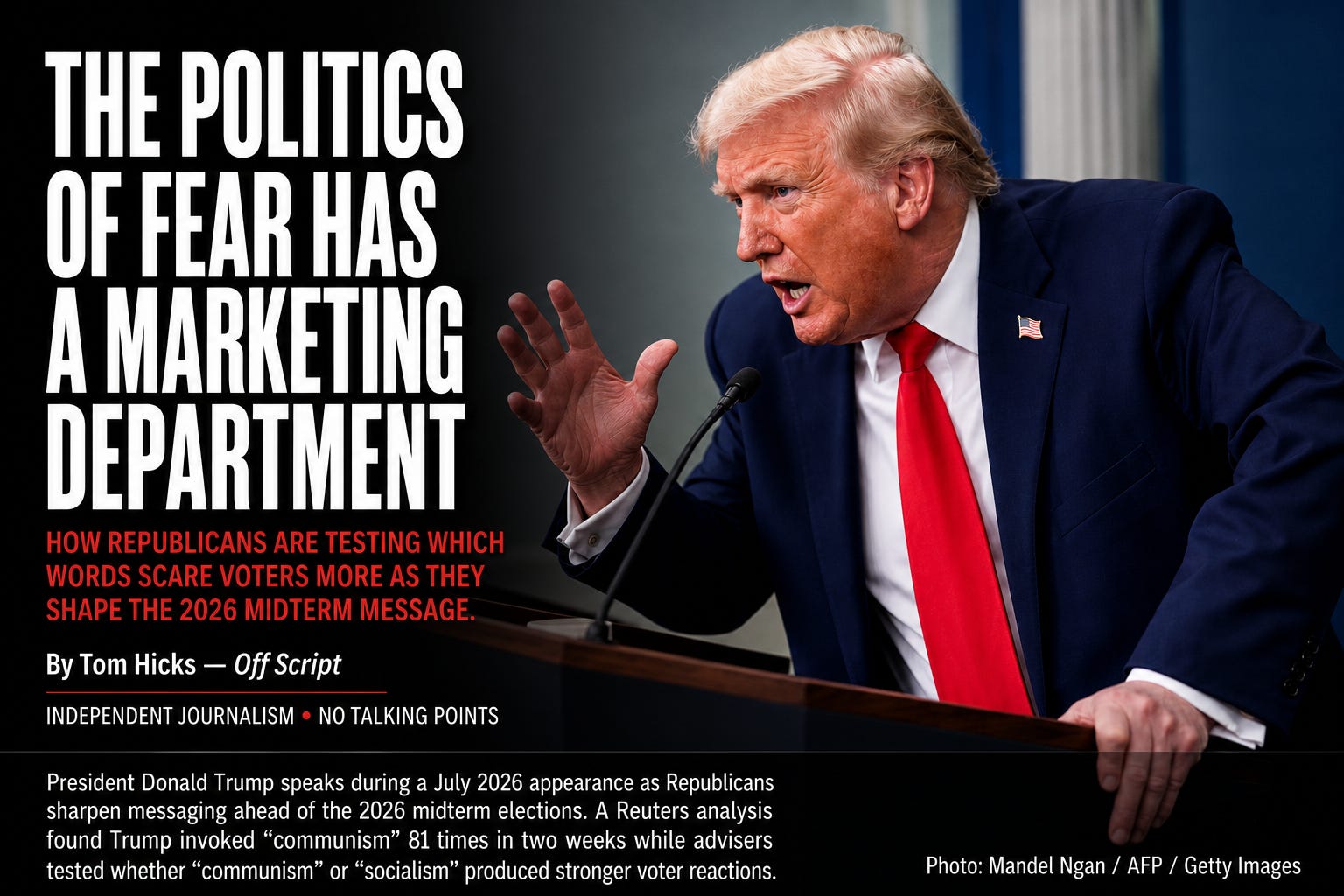
Reuters, in a story highlighted by Ground News, reported that Trump had invoked “communism” 81 times over a two-week period as Republicans tested their message for the 2026 midterm elections. Eighty-one times in two weeks isn’t a stray line at a rally. That’s a word that wandered into a speech, looked around, and never found the exit. Reuters described it as part of a broader effort to turn recent progressive primary wins into a national midterm attack line.
Then I hit the paragraph that made me stop reading the story I thought I was reading.
According to Reuters, Trump’s team wasn’t just using the word. Advisers were testing whether “communism” or “socialism” produced the stronger reaction with voters. “Communism” triggered a stronger emotional response among many Republican voters, the reporting said, while “socialism” might land better in certain districts.
Suddenly, I wasn’t reading about Trump being Trump. I was reading about grown adults with clipboards deciding which fear word tests better, the same way somebody decides whether “New and Improved” outsells “Now with 20% More.”
Not which policy makes the stronger argument.
Which word gets the better response rate, like democracy’s just another product line that needs a spokesperson and a fucking jingle?
My bullshit detector didn’t just hum.
It went off like a fire alarm in a building that’s actually on fire.
Politics has always tested messages. Candidates poll slogans, trial-run attacks, hire consultants to find out which phrases make voters nod, squint, donate, or change the channel. Nobody should pretend campaigns were pure little temples of civic virtue until the internet showed up and spilled Mountain Dew all over the Constitution.
But there’s a difference between testing how to explain an idea and testing which label scares people faster.
That difference matters.
The word “communism” is not just another insult, especially for people who grew up when I did. It carried the Soviet Union, nuclear anxiety, the Berlin Wall, Cuba, Korea, duck-and-cover drills, and that background hum of maybe the world ends before dinner. If somebody was called a communist during the Cold War, it wasn’t the same as being called annoying on Twitter. It could put your loyalty on trial, cost you your job, and get you run out of your own neighborhood, all with one word and no evidence required.
None of that means every fear was invented. Soviet espionage was real. Communist governments did terrible things. The Cold War wasn’t a branding exercise. It was a genuine global conflict with enough nuclear weapons to make sanity look like a hobby we briefly considered.
Join me every morning.
Off Script is independent editorial journalism for readers who are tired of talking points, canned outrage, and political theater dressed up as analysis.
The McCarthy era hangs over this conversation for a reason, but we should be careful with it. Senator Joseph McCarthy rose to power in the early 1950s, claiming communist infiltration had spread through the federal government. The larger Cold War context was real, and there were legitimate espionage concerns in that period. But McCarthy’s name became shorthand for something more corrosive. Accusation outran evidence. A label got powerful enough to end a career before the facts even showed up to the hearing.
That’s the lesson worth carrying forward. Not that every anti-communist argument is McCarthyism—that would be lazy. The lesson is that fear words need discipline. They need definitions. They need evidence.
Otherwise, they’re not arguments.
They’re clubs, and somebody’s always swinging one. It’s usually aimed at whoever can’t afford a lawyer.
What makes the Reuters story so useful is that it shows the machinery behind the language. We’re getting a glimpse of the testing room, somebody in a conference room trying to figure out which label moves which voter in which ZIP code. That may be normal campaign practice, but normal doesn’t always mean healthy.
Lead paint was normal, too.
We eventually had a meeting.
The deeper problem is that fear is efficient. It doesn’t require a policy comparison or a working knowledge of political theory. Fear says there’s a threat.
Pick a side.
That’s why campaigns like it, and that’s why half of social media sounds like people one headline away from biting through a doorknob.
Ideas take time.
Fear moves faster.
That doesn’t mean voters are stupid. Voters are busy, tired, worried about money, and buried under more information than any normal person can process without developing a facial twitch. If a campaign can package a complicated political argument into one emotionally loaded word, plenty of people will respond to the package before they inspect the contents.
That’s human.
It’s also dangerous.
Democracy depends on disagreement, but it also depends on a basic level of shared language. Otherwise, every debate turns into a branding contest, and branding contests don’t produce citizens.
They produce customers.
Customers react to messages. Citizens are supposed to evaluate them. That’s the quiet shift underneath stories like this. When politics borrows too heavily from advertising, the voter stops being treated as a participant in self-government and starts being treated as a target demographic.
That’s how you end up testing “communism” against “socialism” like they’re two subject lines for a Labor Day mattress sale.
None of this means campaigns should never test messages. Of course they will. Politics is persuasion. If you believe your policies are good, you want to explain them in a way people understand.
That’s legitimate.
But the line gets blurry when the goal becomes emotional activation first and meaning second. Once that happens, the word doesn’t have to be accurate.
It only has to work.
That’s the part we shouldn’t get used to.
And if we do, we’ve stopped being citizens and started being an audience.
“The campaign may win the A/B test. The public loses the conversation.”
Reuters suggests the strategy plays stronger with Trump’s base and some infrequent GOP voters, weaker with independents and younger voters. Campaign people will care about that because campaign people are paid to care about what wins.
The rest of us should care about something else.
What does this do to the conversation?
If “communist” becomes a catch-all label for Democrats, it loses precision. If “fascist” becomes a catch-all label for Republicans, it does the same. If every opponent is an existential threat, every election turns into the end of the world, and every ordinary policy disagreement ends up wearing a costume three sizes too dramatic for the occasion.
That may be good for fundraising.
It’s lousy for a republic.
Either way, the A/B test tells us something we shouldn’t shrug off. The next election won’t only be fought over policies. It’ll be fought over words chosen because they perform well under pressure.
Campaigns are testing which words win elections. Nobody’s measuring what those words cost the conversation.
One Question Before You Go
When a campaign uses a political label, do you ask whether the word is accurate—or whether it was chosen because someone already tested how it would make you feel?
One Last Thing
The next time a politician reaches for a word that seems designed to make your blood pressure jump, pause for half a second before reacting.
Somewhere, there may be a consultant very proud of that word.
If you enjoy independent journalism that looks beyond the headlines and asks why the story matters, consider buying me a tea.
It helps keep the research thorough, the questions uncomfortable, and the conversations going.
#OffScript #Politics #PoliticalLanguage #MediaLiteracy #Trump #Communism #Socialism #McCarthyism #CampaignStrategy #IndependentJournalism