

Editorial Note
Campaigns love numbers because numbers feel like certainty.
Voters have a nasty habit of reminding campaigns that people aren’t spreadsheets.
I’ve been seeing this billion-dollar number everywhere for the past week, and after about the tenth story I started wondering if everybody in politics had lost their minds.
Republicans have roughly a billion dollars lined up for the midterms.
Okay.
Now tell me something that actually helps me understand who’s going to win.
Don’t get me wrong. If I were running a campaign, I’d rather have a billion dollars than a couple hundred bucks and a volunteer with a pickup truck. Money matters. It always has. It buys advertising, staff, polling, lawyers, organizers, voter files, direct mail, digital operations, and enough television commercials to make you memorize jingles you never wanted to hear in the first place. Anybody who tells you money doesn’t matter has probably never been anywhere near a campaign.
What I don’t understand is why so many people talk as though money is the story.
It isn’t.
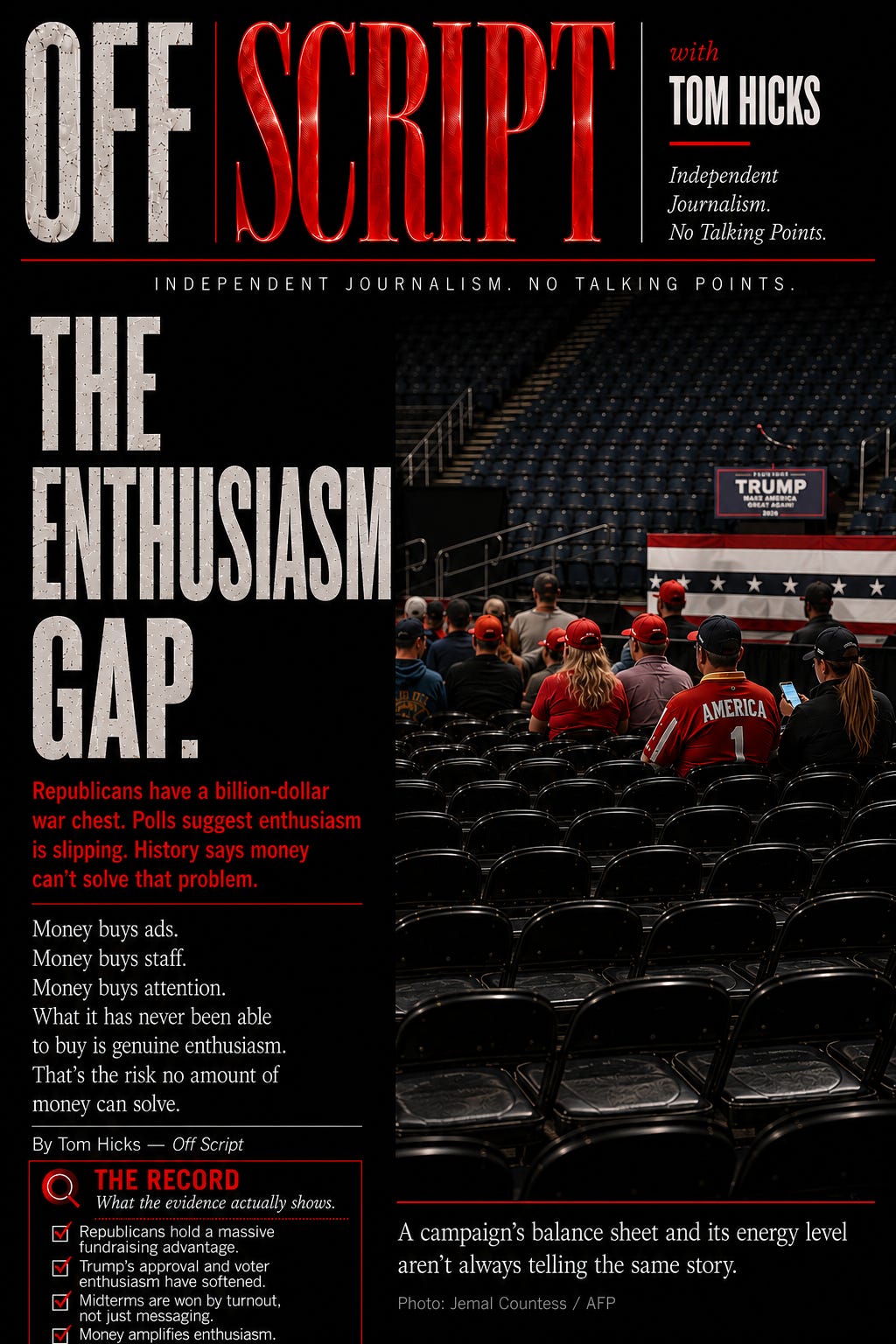
Money tells me Republicans won’t lose because they couldn’t afford enough television ads. It tells me they’ll have consultants producing PowerPoint presentations by the truckload. It tells me they’ll be able to flood competitive districts with mailers, text messages, and digital advertising until voters are sick of seeing them.
What it doesn’t tell me is whether anybody is still excited enough to care.
That’s the part that never fits neatly into a fundraising report.
I’ve watched enough elections to know there’s a world of difference between somebody who votes because it’s Election Day and somebody who spends six months convincing everyone else they know to vote, too. Every successful campaign has both kinds of supporters, but they’re not equally valuable. The second group volunteers on weekends. They knock on doors in lousy weather. They argue politics with relatives who’d rather talk about football. They donate more than once because they genuinely believe the stakes are that high. More importantly, they recruit.
Campaign professionals know exactly how valuable those people are because they’ve spent decades trying to create them.
A television commercial reaches voters.
An enthusiastic supporter creates more voters.
Those are two very different things.
That’s why this billion-dollar conversation feels incomplete to me. Republicans have obviously solved the money problem. If fundraising were the only thing that mattered, we’d already know how November is going to end. History says we don’t.
Ask Jeb Bush.
Before the 2016 Republican primaries, Bush and the super PAC supporting him raised well over $100 million. Political professionals talked about him like the nomination was practically reserved. Then Republican voters showed up and decided they’d rather have Donald Trump. Four years later, Michael Bloomberg spent hundreds of millions chasing the Democratic nomination. He bought advertising everywhere. He hired enormous staffs. He built one of the best-funded campaigns in modern history.
Neither man came close to becoming president.
Money made both impossible to ignore.
It couldn’t make people care.
That’s why the recent polling caught my attention more than the fundraising totals. Several national surveys have shown Trump’s approval rating softening from earlier highs, while others suggest Republican voters remain supportive but aren’t displaying quite the same intensity that defined previous Trump campaigns. Polls aren’t crystal balls, and one survey doesn’t prove anything. Trends are worth paying attention to, though, because they tell you where to start asking questions. (Reuters) (AP News)
Notice what I’m not saying.
I’m not saying Republicans are headed for disaster. I’m not saying conservative ideas suddenly became unpopular. Millions of Americans still support stricter immigration enforcement, lower taxes, conservative judges, and a smaller federal government. The evidence doesn’t suggest those positions have collapsed.
The question may have less to do with the message than the messenger.
Donald Trump spent nearly a decade building something most politicians never manage to build. His supporters didn’t simply vote for him. They recruited for him. They turned rallies into events. They made politics part of their identity. Whether you admired that or couldn’t stand it, pretending it wasn’t real never made much sense.
The question now isn’t whether that movement existed. The question is whether it still has the same energy it once did, because if the excitement is beginning to fade, Republicans have a problem that no amount of fundraising can solve.
Money amplifies enthusiasm; it doesn’t create it.
Democrats Shouldn’t Get Comfortable Either
If you’re a Democrat reading this and feeling smug, slow your roll.
Political parties have an amazing ability to mistake their opponent’s weakness for their own strength.
The Democratic Party has its own problems. Favorability ratings remain underwater. Internal divisions haven’t magically disappeared. Plenty of voters are still frustrated about inflation, immigration, housing costs, and a government that often seems incapable of doing anything efficiently. If Democrats win because Republicans stay home instead of because voters are inspired by Democratic ideas, that’s not exactly a ringing endorsement.
Winning by default has a nasty habit of becoming losing by default a few years later.
That’s one reason midterms are so hard to predict. They aren’t just about which party is more popular. They’re about which side’s voters care enough to interrupt a Tuesday, wait in line, and fill in bubbles on a ballot.
Intensity matters. Sometimes it matters more than persuasion.
THE RECORD
What the evidence actually shows
• Republican campaign organizations and aligned groups have amassed an unusually large fundraising advantage heading into the 2026 midterms.
• At the same time, multiple national polls have shown President Trump’s approval rating slipping from earlier highs, with Republican enthusiasm showing signs of softening compared with previous election cycles.
• Midterm elections have historically been driven as much by turnout and enthusiasm as by persuasion. A highly motivated base can overcome disadvantages in national polling, while an unmotivated one can squander financial advantages.
• Political scientists have long found that campaign spending produces diminishing returns. Money can increase visibility, but it cannot manufacture genuine enthusiasm or trust.
The Bullshit Detector
You’ll hear two competing stories over the next several months. One side will insist Republicans are doomed because Trump’s numbers are falling. The other will insist none of it matters because Republicans have a billion dollars to spend.
The bullshit is pretending either one of those facts settles the election.
Money matters.
Candidates matter.
Issues matter.
Turnout matters.
But enthusiasm is the force multiplier that makes everything else work.
A billion dollars spent trying to excite reluctant voters isn’t nearly as valuable as a billion dollars spent helping already-excited voters reach the polls.
Campaign consultants love to talk about messaging. Political reporters love to analyze strategy. Cable news loves to obsess over fundraising totals because they’re easy to put on a graphic.
Voters, meanwhile, have an annoying tendency to ignore the script.
If Republicans rediscover the energy that carried them through previous elections, today’s polling could look laughably outdated by November.
If they don’t, they’ll discover that enthusiasm is one of the few political assets you can’t buy, borrow, or fake.
And that may turn out to be the most expensive lesson in American politics.
One Question Before You Go
If you had to pick just one factor that decides most elections, what would it be: the candidate, the issues, the economy, or simple voter enthusiasm?
More from Tom Hicks Media
If you liked thinking this hard before 9 a.m., I’ve got more for you.
Panic Room Sports brings the same “slow down and look at the evidence” approach to the NFL.
Tom’s Number Ones is a daily trip through Billboard history with zero politics. And if you need a break from all of us humans overthinking everything,
Lotus Purrspective offers a cat’s unbothered take on human behavior. All are free to subscribe.
☕ If you enjoy Off Script with Tom Hicks, consider buying me a cup of tea. It helps keep the lights on, the research flowing, and the coffee... well, tea... stocked.
Subscribers also get the Off Script Bullshit Detector free. Prefer to buy it outright? It’s available for $4.95 in the Tom Hicks Media Store.
Thanks for reading.
#OffScript #Midterms #Politics #Republicans #Trump #Polling #Elections #PoliticalAnalysis #TomHicksMedia