

EDITORIAL NOTE
The numbers in this article come primarily from the Congressional Budget Office’s August 10 Monthly Budget Review and its February budget outlook. I also went back to CBO’s March analysis of the Supreme Court tariff ruling and the Trump administration’s own public statements about using tariff revenue to reduce deficits. CBO’s August number is still a projection; the fiscal year has two months left, and tariff policy can change again. (cbo.gov)
There are bad months for a revenue plan, and then there’s what happened to tariffs in July.
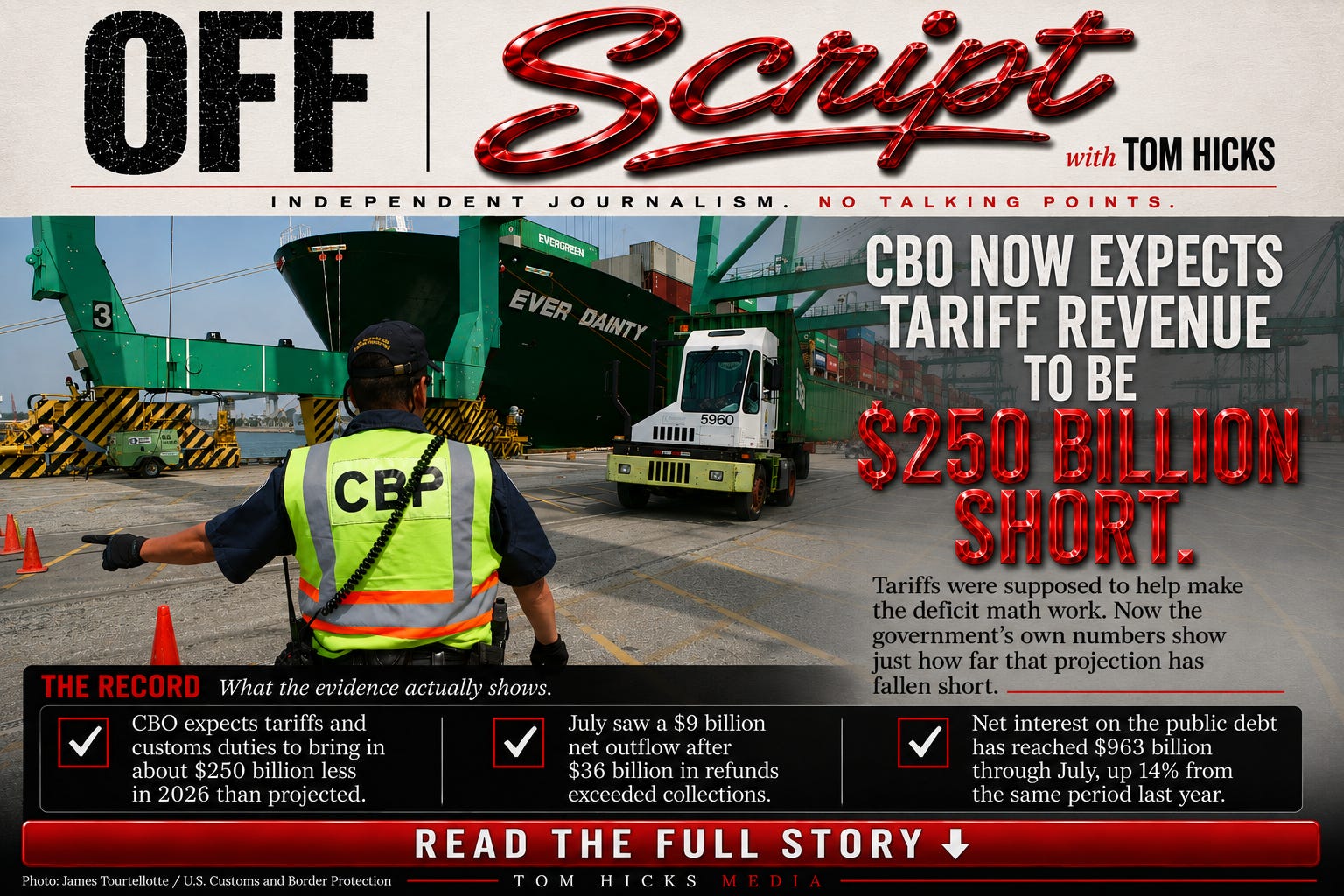
The federal government collected $26 billion in customs duties during the month. It refunded $36 billion, largely because of the Supreme Court ruling that knocked out tariffs imposed under the International Emergency Economic Powers Act. By CBO’s accounting, customs duties produced a $9 billion net outflow in July instead of bringing money into the Treasury. (cbo.gov)
That one month doesn’t tell the entire tariff story, and I don’t want to pretend it does. The administration has imposed replacement tariffs under other legal authority, and CBO expects those to recover a substantial portion of the revenue lost when the IEEPA tariffs disappeared. But July gives you a pretty good picture of why the federal deficit math suddenly looks worse than it did six months ago. (cbo.gov)
In February, CBO projected a $1.9 trillion federal deficit for fiscal year 2026. On Monday, it raised that estimate to $2.1 trillion. The interesting part is buried immediately underneath that number: CBO says it still expects full-year spending to come in fairly close to what it projected in February. The roughly $200 billion deterioration is coming from revenue that now looks about $200 billion lower than expected. (cbo.gov)
And most of that revenue miss is tariffs.
SUPPORT INDEPENDENT REPORTING
Your subscription helps fund reporting, research, publishing, new features, and the continued growth of every Tom Hicks Media publication.
The $250 Billion Hole in the Tariff Math
CBO now estimates that tariffs and other customs duties will bring in about $250 billion less during 2026 than it projected earlier this year. That’s a 60 percent reduction from the previous estimate. Income and payroll taxes are actually doing better than CBO expected, by roughly $75 billion, which is keeping the overall revenue miss from being even larger. (cbo.gov)
That matters because tariff revenue wasn’t being sold as some incidental little bonus sitting off to the side of the administration’s economic policy. It was part of the argument for how the numbers were supposed to work.
Back in April 2025, Council of Economic Advisers Chairman Steve Miran said the tariffs would “help pay for both tax cuts and deficit reduction.” Two months later, the White House defended its tax-and-spending legislation by pointing to a CBO estimate that tariffs would reduce deficits by $2.8 trillion over a decade. In the same White House release, amusingly enough, CBO was described as “partisan” when its other projections were inconvenient. Apparently the Congressional Budget Office becomes much more trustworthy when it brings good news. (whitehouse.gov)
By February of this year, CBO’s own budget outlook estimated that higher tariffs were reducing projected deficits by roughly $3 trillion over the coming decade. So there was real money attached to this assumption. Whether you loved the tariff policy or hated it, the projected revenue had become part of the federal fiscal picture. (cbo.gov)
Then the legal foundation shifted.
On February 20, the Supreme Court ruled that the administration could not impose those tariffs under IEEPA. The administration ended them and moved to other tariff authorities, first Section 122 of the Trade Act and later Section 301. CBO says the replacement tariffs should restore a substantial share of the lost revenue, which is important because saying “the tariffs disappeared” would be wrong. (cbo.gov)
They didn’t disappear. The revenue projection got hammered anyway.
CBO’s latest estimate says customs revenue for this fiscal year will still finish about $250 billion below what it had previously expected. Around $100 billion in refunds tied to the invalidated IEEPA tariffs had already been issued by the end of July. That’s how you arrive at a month in which the Treasury collects $26 billion at the border and sends $36 billion back out. (cbo.gov)
And that’s the part I think deserves more attention than another headline announcing that the federal deficit is huge. We already knew the deficit was huge.
The more interesting question is what happens when Washington starts treating projected revenue from a policy controlled largely through executive action as though it were money safely sitting in the bank. A court ruling changes the legal authority, the policy has to be rebuilt under different statutes, refunds start going out, and suddenly a couple hundred billion dollars moves from one side of the ledger to the other.
Nobody misplaced the money. The assumption changed.
This Doesn’t Let Spending Off the Hook
There’s a temptation here to run in the opposite direction and say the new deficit problem is entirely about tariffs. The numbers don’t support that either.
Federal outlays reached about $6.3 trillion during the first ten months of the fiscal year, $308 billion more than during the same period last year. Some of that increase is a calendar issue because payments scheduled for August 1 were moved into July; once CBO adjusts for those timing shifts, spending is still up about $209 billion, or 4 percent. (cbo.gov)
Social Security spending rose about $70 billion after the timing adjustment. Medicare rose $66 billion and Medicaid $45 billion. Those programs aren’t disappearing because somebody comes up with a clever tariff strategy, and neither is the growing cost of carrying the debt we already have. (cbo.gov)
That last number may bother me more than any of the others.
Through July, the federal government had spent $963 billion on net interest on the public debt. That’s $117 billion more than during the same ten months last year, a 14 percent increase, and we still have August and September to go. CBO says the increase reflects a larger debt load and higher long-term interest rates. (cbo.gov)
We are approaching the point where a trillion dollars in annual interest expense barely produces a raised eyebrow because every number in the federal budget has become too damn large for normal human comprehension.
Think about what that money buys. Nothing new. It doesn’t build a bridge, hire a teacher, buy a fighter jet, send a Social Security check or pave the road you drove on this morning. It pays for money Washington already borrowed, and next year we get to do it again.
That’s why I don’t want to turn this into a cheap “Trump’s tariffs failed” story. The federal government was headed for roughly a $1.9 trillion deficit even when CBO thought the tariff revenue would arrive. A quarter-trillion-dollar tariff shortfall makes the problem worse. It didn’t create the underlying problem. (cbo.gov)
The underlying problem is that Washington has built a fiscal structure where enormous deficits are normal during a period when the country isn’t fighting a world war, digging out of a depression or dealing with a pandemic. CBO’s February outlook had deficits running from $1.9 trillion this year to $3.1 trillion in 2036, with deficits averaging well above their historical share of the economy. Rising interest costs were already one of the major reasons. (cbo.gov)
That was before Monday’s $200 billion revision.
The Promise Was Easier Than the Collection
Tariffs have always had several arguments wrapped around them at once. Protect American manufacturing. Change another country’s behavior. Give American producers an advantage. Generate federal revenue.
You can argue about each of those separately, and reasonable people do. What becomes harder to defend is treating the revenue projection as something close to guaranteed while the policy itself depends on legal authority that can be challenged, changed, or replaced.
That isn’t an argument against ever including tariff revenue in a budget forecast. CBO has to estimate the law and policy that exist at the time. It is an argument for remembering what the word projection means when politicians grab the friendliest number from one of those reports and start selling it as money they’ve already earned.
The White House was happy to point at CBO’s multitrillion-dollar tariff estimate when it helped make the administration’s deficit argument. Now CBO is telling us that this year’s customs revenue alone is likely to come in about $250 billion below the previous projection. Both numbers came from the same place. (whitehouse.gov)
You don’t get to frame the first one and hang it on the wall while pretending the second one never showed up.
There’s still time left in the fiscal year. The new tariffs may bring in more money than CBO currently expects, or less. Economic conditions can change, trade patterns can change, and the administration can change tariff policy again. CBO itself says there is considerable uncertainty around estimating revenue from tariff changes of this size. (cbo.gov)
But we know what the scoreboard says today.
A deficit once projected at $1.9 trillion is now projected at $2.1 trillion. CBO says the full-year spending estimate hasn’t changed much from February, while expected revenue has fallen by about $200 billion. Tariffs and customs duties account for roughly a $250 billion downward revision before higher income and payroll tax collections make up part of the difference. (cbo.gov)
For all the speeches, press releases and arguments about tariffs paying for things, that’s where the accounting sits tonight.
And sooner or later, somebody in Washington has to stop confusing a projection that helps sell a policy with a check that has actually cleared.
THE RECORD
What the evidence actually shows
CBO projects a $2.1 trillion FY2026 deficit, about $200 billion above its February projection of $1.9 trillion. (cbo.gov)
CBO expects full-year outlays to remain close to its February projection. Expected revenue is about $200 billion lower. (cbo.gov)
Tariffs and customs duties are projected to come in about $250 billion, or 60 percent, below the earlier estimate. (cbo.gov)
Income and payroll taxes are projected about $75 billion above the February estimate, partially offsetting the tariff shortfall. (cbo.gov)
July customs refunds totaled $36 billion against $26 billion in gross collections, producing a $9 billion net outflow. (cbo.gov)
Net interest on the public debt reached $963 billion through July, up $117 billion, or 14 percent, from the same period last year. (cbo.gov)
THE BULLSHIT DETECTOR
THE MMR VACCINE ISN’T “QUITE LETHAL”
While signing his vaccine executive order Monday, Trump suggested the combined measles, mumps and rubella vaccine might be “quite lethal” while the three vaccines given separately were safe. There’s no evidence supporting that claim. Decades of use and research show the combined MMR vaccine is safe and effective, and the American Academy of Pediatrics continues to recommend two routine doses. There’s another practical problem with the proposed alternative: separate measles, mumps and rubella vaccines aren’t currently available in the United States. (AP)
NO, PRICES AREN’T “ALL COMING DOWN”
Trump told Fox News that prices were “all coming down now” and specifically included food and groceries. Some individual prices have fallen, including eggs, bread and certain durable goods, but that isn’t the same thing as prices generally falling. The latest available Bureau of Labor Statistics data show consumer prices were 3.5 percent higher in June than a year earlier, food-at-home prices were up 2.7 percent, and energy prices were up 15.7 percent. You can argue about why prices rose. You can’t turn an increase into a decrease. (BLS)
THAT MOTORCYCLE CONVOY ISN’T HEADED FOR DEARBORN
A huge motorcycle convoy has been bouncing around social media with claims that the riders are heading to Dearborn, Michigan, for an anti-Muslim protest following Abdul El-Sayed’s Senate primary victory. There is an anti-Muslim event being promoted for Dearborn later this month, which probably helped the video look believable. The video itself has nothing to do with it. AFP traced the footage to Rodovia dos Bandeirantes in São Paulo, Brazil, and found it circulating online by July 4 — a full month before Michigan’s August 4 primary. (AFP)
EL-SAYED DIDN’T SAY AMERICA “DESERVED 9/11”
Republican Senate candidate Mike Rogers said his Democratic opponent Abdul El-Sayed “believes America deserved 9/11.” The evidence doesn’t support that accusation. The notorious “America deserved 9/11” remark came from streamer Hasan Piker in 2019, not El-Sayed, and Piker later walked it back. More importantly, El-Sayed has answered the question himself. In April he said, “Of course I don’t think 9/11 was justified,” and on Sunday told NBC that America did not deserve the attack. Disliking somebody El-Sayed campaigned with doesn’t transfer that person’s words into El-Sayed’s mouth. (FactCheck.org)
FREE FOR OFF SCRIPT SUBSCRIBERS
The Off Script Bullshit Detector
A practical guide to spotting misinformation, propaganda and political nonsense before it gets comfortable in your head.
Normally $4.95 through the Tom Hicks Media Store.
MORE FROM TOM HICKS MEDIA:
TOM’S NUMBER ONES
One date. Six charts. The songs people were actually listening to, plus the stories, videos and musical detours that make the old charts worth digging up.
LOTUS PURRSPECTIVE
Lotus studies humans from a safe distance and continues finding our species needlessly complicated.
PANIC ROOM SPORTS
Everyone reacts. We’ll check the tape first. Sports analysis with receipts, including the Panic Index and the Panic Room Fantasy Desk.
BUY ME A CUP OF TEA
Off Script is reader-funded. No advertisers are deciding which subjects are inconvenient, and no sponsor is sitting over my shoulder wondering whether I could phrase something a little more politely.
If this article gave you something worth thinking about and you’d like to help keep the reporting going, you can buy me a cup of tea.
ONE QUESTION BEFORE YOU GO
After watching the tariff projections change this dramatically, should Washington still count projected tariff revenue as part of its long-term deficit plans — or wait until the money is actually being collected?
I’m curious where you land. Drop your answer in the comments.

#OffScript #TomHicksMedia #FederalDeficit #NationalDebt #Tariffs #CBO #Economy #Politics #IndependentJournalism