

By Tom Hicks | October 6, 2026
Editorial Note:
This column discusses comparisons between contemporary American political imagery and Nazi propaganda. It does not argue that Pete Hegseth is Adolf Hitler or that the United States is Nazi Germany. Quite the opposite. That’s where this story started falling apart. And where a different story began.
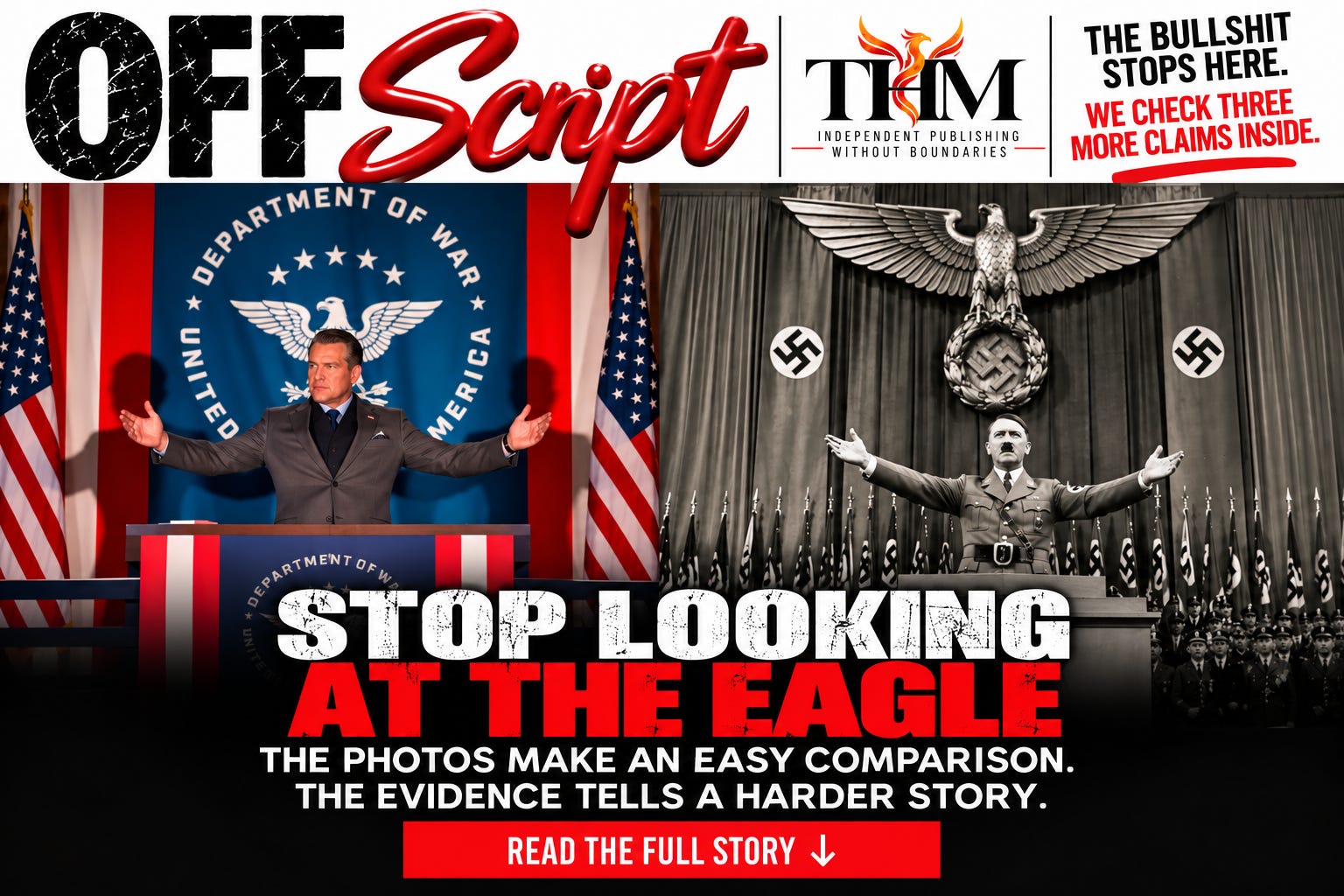
That picture disgusted me.
I’m not going to pretend I approached it as some dispassionate observer who stroked his chin, carefully considered the historical implications, and decided further research was warranted. I looked at Pete Hegseth standing beneath that enormous eagle, looked at the photograph somebody had placed beside it of Adolf Hitler doing something uncomfortably similar, and thought pretty much what whoever created the meme wanted me to think.
Jesus Christ. Look at that.
Then the part of my brain responsible for ruining perfectly good outrage kicked in.
Was I actually looking at something significant, or had somebody found two photographs taken roughly 90 years apart, put them next to each other and pushed exactly the button they knew they could push?
There’s only one way to answer that, and unfortunately it involves doing homework.
So I started with the eagle.
That didn’t go particularly well for my first impression.
The bald eagle has been an American national symbol since 1782. It appears on the Great Seal of the United States, military insignia, government buildings, currency and enough other official American stuff that treating its appearance behind the secretary overseeing the military as evidence of fascism would require throwing out a fairly substantial portion of American history.
The Pentagon’s own branding uses an eagle. Its current brand guide describes the symbol in thoroughly American terms, representing the United States and military strength. (War Department Brand Guide)
There is also no evidence I could find that the Air Force Academy stage was designed to resemble a Nazi rally, that Hegseth’s pose was intended to mimic Hitler or that somebody at the Pentagon pulled out photographs of Nuremberg and said, “Yeah, let’s go with that.”
Which should have made me feel better.
It didn’t.
Because somewhere during all of this, I stopped researching the photograph and started researching what was happening around it.
And the photograph became the least interesting thing I found.
The stage is part of the speech. That’s hardly a revelation. Politicians have understood it since long before television arrived to make the possibilities irresistible. Where you put the speaker matters. What you put behind him matters. So do the flags, the music, the uniforms, the audience, and the camera angle that will eventually turn the whole thing into the image millions of people see.
That doesn’t make political staging sinister. Every president does it. Every political party does it. Hell, every candidate who has ever rolled up his sleeves before talking to factory workers has done a version of it.
The interesting question isn’t whether somebody is creating an image. It’s what they’re trying to communicate with it.
And that’s where Hegseth’s eagle led me somewhere I wasn’t expecting.
Independent journalism. No talking points.
Off Script is free. Subscribe and come back tomorrow — or help fund the research and tools we use every day.
Donald Trump signed an executive order in September 2025 authorizing “Department of War” as a secondary title for the Department of Defense. Congress didn’t legally rename the department, something worth remembering whenever somebody tells you Trump simply changed the name. The statutory Department of Defense still exists. (White House Executive Order)
But the administration wanted War Department.
And it wanted the public to hear it.
The Pentagon’s own branding guidance now tells communicators to use that secondary title in public-facing materials. Its visual identity was revised toward what the department describes as a more “classic and formal treatment.” (War Department Brand Guide)
Again, none of that makes anybody a fascist. Governments rebrand things. Trump has been particularly fond of renaming things.
But then I kept going.
Five days before Hegseth appeared at the Air Force Academy, several hundred service members exercised with him outside the Pentagon wearing matching shirts bearing three words:
THIS IS WAR.
Later that day, Hegseth addressed roughly 600 junior officers and enlisted leaders at Quantico for what he called his “State of the Force” address.
There was plenty of actual military policy in the speech. Hegseth discussed readiness, command structure, autonomous warfare and reductions in senior officer positions. Anyone describing the entire thing as a political rally would be leaving out quite a lot.
Hegseth, however, wasn’t exactly making it difficult to find the politics.
He celebrated the demise of what he called the “woke department.” He talked about generals and admirals who didn’t fit his vision and were no longer there. He ridiculed pronouns and identity programs. At one point he announced:
“No fatties, no trannies, no beardos, no weirdos, no wimps, no radicals. Just warriors.”
That’s from the Pentagon’s own transcript, by the way. I’m not relying on somebody’s angry Bluesky post to tell you what he said. (State of the Force transcript)
He also accused journalists scrutinizing the war with Iran of “treason.” (Axios)
Now we were getting somewhere.
Or perhaps somewhere was getting uncomfortably close to us.
Stop looking at the eagle. That’s what I eventually had to tell myself, because by this point it was becoming a distraction.
Nazi Germany didn’t invent eagles. It didn’t invent flags, uniforms, parades, monumental architecture or military spectacle either. Human beings figured out a very long time ago that making power look powerful was useful.
What the Nazis did understand extraordinarily well was how to assemble those things into political theater.
The Documentation Center at the Nazi Party Rally Grounds in Nuremberg describes the rallies as carefully staged presentations intended to project the regime and Hitler, with architecture, ritual, and mass participation used to turn politics into an emotional experience. (Documentation Center Nazi Party Rally Grounds)
That’s the part of the history worth remembering.
Not the damn eagle.
Political spectacle works because it can communicate something before anyone has made an argument. You don’t have to explain strength when you’ve surrounded yourself with it. You don’t have to describe authority when thousands of people are sitting beneath you listening. And if you’re simultaneously telling that audience who the strong people are, who the weak people are, and who no longer belongs, the scenery starts carrying a little more weight.
That still doesn’t make Pete Hegseth Hitler.
I realize I keep saying that. Unfortunately, the state of American political discourse is such that if I don’t, somebody will read three paragraphs, race to the comments, and inform me that Donald Trump hasn’t invaded Poland.
What bothers me is something much more immediate.
The American military is supposed to have a peculiar relationship with politics. Obviously it isn’t isolated from them. The president is commander in chief. The secretary overseeing the military is a political appointee. Elections have enormous consequences for military policy.
But the people wearing the uniforms don’t swear an oath to Donald Trump. They didn’t swear one to Joe Biden, either.
They swear to support and defend the Constitution of the United States.
That distinction has always mattered because the United States has deliberately tried to maintain a military that belongs to the country rather than to whichever political movement happens to occupy the White House.
Which brings me back to those cadets.
The Hegseth photograph that started all of this was taken at the U.S. Air Force Academy in Colorado Springs, where he addressed roughly 3,500 cadets before the Air Force-Navy football game. The appearance was part of something called the “Send Me Tour,” which is taking Hegseth’s message directly to military units, ROTC programs, cadets, and veterans.
These aren’t Republican cadets.
They aren’t Democratic cadets.
They’re future American officers.
And the man appearing before them isn’t merely talking about physical standards, weapons procurement or how we’re going to deal with China. He’s bringing along the culture war. He’s talking about the previous administration’s ideology, celebrating the departure of senior officers who didn’t share his vision, drawing lines between “warriors” and the people he considers weak or radical, and calling journalists treasonous.
That’s where I have a problem.
Not because civilian leadership shouldn’t change military policy. That’s precisely what elections allow it to do. Hegseth is entitled to demand tougher fitness standards. He’s entitled to reorganize commands. He’s entitled to fire military leaders the president has the lawful authority to replace.
But there’s a difference between changing the policies of the military and changing whose military people believe it is.
And I don’t know exactly where that line is.
I’m not sure anybody does until somebody crosses it.
That’s why I think the viral photograph actually does this story a disservice. It hands everyone a wonderfully convenient argument about Hitler.
If you hate Hegseth, you look at the two pictures and say, “See?”
If you support him, you laugh at another hysterical Nazi comparison.
Everybody goes home having confirmed whatever they believed when they arrived, which is pretty much how political social media manages to accomplish absolutely nothing before lunch every day.
Meanwhile, the more interesting question slips past us.
What happens when the civilian leader of the American military increasingly presents that institution as part of a domestic ideological struggle?
I started this research thinking I was going to write about an eagle.
I ended up reading speeches, Pentagon branding rules, an executive order, military policy, and the history of political spectacle. Along the way, the Hitler comparison mostly fell apart.
Here’s the part I wasn’t expecting.
The more it fell apart, the less comfortable I became.
Because I don’t need Pete Hegseth to be Adolf Hitler before I start paying attention.
Neither should you.
If this was worth your time, hit Like, Restack, or share it. That’s how independent work like this finds new readers.
THE BULLSHIT DETECTOR
CLAIM 1: The people warning that artificial intelligence could become dangerous are the same people behind climate-change warnings and the “Russia” and “Ukraine” hoaxes.
BULLSHIT: 💩💩💩💩
Donald Trump made essentially that argument at the United Nations, lumping warnings about potentially catastrophic AI risks together with climate change and investigations involving Russia and Ukraine.
There’s just one problem with the idea that this is all coming from some interchangeable group on the political left: some of the loudest warnings are coming from the people building the technology.
AI executives and researchers have publicly warned about potentially severe risks from advanced AI. Concern also crosses party lines, while some people on the political left have criticized existential-risk warnings as alarmist.
There are plenty of legitimate arguments over how serious the risks are. Pretending everyone raising them belongs to the same political tribe isn’t one of them. (PolitiFact)
CLAIM 2: A viral video shows a Saudi imam being dragged away and arrested after criticizing U.S. policy in the Middle East.
BULLSHIT: 💩💩💩💩💩
The video is real.
The story attached to it isn’t.
The footage dates to March 2018, not 2026. Contemporary reporting identified the man as someone who climbed onto the pulpit and attempted to deliver the Friday sermon before the mosque’s official preacher arrived. Authorities and worshippers removed him.
He wasn’t an imam being arrested in 2026 for criticizing American Middle East policy.
It’s one of the oldest tricks in the misinformation business: find authentic footage of something dramatic, throw away the inconvenient original context and give it a brand-new story designed for whatever happens to be making people furious today. (Soch Fact Check)
CLAIM 3: BBC News reported that an Indian passenger named Raghav Menon was involved in the recent attack aboard a Flydubai flight bound for Tel Aviv.
BULLSHIT: 💩💩💩💩💩
This one comes with a BBC presenter and everything.
Unfortunately, the BBC broadcast never happened.
A video circulating online was manipulated to make it appear that a BBC News presenter reported that an Indian national named Raghav Menon was involved in the attack. The BBC confirmed the clip is fake, and credible reporting has not identified anybody by that name as the attacker.
Israeli authorities identified the suspect as an Omani national.
So we’ve now reached the wonderful point in human civilization where seeing a familiar news anchor apparently reporting something isn’t sufficient evidence that the familiar news anchor actually reported it.
Technology marches on. Bullshit bought comfortable shoes. (Full Fact)
Bullshit Detector is also available for $4.95 at the Tom Hicks Media Store. Because everyone could use a little less bullshit in their life.
Elsewhere at Tom Hicks Media
WHAT THE HELL?
True stories that sound completely made up, told with exactly the amount of respect they deserve.
PANIC ROOM SPORTS
Smart sports coverage with attitude. Everyone reacts. We’ll check the tape first.
LOTUS PURRSPECTIVE
Life, humans and their questionable decisions, according to the world’s wisest and most judgmental feline.
CHART COLLISION
Music, memories and the stories behind the songs.
RABBIT EARS CLASSIC TV
When television only had a few channels and somehow there was still something worth watching.
THE BACKLOT GHOST
The stories hiding behind the movies you thought you knew.
Buy Me a Cup of Tea
Independent journalism isn’t free to produce, even when it’s free to read. If Off Script gave you something worth thinking about today, you can help keep the research going.
One Question Before You Go
Forget Hitler. Forget the eagle.
At what point does a civilian leader promoting his political worldview to uniformed military audiences cross the line from leading the military into politicizing it?
#PeteHegseth #USMilitary #DepartmentOfDefense #DepartmentOfWar #Military #Politics #PoliticalImagery #OffScript #TomHicksMedia