

By Tom Hicks - The Unredacted Bastard | Independent Journalist • Democracy’s Fire Alarm • Professional Shit-Stirrer
Bastard’s Law
When a system refuses to act on an obvious problem, the problem isn’t confusion. It’s permission.
Stop pretending this is a competency issue.
Maybe he’s declining. Maybe he’s not. At this point, you’d have to be working pretty damn hard at not seeing it — the clips are everywhere, the rambling answers, the contradictions, the moments that feel like watching someone try to finish a sentence they forgot they started three sentences ago. People notice. They talk about it in lowered voices, they share the clips with each other, and then they get dragged into the same circular bullshit argument about diagnosis and proof and who’s “qualified” to say it out loud.
And that’s exactly the trap.
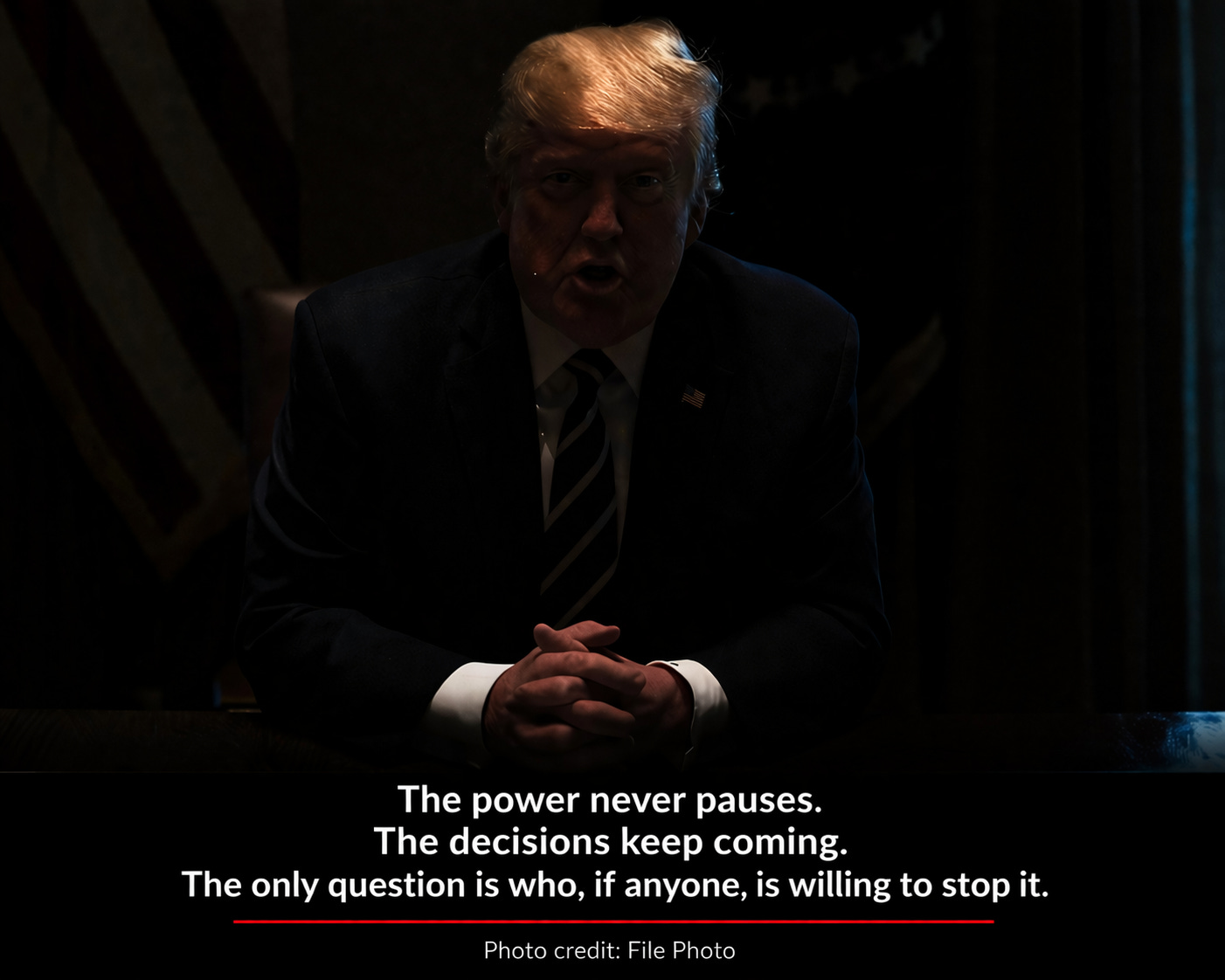
Because while everyone’s busy debating whether the guy can still find his own car in a parking lot, something much more concrete is happening in plain sight. He’s still making decisions and still exercising power. Those decisions land like a dropped piano, whether they make sense or not, and governments don’t pause while cable panels argue, and power doesn’t politely step aside while everyone waits for a consensus that’s never coming.
This was never a medical debate. It’s a power problem. And the reason people keep trying to drag it into a cognitive question is because a cognitive question feels safer — like maybe if you can just prove incapacity, someone else handles it quietly, behind closed doors, and nobody has to say the ugly part out loud.
The ugly part is the whole goddamn point.
If you’re not subscribed yet, you’re doing this the hard way.
The Comfort Blanket We Keep Reaching For
The 25th Amendment has become the political equivalent of a fire extinguisher that everyone agrees should never actually be used. People reach for it because it sounds responsible — measured, clinical, a quiet process where serious adults step in and handle things without the messiness of public accountability.
That’s the bedtime story version.
What it actually requires is for the people closest to power — the cabinet, the vice president, senior officials who’ve spent their entire careers maneuvering toward exactly this kind of moment — to stand up in public and say, out loud, “This cannot continue,” knowing full well they’ll be politically destroyed before the week is out. It demands coordination. Courage. A willingness to burn your own future to the ground to stop something bigger than your career.
So instead it gets floated. Debated on panels. Kicked around as a cable news hypothetical by people who will never, ever be the ones who have to do it. Because talking about action is always easier than taking it, and the conversation fills airtime, and nobody has to actually do a fucking thing, and by Thursday we’re on to the next outrage.
Meanwhile, the real question keeps getting buried under all that noise.
And here’s what makes it worse: there isn’t just one real question. There are two. And the fact that nobody can agree on which constitutional crisis we’re in is doing a hell of a lot of work for the people who’d prefer we stay confused.
These Are Not the Same Tool. And Right Now, Both Apply.
Here’s the part nobody’s explaining clearly, so let me take a run at it.
The 25th Amendment and Article II, Section 4 are not interchangeable. Treating them like they are is how we ended up in this loop of endless discussion with zero movement. But here’s the thing the loop is hiding: we’re not actually choosing between them. We’re watching both apply at the same time, and the people responsible for acting on either one are using that overlap as an excuse to act on neither.
Let me break that down.
The 25th Amendment is for a president who cannot do the job. Incapacity. Physical, cognitive, whatever form it takes. It’s the mechanism that says this person is no longer able to perform the duties of the office — and it requires the people closest to power to say so, publicly, on the record, and to move on it.
Article II, Section 4 is something else entirely. It’s for a president who can do the job but is using that power in ways that betray the public trust. High crimes and misdemeanors. Abuse of power. Conduct that crosses a line so clearly that removal doesn’t just become justified — it becomes constitutionally required.
Now. What happens when you’ve got potential incapacity and documented abuse of power running simultaneously?
You get exactly what we have. A paralysis dressed up as deliberation. Because if he’s declining, that’s a 25th Amendment problem — but invoking it requires his own cabinet to move against him, and they won’t. And if he’s abusing power, that’s an Article II problem — but pursuing it requires a Congress with the spine to act, and they don’t. So instead of picking a lane and driving, everyone points at the other lane and says that’s where this really belongs, and the whole thing spins in place while the damage accumulates.
The confusion isn’t incidental. It’s load-bearing.
“If men were angels, no government would be necessary.” — James Madison
Madison wasn’t being poetic. He was being a realist with a short temper and a long memory. The Constitution was built on the explicit assumption that people handed power would abuse it. That’s not cynicism — that’s the design brief. The mechanisms to stop them are in the document for exactly this moment, and the people responsible for using those mechanisms are currently hiding behind the complexity of having two of them.
The 25th gets you a medical argument. Endless, uncertain, full of plausible deniability, a debate that never has to be resolved because you can always demand more proof.
Article II gets you a different question entirely.
It’s not: Can he do this job? But: What is he doing with it, and is that acceptable?
That question doesn’t have a diagnosis. It has a verdict. And right now, the verdict is being indefinitely postponed by people who have convinced themselves that the existence of two viable options means they don’t have to choose one.
What Article II Actually Does
It’s not vague. It’s not ceremonial. It is one of the bluntest instruments in the Constitution, written for a situation most people spent years telling themselves would never actually arrive.
It allows for the removal of a president — vice president, other civil officers — for “high crimes and misdemeanors.” That phrase does not mean criminal indictment. It never did. It covers abuse of power. Betrayal of public trust. Conduct that so fundamentally breaks the obligations of the office that the person holding it can no longer be permitted to hold it.
In plain English: it exists for the moment when the problem isn’t whether someone can do the job, but whether they should be allowed to keep doing it the way they’re doing it.
And unlike the 25th, which transfers power quietly while leaving the structure around it intact, impeachment and removal are confrontational by design. They force a public accounting. They draw a line. They say, on the record, that what is happening is not acceptable and will not be tolerated.
But here’s the thing nobody wants to say out loud.
Removing a president doesn’t just take out one person. It tears the cover off everyone who enabled him — the advisors who signed off on the decisions, the officials who went on television to defend them, the political machinery that ran interference while the damage was done. Once the top falls, everyone underneath loses the protection that lets them operate without consequence. It doesn’t just cut off the head.
It exposes the whole fucking body.
Which is why nobody wants to touch it. Not really. Not when their own fingerprints are on the glass.
The Trap Running in Real Time
We’re arguing about whether he can do the job, so we don’t have to confront what he’s actually doing with it.
And we’re doing it while also arguing about what he’s doing with it, so we don’t have to prove he can’t do it.
Round and round. Each argument becomes a reason to wait for the other one. The 25th crowd says you can’t ignore the cognitive question. The impeachment crowd says you can’t let abuse of power hide behind a medical debate. And everyone’s right, which somehow produces a situation where nothing happens and everybody gets to feel like the responsible one for pointing at the other lane.
That framing is not accidental. Keep it in the 25th Amendment lane, and the debate never resolves — it’s a medical argument, full of uncertainty and professional hedging and the kind of careful language that gives everyone cover. Nobody has to act because nobody can agree on the standard of proof, and there’s always another clip to debate, another panel to convene, another round of “well, we’d need to see more evidence.”
Frame it as an Article II issue, and the question gets simpler and harder to dodge at the same time.
What is he doing with the power he has? Is that acceptable?
That’s not a clinical question. It’s a judgment call, and the Constitution explicitly assigns it to people who are currently pretending they lost the assignment.
He’s still making decisions. Still signing orders. Policies still move. The machinery keeps running like a train nobody wants to admit has lost its brakes, and the people with the authority to pull the emergency cord are standing in the back arguing about which cord is technically the right one to pull.
At some point, inaction stops being passive and starts being participatory. Choosing not to act — when the mechanisms exist, when the case is there under either constitutional standard, when the damage is happening in real time — is not caution. It’s not uncertainty. It’s a choice, made deliberately, that allows everything currently happening to continue without interruption.
Power doesn’t just come from the person at the top.
It comes from every single person who decides not to stop him.
The Slow Normalization Nobody’s Naming
What we’re watching isn’t just a failure to use available tools. It’s something worse and more deliberate than that.
It’s the quiet normalization of the idea that those tools are effectively off-limits. The 25th is treated as too dangerous, too politically costly, too destabilizing to actually deploy. Impeachment has been dragged through so much partisan mud that it now reads as almost fictional — a fire extinguisher behind glass with a sign that says Do Not Use. No Really. We’re Serious.
Take both off the table, and what you’re left with is a system that has removed its own guardrails while insisting the guardrails are still there. That’s not dysfunction. That’s a choice. And the choice has a constituency.
Because once the expectation shifts from this is how we stop abuse to this is too messy to attempt, you’re not operating under a functioning set of checks and balances anymore. You’re operating under an unspoken agreement that some problems will be tolerated no matter how visible they become and no matter how clearly the Constitution addresses them. You have two mechanisms, both applicable, both available, both sitting there — and an entire political class that has decided, quietly, that using either one is worse than using neither.
That should make you furious. It should make you wonder what the fuck the document is even for.
This isn’t just about one presidency. When a system decides that acting is more dangerous than not acting, you don’t get stability — you get drift. The rules don’t vanish overnight. They just stop being enforced. Like a referee who swallowed the whistle somewhere around the second quarter and decided the game would sort itself out, and also probably his career would go better if he just let it.
Once that line is crossed, it doesn’t reset with the next administration.
It becomes precedent. The administration after this one picks up exactly where this one left off, only now with a cleaner conscience about it, because someone already established that this is just how it works.
The Only Question Left
If he’s unfit, remove him.
If he’s abusing power, remove him.
If both are true… and right now the argument for both is sitting right there in plain sight, then we have twice the justification and somehow half the action, which is its own kind of answer about what this system has decided to be.
The only unacceptable option is doing nothing. And right now, doing nothing is the unanimous decision of everyone with the authority to do something else. That’s not gridlock. That’s not uncertainty about which tool to reach for. That is a deliberate choice, made in full view, by people who will look you in the eye and tell you their hands are tied.
Their hands are not tied.
Their hands are in their pockets.
And they know exactly which pocket the keys are in.
💣 TRUTH BOMB
We didn’t lose the tools to stop this.
We decided not to use them.
And every day that decision holds, it gets a little easier to make tomorrow.
Keep The Bastard Loud
I’m retired. No sponsors. No corporate leash. This runs on readers, period.
Free gets you the signal. The sharp edge of the take.
But if you want the full picture where the dots connect, the deeper analysis kicks in, and the War Room pieces live...
Because there’s a big difference between seeing what happened and understanding what the hell it means.
🐾 Before You Go — Meet The Feline Who Judges Us All
If this hit, go check out Lotus Purrspective. Same reality, different delivery. Less profanity, more judgment. Somehow, even less patience for human nonsense.
📣 Like, Share, Subscribe — Or Let Someone Else Control The Narrative
If this landed, don’t just nod at the screen and move on. Share it. Put it in front of people who need to see it.
Or don’t — and let louder, dumber voices keep swallowing the room.
☕ Buy Me A Coffee
If this saved you from screaming into the void alone, you can Buy Me A Coffee.
#Democracy #ConstitutionalCrisis #Article2 #Impeachment #25thAmendment #Accountability #TheUnredactedBastard