

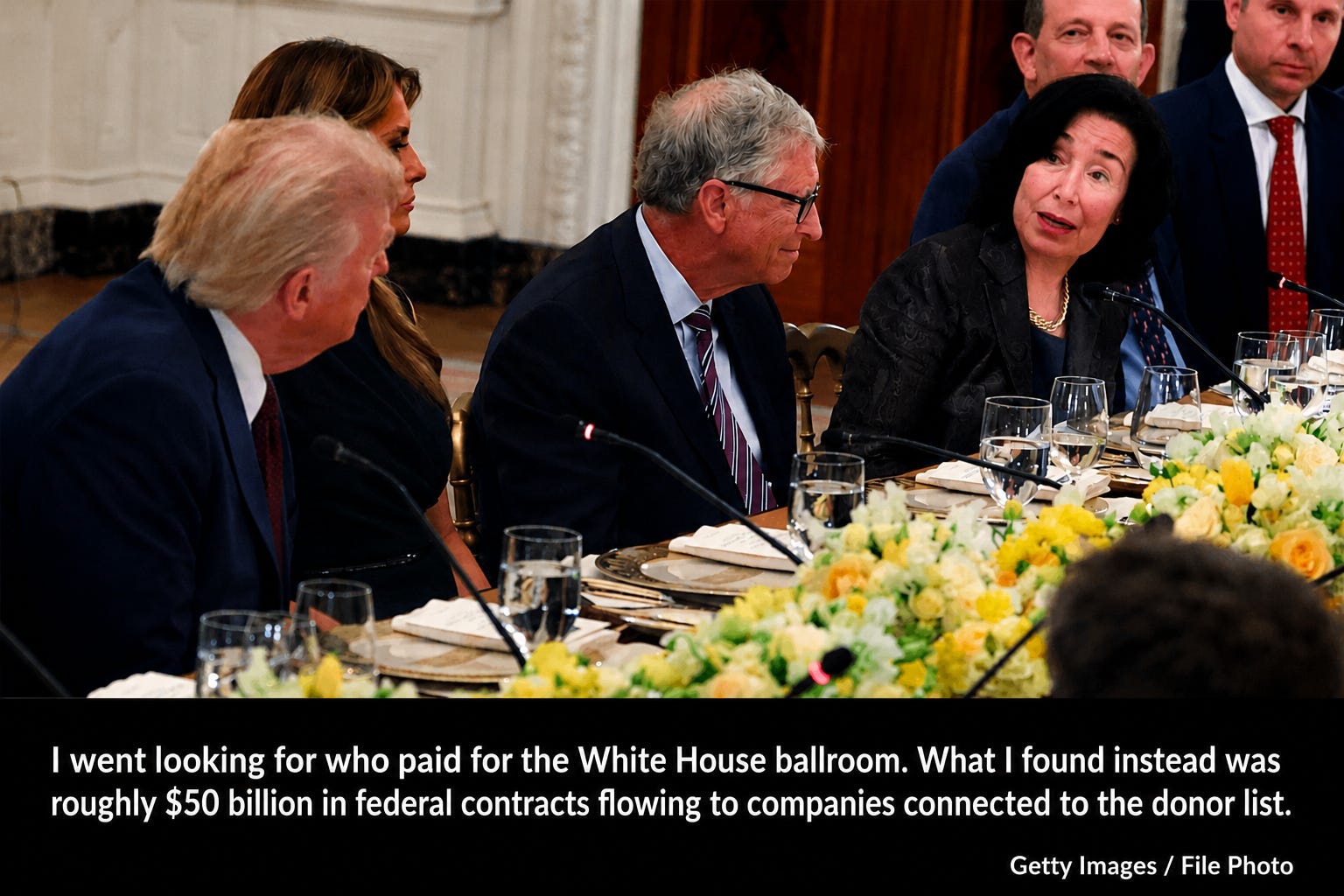

I started reading about Trump’s White House ballroom because I wanted to know who was paying for it.
That was it. No grand theory. No predetermined conclusion. I was trying to answer a simple question. The administration’s position was that private donors were covering the cost of the project, and as far as I could tell, that appeared to be true. Wealthy donors and corporate interests were reportedly financing the ballroom rather than having taxpayers directly cover construction costs.
Under normal circumstances, that probably would have been the end of my interest in the story.
Instead, somewhere along the way, I stumbled across a number that made me stop reading and start checking sources.
Fifty billion dollars.
According to Moneywise reporting, I found while following the donor trail, companies connected to the ballroom donor list later received roughly $50 billion in federal government contracts. Maybe there are perfectly reasonable explanations for every penny of it. Maybe every contract was awarded through a fair and competitive process. Maybe every company involved was simply the best-qualified bidder.
But if you’re wondering why that figure caught my attention, I don’t know what to fucking tell you. Fifty billion dollars ought to get anybody’s attention.
The deeper I dug, the less interested I became in the ballroom itself. In fact, I probably wouldn’t have built the goddamn thing in the first place. At a time when politicians routinely tell us there isn’t enough money for countless public needs, a massive new ballroom doesn’t exactly strike me as an urgent national priority. Still, that’s largely beside the point. If wealthy donors want to finance a ballroom, that’s an argument people can have on its own merits.
What interested me was the intersection of donor money, government contracts, and potential taxpayer obligations, all showing up in the same story.
The question that kept nagging at me wasn’t whether the ballroom itself was privately funded. The question was whether taxpayers were eventually being asked to participate in the transaction anyway. If donor companies later received roughly $50 billion in federal contracts and taxpayers were also being discussed as a source of project-related costs, where exactly are we supposed to draw the line between a privately funded project and a publicly subsidized ecosystem?
Years of legal research taught me that most investigations don’t begin with answers. They begin with something that doesn’t quite fit. You pull on a thread expecting to find a loose stitch, and suddenly you’re holding half the sweater in your hands, wondering how the hell you got there.
I started with a question about construction costs. Then I found Moneywise reporting about donor companies receiving billions in federal contracts. Then I found discussions about taxpayer-funded security and infrastructure costs associated with the project. None of those facts proves wrongdoing. None of them automatically establishes corruption. But together they create something that absolutely deserves scrutiny — and frankly, something that deserves a hell of a lot more attention than it’s getting.
If you’re tired of being told that asking questions is somehow partisan, subscribe and join us. Independent journalism only works when somebody is still willing to follow the paper trail.
Unfortunately, scrutiny has become strangely controversial in modern America. And I mean that in the most literal, what-the-fuck-happened sense of the word controversial.
You’ve probably noticed this yourself. People who once demanded investigations, audits, hearings, and document dumps suddenly become very selective about when those principles apply. The standard isn’t the evidence anymore. The standard is whether the story helps or hurts their side.
That’s a dangerous habit. Not annoying. Not politically inconvenient. Dangerous.
If a Democratic administration announced a major presidential project financed by wealthy donors and many of those same donors later received tens of billions of dollars in government contracts, conservatives would be losing their minds. Frankly, they’d be right to lose them.
If a Republican administration does the same thing, liberals should be just as pissed off. That’s how accountability is supposed to work. The goal isn’t to prove guilt. The goal is to establish confidence that public decisions are being made for public reasons. The moment we decide questions are off-limits because they make our preferred political team uncomfortable, we’ve already started abandoning the process that keeps power honest.
One thing that keeps bothering me about this story is how quickly some people move from “there’s no evidence of corruption” to “therefore nobody should investigate anything further.”
Those are not the same fucking statement.
The absence of evidence is often the reason people start looking more closely. Every inspector general, auditor, investigator, journalist, prosecutor, and researcher I’ve ever respected understood that. You don’t wait until the last page of the book to start reading the first chapter. You begin with the questions, and you follow them wherever they go, regardless of whose feelings get hurt along the way.
That’s why I find the public reaction almost more interesting than the ballroom itself. A remarkable number of people seem less interested in whether the arrangements deserve examination than in making sure nobody examines them at all. One side assumes guilt before anyone’s looked at a single document. The other side insists that curiosity is unfair, that asking questions is an attack, that wanting to see the paperwork makes you a partisan hack. Neither response does a damn thing for the public interest.
What would actually be useful is transparency. Show the contracts, show the timelines, show the bidding processes, show the donor relationships, and show the costs. If everything was handled properly, transparency strengthens public confidence. If there are problems, transparency exposes them. Either way, the public comes out ahead knowing more rather than less.
Funny how the people who claim everything was done right are also the people most opposed to showing us the work.
One of the first lessons I learned as a legal researcher was that documents don’t care who you’re rooting for. They don’t care whether you’re conservative, liberal, independent, libertarian, or politically homeless. They don’t care whose bumper sticker is on your car or whose campaign sign is in your yard. The record is the record, and your job is to follow it wherever it leads — even when it leads somewhere uncomfortable, even when it leads somewhere you weren’t expecting to end up.
That’s exactly what I was trying to do when I started reading about a ballroom. I wasn’t looking for a scandal. I certainly wasn’t expecting to spend my afternoon tracing donor lists and contract figures back through federal databases. I was trying to answer a simple question about who was paying for a construction project.
Instead, I found a much larger question that still hasn’t been answered to my satisfaction.
Why are so many people comfortable asking less of power than they used to?
Whether you’re talking about a ballroom, a bridge, a military contract, or a federal agency, accountability begins with curiosity. The moment loyalty becomes more important than curiosity, power stops worrying about explanations. And when power no longer feels obligated to explain itself, history suggests the rest of us eventually get handed the bill — and it’s always a lot bigger than fifty billion dollars.
The first casualty of blind loyalty isn’t truth. It’s curiosity.
Upgrade: I’m retired. No sponsors. No corporate leash. War Room is where the deeper patterns live. Not just what happened, but how it works and where it’s going next. If you want the full picture, upgrade. If not, you’ll still get the headlines. Just not the part that actually explains them.
Same reality, different delivery. Go check out Lotus Purrspective. Less profanity. Sharper judgment.
Buy Me A Cup Of Tea, because yelling ‘what the fuck are we doing?’ at the news doesn’t pay for itself.”
#Politics #GovernmentAccountability #FollowTheMoney #Trump #InvestigativeJournalism