

By Tom Hicks | Off Script with Tom Hicks
Editorial Note
This is an analysis of President Donald Trump’s proposed $5,000 “Trump Dividend,” the previous cash-payment proposals that never materialized, and what would actually have to happen before anybody gets paid. There’s a difference between something that looks a hell of a lot like an election inducement and something that legally qualifies as buying votes. We’ll keep that distinction where it belongs.
Your subscription helps fund reporting, research, publishing, new features, and the continued growth of every Tom Hicks Media publication.
A five-thousand-dollar check will get almost anybody’s attention. Trump apparently understands that because he announced one at the Republican midterm convention in Dallas with a very specific condition attached: Republicans have to keep both the House and Senate. The White House followed by promoting the proposal itself, quoting Trump saying that if Republicans win both chambers, he will issue every adult American citizen a $5,000 dividend. White House · Reuters
That qualifier matters. This isn’t a proposal Trump says Americans need badly enough to pass right now. It’s a proposal they supposedly get after Election Day, provided they return his party to power. The White House isn’t hiding the condition in page 47 of a policy paper. It’s the pitch. White House · Reuters
Then we get to the small matter of finding more than a trillion dollars.
Trump described the payment as a dividend made possible by America’s economic success. Roughly 240 million adult citizens multiplied by $5,000 comes to about $1.2 trillion, and Congress would have to authorize the spending. Trump and Vice President JD Vance have pointed toward tariff revenue as a possible source, but FactCheck.org calculated that current tariff revenue would need more than six years to cover one round of checks. Reuters · FactCheck.org
The latest Treasury numbers make the gap even harder to ignore. Through August, the federal government had collected $167.3 billion in net customs revenue for the fiscal year after $125.2 billion in tariff refunds. Meanwhile, the federal budget deficit had already reached $1.97 trillion, with another month left in the fiscal year, and federal interest expenses were up 13 percent from the same period last year. Reuters
And now the administration has introduced yet another way the money might appear. Commerce Secretary Howard Lutnick told NBC News that the $5,000 payments would use neither taxpayer money nor deficit spending, saying the administration would “earn the money” instead. Lutnick pointed to revenue from the $5 million Trump Platinum Card visa program and gains on the federal government’s Intel holdings. That explanation doesn’t match Vance’s suggestion that tariff revenue could fund the checks, while National Economic Council Director Kevin Hassett has said Republicans could use a congressional budget reconciliation bill to approve them. The Hill · Axios (Axios)
So at the moment, the Trump Dividend has a firm dollar amount, an election condition and several different explanations for how it gets paid for. Tariffs have been mentioned. So have visa revenue, government investments, and reconciliation through Congress. The check appears to be considerably more settled than the money behind it. Axios (Axios)
There’s also something slippery about saying the payment wouldn’t involve “taxpayer dollars.” Federal revenue doesn’t stop being public money because it came from a tariff, a visa fee, or the sale of a government asset. Article I of the Constitution says no money may be drawn from the Treasury without an appropriation made by law, which means Congress still controls whether that money gets spent. So even if Lutnick eventually finds $1.2 trillion behind the couch, the administration doesn’t get to mail it out simply because somebody found a new name for the pot of money. Congress.gov (Constitution.gov)
Calling this a “dividend” makes it sound as though Uncle Sam found a giant pile of profit under the couch cushions and decided to split it with the shareholders. That’s generally not how dividends work when you’re already spending almost $2 trillion more than you’re taking in. If Washington has to borrow most of the $1.2 trillion needed to mail the checks, we can probably stop pretending somebody discovered free money.
And this is where the story stops being about one promised check.
We’ve Seen This Check Before
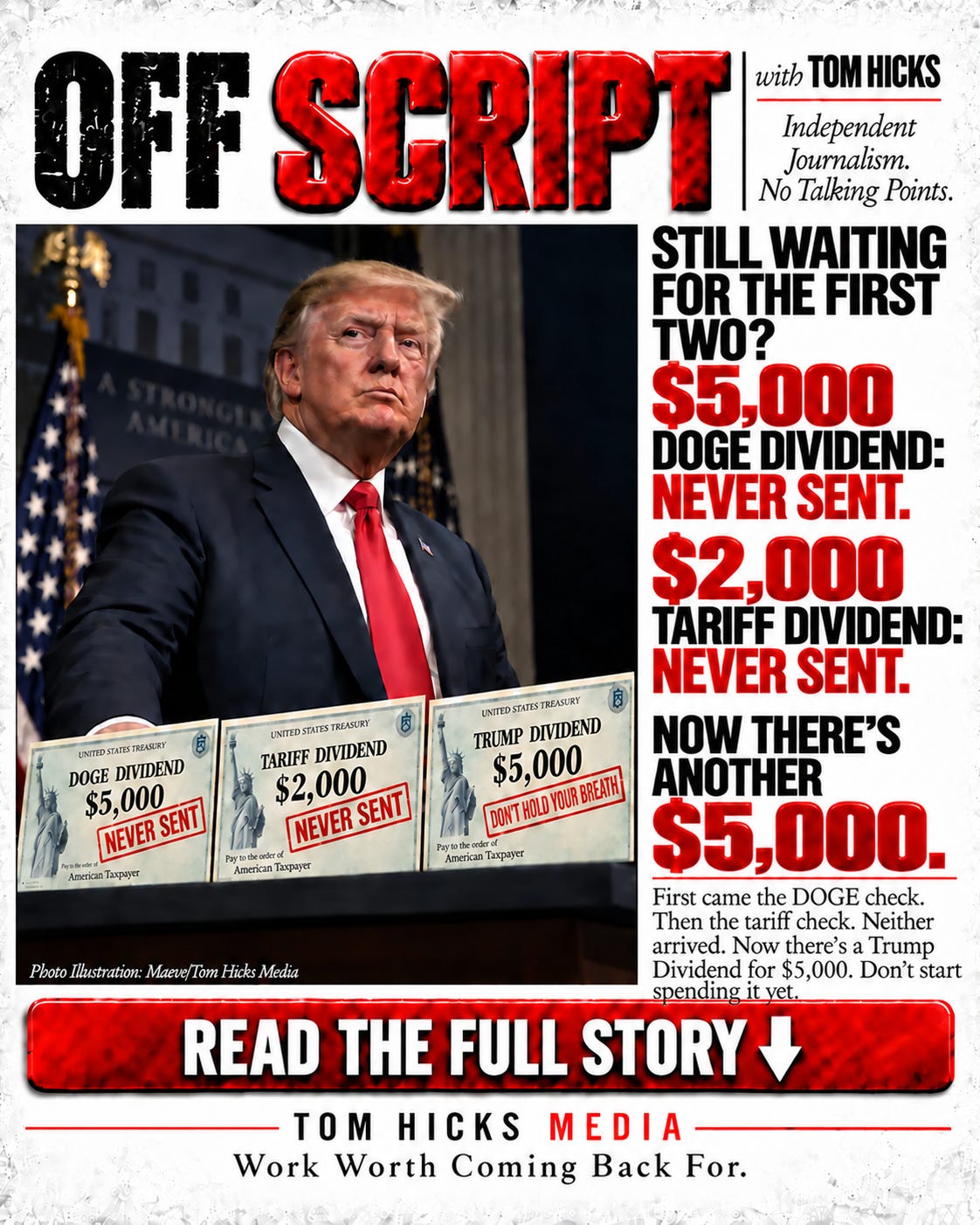
Back in February 2025, Trump said his administration was considering returning 20 percent of DOGE savings to Americans and using another 20 percent to reduce the national debt. The proposal originated with businessman James Fishback, who envisioned $5,000 checks for taxpaying households if Elon Musk’s Department of Government Efficiency managed to generate $2 trillion in savings. Musk said he would check with the president, Trump publicly embraced considering it, and the idea became known as the DOGE Dividend. Reuters
The catch was fairly obvious even then. The $5,000 figure depended on DOGE producing savings massive enough to fund the program, and the numbers never got there. July 2026 arrived; the envisioned DOGE payout did not, and American households did not suddenly discover a $5,000 government check in the mailbox. Reuters reported this week that Trump had proposed payments from DOGE savings before and that those dividends never came to fruition. Reuters
Then came the tariff dividend.
In November 2025, Trump said Americans, excluding high-income earners, would receive a tariff-funded dividend of at least $2,000. FactCheck.org found at the time that no formal plan had been finalized or approved by Congress, that there wasn’t enough tariff revenue to pay for it, and that despite online rumors claiming otherwise, there were no $2,000 direct deposits scheduled and no checks in the mail. FactCheck.org
That payment didn’t materialize either. By February 2026, after the Supreme Court struck down a major portion of Trump’s tariffs, Reuters was already reporting that his desired $2,000 tariff dividend might not be possible. This week, Reuters put the history plainly: Trump had previously promised dividends from both tariff revenue and DOGE savings, and none came to fruition. Reuters · Reuters
Now we have another $5,000 check.
One unrealized proposal can die because Congress won’t cooperate. Another can collapse because the revenue never appears. By the third trip through the checkout line, however, voters are entitled to ask whether there’s actually anything in the cart.
Where are the other checks?
That isn’t some partisan gotcha. It’s the first question you should ask anybody who has repeatedly floated sending you money and is now promising an even bigger payment. Before mentally spending the newest $5,000, it seems reasonable to ask what happened to the previous $5,000 and the $2,000.
Changing the name on the imaginary check doesn’t make the check more real.
So Why Wait Until After the Election?
Republicans control the White House, House and Senate today. Congress has not approved the Trump Dividend, however, and congressional Republicans haven’t exactly greeted the trillion-dollar proposal with a ticker-tape parade. Reuters reported that several Republican lawmakers immediately expressed concern that the plan would worsen inflation and the country’s fiscal position. Reuters
There are legitimate procedural obstacles. Senate rules could make passage before the election difficult, particularly if Democrats oppose it, and budget reconciliation presents its own timing problems. None of that changes the peculiar political arrangement being presented to voters: elect Republicans first, then we’ll see about the five grand. Reuters
Politically, the smell test isn’t particularly difficult. If a Democratic president stood at the Democratic convention and told every adult American, “Give us the House and Senate and I’ll give you $5,000,” Republicans would lose their collective minds before the speech ended. And frankly, I’d understand why.
Is It Actually Vote Buying?
Probably not in the legal sense, and that distinction matters.
Federal law prohibits paying people in exchange for their votes, but the Trump proposal doesn’t make an individual’s payment dependent on whether that person actually votes Republican. Election-law experts have pointed toward Brown v. Hartlage, 456 U.S. 45 (1982), in which the Supreme Court treated a candidate’s general promise of economic benefit differently from an individual quid pro quo for a vote. Reuters reported that legal experts generally view Trump’s proposal as closer to an ordinary campaign promise involving taxes or government benefits than criminal vote buying. Cornell Legal Information Institute · Reuters
Legal and sleazy are two entirely different measuring sticks.
A politician can legally promise voters a tax cut, student-loan relief, a new government benefit, or any number of things that would leave them financially better off. Voters then get to decide whether the promise is credible, whether they like it, and whether the politician deserves their vote. That’s politics.
The unusual part here is how nakedly transactional Trump has made the condition. Keep my party in control, and you get $5,000. The lawyers may be right that it passes constitutional muster, but nobody should have to pretend they can’t see what’s printed on the price tag.
Then There’s Inflation
There’s also an inconvenient economic question lurking behind all that free money. Economists told CBS News that a $5,000 payment to American adults would likely increase the federal deficit, push consumer spending higher and risk reigniting inflation. The pandemic stimulus checks helped households through an extraordinary crisis, but research has also found that the added demand contributed to the inflation that followed. CBS News · Reuters
That doesn’t mean an American getting five thousand bucks wouldn’t benefit from it. Of course they would. Hand me five grand, and I can think of uses for it before the check finishes clearing.
But government money doesn’t materialize because a president calls it a dividend. Whether the administration points to tariffs, visa fees, investments or something else, Congress still has to authorize the spending. With a fiscal-year deficit already brushing against $2 trillion before this proposal was even made, a $1.2 trillion payout deserves more discussion than “everybody gets a check.” Reuters · Congress.gov (Constitution.gov)
And that brings us back to the part of this story I can’t get past.
We’ve had the DOGE Dividend. No check.
We’ve had the tariff dividend. No check.
Now there’s a Trump Dividend for $5,000, payable sometime after voters give Republicans control of Congress again.
Maybe Republicans win. Maybe Congress approves it. Maybe Trump signs it. Maybe $5,000 really does land in millions of American bank accounts, and if it does, I’ll happily acknowledge that he delivered what he promised.
Until then, though, there’s a DOGE check that never arrived, a tariff check that never arrived, and a brand-new promise conveniently postdated until after Election Day.
That isn’t $5,000.
It’s an IOU from a guy with outstanding IOUs.
From Off Script: The Bullshit Detector
The claim:
Trump said more than $20 trillion has been invested in the United States from foreign countries and companies since he returned to office.
Bullshit.
Why:
Trump hasn’t provided an accounting that gets anywhere near $20 trillion. Even the White House’s own investment page lists about $11.2 trillion, and that figure includes announcements and pledges stretching years into the future rather than money already invested. Actual federal foreign-direct-investment data comes nowhere close to supporting the president’s claim. FactCheck.org
The claim:
Trump called his 2025 tax law “the largest tax cuts in the history of our country.”
Bullshit.
Why:
Measured as a percentage of GDP, which economists commonly use to compare tax legislation across eras, FactCheck.org reports that the law ranks sixth rather than first. The bill is unquestionably large, but “largest in history” is a measurable claim and the numbers don’t support it. Apparently sixth place needed better marketing. FactCheck.org
The claim:
Trump said, “food prices and almost every other item are rapidly going down.”
Bullshit.
Why:
Some individual prices have dropped, most visibly eggs after their enormous bird-flu-driven spike, but overall consumer prices were still rising. FactCheck.org reported that average grocery prices increased between January 2025 and July 2026, while the Consumer Price Index was up 3.4 percent over the previous 12 months. A cheaper carton of eggs doesn’t magically drag the rest of the supermarket downhill with it. FactCheck.org
The claim:
Trump said Americans now “pay the lowest prices in the entire world for prescription drugs.”
Bullshit.
Why:
There’s no evidence Americans now pay the world’s lowest prescription-drug prices. The administration has negotiated agreements intended to bring some prices closer to those paid in other wealthy countries, and some consumers may see savings on particular drugs, but the available evidence doesn’t remotely support the blanket claim Trump made. Lower in some places is not lowest in the world. FactCheck.org
Ferret Out the Bullshit
Bad claims don’t usually arrive wearing a name tag. They show up dressed as statistics, headlines, talking points, viral posts, and very confident people hoping nobody checks the math.
The Bullshit Detector is built to help you spot the tricks, test the claim, follow the evidence, and figure out when somebody’s feeding you a line.
$4.95 through the Tom Hicks Media Store, and free for paid subscribers.
More From Tom Hicks Media
Blind Spot
Is the Sunday’s Off Script with Tom Hicks deep dive into the story beneath the story, where the uncomfortable details usually live.
Lotus Purrspective
The world according to a tuxedo cat who remains deeply suspicious of nearly everything humans do.
Tom’s Number Ones
Six charts, one day in music history and enough records to remind you when radio could still surprise you.
Panic Room Sports
Smart football coverage with attitude. Everyone reacts. We’ll check the tape first.
Rabbit Ears Classic TV
Classic television without pretending everything old was automatically brilliant.
The Backlot Ghost
Movies, near-misses, strange casting choices and the Hollywood stories that refuse to stay buried.
Buy Me a Cup of Tea
Independent publishing runs on reporting, research, stubbornness and an unreasonable quantity of tea. If Off Script is worth coming back for, you can help keep it going by buying me a cup.
One Question Before You Go
After the DOGE dividend and tariff dividend never arrived, does the new $5,000 promise make you more interested in voting Republican, or less likely to believe the check is ever coming?

#Politics #DonaldTrump #TrumpDividend #DOGE #Tariffs #Midterms2026 #Economy #IndependentJournalism #OffScript
Would never consider voting Republican. TRUMPUS just trying to trick people who are not very bright.