
Tom Hicks | October 29, 2026
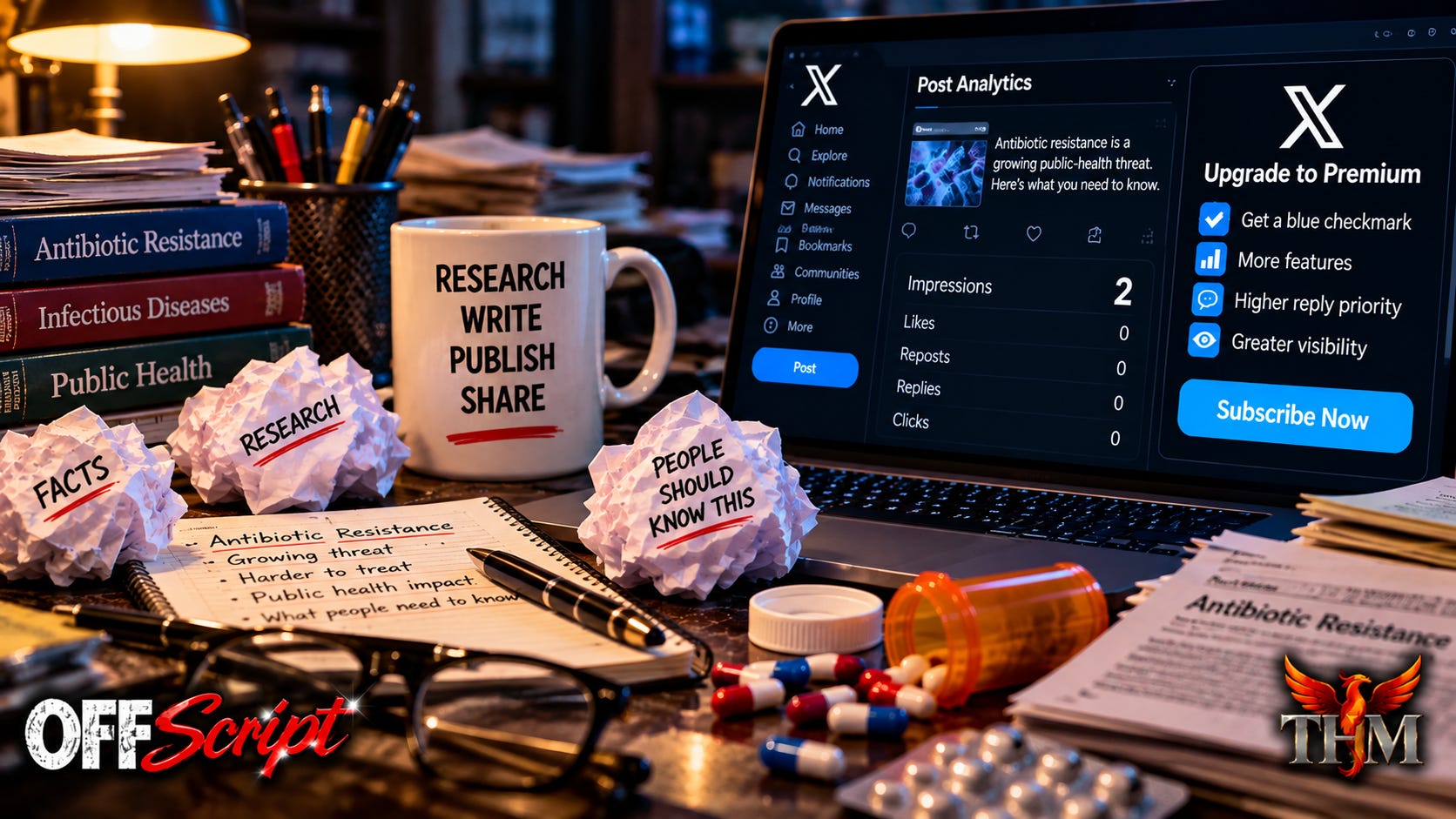
I spent a good chunk of a day researching and writing an article about antibiotic-resistant germs. You know, those nasty little bastards that are becoming increasingly difficult to kill because some of our most important medicines are losing their effectiveness. It’s a serious public-health problem, the kind of thing that deserves considerably more attention than whatever celebrity is currently fighting with another celebrity.
I finished the article, published it, shared it on X, formerly known as Twitter, and went about my business. More than 24 hours later, I checked the numbers. According to X, my post had received two impressions. Not two people who read the article or clicked through to learn something. Two times the post was displayed on somebody’s screen.
Two fucking impressions.
I’ve had more people look at me when I sneeze in the grocery store. Apparently, the algorithm decided antibiotic resistance wasn’t contagious enough to spread.
And here’s where the whole thing gets particularly ridiculous. Every damn day, X reminds me that I could be paying for a Premium subscription. Get yourself a shiny blue checkmark! Unlock more features! Join the exclusive club! Apparently, the platform has no trouble locating me when it wants my credit card, but when I publish something I actually want people to read, suddenly I’m the invisible man.
There’s something deeply screwed up about a system that can find me whenever there’s money to be made but apparently can’t find two dozen people who might be interested in a public-health story. And before somebody starts screaming that paying for Premium is simply the price of doing business, let’s remember what we’re talking about. X advertises preferential treatment for replies from paying subscribers, with higher tiers offering greater reply prioritization.
That doesn’t prove my article was buried because I didn’t pay. Reply prioritization isn’t the same thing as guaranteed distribution of original posts. But it does raise a hell of a question: When visibility becomes something a platform can sell, what happens to everybody who doesn’t buy it? And when did we collectively agree that being heard should come with a monthly service charge?
How the Hell Can Something Fail Before Anybody Sees It?
Here’s what really pisses me off. I’ve been writing long enough to know that some articles connect and others land with a thud. Sometimes you pour your heart into something and nobody gives a damn. Sometimes you toss off a quick observation over morning tea and people go nuts. That’s writing, publishing, and life. I can live with readers deciding something I’ve written isn’t worth their time.
But how the hell can an algorithm conclude that nobody is interested in an article when it barely showed the article to anybody? Two impressions in more than 24 hours. What exactly are we measuring here? The overwhelming indifference of two appearances on somebody’s screen?
If a restaurant opens for dinner and the landlord locks the front door, you can’t blame the chef because nobody ordered the chicken. Maybe the algorithm predicted people wouldn’t be interested. Maybe it had other reasons for keeping the post out of sight. But a prediction isn’t an audience reaction, and you can’t claim the audience rejected something when the audience was never given a meaningful chance to accept it.
Here’s the really fucked-up possibility. If an algorithm predicts a post won’t generate much engagement, gives it almost no exposure, and then uses the lack of engagement to justify keeping it invisible, we’ve created a beautiful little self-fulfilling prophecy. The machine guesses nobody cares, makes sure almost nobody sees it, and then congratulates itself for being right. That’s a rigged game of hide-and-seek.
I don’t know whether that’s precisely what happened to my post. X doesn’t give me enough information to know, and that’s part of the problem. The platform knows how its systems distribute content. The person who actually created the content gets a handful of numbers and is left trying to read tea leaves. And I drink enough tea to know that’s a lousy way to find answers.
Journalism Isn’t Supposed to Be a Slot Machine
I’m not suggesting X owes me a million impressions. Hell, I’d settle for enough exposure to find out whether anybody gives a damn. But social media companies have inserted themselves between publishers and audiences on an extraordinary scale. Their systems decide what gets recommended, what rises to the surface, and what sinks into the digital swamp.
X describes its For You feed as a ranking system that uses signals from user behavior, interests, relationships, and interactions to predict what people might find relevant. Fine. I understand why a platform drowning in content needs some way to sort through the mess. But relevance according to whom?
A celebrity’s wardrobe malfunction might generate thousands of reactions while an explanation of a growing public-health threat gets virtually ignored. That doesn’t mean the wardrobe malfunction is more important. It means the celebrity story may be better at generating the kind of behavior the system is looking for. An algorithm can be very good at predicting what keeps people scrolling without being particularly good at deciding what they ought to know.
Worse, writers start changing what they write to satisfy the damn thing. Maybe the headline needs to be angrier, the subject more controversial, or the article needs fewer links and more outrage. Maybe I should include a photograph of somebody discovering a raccoon in their underwear drawer. Eventually, the question stops being What do readers need to know? and becomes What will the algorithm let them see?
That’s a shitty way to run a public conversation. Independent publishers are especially vulnerable because we don’t have giant marketing departments, advertising budgets, or teams of people trying to figure out which combination of words will make a recommendation system happy. We research, write, edit, publish, and hope somebody sees the damn thing. When nobody does, we’re left staring at an analytics screen like a detective investigating a crime scene where somebody stole all the evidence.
A Quick Favor
If you’re reading Off Script through Substack, consider subscribing directly. That gives us a way to stay connected without depending entirely on a social media feed to decide whether we should meet again.
If you know somebody who might appreciate independent reporting with a little attitude, send them the article yourself. Apparently, human beings are still pretty good at delivering messages.
Nobody Has to Be Conspiring for the System to Be Broken
Let’s be careful about one thing, because I don’t intend to replace actual reporting with bullshit simply because I’m pissed off. Two impressions do not prove X deliberately suppressed my article. I have no evidence that somebody flagged it, penalized my account, or pushed a secret button marked Screw This Guy.
Maybe the post simply got lost. Maybe the timing was lousy, or the subject didn’t fit the interests of whatever tiny audience the system initially considered. All plausible. But here’s the question nobody seems particularly interested in answering: How the fuck am I supposed to improve something when I can’t tell whether it failed or was never given a chance?
Imagine writing a newspaper column, handing it to the publisher, and discovering that the paper never made it onto the delivery trucks. Then the publisher tells you your column didn’t attract enough readers. No shit, Sherlock. And while you’re trying to figure out what happened, the publisher wanders into your office and offers to sell you a premium delivery package.
That’s pretty much where I find myself. The people controlling distribution have the information. The people producing the work have the frustration. And the people who might have wanted to read it don’t even know it exists. What a magnificent little clusterfuck.
The Stories That Disappear
My antibiotic-resistance article isn’t going to change the world by itself. I know that. But the subject matters. Antibiotic resistance affects ordinary people, hospitals, families, and the future of medical care. It’s exactly the kind of issue that becomes easier to ignore when it doesn’t generate immediate outrage or entertainment.
And this goes well beyond one article. Local government, school boards, consumer protection, environmental hazards, investigative reporting, and all the other unglamorous stories that help people understand what’s happening around them compete in an environment where attention is currency. Their distribution is increasingly influenced by systems that most readers barely notice.
I’m not against entertainment. People deserve to laugh, watch ridiculous videos, and occasionally spend twenty minutes looking at a cat that appears to be arguing with a ceiling fan. Hell, I publish a cat column myself, and believe me, she has opinions. But something has gone seriously sideways when the machinery connecting us to information becomes so opaque that writers can’t distinguish rejection from invisibility.
And the answer cannot simply be that everybody should pay the platform more money.
One Question
Have you ever posted something important, useful, or genuinely interesting and watched it disappear into the social media void?
I’m especially interested in hearing from independent writers, small publishers, and ordinary people who aren’t trying to become influencers. They’re just trying to be heard. Tell me what happened, and if you’ve got actual numbers, even better. I’d like to know whether my two impressions are an isolated embarrassment or part of something much bigger.
The Bullshit Detector
The Official Bullshit Detector Stink Scale
💩 A Little Whiff — Misleading, with some truth.
💩💩 Something Smells — Important context is missing.
💩💩💩 Steaming Pile — Serious distortion of the facts.
💩💩💩💩 Full-Blown Bullshit — Overwhelmingly false or deceptive.
💩💩💩💩💩 Weapons-Grade Bullshit — Spectacularly dishonest nonsense.
1. The Mexican President’s Imaginary Hospital Set
Claim: Mexican President Claudia Sheinbaum staged a hospital visit on a television set, pretending to care about patients while cameras recorded the performance.
Bullshit: The supposedly incriminating photograph was manipulated. The original images did not show the television equipment added to the viral version.
💩 Rating: 💩💩💩💩💩 Weapons-Grade Bullshit
Why: Reuters examined the circulating photograph and compared it with the original images. The supposed evidence of a staged hospital visit had been digitally altered, creating a scene that wasn’t there. Somebody apparently decided that if reality wouldn’t cooperate with the accusation, they’d just manufacture a more convenient reality.
2. Britain’s Imaginary Ministry of Speech
Claim: British parents face fines of up to £10,000 and confiscation of devices if their children use social media, thanks to a new Under-16 Social Media Safety Bill.
Bullshit: The supposed legislation and the government department promoting it were fabricated.
💩 Rating: 💩💩💩💩💩 Weapons-Grade Bullshit
Why: Reuters investigated the circulating document and found no such bill or government agency called the Ministry of Speech. Britain has genuine online-safety laws and debates about children’s social media use, but the viral document invented its own legal nightmare. The Ministry of Speech sounds like something George Orwell would have rejected for being a little too obvious.
3. The Refugee Sign That Never Existed
Claim: A woman confronting looters at a Paris convenience store had previously attended a pro-refugee demonstration holding a welcoming sign, supposedly proving she was getting a taste of her own medicine.
Bullshit: The protest photograph was digitally manipulated, and the claim that the woman owned the looted store was unsupported.
💩 Rating: 💩💩💩💩💩 Weapons-Grade Bullshit
Why: Reuters traced the supposed protest photograph to a 2016 demonstration in London. The woman from the Paris video had been inserted into the image. The store’s parent company also confirmed that she wasn’t an employee. Somebody couldn’t find an actual example of hypocrisy, so they manufactured one with Photoshop. Apparently, reality wasn’t cooperating with the narrative, so they told reality to go fuck itself.
The Part That Really Gets Me
I can handle an article failing. I’ve written things that deserved a bigger audience and things that probably deserved to be wrapped around fish. Most writers have. But I’d like the opportunity to succeed or fail based on whether somebody actually wants to read what I’ve written, rather than whether I guessed the right combination of keywords, hashtags, posting times, and ritual sacrifices to the digital gods.
And certainly not because I refused to buy a shiny checkmark.
Twenty-four hours after sharing a story about a serious public-health issue, I had two impressions to show for it. Meanwhile, X was still perfectly capable of reminding me that I could upgrade my account.
Maybe tomorrow I’ll write about the dangers of antibiotic resistance while wearing a bikini and wrestling an alligator. At least then the algorithm might think I’m interesting.
Around Tom Hicks Media
If the algorithms have you ready to scream into a pillow, Frank N. Krancke has probably beaten you to it. Over at Is It Just Me?, he’s taking on the everyday bullshit that drives otherwise reasonable people absolutely nuts. Blind Spot digs beneath the political headlines, while What the Hell? proves that reality can be more ridiculous than anything we could invent.
And that’s just a taste of what we’re publishing. Music, sports, classic television, movies, feline judgment, and a few neighbors who probably know too much about everybody else’s business.
Explore the Complete Tom Hicks Media Collection
Every publication, one place. Pick whatever interests you, and come back whenever you like.
Coming soon: Just Lucy. A four-and-a-HALF-year-old with questions about the grown-up world, very definite opinions, and absolutely no intention of accepting a stupid answer.
Your turn. Have you ever watched something you posted disappear into the algorithmic black hole? Or do you think we’re giving these platforms too much credit for what might just be ordinary indifference?
Hit Leave a Comment below and tell me what you think. Agree, disagree, or tell me I’m full of shit. Just don’t make me guess whether anybody actually saw the damn thing.
Join the conversation: The Tom Hicks Media Discord is open for readers who want to talk about the stories, argue a little, share ideas, or just escape the algorithms for a while.
If you know somebody who’s fighting the same invisible battle, send this article along. And if you’re tired of leaving independent journalism at the mercy of a machine, subscribing directly to Off Script is one small way to take back control.
#OffScript #IndependentJournalism #SocialMedia #Algorithms #Twitter #X #MediaTransparency #DigitalPublishing #FreePress #TomHicksMedia