

Some power grabs kick the door down screaming.
Others stroll in wearing a suit, mumbling statutory citations, hoping nobody notices they’re quietly trying to bulldoze the guardrails Congress installed to stop exactly this kind of bullshit.
What just happened in the Northern District of New York is the second kind — a dry-looking legal maneuver that is, in reality, a deliberate stress test of executive power. And the administration didn’t wander into this gray zone by accident. This was a conscious decision to shove Article II authority up against a statutory wall and see if the wall cracks.
This isn’t bureaucratic housekeeping. It’s a separation-of-powers bar fight disguised as paperwork.
And yes — it’s almost certainly headed straight into litigation hell.
The Guardrail Congress Built — and Why It Exists
U.S. attorneys don’t descend from Mount Constitution carrying tablets. They exist because Congress said so, and Congress — having seen what happens when the executive branch gets cute with “temporary” appointments — wrote a vacancy system designed to stop DOJ from playing musical chairs with loyal placeholders.
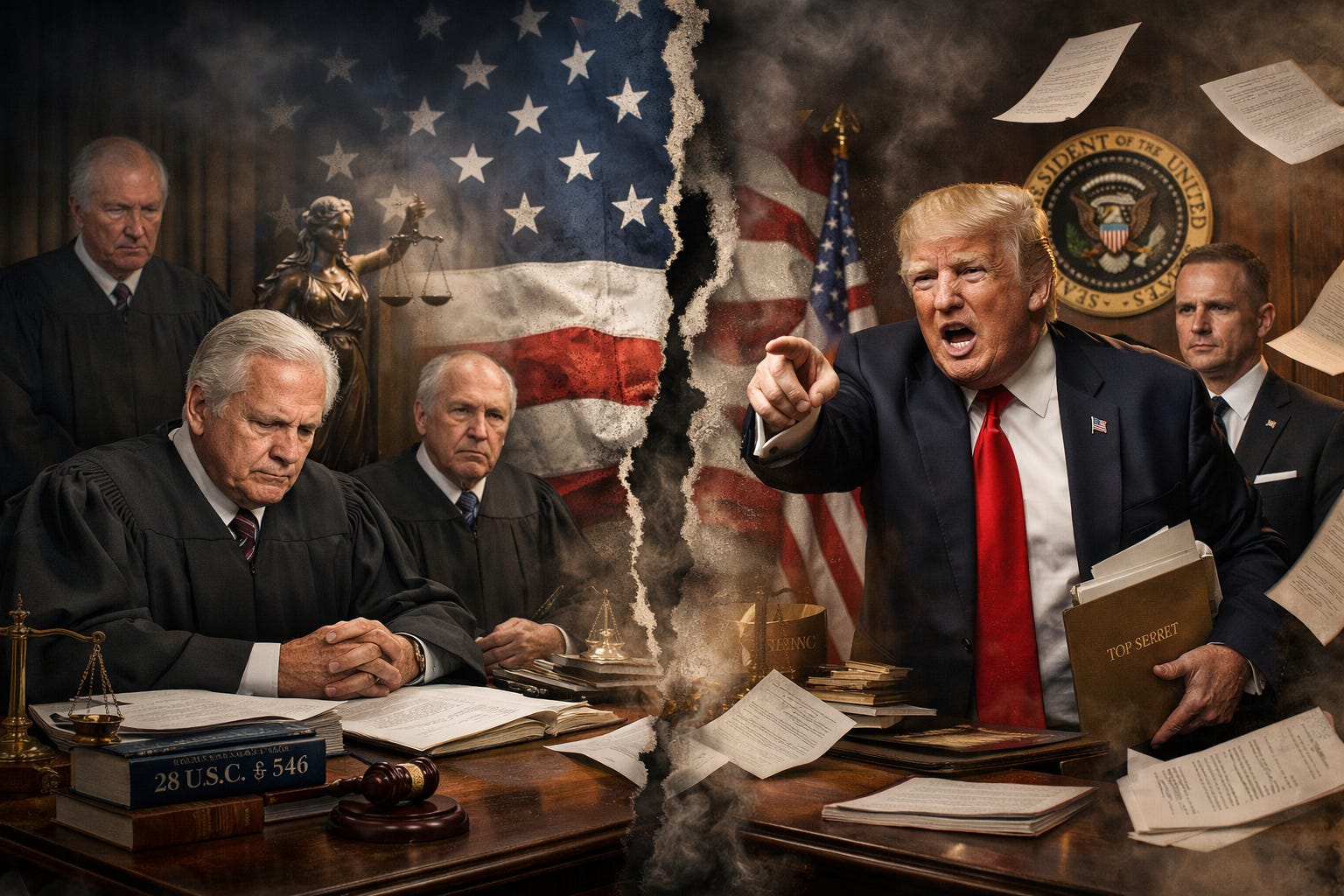
Under 28 U.S.C. § 546, when a U.S. attorney position opens, the Attorney General gets a 120-day interim appointment window. That’s the leash. If the Senate hasn’t confirmed someone by then, district court judges step in and appoint an interim U.S. attorney to serve until confirmation happens.
That judicial appointment is not ceremonial. It’s a statutory circuit breaker. Congress built it to prevent the executive branch from dragging interim appointments out indefinitely while pretending everything is fine.
Recent court rulings interpreting § 546 hammered this home: once judges appoint someone, DOJ doesn’t get to yo-yo the authority back. The statute is supposed to bite, not politely gum the problem.
Which is why what happened next smells less like governance and more like a deliberate “let’s see if we can get away with this shit” experiment.
The New York Flashpoint
The Northern District of New York became ground zero after DOJ tried to keep Trump-aligned acting U.S. attorney John Sarcone in office past the 120-day limit using procedural gymnastics that a court basically looked at and said, “Nope. Try again.”
So the judges followed the statute. They appointed veteran prosecutor Donald Kinsella under § 546. That should have been the clean statutory reset Congress envisioned.
Instead, within hours, Deputy Attorney General Todd Blanche declared Kinsella terminated, publicly asserting that judges don’t pick U.S. attorneys — the president does — and invoking Article II removal power like it’s a universal skeleton key.
Kinsella’s reaction was the legal equivalent of, “Well… this is going to court.” He’s consulting with the judges because nobody involved is pretending this is settled law. Everyone understands this is a live constitutional knife fight, not a clerical misunderstanding.
And the administration clearly decided this was a fight worth picking.
The Legal Knife Fight Beneath the Headlines
Strip away the politics and you’ve got two legal principles grinding against each other hard enough to throw sparks.
On one side sits presidential removal authority. Historically, executive officers are removable at will unless Congress explicitly restricts that power. Supporters of the firing lean on 28 U.S.C. § 541(c), which says each U.S. attorney is subject to presidential removal. Read literally, that language doesn’t carve out judge-appointed interims. It’s broad, clean, and backed by a long tradition of executive control over executive officers.
That’s not a clown argument. It has real doctrinal weight.
On the other side is the structure and purpose of § 546 itself. Congress didn’t hand judges interim appointment authority for fun. It did it to stop DOJ from gaming vacancy rules. If the president can instantly fire a judge-appointed interim, the safeguard collapses into theater. Courts generally frown on statutory interpretations that render entire provisions pointless.
This is where constitutional law stops being abstract civics class trivia and turns into an institutional tug-of-war. The executive says removal authority is king. The judiciary says Congress deliberately inserted us here to keep the executive from pulling exactly this stunt.
Both sides have plausible footing. Neither side has a Supreme Court opinion that cleanly ends the argument. That uncertainty is gasoline.
What Courts Are Likely to Wrestle With
There’s no neat precedent that says, “Here’s exactly what happens when a president nukes a judge-appointed interim U.S. attorney.” So courts are walking into open terrain.
A strict formalist judge could say the appointment mechanism doesn’t change the officer’s executive character — meaning Article II removal authority still applies. Case closed, thanks for playing.
But judges already irritated by DOJ vacancy maneuvering may see this as a deliberate end-run around both statutory purpose and judicial authority. That opens the door to injunctions, temporary orders preserving Kinsella’s authority, and expedited appellate chaos.
Whatever happens, this isn’t staying quiet. Courts take institutional boundary fights personally, because they’re not about personalities — they’re about who actually controls the levers of government.
And when judges smell an executive branch trying to turn a statutory safeguard into decorative trim, they tend to react.
