

EDITORIAL NOTE
There is a version of this story that says Donald Trump is attacking mail voting again. That version is true, easy to write, and about as surprising as discovering water at the bottom of a swimming pool. Trump has spent years attacking voting by mail, and his administration has been pushing new federal restrictions on it throughout 2026. Reuters, Aug. 18
There is another version that says the Postal Service has already begun rejecting Americans’ ballots. That version is wrong. USPS says the final rule it published Friday will not be implemented for the November election unless the courts lift the injunctions currently blocking it. Reuters, Aug. 22
The interesting story sits between those two.
A federal judge ordered USPS not to implement the challenged portion of Trump’s executive order and specifically barred the agency from “initiating or completing rulemaking” for the regulations at issue in the November election. Weeks earlier, USPS itself had publicly promised that it would not publish a final rule until it obtained relief from the injunctions. Then, late Friday, USPS published the 95-page final rule anyway. U.S. District Court order, Aug. 11 USPS Federal Register notice, July 17 Reuters, Aug. 22
Now we have a story.
Donald Trump voted by mail in Florida’s Republican primary this month.
The White House confirmed the circumstances after reports of Trump’s mail ballot surfaced, even as Trump continued pushing restrictions on the same method of voting. White House spokeswoman Olivia Wales defended the president’s use of it by pointing to exceptions for travel and noting that Trump remains a Palm Beach resident while primarily living at the White House. Reuters also reported that Trump voted by mail in a Florida special election in March. Reuters, Aug. 18
In other words, Donald Trump has personally trusted the United States mail with his vote at least twice this year while arguing that mail voting needs a much heavier federal hand.
That hypocrisy deserves to be called what it is. But even that isn’t the biggest problem hiding in this story.
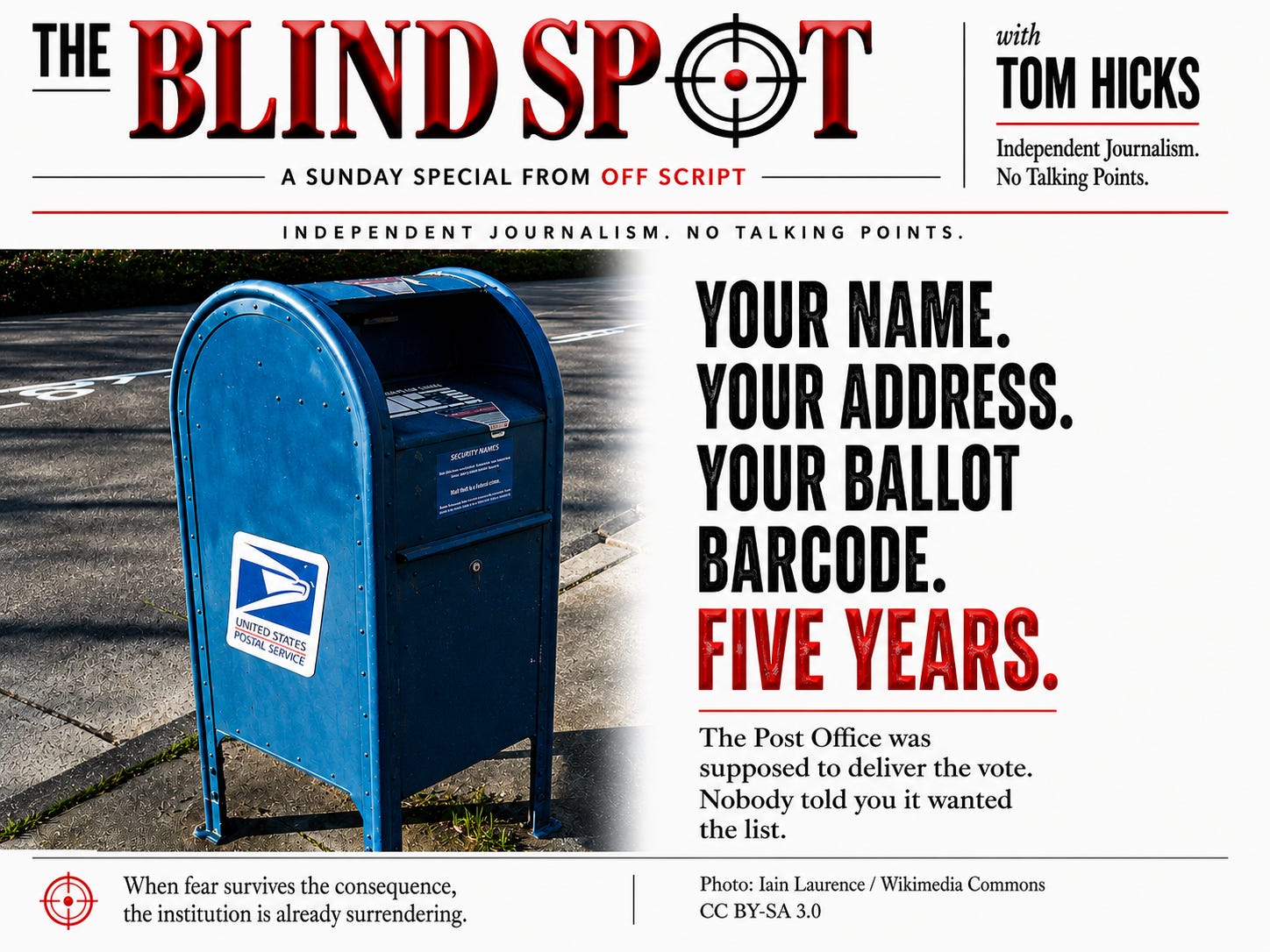
Trump’s March 31 executive order directed USPS to develop federal standards for mail ballots. Among other things, it called for unique Intelligent Mail barcodes, state-provided lists of voters receiving mail ballots, and a system under which USPS would not transmit certain ballot mail unless the voter had been enrolled on a state-specific list with the Postal Service. Executive Order 14399, Federal Register
The order also directed USPS to coordinate with its inspector general and the Justice Department on suspected unlawful use of the mail involving federal election materials. It required any final rule under that section to be issued within 120 days. Executive Order 14399, Sections 3(c) and 3(d)
That is considerably more than asking election offices to put the right postage on an envelope.
And that is where the courts entered the picture.
THE COURT SAID THE EXECUTIVE BRANCH DOESN’T GET TO DO THIS
In June, U.S. District Judge Indira Talwani ruled against major portions of Trump’s election order in a lawsuit brought by states challenging the administration. Her order barred USPS from implementing the challenged mail-ballot provisions against the plaintiff states for the November election and prohibited the agency from “initiating or completing rulemaking” to promulgate those regulations for that election. The court also ordered federal defendants to notify relevant employees that Sections 2 and 3 of the executive order were “unlawful, null, and void” as applied to those states. U.S. District Court order, June 25
Then came a second case brought by voting-rights organizations.
On August 11, Talwani issued a broader preliminary injunction covering USPS implementation of Section 3 for the November 3 election or any earlier federal election. Her conclusion on the constitutional question did not require a translator: “The executive branch has no authority to regulate elections.” U.S. District Court memorandum and order, Aug. 11
The injunction barred USPS from implementing, enforcing or giving effect to Section 3 for the November election, including refusing to transmit mail ballots. Then it added the language that makes everything that happened Friday worth watching: USPS was also barred from “initiating or completing rulemaking” for the specified regulations. U.S. District Court order, Aug. 11
That alone creates a legitimate legal question about publishing a final rule while the injunction remains in place.
But USPS had already made the situation even clearer itself.
USPS MADE A PROMISE IN WRITING
On July 17, the Postal Service published a Privacy Act notice describing the records system it intended to use with its new Federal Ballot Mail Portal. Right at the beginning, USPS acknowledged that the ballot-mail rule was subject to two injunctions being appealed. Then the agency wrote this: “The Postal Service will not publish a final rule unless and until the government obtains relief from all relevant injunctions.” USPS Federal Register Privacy Act notice, July 17
There is not much wiggle room in that sentence.
USPS did not say it would publish the rule but decline to enforce it. It did not say it would finish the rule and hold implementation. It said it would not publish a final rule unless and until the government obtained relief from the injunctions. USPS Federal Register Privacy Act notice, July 17
On Friday night, with the court restrictions still in place, USPS published the final rule.
Reuters reported that USPS says it did so to allow the rule to take effect quickly if the courts later lift the injunctions. The agency says it will take no action to implement the rule for the 2026 election unless that happens. Reuters, Aug. 22
There is an obvious question now.
If a court tells an agency not to complete a rulemaking, and the agency itself promises not to publish the final rule without court relief, what exactly are we supposed to call it when the agency publishes the final rule before getting that relief?
KEEP READING THE BLIND SPOT
This is where the story stops being a fight over envelopes and starts becoming a fight over federal power.
Behind the paywall, we’re going into the Postal Service’s own documents. They describe a federal system built to hold voter names, home addresses, and the unique barcodes attached to both outbound and return ballot envelopes. USPS says one stated purpose of that system is to “facilitate law enforcement efforts,” and the records are scheduled to be retained for five years. USPS Federal Ballot Mail system notice USPS five-year retention policy
Then there is the bigger question.
When the federal government cannot directly take over a state function, how much control can it gain by taking control of something that function needs?
Your paid subscription supports the research, document review, and independent reporting behind The Blind Spot and every Tom Hicks Media publication.
UPGRADE TO PAID TO CONTINUE READING
WHAT USPS WANTS STATES TO HAND OVER
The phrase “Federal Ballot Mail Portal” sounds like something dreamed up by a committee whose greatest fear is interesting nouns.
What goes into it is more interesting.
USPS’s July Privacy Act filing says the system would receive a list of people who are sent mail or absentee ballots in federal elections. For each person, the system would contain the individual’s address, the unique Intelligent Mail barcode printed on the outbound ballot envelope, the barcode printed on the return ballot envelope and the state that issued the ballot. USPS Federal Register Privacy Act notice
The categories of records are equally plain. USPS lists the voter’s name, address, unique barcode numbers, and originating election-office state. The filing says those records can be retrieved using personal identifiers including first and last name, address, issuing state, and barcode. USPS Federal Ballot Mail records description
That does not mean USPS knows how you voted.
The Postal Service says it will not inspect ballot contents, and Reuters reports that the final rule does not collect party affiliation. Postal workers are not suddenly going to steam open envelopes in the back room and see whether Aunt Martha voted Republican. Reuters, Aug. 22
Good.
That still leaves the federal government holding a database connecting a voter’s identity and address to unique tracking information on the envelopes carrying that person’s ballot.
Those are different concerns, and we should be capable of holding both thoughts in our heads at the same time.
THEN THERE’S THE FIVE-YEAR PART
The Postal Service’s own filing says the records in the Federal Ballot Mail system would be retained for five years.
That filing also says the records would be retrievable by name, address, issuing state, and barcode. USPS says access would be limited to personnel whose official duties require it, facilities would have access controls, and online transmissions would be encrypted. USPS retention and safeguards notice
Those protections matter. Pretending otherwise would turn this into the kind of hysterical bullshit we usually spend our time mocking.
But safeguards answer the question of how the government says it will protect the database. They do not answer why a federal postal agency needs a five-year voter-linked ballot-envelope database in the first place.
USPS supplies an answer to that too.
The very first stated purpose of the system is “To help determine adherence to federal law and facilitate law enforcement efforts.” Another stated purpose is receiving the voter lists, addresses, outbound and return barcodes and issuing-state information. USPS Federal Ballot Mail system purposes
There is the part I cannot get past.
We have moved a long way from delivering the mail.
THE POWER IS IN THE CHOKEPOINT
The Constitution gives states broad authority over the mechanics of elections, subject to Congress’s constitutional powers over federal elections. Talwani relied on that allocation of power when she concluded that the executive branch did not possess the authority Trump was trying to exercise through the order. U.S. District Court memorandum and order, Aug. 11
The Trump administration’s approach does something more subtle than announcing that Washington will run state elections.
It uses infrastructure.
A state can administer its own election, maintain its own voter rolls, decide who qualifies for an absentee ballot under state law and prepare those ballots itself. But if the federal agency controlling the mail can attach federal conditions to the moment those ballots enter the postal system, Washington has gained leverage over the election without moving the entire election apparatus to Washington.
That is the Blind Spot.
Control the choke point, and you don’t necessarily have to control everything upstream.
Trump’s executive order directed USPS to develop a process under which states could submit lists of mail-ballot voters, and USPS would maintain state-specific participation lists. The order said USPS should not transmit covered ballots from individuals unless they had been enrolled on the relevant list, and it required unique ballot-envelope identifiers such as barcodes. Executive Order 14399, Section 3
The Postal Service’s June proposed rule translated much of that into postal procedure. It described the Federal Ballot Mail Portal, unique barcode requirements, and compliance checks tied to ballot-mail preparation. USPS proposed rule, June 2
Reuters reports that the final rule published Friday continues to require states to provide USPS with names and barcodes tied to mail ballots, including unique barcodes for outbound and return envelopes. USPS says the final rule will not be implemented unless the courts allow it. Reuters, Aug. 22
That last sentence is important.
Nobody should leave this article believing the system is operating today.
But nobody should leave believing this is theoretical anymore, either.
The final rule is written.
THE PRESIDENT WHO TRUSTS HIS OWN BALLOT
And now we come back to Donald Trump.
The White House acknowledged this month that Trump voted by mail in Florida’s Republican primary. The administration defended his use of the system under exceptions it supports for circumstances such as travel, while continuing to argue against universal mail voting as too susceptible to fraud. Reuters, Aug. 18
Trump also voted by mail in a Florida special election in March.
So we can dispense with the idea that the president believes putting a ballot into the mail is inherently too dangerous to trust. He has trusted it with his own vote more than once. Reuters, Aug. 18
The administration can make a perfectly legitimate policy argument that absentee voting with defined eligibility requirements is different from automatically mailing ballots to every registered voter.
Fine. Make that argument.
What it cannot do is use Trump’s rhetoric about mail voting as though the mechanism itself becomes safe or unsafe depending upon who happens to be using it.
Trump called mail ballots “cheating,” Reuters reported, and continues pressing Congress and federal agencies for tighter restrictions. Then he requested one, filled it out and mailed it back. Reuters, Aug. 18
If voting by mail is trustworthy enough for the president of the United States, Americans are entitled to ask why everybody else requires a new federal database, individually linked envelope barcodes and a Postal Service system designed in part to facilitate law enforcement.
That isn’t partisan snark.
It is the obvious question created by his own behavior.
THIS ISN’T A CONTEMPT RULING
There is one place where we need to be extremely careful.
No court ruling I have found as of Saturday says USPS committed contempt by publishing Friday’s final rule. The Blind Spot is not making that legal conclusion.
The distinction USPS appears to be relying on is that publication is being done in preparation for possible future court relief, while implementation remains frozen. Reuters reports that USPS says it published the rule so it could take effect immediately if the injunctions are lifted. Reuters, Aug. 22
Courts will decide whether that distinction complies with the existing orders.
But we do not have to pretend the wording of those orders disappeared.
The August 11 injunction expressly bars USPS from “initiating or completing rulemaking” for the specified regulations for the November election. The July 17 USPS filing expressly said the agency would not publish a final rule until the government obtained relief from the relevant injunctions. Federal court order, Aug. 11 USPS Federal Register notice, July 17
Then USPS published the final rule while those injunctions remained.
You do not need a law degree to understand why lawyers are going to have something to talk about.
THE REAL BLIND SPOT
The mail-voting argument is going to swallow most of the attention because that is how political coverage works now. Republicans will talk about fraud. Democrats will talk about voter suppression. Cable television will locate eight people willing to scream at one another by dinner.
Meanwhile, the more durable question is sitting underneath all of it.
How much power can a president gain over something the Constitution does not assign to him by ordering an executive-branch agency to regulate the infrastructure that something depends on?
Judge Talwani answered the first part of that question forcefully. Her August ruling says the executive branch has no authority to regulate elections, and her injunction blocked USPS from implementing the challenged requirements for November. U.S. District Court memorandum and order, Aug. 11
The administration is entitled to challenge that ruling through the courts.
What deserves scrutiny is what happens while those challenges play out.
USPS was told not to complete the specified rulemaking for November.
USPS publicly said it would not publish a final rule without relief from the injunctions.
Then it published one.
Maybe a higher court ultimately clears the road and the rule becomes lawful to implement. Maybe the administration loses, and the thing remains a 95-page monument to an idea that never got off the ground.
Either way, something important happened Friday night.
The government reached a stop sign, finished building what was on the other side, and parked it there with the engine running.
Donald Trump, meanwhile, mailed in his ballot.
THE RECORD
MARCH 31: Trump signs Executive Order 14399, directing USPS to develop new federal ballot-mail requirements including unique barcodes and state-specific mail-ballot participation lists. Executive Order 14399
JUNE 25: Judge Indira Talwani blocks major portions of the executive order as applied to the plaintiff states and bars USPS from completing the challenged rulemaking for the November election. Federal court order, June 25
JULY 17: USPS publishes a Privacy Act notice saying it “will not publish a final rule unless and until” the government obtains relief from the injunctions. The same notice describes the voter data and five-year record retention contemplated for the Federal Ballot Mail system. USPS Federal Register notice, July 17
AUGUST 11: Talwani issues a broader preliminary injunction, stating that “The executive branch has no authority to regulate elections” and again barring USPS from initiating or completing the specified rulemaking for November. Federal court order, Aug. 11
AUGUST 18: The White House defends Trump’s use of a mail ballot in Florida’s Republican primary. Reuters reports that he also voted by mail in a Florida special election in March. Reuters, Aug. 18
AUGUST 21: USPS publishes its 95-page final rule while saying it will not implement the changes unless the injunctions are lifted. Reuters, Aug. 22
THE BULLSHIT DETECTOR
TRUMP: THE CENSUS PROVED 24,000 NONCITIZENS VOTED IN 2020
BULLSHIT. Trump claimed a preliminary Census Bureau analysis proves more than 24,000 noncitizens illegally voted in 2020. The report itself does not establish that, and election experts say its methodology leaves substantial room for false matches involving names, addresses and outdated citizenship records. Even if every one of those 24,000 cases proved legitimate, they would represent about 0.015 percent of the presidential vote and would not have changed the winner of any state. Associated Press
TRUMP: HIS POLICIES CAUSED THE HISTORIC DROP IN CRIME
BULLSHIT, WITH AN ASTERISK. The crime drop is real. Trump’s claim to have caused it is where things come apart. FBI data show violent crime was already falling during the final two years of the Biden administration, while criminologists say the continued decline has multiple causes and cannot honestly be pinned on one president or one policy. Trump has also claimed crime fell 70 to 80 percent in cities where he deployed the National Guard, figures that do not line up cleanly with local police data. FactCheck.org
RFK JR.: A NEW STUDY PROVES THE MMR VACCINE SHOULD BE SPLIT UP
BULLSHIT. Health Secretary Robert F. Kennedy Jr. said a recent study had “just come out” strongly supporting separating the measles, mumps and rubella vaccine. FactCheck.org searched the medical literature, consulted vaccine experts and found no credible new study supporting that claim. One recent study involving records from more than 2.5 million American children instead reinforced the safety of the combined vaccine and found no association between MMR vaccination and autism. HHS did not identify the study Kennedy said existed. FactCheck.org
DEMOCRATIC AD: SUSAN COLLINS VOTED FOR TRUMP’S MEDICAID CUTS
ALSO BULLSHIT. A Democratic outside group running ads in Maine says Republican Sen. Susan Collins “voted to support” Trump’s legislation containing major Medicaid cuts. Collins did vote to advance the bill to debate, which Democrats are perfectly entitled to criticize. But when the Senate actually voted on passage, she joined every Democrat and two other Republicans in voting against it, citing the Medicaid provisions as a major reason. Political advertising doesn’t get a truth exemption because we happen to dislike the person being attacked. FactCheck.org
WANT THE BULLSHIT DETECTOR WITHOUT WAITING FOR SUNDAY?
Four stories barely gets us through breakfast.
The Bullshit Detector goes deeper into the claims, numbers, political spin and convenient omissions that survive mostly because nobody bothers checking the paperwork.
It is free to Off Script subscribers, or available separately for $4.95 in the Tom Hicks Media store.
Because bullshit rarely observes office hours.
MORE FROM TOM HICKS MEDIA
Tom’s Number Ones
Music history that still has a pulse. Daily chart trips, videos, collector cards, jukebox games, and The Afterlife Charts, where supposedly old music keeps finding new listeners.
Lotus Purrspective
Lotus has spent years observing human behavior from a safe distance and has reached conclusions. Daily feline wisdom, Saturday Species Reviews and the occasional reminder that humans are making all of this much harder than necessary.
Panic Room Sports
NFL coverage for people who would rather check the tape before setting the building on fire. The Panic Index, fantasy football, reality checks, and an appropriate level of concern about your quarterback.
Rabbit Ears TV
Classic television and the stories hiding behind the shows everybody remembers. New issues Mondays and Thursdays, when television had antennas and nobody needed six passwords to find something to watch.
The Backlot Ghost
Every movie leaves something behind. Strange productions, abandoned ideas, accidents, secrets, and the stories still wandering around Hollywood after the lights went out.
ONE QUESTION BEFORE YOU GO
Forget for a moment whether you support or oppose mail voting.
If a federal court tells an agency not to complete a rulemaking, and that agency has separately promised it will not publish the final rule until the injunction is lifted, what would you call publishing it anyway?
I want to know where you draw that line.
Independent publishing survives because readers decide it should.
Your subscription helps fund reporting, research, publishing, new features, and the continued growth of every Tom Hicks Media publication. Paid subscriptions make long-form work like The Blind Spot possible, especially on stories where the interesting part is buried somewhere around page 73 of a government filing.
SUBSCRIBE OR UPGRADE TO PAID
If this one made you say, “Wait, they did what?” send it to somebody else.
#TheBlindSpot #TomHicksMedia #USPS #MailVoting #VotingRights #Election2026 #DonaldTrump #ElectionLaw #IndependentJournalism