

By Tom Hicks | The Unredacted Bastard Independent Journalist • Democracy’s Fire Alarm • Professional Shit-Stirrer
Bastard’s Law
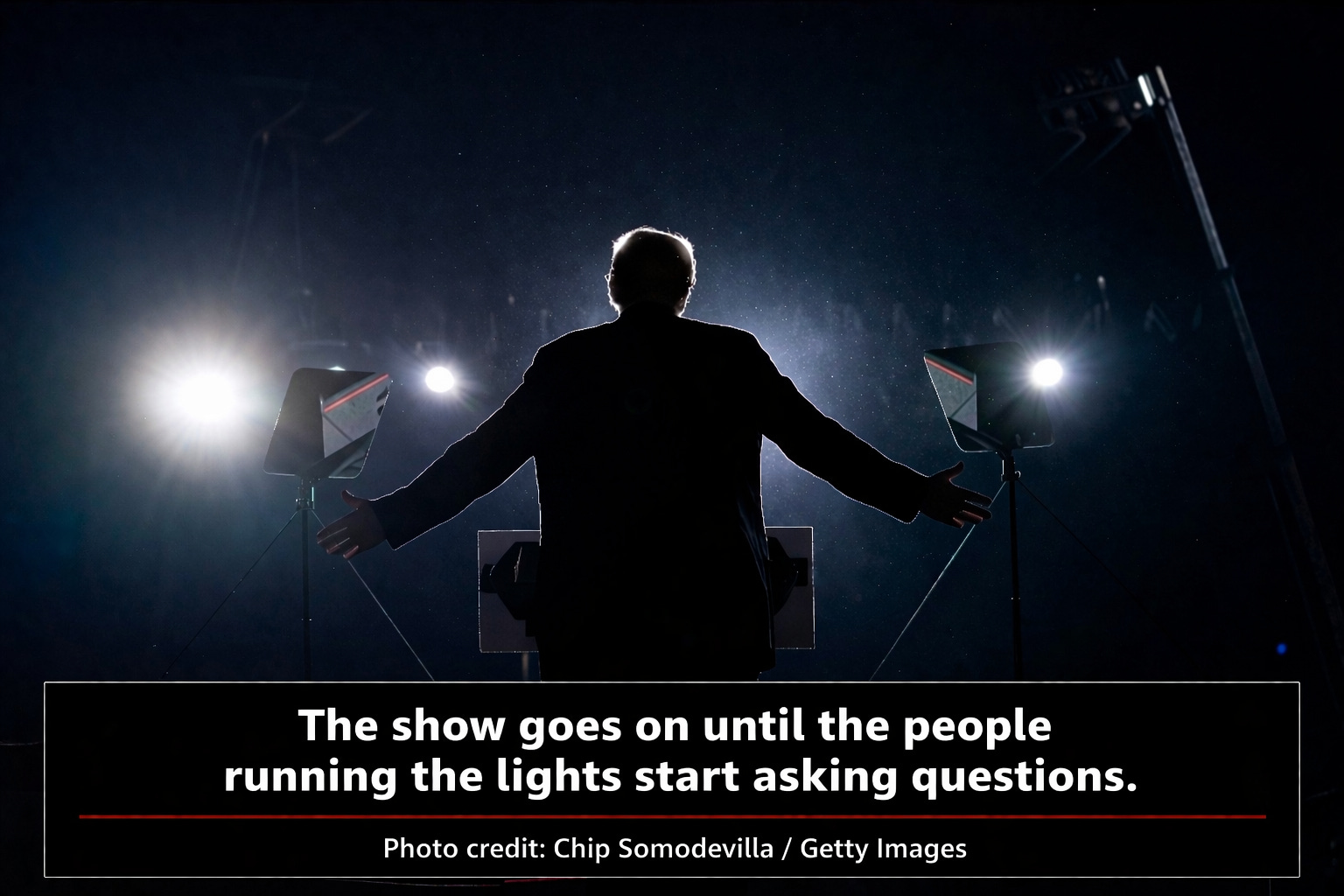
The moment a movement built on absolute loyalty starts questioning its leader out loud, the problem isn’t optics. The problem is control.
Not that long ago, questioning Donald Trump inside his own ecosystem was like standing up in an Imperial briefing room and saying, “Hey, maybe the Death Star isn’t a great long-term investment.” You weren’t debated. You weren’t managed. You were vaporized, erased, and replaced before your chair got cold. That was the deal: total loyalty, no hesitation, no daylight, no deviation, no exceptions. Ever.
The people who built that wall are now poking holes in it themselves. In public. Not the usual critics. Not the media. Not Democrats doing their performative hand-wringing on cable television at eleven o’clock on a Tuesday. The people inside the house — and that’s what makes this different from every other round of “is Trump in trouble?”
Candace Owens isn’t just breaking with him on policy. She’s calling him a “genocidal lunatic” and floating the 25th Amendment out loud like it’s a reasonable conversation to be having. Alex Jones — a man who has defended Trump through things that would’ve ended fifteen normal political careers — goes on air and asks, straight-faced, how to 25th Amendment his ass. Marjorie Taylor Greene, who once talked about him like he was a political messiah sent specifically to vindicate her, is now using words like “evil” and “madness.”
Sit with that for a second.
“How do we 25th Amendment his ass?” — Alex Jones
If this were a movie, this is where the villain’s own generals start exchanging looks across the war room table. Still nodding. Still in their seats. But exchanging looks.
If you’re not subscribed yet, you’re reading this the hard way.
Reality Mechanism: How the Hell Did We Get Here?
Movements like this don’t collapse all at once because they can’t. They erode in layers, and the layers have an order: confusion first, then frustration, then something much harder to walk back. What we’re watching right now is that progression in real time, and it is messy as hell.
Tariffs get announced like a 2 a.m. impulse buy. Markets react like someone pulled the fire alarm in a packed theater. The messaging changes so fast it’s like trying to follow a conversation while someone keeps switching languages mid-sentence and acting like you’re the asshole for not keeping up. And then the explanations come, and the explanations don’t match, and nobody in the room seems bothered by that, which is its own kind of tell.
Joe Rogan — not exactly a charter member of the anti-Trump club — starts sounding genuinely uneasy. Dave Portnoy watches his portfolio get kneecapped and says, more or less, what the fuck are we doing.
“This could go really bad.” — Joe Rogan
That’s not betrayal. That’s the first visible crack in a system that was specifically engineered not to crack. Authoritarian-style loyalty doesn’t bend — it holds until it breaks, and when it starts breaking, it doesn’t go quietly. It creaks. Then it fractures. Then it spreads like a stress crack across a windshield you keep telling yourself you’ll deal with later, until one morning you can’t see through it at all.
Escalation: From “What Is He Doing?” to “What Is Wrong With Him?”
Confusion doesn’t stay confusion. People don’t tolerate sustained uncertainty when the stakes are this high. It evolves — disagreement with a policy becomes confusion about the process, and then one day it crosses a line into something else: a genuine loss of faith in the decision-maker himself. Once you’re there, loyalty doesn’t have anything left to stand on.
Trump’s rhetoric has been jumping from negotiation to annihilation like a drunk flipping channels at three in the morning. One minute it’s strategy. The next it’s threats that sound like the third act of Dr. Strangelove, delivered with the same energy as a guy who’s decided the rules don’t apply tonight. That’s not political behavior — that’s volatility, and volatility makes even allies start quietly doing risk math instead of defending instinctively.
And then there’s the other stuff. The stuff that makes people stop mid-sentence and go: wait, what?
Claiming personal credit for taking down Osama bin Laden — rewriting a documented military operation like it’s a bar story he decided to take ownership of halfway through the telling. Placing himself physically in Iowa on a day records show he never left Washington, while the people around him nodded along like extras in a production that had stopped making sense three scenes ago. Statements that pivot between bravado, grievance, and flat contradiction so fast it stops feeling like messaging and starts feeling like something else. Something people don’t want to name yet.
Each one gets explained away individually. That’s what the machinery is built to do. But they’re not landing individually anymore. They’re landing together, and together they form a pattern that even true believers are having trouble running cover for.
Who Benefits From the Chaos?
Here’s the thing about unpredictability: it’s a power move. When nobody knows what’s coming, when the messaging contradicts itself every forty-eight hours, when even allies are left guessing — the only fixed point in all of it is the person creating the instability. That’s not an accident. Chaos shifts power toward whoever controls the next move.
It works, right up until the people inside the system decide the instability has become a liability. Same logic casinos use when they take the clocks off the walls and seal the windows — except here the stakes aren’t chips. They’re markets. Alliances. Decisions that can’t be walked back if this goes the wrong direction.
Gaslight Zone: “This Is Fine, Nothing to See Here”
The official line is still that everything is under control, because it always is until it absolutely isn’t. Power structures don’t advertise doubt. They manage it quietly and hope it reverses before anyone notices the seams.
History’s seen this before. Nixon insisted everything was fine while the walls were literally closing in around him. Administrations quietly managed around moments they didn’t want anyone looking at too hard. The difference now is that the usual defenders aren’t defending uniformly. Some are hedging. Some are questioning. Some have jumped directly to asking whether removal should be on the table — which is not a rhetorical question. That’s not a small leap, and everyone in the room knows it.
That shift doesn’t happen in a vacuum. Something pushed it there.
Democracy Damage Report
You don’t get to 25th Amendment language because of one bad policy. You don’t even get there from a string of bad decisions. That conversation only happens when people start questioning whether the person making the decisions is capable of making them.
“This is evil. This is madness.” — Marjorie Taylor Greene
Once that threshold is crossed, the conversation doesn’t disappear. It spreads — and it spreads fastest through the people who were once the most committed. Hesitation becomes discussion. Discussion becomes something real. And something real has a momentum of its own that press releases and loyalty pledges can’t shut down.
The Fork in the Road
This either stabilizes or accelerates. There isn’t much middle ground once internal doubt reaches this level, because movements built on absolute loyalty don’t operate with ambiguity. They can’t. Ambiguity is the thing they were built to eliminate.
History’s pretty consistent on how strongman systems actually fall. It’s almost never external opposition that brings them down. Its internal confidence is eroding past the point where loyalty can be maintained without constant, exhausting reinforcement. When that reinforcement starts failing — when the generals start exchanging looks across the table instead of nodding in unison — everything built on top of it becomes unstable. Ready or not.
Verdict
The 25th Amendment isn’t the story. It’s the symptom.
The story is that the people who once treated Trump as untouchable are now openly entertaining the idea that he might need to be removed. You can dismiss critics. You can ignore the press. You can frame every outside attack as bias or bad faith or a coordinated hit job. What you cannot do is explain away your own side arriving at the same conclusion, independently, in public, with their names attached.
That’s not narrative. That’s a shift in perception. And perception, once it moves, doesn’t move back easily.
Remember the Death Star briefing — the one where you got vaporized for asking the wrong question? The generals are asking it now. Out loud. In front of each other.
What the fuck are we doing?
💣 TRUTH BOMB: You don’t start talking about removing a leader unless you’ve already stopped trusting him to lead.
I’m retired and doing this reader-funded because someone has to call this shit exactly what it is — without advertisers to protect, without access to lose. Paid subscribers get the deeper dives, the War Room briefings, and the stuff that doesn’t go out front.
If you want the full picture, hit upgrade.
If this is the part of your brain that likes the sharp edges, go check out Lotus Purrspective*. Same reality, different delivery. Less profanity. More judgment. Somehow even more accurate.*
Buy Me A Coffee If this piece made you mutter “what the fuck are we doing?” under your breath, consider fueling the next one.
Because yelling that at the news doesn’t pay for itself.
#Politics #Trump #Media #Democracy #Power #Unfiltered #TheUnredactedBastard