


I was halfway through another story about a local newspaper shutting down when I felt my eyes start to glaze over. Not because the reporting was bad, and not because the journalists involved had done anything wrong. Mostly because I’ve seen some version of that headline so many damn times that my brain had already decided it knew where the story was going. Local paper closes. Journalism struggles. Advertising revenue disappears. Internet wins. Everybody laments the loss—the end.
You’ve probably seen those stories too. I know I have.
Normally, I would’ve read it, nodded thoughtfully for a few seconds, and moved on to whatever fresh insanity was erupting out of Washington that day. This time, though, something bothered me. The more I thought about it, the more I realized I wasn’t actually looking at a newspaper story at all. I was looking at a power story. Once I started pulling on that thread, I ended up somewhere a lot darker than I expected.
The question that sent me down the rabbit hole was surprisingly simple: Who the hell is watching now?
At first, I thought I was researching the decline of local journalism. That’s certainly part of the story. Newspapers have been shrinking, merging, laying people off, and disappearing for years. Advertising collapsed. Corporate consolidation hollowed out newsrooms. The internet rewrote the business model. None of that is new. What struck me was what happened after I stopped focusing on newspapers and started focusing on reporters.
Because newspapers aren’t the important part. Reporters are.
A newspaper is paper. A website is code. A social media account is an algorithm. Those things matter, but they’re not the heart of the story. The heart of the story is the person sitting in the back of the room taking notes. It’s the person reading the budget nobody else wants to read, filing the records request, comparing what officials promised six months ago to what they’re doing today, and asking questions powerful people would rather not answer.
In other words, the witness.
As a paralegal, I spent years around investigations, records, evidence, and documentation. One thing you learn very quickly is that people behave differently when somebody is watching. They behave differently when somebody is taking notes. They behave differently when they know there might be a record tomorrow morning proving exactly what happened today. That’s true in courtrooms, police investigations, corporate boardrooms, and government offices. Witnesses matter because accountability depends on somebody being able to say, “Here’s what happened, here’s when it happened, and here’s the evidence.”
The more I dug into this story, the more convinced I became that we’ve spent years talking about the wrong thing. The problem isn’t that newspapers are disappearing. The problem is that the people keeping score are disappearing. And when the people keeping score disappear, power starts behaving differently.
That’s the story.
Across America, entire communities now have little or no consistent local reporting. Researchers call it a “news desert,” and it’s an accurate term, but I think it accidentally hides the most important part of what’s actually happening. When most people hear “news desert,” they think they’re hearing a story about journalism. They picture struggling newspapers, declining subscriptions, and another casualty of the digital age.
What they should hear is a story about observation becoming scarce.
In some places, nobody regularly attends county commission meetings. Nobody consistently reviews public records. Nobody tracks local budgets from one year to the next. Nobody notices when the same names keep appearing on contracts, appointments, or development projects. The information may technically remain public, but information that nobody gathers, organizes, explains, or distributes isn’t much use to ordinary citizens.
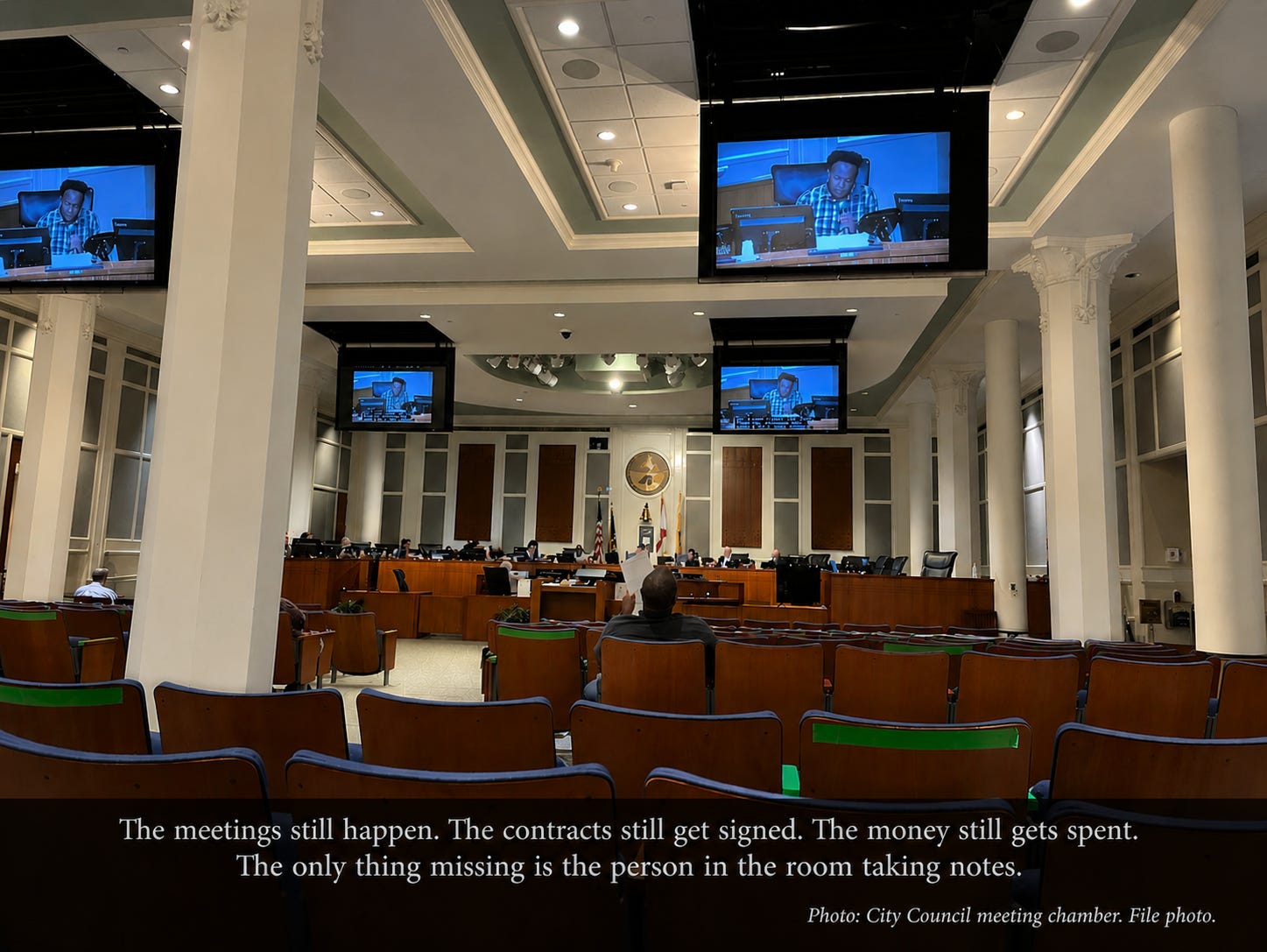
The meetings still happen. The contracts still get signed. The money still gets spent. The permits still get approved. The votes still get cast. Government doesn’t grind to a halt because a newspaper closes its doors. The machinery keeps running exactly as before. The only thing that’s missing is the person sitting in the room watching it happen.
Think about what local reporters actually do. Most of it is boring. They sit through meetings that nobody wants to attend. They read documents that nobody wants to read. They compare public statements with public actions. They file records requests, follow paper trails, and ask questions that frequently irritate the people being questioned. Almost none of it goes viral. Almost none of it becomes a national story. Yet all of it creates accountability because somebody is paying attention.
That’s why I think we’ve misunderstood the problem for years. A newspaper is a delivery system. A reporter is oversight. Those are not the same thing.
Most people stop at the headline.
The War Room starts where the headline ends.
Let’s pull the records, follow the money, and see what the evidence actually says.
