

Editorial Note
I don’t write many articles from the perspective of a veteran because I don’t think military service makes someone’s opinion automatically more valuable than anybody else’s. Facts are facts, no matter who’s reading them.
This one is different.
When I read that the Pentagon had created a new casualty category after declaring Operation Epic Fury over, moving four Americans killed and dozens wounded during renewed fighting into a separate “Overseas Operations” category, I didn’t just read it as a writer. I read it as someone who once wore the uniform.
And I’ll be honest with you: It pissed me off.
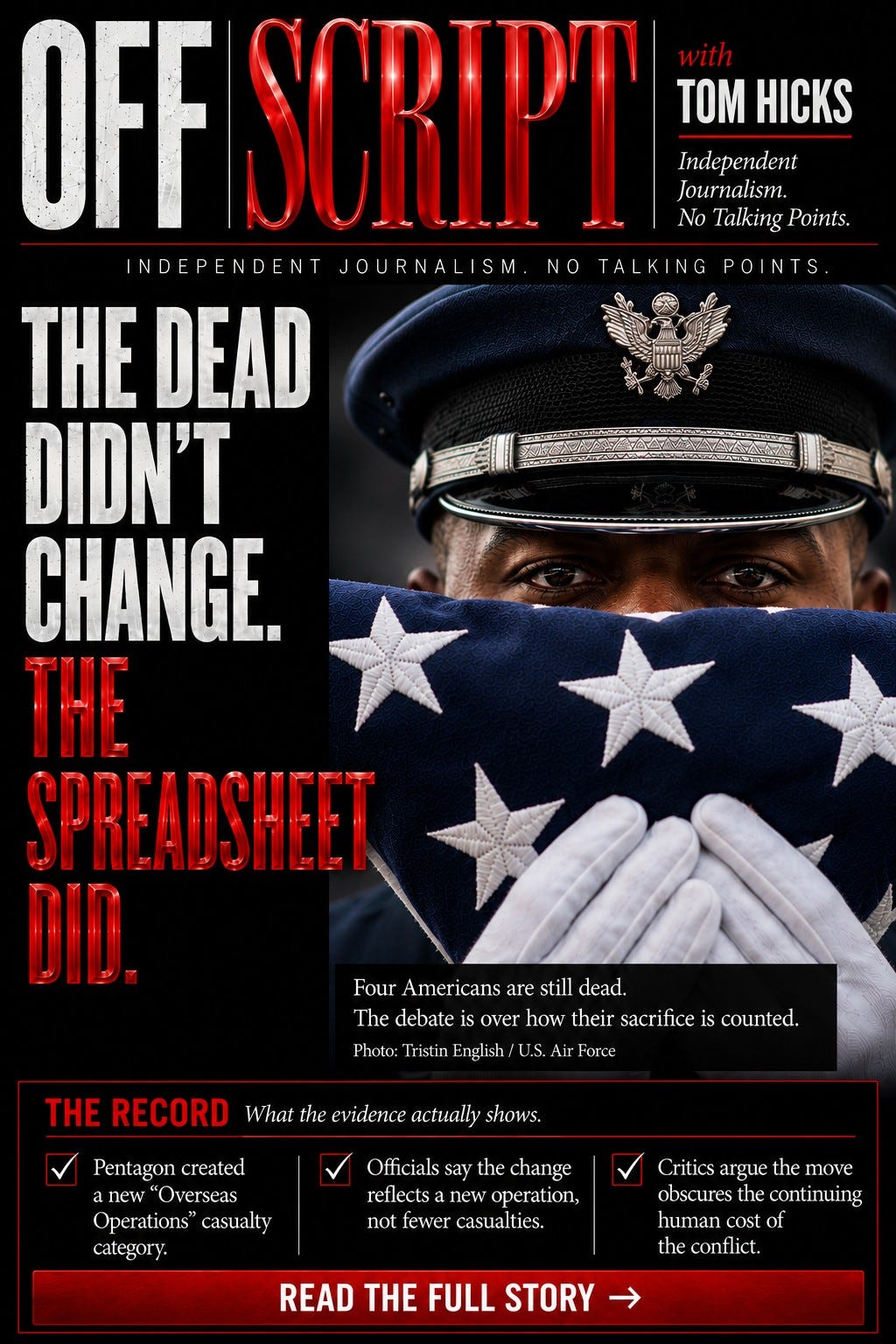
The Pentagon’s explanation is straightforward enough. Operation Epic Fury officially ended. The fighting that followed is considered a separate operation. Therefore, the casualties belong in a different category. That’s the government’s position, and if you’re being fair, you have to start there because that’s what the Pentagon says happened. (Associated Press)
Here’s my problem.
If the American people have to read three news stories, two Pentagon statements, and a military accounting manual to understand how many Americans have been killed in what appears to be the same conflict, somebody has failed. Maybe it’s a failure of communication. Maybe it’s a failure of judgment. Maybe it’s both. Whatever the cause, the result is exactly the same: people stop trusting what they’re being told.
Trust is a funny thing. It rarely disappears because of one spectacular lie. It disappears because people start noticing little things that don’t quite pass the smell test. A statistic gets presented differently. A definition quietly changes. A report gets rewritten. None of those decisions, standing alone, may amount to much. Stack enough of them together, though, and people begin wondering whether they’re getting the whole story or simply the version that’s most convenient for the people doing the talking.
That’s why this story matters.
It’s not because four names moved from one column to another on a spreadsheet. It’s because those four names belonged to four Americans who answered their country’s call, and the government owes every one of us a crystal-clear accounting of the price they’re asking our military to pay. The moment that accounting becomes confusing, even for understandable administrative reasons, the burden shifts to the government to explain itself in plain English. (Associated Press)
Every morning I dig into the evidence, separate signal from noise, and call bullshit when it’s earned.
Paid subscribers also receive my Off Script Bullshit Detector free. It’s also available separately through the Tom Hicks Media store for anyone who wants a practical guide to spotting misinformation, political spin, and statistical sleight of hand before it spreads.
Subscribe today and join me every morning.
I spent enough time in the military to appreciate that paperwork matters. Every mission has orders. Every deployment has codes. Every casualty report follows procedures that most civilians will never see. That’s not bureaucracy run amok. That’s how a military organization keeps track of millions of moving parts.
But paperwork is supposed to serve reality.
Reality isn’t supposed to serve the paperwork.
That’s where I think this decision went off the rails.
The Pentagon insists it isn’t reducing the number of casualties. Officials say they’re simply reporting them under a different operational heading because Epic Fury formally concluded before the renewed fighting began. If that’s genuinely all this is, then explaining it should have been the easiest public affairs briefing of the year. Lay out both totals. Show the public exactly where the casualties appear. Explain why the categories changed. Answer questions. Move on.
Instead, the accounting change became the story.
And that’s a self-inflicted wound. (Associated Press)
The military asks extraordinary things of ordinary Americans. It asks young men and women to spend birthdays half a world away from their families. It asks them to walk toward danger when every instinct tells them to walk the other direction. Sometimes it asks them to make the ultimate sacrifice.
The least the government can do in return is make damn sure the public never has to wonder whether that sacrifice is being presented as clearly and honestly as possible.
“The dead didn’t change. The spreadsheet did.”
Maybe I’m old-fashioned. Scratch that. I am old-fashioned.
I still think one of the government’s first obligations is to level with the people who pay the bills, elect the leaders, and send their sons and daughters into harm’s way. I don’t expect perfection. Lord knows Washington has never been confused with perfection. But I do expect honesty, and honesty isn’t just about telling the truth. It’s about telling it in a way that doesn’t require a decoder ring.
That’s why I keep coming back to one simple question: if this accounting change is as routine and innocent as the Pentagon says it is, why wasn’t the explanation every bit as clear as the accounting itself?
Nobody should have to compare databases, read policy manuals, and piece together news reports to figure out how many Americans have been killed in a conflict. If the answer is, “The total hasn’t changed. We’ve simply created a new category because the previous operation officially ended,” then say exactly that. Put both numbers on the same page. Make the relationship obvious. Don’t leave room for confusion, because confusion is where conspiracy theories go to breed.
The Pentagon has every right to organize its records however military regulations require. What it doesn’t have is the luxury of ignoring how those decisions look to a public whose confidence in institutions has been eroding for years. Whether we’re talking about public health, intelligence, law enforcement, Congress, the media, or now the military, the pattern is depressingly familiar. Officials make what they believe is a reasonable administrative decision. The public sees another example of information being filtered through a bureaucratic lens instead of being presented in the simplest, most transparent way possible. Then everyone acts surprised when trust drops another notch.
That isn’t because Americans have suddenly become irrational. It’s because credibility is cumulative. Every decision either adds to it or subtracts from it. This one, fairly or unfairly, subtracts from it.
“Bureaucracy should make the military more effective, not make the public wonder what it’s looking at.”
There’s another piece of this that has bothered me since I first read the story. Somewhere tonight there are families who lost a son, a daughter, a husband, a wife, a mother, or a father. They aren’t thinking about operational designations or casualty databases. They’re thinking about an empty chair at the dinner table and a folded flag they’ll keep for the rest of their lives.
That’s why this conversation deserves more care than it’s getting.
Those families shouldn’t become supporting characters in a debate about spreadsheets. Their sacrifice should remain the center of the story. If an accounting change shifts the public conversation away from the people who paid the price and toward the mechanics of government bookkeeping, then something has gone wrong, even if every regulation was followed to the letter.
I don’t know the motives of the officials who made this decision, and neither do you. I’m not going to accuse people of hiding casualties without evidence because that’s not how I do this. But I don’t have to know their motives to criticize their judgment. Good leadership isn’t measured only by whether a decision is technically correct. It’s measured by whether reasonable people can understand it and trust it.
On that standard, I think this decision failed.
It failed because it invited questions that never needed to exist. It failed because it shifted attention from the sacrifice of American service members to the government’s accounting practices. Most of all, it failed because it gave millions of Americans one more reason to ask whether they’re getting the whole story.
Government officials often complain that people don’t trust institutions anymore. Here’s a suggestion: stop making decisions that require a public relations campaign to explain. Just tell us what’s happening. Tell us how many Americans have been killed, how many have been wounded, and why those numbers are reported the way they are. Then answer every damn question until people understand.
That’s not a burden.
That’s the price of asking a free people to trust you.
“Trust isn’t built by managing perceptions. It’s built by making sure the public never has to wonder if the numbers changed because the story did.”
One Question Before You Go
Do you think the Pentagon’s new casualty category is a reasonable administrative change, or do you think it unnecessarily undermines public trust? I’d like to hear your perspective in the comments.
The Record
What the evidence actually shows.
The Pentagon created a new “Overseas Operations” casualty category after declaring Operation Epic Fury complete and moved four service members killed and dozens wounded during renewed fighting into that category. Pentagon officials say the change reflects the end of one operation and the beginning of another, not an attempt to reduce or hide casualties. Critics, including veterans and some lawmakers, argue the move obscures, or at least appears to obscure, the continuing human cost of the conflict. Whatever readers conclude about the decision itself, those underlying facts are not in dispute.
Sources: Associated Press • Military Times • U.S. Department of Defense
The Bullshit Detector
One of the easiest ways to mislead people is without telling a single lie.
Change a definition.
Create a new category.
Shift a reporting method.
Sometimes those changes are completely justified. Sometimes they aren’t.
Either way, the first question should always be the same:
Does this help the public understand what’s happening, or does it make understanding harder?
Subscribe
If you’re tired of politicians, bureaucrats, and cable-news personalities treating facts like accessories they can swap out whenever it’s convenient, subscribe to Off Script with Tom Hicks. Every morning I dig into the evidence, separate signal from noise, and call bullshit when it’s earned.
Subscribers also receive my Off Script Bullshit Detector free as a thank-you for supporting independent journalism. It’s a practical guide to spotting misinformation, political spin, manipulated statistics, and the rhetorical tricks used to make bad arguments sound convincing. If you’re not ready to subscribe, you can also purchase it separately for $4.95 in the Tom Hicks Media Store.
More from Tom Hicks Media
Panic Room Sports
Football without the hot takes, separating what actually matters from training-camp noise and Sunday overreactions.
Tom’s Number Ones
A daily trip through Billboard history featuring the songs America couldn’t stop playing on this date.
Lotus Purrspective
The world’s wisest (and most judgmental) cat explains human behavior with equal parts sarcasm and uncomfortable accuracy.
Buy Me a Cup of Tea
If you enjoy independent, evidence-first journalism that answers to readers instead of advertisers or political parties, consider buying me a cup of tea. Every contribution helps keep Off Script independent and supports the work that goes into asking uncomfortable questions and following the evidence wherever it leads.
Sources
Associated Press
Military Times
U.S. Department of Defense
#OffScriptWithTomHicks #Military #Veterans #Pentagon #Transparency #Accountability #NationalSecurity #Journalism #FactsMatter