

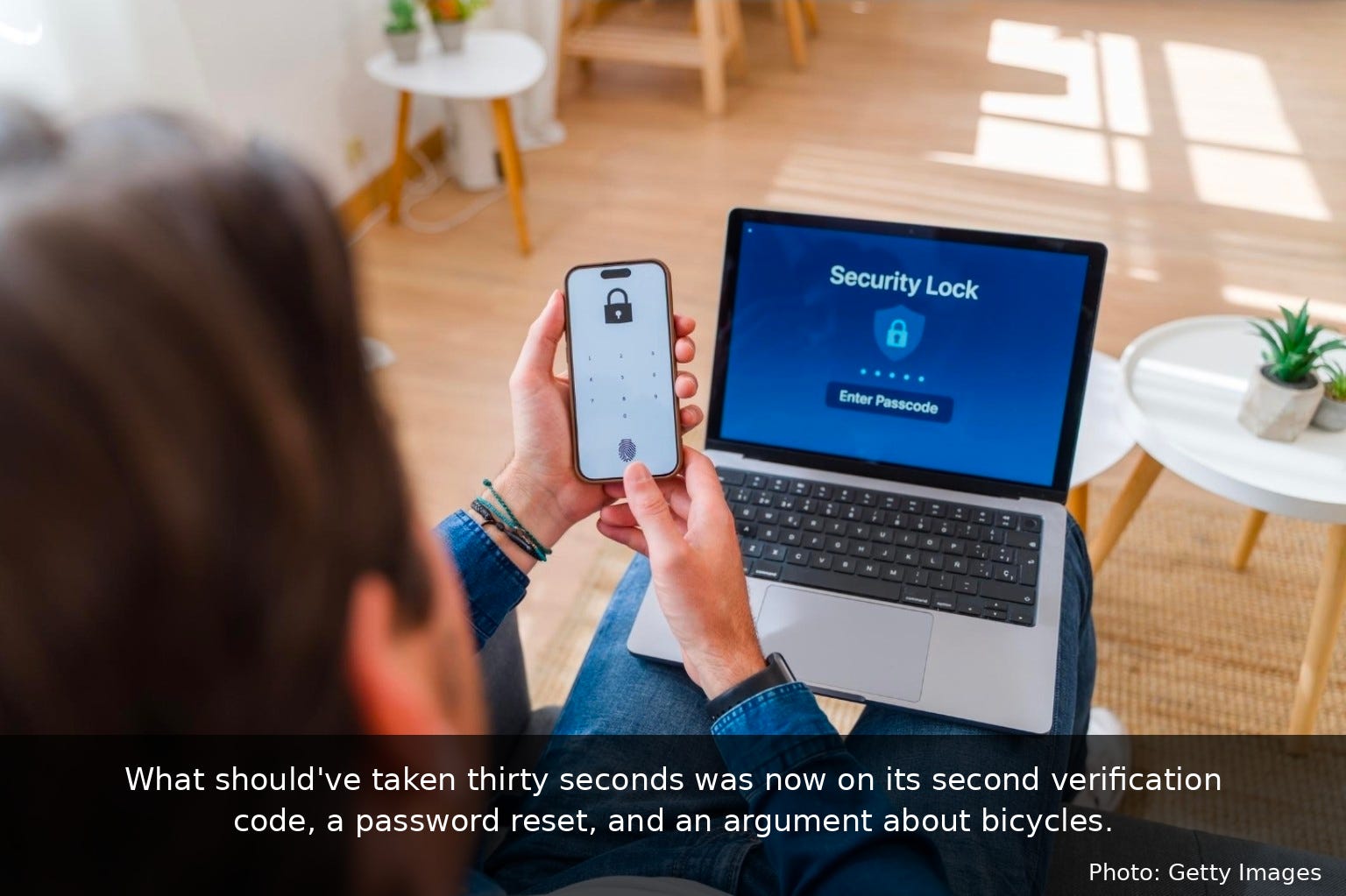

I wanted to do something simple the other day.
Those are dangerous words in 2026.
Not because the task itself was difficult. It wasn’t. I wasn’t applying for a mortgage, filing a lawsuit, or attempting to assemble furniture designed by a Swedish sadist. I just wanted to check something in one of my accounts. The kind of thing that should take thirty seconds and exactly zero emotional investment.
Twenty minutes later, I was updating an app, resetting a password, waiting for a verification code, requesting another because the first one had wandered off and started a new life somewhere, and trying to convince a CAPTCHA that I knew what a bicycle looked like.
Somewhere in the middle of all this nonsense, it occurred to me that I wasn’t actually checking my account anymore.
I was participating in a fucking obstacle course.
The thing that struck me afterward wasn’t the annoyance. We’ve all become accustomed to being annoyed. What struck me was how normal the whole experience felt. There wasn’t anything unusual about it. In fact, that’s the weird part. The experience was so familiar that I barely questioned it until I found myself twenty minutes deep into a task that should’ve been over before my coffee got cold.
Maybe you’ve noticed this too.
The problem isn’t that modern life has become difficult. Most of the individual tasks aren’t difficult at all. That’s almost what makes them so irritating. Nobody wakes up in the morning worried they’ll be defeated by a password reset. The frustration comes from death by a thousand tiny interruptions. Each step takes only a few seconds. It’s the accumulation that gets you. A password here. A confirmation email there. A text message code. An app update. A permission request. Another login. Another verification. By themselves, they’re harmless. Together, they’re the reason a thirty-second task somehow eats half your lunch break.
And the strange thing is that we’re constantly told all this technology is making life easier.
To be fair, some of it absolutely does. I can deposit a check with my phone. I can order groceries from my couch. I can communicate instantly with people on the other side of the planet. Those are genuinely remarkable achievements. If you’d described them to somebody a hundred years ago, they would’ve assumed you were either a wizard or in desperate need of medical attention.
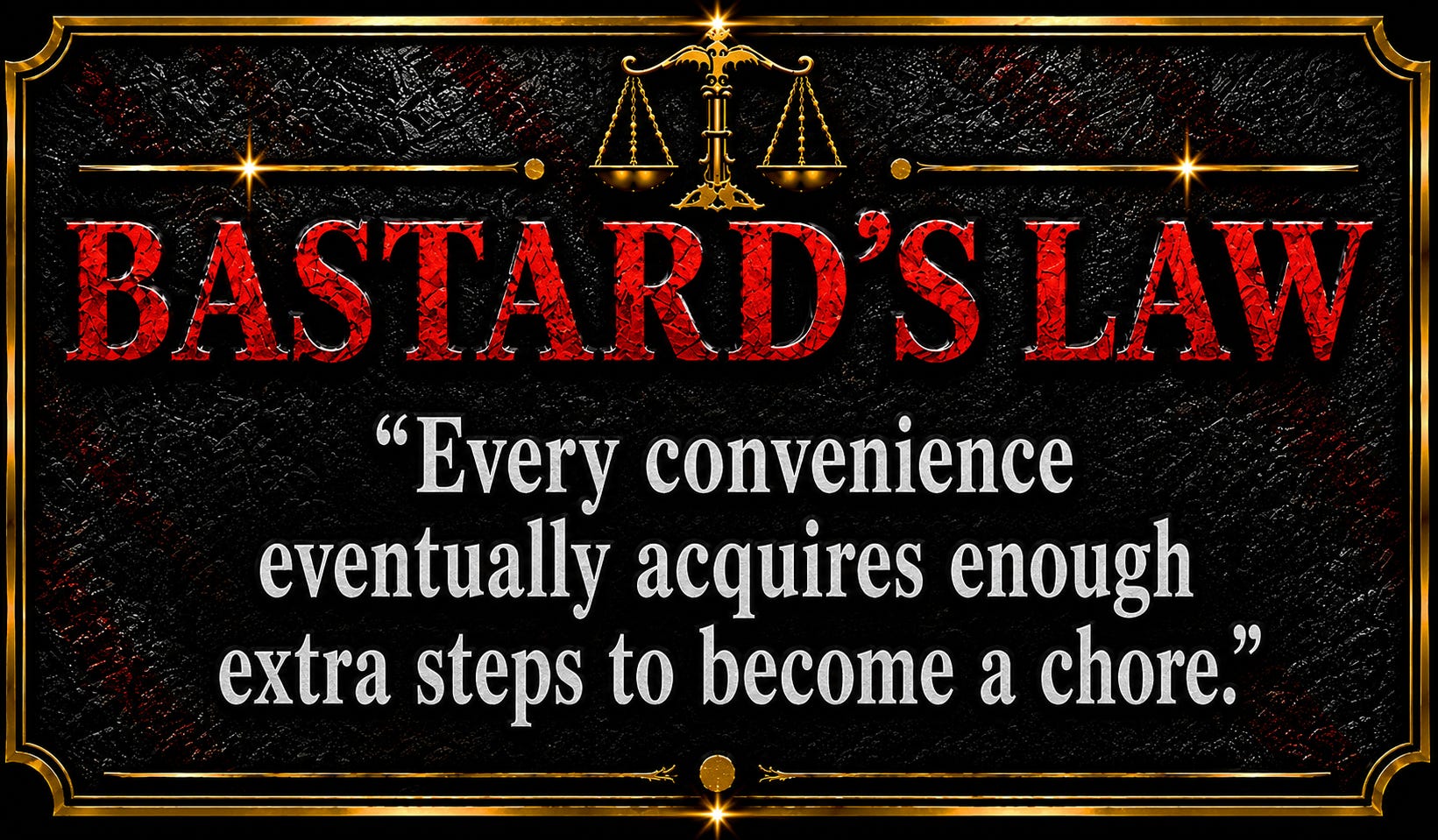
But somewhere along the way, convenience and simplicity stopped being the same thing.
Because the more I think about it, the more it feels like we’ve quietly witnessed the death of easy.
Easy used to mean you wanted something, so you did the thing and got the result. Now every simple task seems to arrive carrying administrative overhead.
Every convenience seems to arrive carrying paperwork.
Take that account login.
Once upon a time, you typed in a password and moved on with your life. Today the process feels like trying to gain access to a classified government facility. First you enter your password. Then you’re informed your password is incorrect. Then you’re informed your password has expired. Then you’re asked to create a new password that can’t resemble any password you’ve used before, any word found in the dictionary, or apparently anything a human being could realistically remember.
Then comes the verification code, followed by a second verification code because apparently the first verification code was lonely. Then comes the CAPTCHA gatekeeper, and that’s where things usually go completely off the rails.
The CAPTCHA always starts with an air of confidence that I find deeply insulting.
“Select all images containing a bicycle.”
Fine.
There are nine squares. One contains half a bicycle. One contains what might be a bicycle. One contains an object that could be a bicycle if viewed from the proper angle, under favorable lighting conditions, by somebody willing to make several generous assumptions and perhaps consume a controlled substance.
I make my selections.
The computer informs me that I have failed.
Now prove you’re human again.
Which is ironic because at this point, the computer is behaving far more irrationally than any human being I’ve encountered all week.
If you’ve ever spent ten minutes trying to accomplish a task that should’ve taken thirty seconds, you’re exactly the kind of reader I write for.
Subscribe for independent journalism about the increasingly ridiculous systems we all have to live with.
The more I paid attention, the more I started seeing this everywhere.
You don’t really buy things anymore. You create accounts. Products arrive with apps attached to them. Services arrive with passwords attached to them. Subscriptions arrive with terms and conditions long enough to qualify as Russian literature. Somewhere between purchasing the thing and actually using the thing, you’ve picked up three new administrative responsibilities and a user agreement nobody expects you to read.
And God help you if you decide you’d like to leave.
Canceling a subscription now feels less like ending a service and more like escaping a cult.
The company doesn’t want you to leave. The website doesn’t want you to leave. The app definitely doesn’t want you to leave. Everybody involved suddenly develops a passionate interest in your long-term happiness the moment you click the cancellation button.
Suddenly, everybody wants to negotiate.
“Are you sure?”
“Would you like a discount?”
“What if we cut the price in half?”
“What if we give you three months free?”
At some point, you’re no longer canceling a subscription.
You’re negotiating a hostage release.
That’s when I started wondering whether technology had actually eliminated work or simply moved it.
Because a lot of the tasks we’re performing today used to be somebody else’s job. The bank used to process things. The airline used to handle check-in. The store used to ring up purchases. Customer service used to involve an actual human being whose job was solving problems.
The work didn’t disappear. A lot of it just got reassigned to us.
That’s a hell of a trick when you think about it. Convince customers they’re receiving a convenience while quietly handing them part of the workload. No wonder everybody seems exhausted. Not because any individual task is difficult, but because every task now arrives with a trail of additional tasks attached to it.
Need to refill a prescription? There’s an app for that. Need to access the app? Update the app. Need to update the app? Verify your account. Need to verify your account? Check your email. Need to check your email? Log into your email account.
And suddenly, the simple thing you wanted to do this morning has become the only thing you’ve accomplished before lunch.
The funny thing is that we’ve adapted to all of this so thoroughly that we barely notice it anymore. Humans are remarkably good at adapting. We adapt to traffic. We adapt to inflation. We adapt to politicians. We adapt to all kinds of ridiculous shit.
What we don’t always notice is how much energy adaptation consumes.
Every extra step is small. Every interruption is minor. Every verification seems reasonable. But stack enough of them together, and you end up spending part of every day navigating systems that somehow manage to be both incredibly sophisticated and weirdly inconvenient.
That’s what keeps nagging at me.
We’re living in one of the most technologically advanced periods in human history. The device in my pocket is more powerful than the computers that helped send astronauts to the moon. I can access nearly the entirety of human knowledge in seconds.
And yet I still spend part of my week proving I’m not a robot to a machine that can’t reliably identify a bicycle.
That feels like progress in the same way a flaming shopping cart feels like transportation.
Maybe technology didn’t fail.
Maybe we just confused convenience with simplicity.
Convenience means you can do something from anywhere. Simplicity means you can do it without needing three passwords, two verification codes, a CAPTCHA exam, and a minor spiritual awakening.
We’ve become very good at the first one.
The second one seems to have wandered off years ago.
Technology promised to save us time. Instead, it often hands us new chores and calls them features.
If this conversation felt painfully familiar, there’s a reason.
You’re probably living it too.
📢Share this with somebody who’s ever spent twenty minutes proving they’re human so they could perform a task that used to take thirty seconds.
For deeper dives into the systems shaping everyday life, upgrade your subscription and join me in the War Room.
Lotus has opinions about technology, too. Most of them involve why humans need six passwords to open a can of tuna.
☕ If you’d like to support independent journalism fueled by evidence, caffeine, and occasional profanity: Buy Me A Coffee
#Technology #Culture #EverydayLife #TheUnredactedBastard #CustomerExperience #ModernLife
So spot on.