

EDITORIAL NOTE:
If you came here looking for another culture-war cage match over gender-affirming care, you’re going to be disappointed. There are plenty of places having that fight already. This one is about something much simpler: when the federal government says an institution violated federal law, takes money from it and dictates what medical care it can provide, how much explanation does the government owe the rest of us?
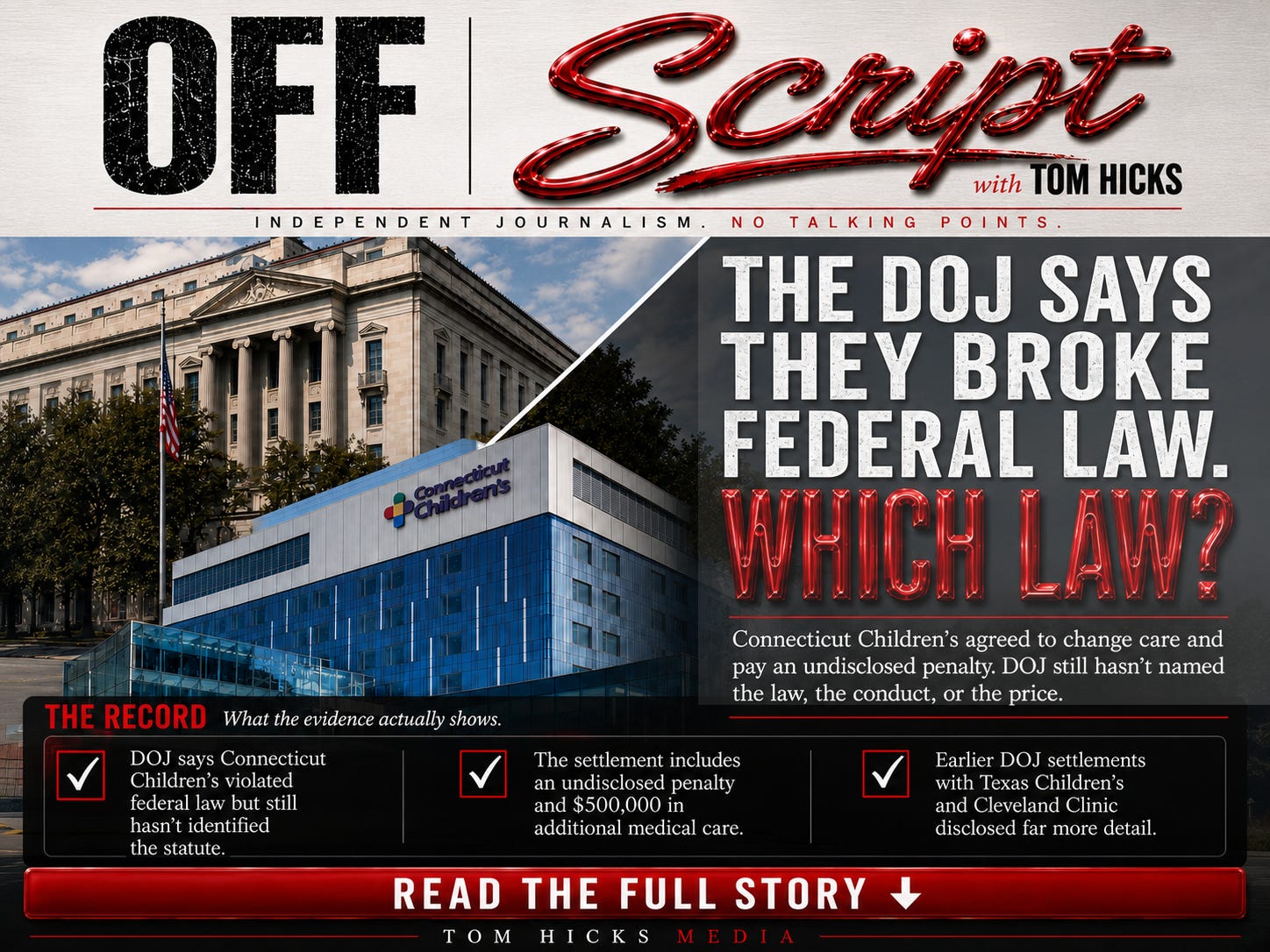
The Justice Department would apparently like a little credit for its latest settlement with Connecticut Children’s Medical Center (CCMC).
Fine, but before I clap, I’d like to know what federal law the hospital supposedly broke.
That really shouldn’t be a trick question.
DOJ announced on August 5 that Connecticut Children’s had entered into agreements arising from the department’s national investigation into what it calls violations of federal law involving gender-affirming care for minors. Under the deal, Connecticut Children’s agreed not to provide puberty blockers or cross-sex hormones to minors or perform gender-related surgeries. It also agreed to pay an undisclosed monetary penalty and commit another $500,000 in medical care for people DOJ says suffered harmful consequences from previous treatment. (Department of Justice)
Pretty serious stuff. Serious enough that Associate Attorney General Stanley Woodward used the announcement to warn hospitals, doctors and pharmaceutical companies that DOJ would “vigorously enforce federal law.” U.S. Attorney Ryan Raybould of the Northern District of Texas said the department would act when medical practices “violate federal law.” (Department of Justice)
So which federal law?
DOJ doesn’t identify the statute, describe the alleged false claim or tell us whether this involved prescribing, coding, reimbursement, drug labeling or something else. It announces a monetary penalty without telling us the amount. And the Connecticut Children’s release doesn’t link to the actual agreements. (Department of Justice)
Here’s what makes that harder to shrug off as somebody forgetting to attach a PDF: DOJ updated the page on August 10.
Still no statute. Still no amount. Still no agreement. (Department of Justice)
Connecticut Children’s denied all of DOJ’s allegations, and the department itself says there has been no determination of liability. That makes the missing details more important, not less. We have a government announcing a successful enforcement action against an institution that says it didn’t do anything wrong, while the public still doesn’t know what the alleged wrongdoing was. (Department of Justice)
Name the law. Name the conduct. Name the price. Show us the agreement.
That’s not a partisan demand. That’s what the receipt is supposed to look like.
Funny, DOJ knew how to explain itself in Texas
We don’t have to invent some impossible standard for government transparency here. DOJ already demonstrated that it knows exactly how to do this.
In May, the department announced a settlement with Texas Children’s Hospital. Texas Children’s agreed to pay $10 million to resolve allegations that it submitted false billings to public and private insurers to secure coverage for pediatric gender-related procedures. DOJ specifically said it believed that conduct implicated the Federal Food, Drug, and Cosmetic Act, the False Claims Act, and federal fraud and conspiracy laws. The department also linked the agreements so anyone interested could read them. Texas Children’s denied the allegations, and there was no determination of liability. (Department of Justice)
That is how this is supposed to work.
Government makes an allegation. Government identifies the law. Government describes the conduct. Government tells us how much money changed hands. Government publishes the paperwork.
A few weeks later, DOJ announced its Cleveland Clinic resolution. Again, it told the public what the allegation was: false billings submitted to public and private payors to obtain coverage. It disclosed the penalty — $308,000 — and Cleveland Clinic’s additional $2 million commitment for restorative care. The DOJ release also linked the agreements. (Department of Justice)
Then Connecticut Children’s got the trust-us version.
I don’t know why.
That’s sort of the point.
Your subscription helps fund reporting, research, publishing, new features, and the continued growth of every Tom Hicks Media publication.
Connecticut Children’s was already heading for the exit
There’s another wrinkle here that makes the victory-lap language in DOJ’s announcement worth a closer look.
Connecticut Children’s announced more than a year ago, in July 2025, that it was winding down its gender-care program for patients under 19. Hospital leadership said the decision followed medical and legal review amid what it described as an increasingly difficult government environment surrounding the care. (CT Mirror)
And this matters: according to Connecticut Mirror’s reporting at the time, Connecticut Children’s did not provide medication or hormone treatment to prepubescent children and did not perform gender-related surgeries at all. Families were involved in treatment decisions, and the hospital said parental consent was required. (CT Mirror)
Now go back to DOJ’s August 2026 announcement. Among the things the department celebrates is Connecticut Children’s promise not to perform surgeries on minors. (Department of Justice)
Well, okay.
If the Yankees make me sign an agreement promising never to start Game Seven of the World Series, Brian Cashman has technically prevented it.
I’m still waiting for the call.
The medication provisions are different. Connecticut Children’s had provided puberty blockers and hormones to some adolescents before announcing the program’s shutdown in 2025. So DOJ did obtain restrictions on care the hospital once provided — just a year after the hospital had already decided to wind it down. (CT Mirror)
That raises a legitimate question without pretending we already know the answer: what did this federal settlement materially accomplish that Connecticut Children’s hadn’t already decided to do?
Maybe the agreement answers that.
Show it to us.
There are laws DOJ can use. That isn’t the issue.
This is where I don’t want to make the lazy argument.
DOJ isn’t wandering around without federal statutes and hoping nobody notices. The department has legal tools it can investigate, and Attorney General Pam Bondi spelled some of them out in an April 2025 enforcement memo.
Bondi directed the Civil Division to investigate possible Food, Drug, and Cosmetic Act violations involving drug manufacturers and distributors, including alleged misbranding. She separately directed False Claims Act investigations involving claims submitted to federal health programs. (Department of Justice)
The examples in her memo are specific. One involves a doctor prescribing a puberty blocker for gender dysphoria while reporting a different diagnosis to obtain federal reimbursement. Another involves a hospital performing one procedure while billing Medicaid for something else. (Department of Justice)
Whatever you think of Bondi’s policy, those examples at least describe conduct you can examine: you told the government you did X while allegedly doing Y.
That’s a fraud allegation. There are records. There’s a claim. There’s a law.
So what is the Connecticut Children’s allegation?
Did the hospital falsify a diagnosis, miscode treatment, seek reimbursement for something federal programs wouldn’t cover or get tangled up in a drug-distribution issue?
We don’t know.
That’s not because DOJ lacks the vocabulary. It used the vocabulary with Texas Children’s. It used it with Cleveland Clinic. (Department of Justice)
Here it gave us “violations of federal law” and headed for the door.
This is bigger than one hospital
Connecticut Children’s didn’t land in some isolated federal investigation that began last Wednesday.
In July 2025, DOJ announced that it had issued more than 20 subpoenas to doctors and clinics providing gender-related medical care to minors. The department said those investigations involved health-care fraud, false statements “and more.” (Department of Justice)
Since then, judges have repeatedly pushed back against DOJ efforts to obtain patient records. In June, U.S. District Judge Julie Rubin blocked DOJ from obtaining patient information from Children’s National Hospital, calling part of the subpoena “oppressive,” although she refused to turn that case into a nationwide order covering every hospital. Reuters reported that at least seven district judges had quashed related subpoenas in whole or in part. (Reuters)
Then things got uglier in Rhode Island.
U.S. District Judge Mary McElroy found that DOJ lawyers had misrepresented facts and withheld information while trying to force Rhode Island Hospital to turn over records. In June, she referred two department lawyers for possible disciplinary action. DOJ hadn’t merely lost an argument over the scope of a subpoena; a federal judge was questioning how government lawyers had handled the case. (Reuters)
That history matters because of one name sitting in the Connecticut Children’s announcement.
The U.S. Attorney’s Office for the Northern District of Texas.
DOJ says that office participated in the Connecticut resolution, and its U.S. attorney is quoted in the announcement. (Department of Justice)
Why should anybody care that Texas shows up in a Connecticut hospital case?
Because this same national investigation already produced a fight over DOJ’s decision to move some gender-care subpoena enforcement to Northern Texas after losing elsewhere. Reuters reported that after several judges quashed similar subpoenas, DOJ declared that its probes were being run from Northern Texas and went there to enforce the Rhode Island Hospital subpoena. Judge McElroy accused the department of using a “subterfuge” to keep the hospital from realizing it had decided to seek an enforcement order in Texas. (Reuters)
None of that tells us why Northern Texas participated in the Connecticut Children’s settlement.
DOJ hasn’t explained that.
Which makes the question pretty simple: why was Northern Texas involved in a Connecticut hospital case?
Maybe there’s a perfectly ordinary explanation. If so, this ought to be one of the easiest questions in Washington.
Connecticut has a few questions too
The settlement may also create a headache closer to home.
Connecticut state Sen. Matt Lesser, chairman of the Senate Human Services Committee, reacted by asking why Connecticut Children’s is paying money, how much it’s paying, whether patient confidentiality was compromised, whether the agreement puts the hospital at odds with state anti-discrimination requirements or Medicaid obligations, and what other terms the hospital accepted. Lesser says his committee intends to exercise its oversight authority. (Connecticut Senate Democrats)
One of those questions now has at least a partial answer. Connecticut Children’s says patient privacy was its foremost concern and that it resolved the federal matter without disclosing protected patient information to the U.S. government. The hospital also says it has complied and will continue to comply with federal and state law. (NBC Connecticut)
The rest isn’t so tidy.
Connecticut enacted Public Act 25-154, effective October 1, 2025, making it a discriminatory practice for health-care providers to knowingly discriminate in providing health-care services based on protected characteristics that include sex and gender identity or expression. The law contains qualifications involving professional judgment and standards of care, so simply citing it doesn’t settle whether Connecticut Children’s current policy violates anything. That question would have to be decided under the actual law and facts. (Connecticut General Assembly)
And somebody is already asking Connecticut regulators to decide.
According to complaints obtained and reviewed by Connecticut Mirror, ten families filed two complaints with the Connecticut Commission on Human Rights and Opportunities in December 2025 — three families against Connecticut Children’s and seven against Yale New Haven Health. They allege that ending medication-based gender care for transgender minors while the same medications remain available for other diagnoses violates Connecticut anti-discrimination law. Those are allegations in an ongoing state process, not findings against either hospital. (CT Mirror)
So Connecticut Children’s is now operating under a federal agreement restricting care while families are separately arguing before the state’s civil-rights commission that withholding some of that care violates Connecticut law.
Nobody has ruled that those obligations conflict.
But if the state proceeding eventually goes the families’ way, the hospital could face a pretty obvious question: how does it comply with both?
Once again, seeing the actual federal agreement would help.
Funny how we keep ending up there.
THE RECORD
July 2025: Connecticut Children’s announces it is winding down its gender-care program for patients under 19. Contemporary reporting says the hospital did not perform gender-related surgeries. (CT Mirror)
May 15, 2026: DOJ announces the Texas Children’s settlement, identifies alleged false billing, names federal laws it says were implicated, discloses the $10 million payment and links the agreements. Texas Children’s denies the allegations; there is no determination of liability. (Department of Justice)
June 5: DOJ announces Cleveland Clinic’s resolution, disclosing alleged false billing, a $308,000 payment and a $2 million restorative-care commitment. (Department of Justice)
August 5: DOJ announces the Connecticut Children’s agreement, including restrictions on future care, an undisclosed monetary penalty and another $500,000 in medical care. Connecticut Children’s denies the allegations; there is no determination of liability. (Department of Justice)
August 10: DOJ updates the Connecticut Children’s announcement. The public release still doesn’t identify the specific alleged unlawful conduct, disclose the amount of the monetary penalty or link the underlying agreements. (Department of Justice)
THE BULLSHIT DETECTOR
DOJ says this settlement shows it is vigorously enforcing federal law.
Maybe it is.
Maybe investigators have a rock-solid fraud allegation sitting in a file cabinet somewhere. Maybe Connecticut Children’s looked at the evidence and decided a settlement was cheaper than spending years fighting the federal government. Maybe some facts would make DOJ’s side of this look considerably stronger than it does from the press release.
Then show us.
That’s the part I can’t get past.
The government publicly announced that a major children’s hospital had become the third target to resolve allegations arising from a national federal-law investigation. It got restrictions on medical care, an undisclosed financial payment and another $500,000 commitment. The hospital denies the allegations. Nobody has been found liable. (Department of Justice)
And the rest of us are apparently supposed to nod along while the actual alleged violation stays offstage.
No.
If there was fraud, tell us the fraud.
If there was false billing, show us what was falsely billed.
If a federal statute was violated, name the damn statute.
That isn’t defending Connecticut Children’s. Maybe the hospital deserves every ounce of scrutiny it got. If DOJ has the evidence, put the evidence on the table and let the hospital answer it.
This is about the standard we’re willing to accept from our government.
Because “we investigated them, they paid us, trust us” is a lousy standard when your political opponents are running the Justice Department.
It’s also a lousy standard when your side is running it.
Someday the government will be coming after an institution you like.
You’ll want the receipts then.
THE BULLSHIT DETECTOR
Tired of headlines that smell funny before you even finish reading them? The Bullshit Detector is a practical guide to spotting manipulation, missing context, loaded language, cherry-picked numbers, and the other little tricks that turn information into propaganda.
$4.95 through the Tom Hicks Media Store — free to Off Script with Tom Hicks subscribers.
Sometimes the easiest way to avoid being played is knowing where to look for the strings.
FROM TOM HICKS MEDIA
Tom’s Number Ones digs through the charts, records, and forgotten corners of popular music without pretending every old song became brilliant simply because we remember the chorus.
Lotus Purrspective is what happens when a cat watches humans long enough to realize the species probably shouldn’t have been left unsupervised.
Panic Room Sports checks the tape before joining the screaming. Sports analysis with receipts, context, and considerably less interest in whatever everybody lost their minds about five minutes ago.
BUY ME A CUP OF TEA
If Off Script is worth reading, you can help keep the research going with a cup of tea. No billionaire ownership group. No party committee. Just enough caffeine to keep asking irritating questions of people who’d really prefer I didn’t.
ONE QUESTION BEFORE YOU GO
If the Justice Department announces that an institution violated federal law and collects a settlement, should it have to tell the public exactly what law was violated and what the institution allegedly did?
#OffScript #ConnecticutChildrens #DepartmentOfJustice #DOJ #GovernmentAccountability #GenderAffirmingCare #FederalLaw #IndependentJournalism