
Tom Hicks | October 26, 2
026
EDITORIAL NOTE:
Today we’re talking about the difference between what politicians promise, what they put into law, and what happens when the rest of us finally get the bill. I’ve reached an age where I take this stuff personally. You’ll understand why.
I’m 70 years old, which means I’ve reached that wonderful stage of life where a conversation about government benefits can be considerably more frightening than a conversation about my latest medical appointment.
Social Security matters. Medicare matters. The cost of groceries matters. So does the possibility that somebody in Washington has decided to rearrange the rules while I’m busy trying to figure out why a bag of groceries costs what a decent used car did when I was young.
I spent decades working and paying into a system that was supposed to provide some measure of security when I got older. I never expected luxury. I wasn’t counting on a government-funded yacht or a personal chef. I figured being able to afford dinner and see a doctor without selling a kidney would be a reasonable arrangement.
Apparently, even reasonable arrangements are subject to congressional revision.
We’re eight days away from the November 3 midterm elections. Candidates will spend the remaining days explaining how they’re going to protect Social Security, strengthen Medicare, reduce waste, and make life more affordable.
Meanwhile, some of the biggest changes to federal health programs have already been written into law. Their consequences are scheduled to unfold after the election.
And here’s the part that ought to concern people regardless of which party they support: The next Congress won’t take office until after some of those changes begin.
The Promise and the Paperwork

On July 4, 2025, President Donald Trump signed the legislation commonly known as the One Big Beautiful Bill Act.
Supporters presented the measure as a combination of tax relief, spending restraint, tighter eligibility rules, and efforts to reduce waste in government programs. They argued that Medicaid work requirements would encourage employment and help preserve resources for people who need them most.
Those are arguments worth examining. Nobody should be comfortable with fraud, and a program that spends hundreds of billions of dollars ought to be accountable for where that money goes.
But accountability has to include the consequences of the legislation itself.
The Congressional Budget Office projected that the law would reduce federal Medicaid spending by approximately $911 billion over ten years and increase the number of uninsured Americans by roughly 10 million in 2034. Of that projected increase, about 5.3 million is attributable to Medicaid work requirements. Those are estimates, not a count of people who have already lost insurance.
Those numbers were available publicly. The provisions weren’t hidden in a locked filing cabinet beneath the Capitol.
That doesn’t settle the question of whether Americans understood what was coming.
There’s an enormous difference between making a massive legislative package available for inspection and explaining what it means to somebody who depends on the programs being changed.
A politician can spend an entire afternoon talking about eliminating waste without explaining how many people might lose coverage because they failed to submit a form.
Both things can be part of the same law. Only one makes a particularly attractive campaign commercial.
January Is Coming
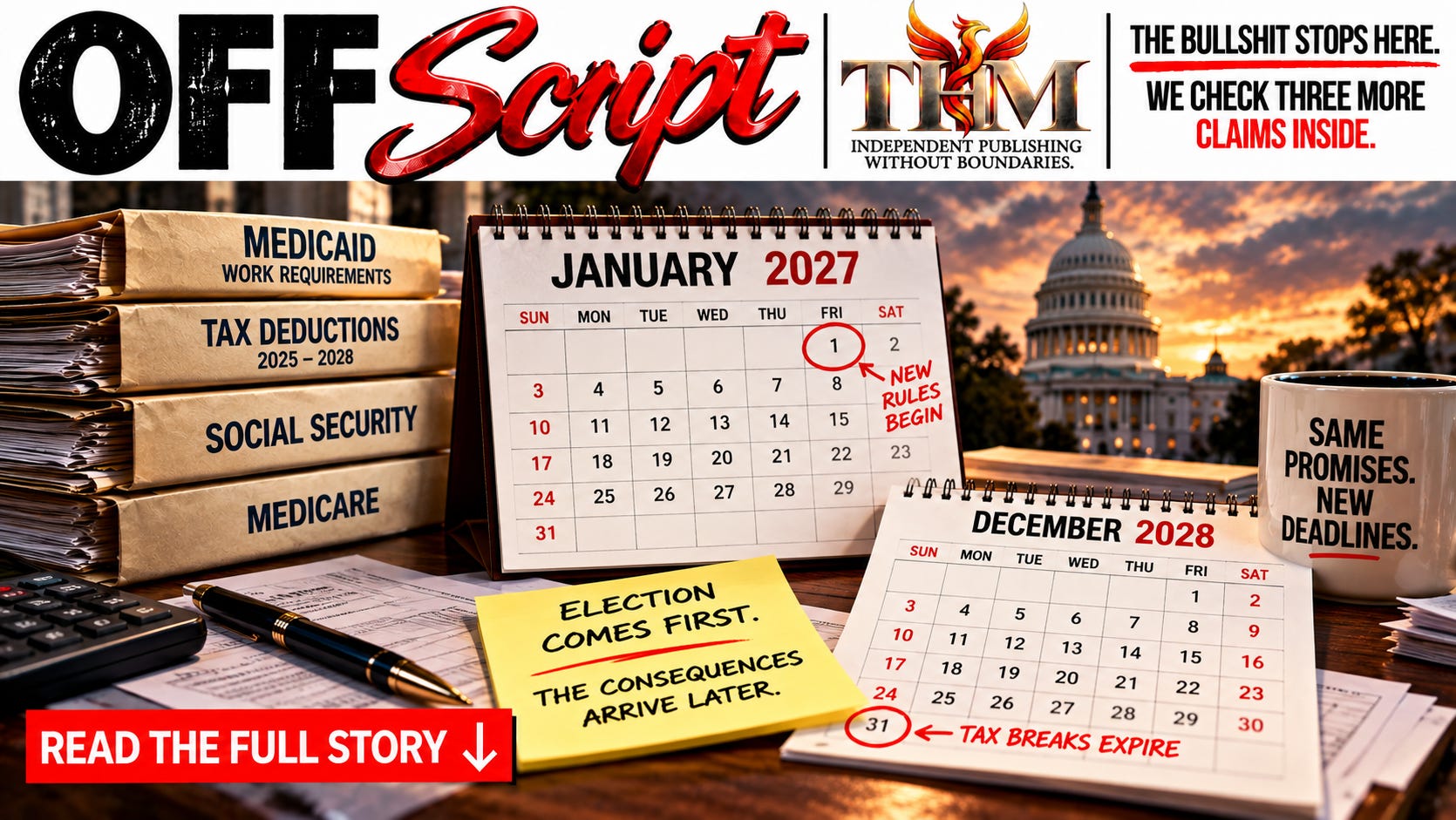
Under the new law, certain Medicaid recipients ages 19 through 64 will generally need to demonstrate 80 hours a month of work, education, community service, or other qualifying activity. There are exemptions, and some people can qualify through earnings rather than documenting hours. States must generally implement the requirements by January 1, 2027, although qualifying delays are possible.
Now imagine someone working irregular shifts at a restaurant. One month they’re scheduled for 100 hours. The next month business slows, and they get 65. They haven’t quit. They haven’t decided to become a professional couch ornament. Their employer simply didn’t have enough work.
That doesn’t automatically mean they lose coverage. Earnings, exemptions, and other circumstances matter. But it illustrates how complicated a seemingly simple requirement can become.
And even people who qualify for exemptions may face administrative hurdles. States are supposed to use existing information where possible, but documentation and eligibility verification still matter.
The law also requires more frequent eligibility checks for adults covered through Medicaid expansion, generally moving from annual to six-month renewals beginning January 2027.
The paperwork becomes part of the story because losing insurance over an administrative problem can be every bit as consequential as losing it over a change in eligibility.
According to KFF’s Medicaid analysis, many potentially affected adults already work or have circumstances that may qualify them for exemptions. Reporting and documentation barriers could nevertheless cause eligible people to lose coverage.
Which raises a reasonable question: How much money are we saving by making people prove something the government may already know?
And how much are we spending to make them prove it?
Two days. That’s the distance between the general Medicaid implementation deadline and the arrival of the new Congress.
It doesn’t mean everybody affected will lose coverage on New Year’s Day. Existing beneficiaries are evaluated through applicable eligibility procedures, and states may receive implementation extensions.
But it does mean the new Congress could inherit a law that’s already being put into operation.
And January isn’t the only date worth circling.
The Benefits Have an Expiration Date. The Campaign Promises Didn’t.
Remember no tax on tips? No tax on overtime? No tax on Social Security?
Those were memorable promises. They also sounded considerably simpler than the provisions Congress actually passed.
The law does provide real tax relief for qualifying taxpayers. But four prominent deductions have restrictions that weren’t necessarily obvious from the slogans, and they share an expiration date: December 31, 2028.
Here’s what the IRS says the law actually provides.
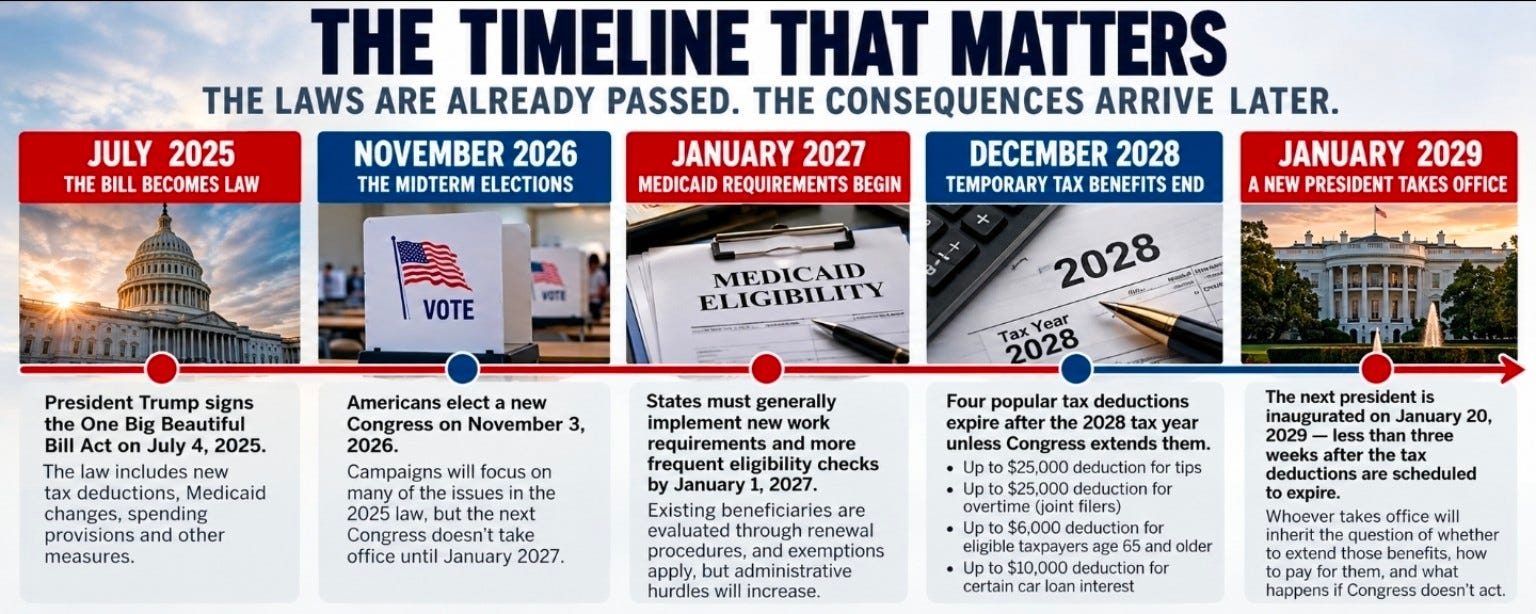
That’s not a minor footnote.
A $10,000 deduction is not a $10,000 tax refund. For someone whose entire deduction offsets income taxed at 12 percent, it could mean approximately $1,200 in federal income-tax savings. That’s real money, but it’s a different thing.
Likewise, tips and overtime remain subject to applicable payroll taxes. And the additional senior deduction does not eliminate federal taxation of Social Security benefits. It may reduce a qualifying taxpayer’s overall taxable income, but it isn’t the repeal people might have expected from the slogan.
At 70, I pay particular attention to that last one.
An extra deduction is welcome. But if you’re going to tell older Americans you’re eliminating taxes on Social Security, you ought to explain that what you actually passed is a temporary deduction with income limits.
I don’t think that’s an unreasonable expectation.
Now look at the calendar.
Donald Trump’s current presidential term ends January 20, 2029.
Those four deductions expire after the 2028 tax year, less than three weeks before that.
Funny how that works.
There’s a legitimate budgetary explanation. Temporary tax provisions cost less within the government’s ten-year budget calculations than permanent ones. In fact, the 2025 law made several other tax provisions permanent, including major elements of the 2017 individual income-tax changes, while giving these newer deductions a four-year lifespan.
But budget calculations and political calculations aren’t mutually exclusive.
Maybe the dates were chosen entirely to make the numbers work. Maybe the political timing entered the discussion. The law itself doesn’t establish anyone’s motive, and I’m not going to pretend otherwise.
Still, here’s a question I’d love somebody who helped write the legislation to answer:
Why were some tax benefits made permanent while these particular promises were scheduled to expire almost exactly when Trump’s term ends?
Because whoever takes office in January 2029 will inherit the question of whether to extend those deductions, how to pay for them, and what happens if Congress doesn’t act.
And if they disappear, the next president won’t have created the original expiration date. That decision was made in the law Trump signed in July 2025.
The next administration may get the political headache. The current one signed the calendar.
Washington is very good at announcing when a benefit begins. It’s worth checking how loudly they announce when it ends.
[SHARE BUTTON]
What Can the Next Congress Actually Fix?
This is where campaign promises encounter the United States Constitution, which has a remarkable talent for ruining a perfectly good political slogan.
Suppose voters elect a Congress whose members want to reverse some of these changes.
They can introduce legislation to delay Medicaid requirements, restore funding, change eligibility standards, or extend the temporary tax deductions.
But passing a bill through the House is only the beginning.
Ordinary legislation generally needs approval from both chambers and the president’s signature. A presidential veto can be overridden, but only with two-thirds support in both chambers. Senate rules can create additional hurdles for many bills.
Budget reconciliation offers another route for qualifying fiscal legislation, but it has restrictions of its own. It isn’t a magical legislative eraser.
Congress can also hold oversight hearings, demand records, and investigate implementation problems. Those powers matter. They can expose failures and influence policy.
They do not, by themselves, repeal a statute.
And that’s the distinction I’d like every candidate promising to fix these programs to explain.
What exactly would you change, how would you pass it, and what happens to people while you’re trying?
A promise without a workable legislative path is just a campaign speech with better lighting.
The Part That Bothers Me
I don’t expect every voter to read every page of every law. Hell, I spent part of my working life as a paralegal, and I wouldn’t wish that assignment on anybody without hazard pay.
But I do expect elected officials to explain consequential changes plainly.
If you believe Medicaid work requirements will improve the program, defend them. Explain the evidence, the exemptions, the administrative costs, and the projected coverage losses.
If you believe reducing federal Medicaid spending will make the system more sustainable, explain what states may have to do when the federal money isn’t there.
If you believe a tax deduction is worth celebrating, tell people what it actually saves them, who qualifies, and when it expires.
And if you promise to reverse any of these policies after an election, explain how you intend to overcome the obstacles.
The consequences of legislation shouldn’t be a surprise delivered after the ballots have been counted.
I’m 70. I’ve heard enough campaign promises to fill a warehouse, and I’ve watched enough politicians discover that governing is harder than campaigning.
What I want now is considerably simpler.
Tell people what the law does. Tell them when it happens. Tell them what it will cost, who may lose something, and what can realistically be changed.
Then let them make up their minds.
Because the election comes first.
The bill comes later.
And some of us are already living on a budget that doesn’t have much room for surprises.
THE BULLSHIT DETECTOR
💩 Misleading · 💩💩 Distorted · 💩💩💩 False
💩💩💩💩 Fabricated/manipulative · 💩💩💩💩💩 Potentially serious harm
1. The Polar Bear Rescue That Never Happened
CLAIM: A heartwarming viral video documented a man rescuing an injured polar bear cub, nursing it back to health, and releasing it into the wild a year later.
BULLSHIT: 💩💩💩 — False
WHY: The footage came from an AI-content creator whose original post included an AI disclaimer. It wasn’t documentary footage of an actual rescue. Lead Stories traced the video to its source in an October 23 fact-check.
Apparently, artificial intelligence has discovered that nothing attracts an audience quite like an injured animal and a human with a heart of gold.
I like a happy ending as much as anybody. I’d just prefer that the animal actually existed.
2. Spotify Supposedly Erased Ed Sheeran
CLAIM: Spotify removed all of Ed Sheeran’s songs from its platform.
BULLSHIT: 💩💩💩 — False
WHY: Spotify did no such thing. The rumor originated with satire and spread after being detached from its original context. RumorGuard verified that Sheeran’s music remained available.
There’s something especially impressive about a rumor that can be disproved by opening the very app it’s about.
Apparently, checking was too much work.
3. Superman Gets a License to Kill
CLAIM: Henry Cavill had officially been announced as the next James Bond, starring in a film directed by Denis Villeneuve.
BULLSHIT: 💩💩 — Significant distortion through misleading presentation
WHY: No such casting announcement had been made. The viral post came from a parody account designed to resemble a legitimate entertainment-news source. Its parody labeling was easy to overlook when the claim spread elsewhere. RumorGuard examined the false announcement.
Cavill might make an interesting Bond. That’s an opinion.
Announcing that he already has the job is something else entirely.
Keep Asking Questions
Off Script isn’t interested in handing you a party’s talking points with the serial numbers filed off. I want to know what the promises mean, what the documents say, and what happens when the headlines fade.
If that sounds like your kind of reading, subscribe for free. You can also become a paid subscriber to help keep the research and reporting going. Either way, you’re welcome here.
The Conversation Doesn’t End Here
The articles are only half the fun. We’ve got a Tom Hicks Media Discord community where we can talk politics, music, movies, sports, and whatever else happens to wander into the conversation. No talking points required, and nobody has to agree with me. Hell, that would get boring.
Come pull up a chair. The conversation is free, and you’re invited.
Around Tom Hicks Media
Frank N. Krancke has joined the THM household, bringing his own particular talent for being thoroughly fed up with the world. And this Wednesday, October 28, Eve Next Door makes its debut with Eve N. Tempere, whose view of everyday life promises to be considerably more interesting than whatever the neighbors think is happening.
Chart Collision digs into the music, memories, and stories behind the songs, while Rabbit Ears Classic TV revisits the television that shaped our lives. The Backlot Ghost keeps the projector running for movies worth remembering, and What The Hell? specializes in true stories that sound like somebody lost a bet.
Panic Room Sports takes on the games, the hype, and the occasional spectacular stupidity surrounding them. Meanwhile, Lotus Purrspective continues providing the household’s feline perspective, largely because Lotus has decided that the humans cannot be trusted to explain anything correctly.
One Question
When politicians announce a new benefit, should they give its expiration date as much attention as its start date?
I’d really like to hear what you think.
#OffScript #TomHicksMedia #Medicaid #TaxPolicy #SocialSecurity #Congress #Midterms2026 #IndependentJournalism