

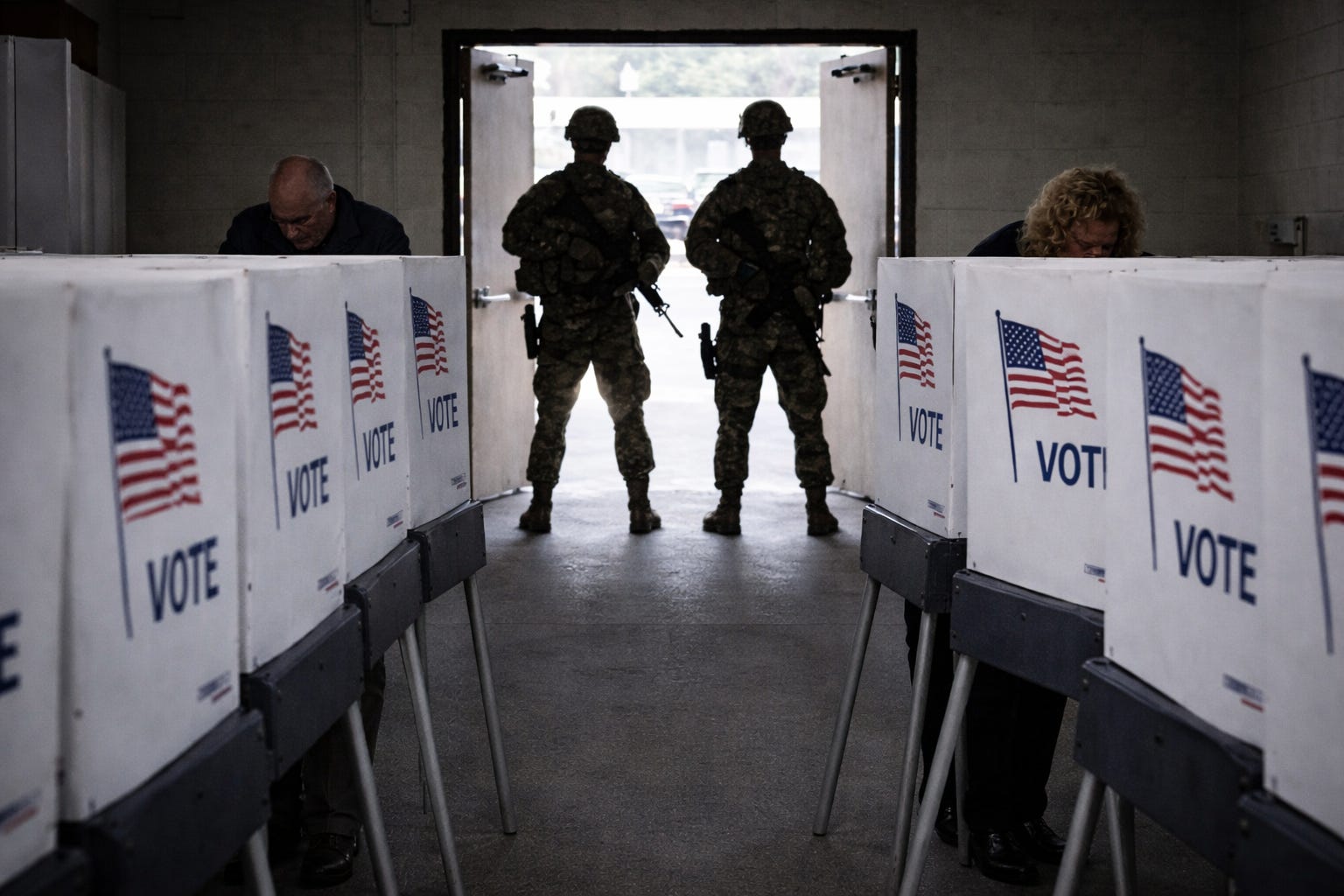
When Americans imagine democracy collapsing, they usually picture something dramatic.
Tanks rolling through Washington. Soldiers guarding ballot boxes. Some nervous official announces that extraordinary circumstances require extraordinary measures while the cameras capture the moment the system breaks.
That’s the movie version.
In the real world, democracies rarely fail that way. They erode slowly, the way rust spreads through steel or the way a shoreline disappears under a rising tide. The first thing that changes is the language around elections themselves. Voting stops being treated as a civic ritual and starts being described as a security problem.
Politicians warn about instability. Commentators talk about chaos. Government officials begin describing election systems the same way they talk about power grids, airports, and pipelines—critical infrastructure that must be protected from disruption.
Once elections are framed that way, the institutions responsible for national security begin drifting toward the process like iron filings toward a magnet.
Not to control it.
To protect it.
And that’s usually where the shift begins.
💣 TRUTH BOMB
You don’t rig a democracy by canceling elections.
You rig it by protecting them until they behave.
Right now, American politics is saturated with election-cycle noise. Cable news panels are arguing about unrest. Politicians are warning that democracy itself is under attack. Commentators are predicting chaos if the wrong side wins.
Most of that noise is theater.
But beneath the spectacle, something quieter has been happening for years: elections themselves are increasingly described using the language of national security.
Federal officials classify election systems as critical infrastructure. Intelligence agencies treat election interference like a battlefield maneuver. Political leaders talk about unrest surrounding elections as if the country is always one bad weekend away from a five-alarm fire.
Individually, those moves sound responsible. Protecting voting systems from cyberattacks or foreign interference is obviously a legitimate concern.
Taken together, however, they slowly reshape the entire frame around elections.
Once elections are treated primarily as security vulnerabilities, the people who arrive to “solve the problem” aren’t civic administrators.
They’re security agencies.
And security agencies don’t run democratic rituals.
They run operations.
Everything above is the story most people are watching.
The real story begins when you ask what happens if that security mindset collides with a contested election and nationwide unrest at the same time.
Because at that moment, the tools governments reach for stop looking democratic.
They start looking like emergency powers.
Behind the wall, we’re going to walk through how those powers could actually be triggered during an election crisis, how the move would be sold to the public, and why the safeguards people assume would stop it might not work the way they expect.
And once you see the sequence step by step, the risk becomes a lot harder to ignore.
