

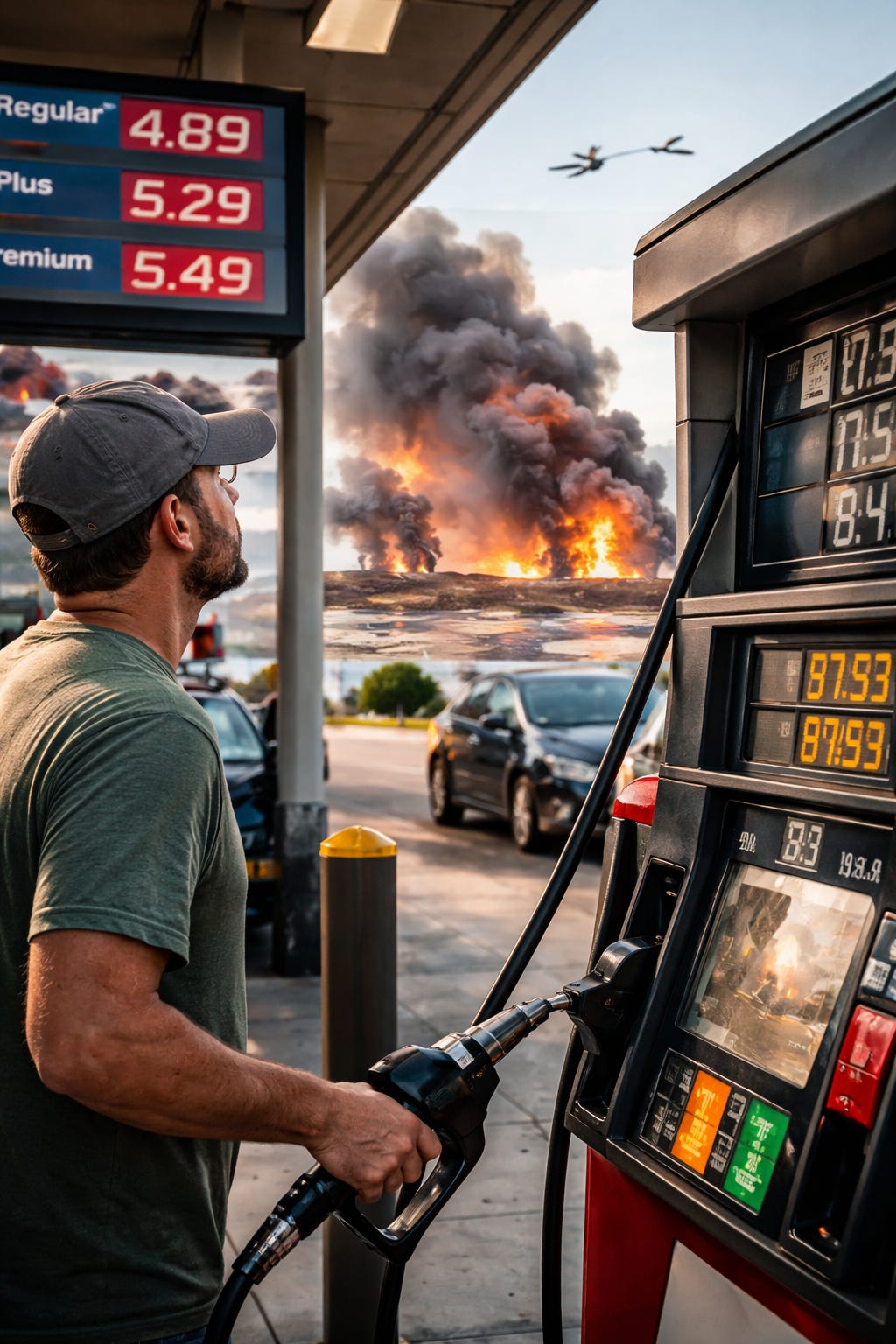
Every time gas prices move even a little bit, the same political circus shows up like clockwork. Somebody snaps a photo of a gas pump. A meme account slaps a caption on it. And suddenly, the comment section is full of people declaring that they’ve cracked the entire global energy market with one smug sentence.
Right now, the line making the rounds is: “Still cheaper than Biden.”
That’s the whole argument. That’s the big economic thesis. A global commodity market that moves trillions of dollars a year gets reduced to a bumper sticker written by a guy with Oakleys in his truck.
And the reason that talking point exists at all is because the actual explanation for the price spike is deeply inconvenient to the same people repeating it.
Gas prices are climbing right now because the United States is involved in a rapidly escalating war in one of the most oil-rich regions on the entire fucking planet. Oil markets do not particularly enjoy wars near major supply hubs. They react to them instantly, violently, and with the kind of panic that makes Wall Street traders sweat through their thousand-dollar shirts.
Before we go further, if you want analysis that actually explains what the hell is happening instead of recycling whatever meme the algorithm served up this morning, hit subscribe. This place exists precisely to drag reality back into conversations that propaganda keeps trying to derail.
The Mechanism Everyone Pretends Not To Understand
Oil markets are brutally simple in one respect: they are obsessed with supply risk. The second traders believe that oil might become harder to move or produce, the price starts climbing. It doesn’t matter whether the disruption actually happens or whether it’s just a possibility; the fear alone is enough to move billions of dollars.
That’s why the Middle East has always been the most sensitive region in global energy markets. An absurd amount of the world’s oil sits under that stretch of land, and a massive percentage of it moves through a very narrow shipping corridor called the Strait of Hormuz. Roughly a fifth of the planet’s oil supply passes through that choke point every single day. If that route even looks like it might turn into a battlefield, traders react the same way a herd of deer reacts when somebody fires a rifle in the woods.
Now layer the current war on top of that reality. Strikes inside Iran, naval tensions in the Gulf, and the constant possibility that tanker traffic could get disrupted are already enough to make markets twitchy. But the part of this story that hasn’t gotten nearly enough attention is the damage spreading into Iraq’s energy infrastructure.
Iraq is not some minor oil producer on the sidelines of the global economy. It is one of the largest exporters in the world, pumping millions of barrels of crude into international markets every single day. When airstrikes start hitting facilities connected to that system—even if the targets are Iranian-aligned militias or storage depots—the market doesn’t sit around politely sorting out the geopolitical details. It sees pipelines, fields, and infrastructure inside one of the world’s major oil producers under fire.
To traders, that looks like supply risk. And supply risk makes prices jump.
The Iraqi Oil Field Factor
Several of the facilities struck in recent operations were tied to Iranian-backed groups operating around Iraqi oil infrastructure. Militarily, those targets might make sense. Economically, they still create the same ripple effect: fewer guarantees that oil production and transportation will proceed normally.
Oil markets don’t care about the political rationale behind the bombs. They care about barrels. If traders think even a fraction of Iraq’s output could be disrupted—or if pipelines and storage facilities might get damaged—they start pricing that risk into the market immediately. Tanker insurance rates go up. Shipping costs climb. Futures contracts spike as speculators rush in to hedge against potential shortages.
Within days, the price of crude rises. Within a week or two, drivers start noticing the difference at the pump.
That’s the chain reaction. It’s not complicated. But it is apparently complicated enough that half the internet is pretending it doesn’t exist.
The “Still Cheaper Than Biden” Trick
Now let’s talk about that MAGA talking point, because it’s a masterclass in selective memory.
When people say gas is “still cheaper than Biden,” they’re referring to the brief period in 2022 when prices approached five dollars a gallon. That spike happened after Russia invaded Ukraine and global energy markets lost their damn minds. It was one of the biggest supply shocks the oil industry had seen in decades, and prices surged worldwide—from Europe to Asia to the United States.
But here’s the part that gets quietly left out of the meme.
For most of 2023 and 2024, gas prices were sitting somewhere around the low-to-mid three-dollar range. They fluctuated a little, as gas prices always do, but they lived roughly in the same band that they had occupied for years.
In other words, before this war started rattling oil markets, the price of gas was already sitting in the exact same neighborhood it had occupied for a good chunk of the previous administration.
Comparing today’s price to the single worst spike of the Biden era is like comparing the weather in April to the worst blizzard of the decade and declaring that winter has disappeared forever. It’s a rhetorical trick designed to make a talking point sound factual when it’s really just cherry-picking.
The Part That Makes The Whole Argument Collapse
The real reason the MAGA line falls apart is much simpler than any economic analysis.
The same people chanting “still cheaper than Biden” are often the exact same people cheering the military escalation that is currently freaking out global oil markets. They want the geopolitical muscle flexing, they want the bombs falling, they want the strong-man optics of confrontation in the Middle East.
But they also want gas prices to behave as if none of that is happening.
That’s not how markets work. That’s not how war works. And it’s definitely not how oil works.
Starting or expanding a conflict in one of the world’s most oil-sensitive regions is basically the economic equivalent of kicking a hornet’s nest and then acting surprised when the hornets show up angry.
The Danger Nobody Is Talking About Yet
What we’re seeing right now is the early tremor, not the full earthquake. Oil markets are reacting to instability, but the real nightmare scenario hasn’t happened yet.
If tanker traffic through the Strait of Hormuz were seriously disrupted—even for a short period—the impact would dwarf anything we’re seeing today. Roughly twenty percent of the global oil supply moves through that narrow passage. Interrupt that flow and prices don’t just creep upward; they rocket.
Energy analysts have been warning about this scenario for decades. It’s the reason every escalation in the region makes traders nervous. Markets understand just how fragile the system can become when war and oil supply overlap.
The Crystallization Line
Strip away all the partisan shouting and the bumper-sticker economics, and the truth becomes painfully obvious:
Gas prices don’t care who the president is. They care whether oil tankers can safely pass through a war zone.
You can chant slogans about the previous administration all day long. The global oil market will continue reacting to the same thing it has always reacted to—supply disruptions, military escalation, and the risk that oil might suddenly become harder to move from point A to point B.
Missiles near supply lines beat political talking points every time.
The Verdict
The MAGA gas-price argument isn’t an economic explanation. It’s a coping mechanism. It exists to shield a political narrative from the obvious consequences of a geopolitical reality.
Wars in oil regions move markets. Damage the infrastructure, and the markets move faster. Threaten shipping routes, and the markets practically sprint.
Those are the rules of the global energy system. They were true under the last president, they’re true under the current one, and they’ll still be true under the next one.
Pretending otherwise doesn’t change the math. It just makes the conversation dumber.
💣 TRUTH BOMB
If you cheer the war that spooks global oil markets and then blame someone else when gas prices rise, you’re not analyzing economics.
You’re performing political theater while the global energy market laughs and keeps doing exactly what it always does.
Upgrade to the Bastard War Room
If you want the deeper strategic analysis—the stuff that connects the political decisions to the consequences before the headlines catch up—that’s what the Bastard War Room is for.
This newsletter is reader-funded. No corporate sponsors. No billionaire patrons whispering in the background.
Paid subscribers get:
• War Room briefings
• Investigative deep dives
• Direct Q&A access
If you want the uncensored version of what’s actually happening, upgrade and join the War Room.
Cross-Promo
If this article raised your blood pressure, head over to Lotus Purrspective, where a judgmental tuxedo cat explains human stupidity with considerably more patience than the Bastard can usually manage.
It’s the same reality check—just with fewer F-bombs and more whiskers.
👍 If this piece landed, like, share, and subscribe so it reaches people who still prefer facts over memes.
☕ And if you want to keep the Bastard caffeinated and dangerously opinionated:
Buy Me A Coffee
#politics #energy #gasprices #iranwar #economics #propaganda