


When power can’t win the argument, it starts making examples.
Here’s some deeply unsettling bullshit nobody wants to say out loud because it sounds dramatic right up until suddenly it doesn’t: the government does not actually need to ban speech if it can scare enough people into shutting the fuck up first. That is the scam. That is the whole goddamn trick. Everybody keeps waiting for censorship to arrive like a movie villain kicking down newsroom doors while ominous music plays and somebody on cable news dramatically announces the death of freedom between pharmaceutical commercials. But real democratic rot rarely arrives yelling. The smarter version walks in quietly, carrying a clipboard, speaking fluent bureaucratic bullshit about “professional standards,” “security concerns,” “responsible conduct,” or “appropriate procedures,” and gently teaching people that speaking plainly now comes with consequences.
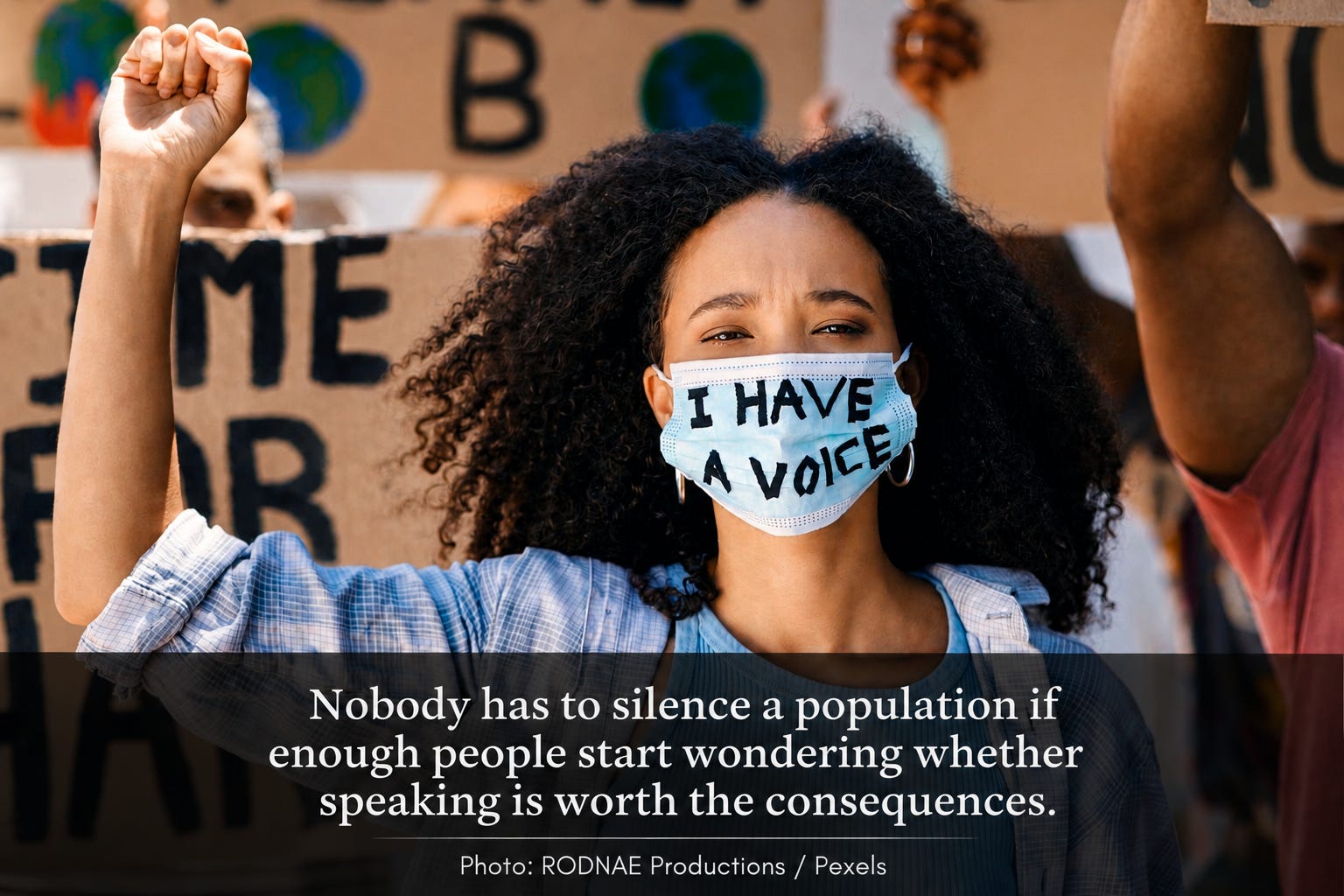
The reason this matters is simple: fear scales better than punishment. Arresting dissidents is loud, expensive, messy, terrible public relations, and likely to end up in court with a constitutional scholar explaining why everyone should be alarmed. Scaring ten thousand ordinary people into self-editing before they speak is efficient as hell. Nobody has to outlaw criticism if journalists begin worrying about access, teachers start wondering whether honesty becomes a career problem, students quietly calculate whether speaking up is worth future consequences, and ordinary citizens decide maybe silence feels safer than attention.
That is how the game works. Not, Can I say this? But what happens to me if I do? That shift should scare the absolute shit out of people, because rights survive on paper a lot longer than they survive in practice. You can technically possess freedom while quietly becoming too nervous, exhausted, or professionally vulnerable to use it. Democracies do not always lose their voice because someone confiscates it. Sometimes they lose it because people begin treating honesty like one of those luxury hobbies they simply cannot afford anymore.
And before the comments section fills with Constitution Guy yelling, “WELL ACTUALLY FREE SPEECH ONLY MEANS THE GOVERNMENT CAN’T THROW YOU IN JAIL,” congratulations, buddy, you passed freshman civics. The First Amendment matters enormously. Nobody is arguing otherwise. But democracies are not held together by legal theory alone. They run on norms, expectations, and atmosphere. Rights only stay alive when enough people feel free enough to exercise them without running twenty separate risk calculations first.
Because let’s be brutally honest about how humans actually operate. Most people are not fearless revolutionaries waiting for their cinematic resistance moment. They are tired. Working. Paying bills. Raising kids. Fighting insurance companies that behave like medieval toll collectors. Doomscrolling at midnight while stress-eating crackers over the sink and wondering whether retirement is real or a prank invented by financial planners with suspiciously perfect smiles. If consequences suddenly feel uncertain, people do math. Will this hurt me? Will this follow me? Will somebody decide I’m a problem? That calculation is where intimidation politics quietly moves into the house.
If you’re not subscribed yet, you’re reading this the hard way. I do this daily. No sponsors. No filter.
Subscribe if you want it in your feed instead of chasing it down.
Because once you start looking for this pattern, holy hell, you see it everywhere. A journalist suddenly wonders whether pushing harder costs access. Nobody explicitly says, “Tone it down or else.” Instead, the doors quietly get heavier. Interviews become harder. Officials stop returning calls. Access starts feeling conditional. Maybe coverage becomes more careful. Maybe language softens. Maybe nothing changes at all. But the fear entered the room, and once fear enters the room, it rarely leaves quietly.
Universities feel it. Teachers feel it. Librarians feel it. Government workers scrub old posts because opinions suddenly feel radioactive. Students weigh whether protests today become consequences tomorrow. Nonprofits rewrite language because certain phrases mysteriously start feeling dangerous to funding. Nobody announces censorship with a giant banner reading WELCOME TO AUTHORITARIANISM. Institutions simply learn to flinch.
And here is the especially insidious part: self-censorship feels rational. People love pretending they would be brave in hindsight. Americans are particularly addicted to this fantasy. Everybody imagines themselves heroically standing against tyranny while dramatic orchestral music swells behind them and history lovingly records their courage in tasteful documentary lighting. Meanwhile, half the country gets nervous sending a mildly assertive email at work. That is not judgment. It is reality.
If speaking threatens your paycheck, healthcare, immigration status, housing, reputation, funding, relationships, or future, silence starts looking less like cowardice and more like common sense. Humans adapt because adaptation is what humans do. We adapt to ridiculous medical bills, surveillance capitalism, airports that somehow feel like detention centers with snack kiosks, and social systems that quietly grind us into powder while asking whether we’ve tried mindfulness. Fear works exactly the same way. At first, it feels temporary. Then practical. Then cultural.
What gets missed in these conversations is that democracies are supposed to be loud, annoying, argumentative, and occasionally embarrassing. Journalists are supposed to piss off powerful people. Protesters are supposed to inconvenience authority. Writers are supposed to say things that make somebody mutter, “Jesus Christ, I hate that this asshole might have a point.” Public officials are supposed to develop emotional scar tissue because criticism comes with the damn job. The friction is not failure. The friction is the feature.
The moment people stop asking What do I believe? and start asking What is safe to say?, something fundamental starts breaking. Not loudly. Quietly. The room gets a little softer. A little safer. A little more rehearsed. A joke goes unsaid. A criticism gets swallowed. A sentence becomes gentler than the truth demanded. That silence spreads — and once it does, it’s a hell of a lot harder to walk back than it was to start.
History says the smartest censorship rarely burns books. It leaves the Constitution standing, wraps itself in patriotic language, insists everyone remains perfectly free, and scares the shit out of people anyway. It teaches citizens that honesty suddenly feels expensive, visibility feels dangerous, and speaking plainly might not be worth the headache. A government does not need to silence a population if it can convince enough people that silence is the smarter bet. Free speech rarely dies because somebody slams the door. It dies when enough ordinary people quietly decide that opening their mouths costs too damn much.
Upgrade
I’m retired. This is reader-funded. No sponsors. No corporate leash. No one telling me to tone it down.
Paid subscribers get bonus rants, full archive access, priority Q&A, and deeper dives that don’t make it into the free feed.
Upgrade and support independent work that doesn’t play nice.
If you want the same reality with a quieter voice and sharper claws, go check out Lotus Purrspective.
That’s where the judgment is calmer, cleaner, and somehow even more brutal.
Buy Me A Coffee
If this hit, consider supporting the work—because yelling “what the fuck are we doing?” at the news doesn’t pay for itself.
#TheUnredactedBastard #FreeSpeech #FirstAmendment #Democracy #PressFreedom #PoliticalCommentary #IndependentJournalism #CivilRights #Censorship #ChillingEffect #DemocracyInDanger #Authoritarianism #SpeakTruth #Politics #Resist