

EDITORIAL NOTE
There’s an important distinction at the center of this story. Government datasets change all the time because surveys end, questions become obsolete, agencies reorganize information, funding disappears, and sometimes a program simply isn’t worth continuing. Pretending every missing spreadsheet is evidence of some sinister master plan would be lazy and, frankly, bullshit.
What matters is the pattern created when federal agencies suppress information they already collected, stop publishing measurements that let outsiders judge government performance, propose eliminating long-running civil-rights reporting, and remove hundreds of data elements from public collections. In several cases, the agencies have explained exactly why they made those decisions. The Blind Spot is what happens when we stop treating those decisions as unrelated and put the damn pieces on the same table.
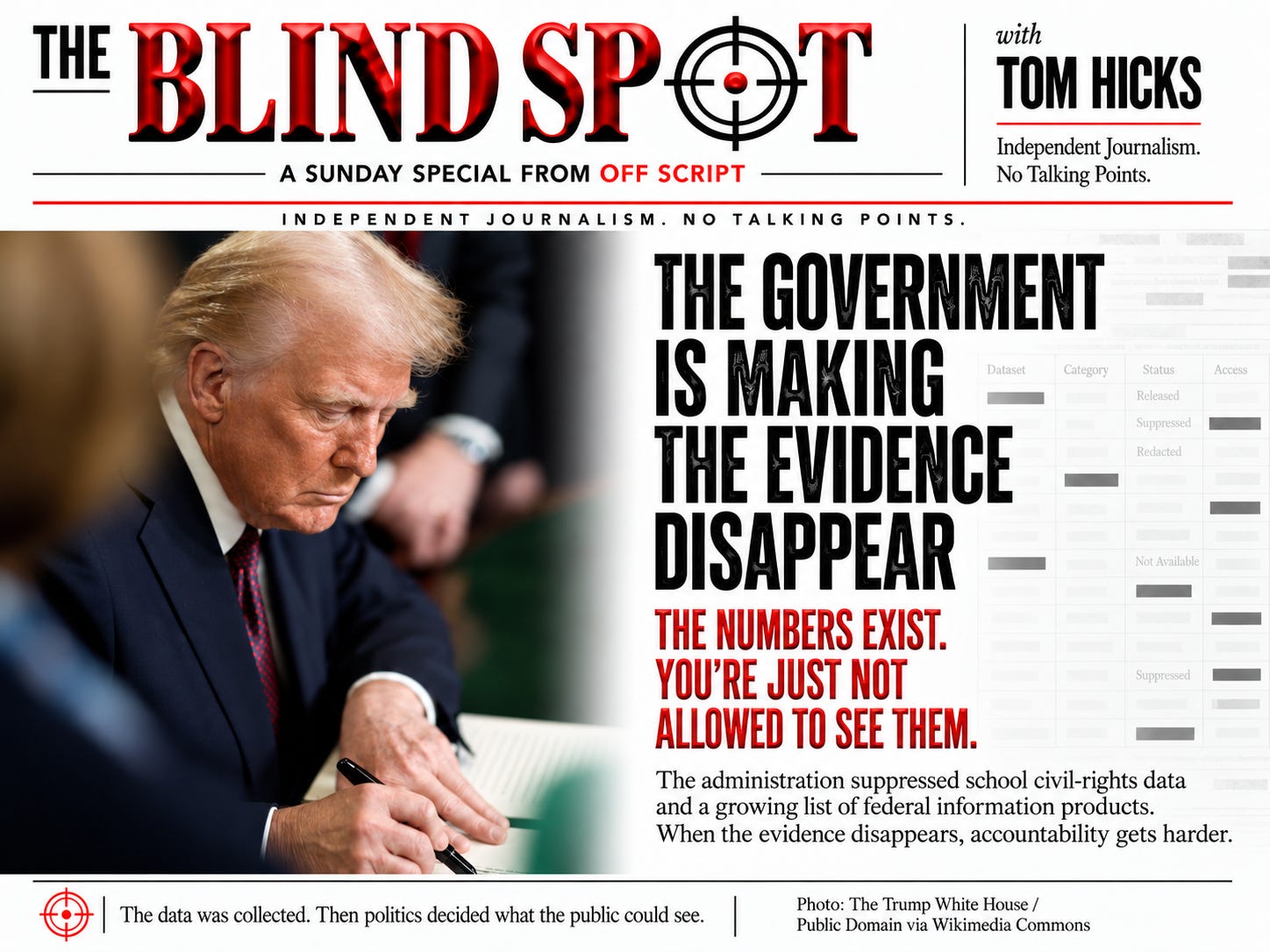
The Data Was Already There
This would be a very different story if the federal government had simply decided it didn’t want to ask certain questions anymore. Governments change surveys constantly, and reasonable people can argue about what information belongs on them. That isn’t what happened here.
The Department of Education quietly released data this week from its 2023-24 Civil Rights Data Collection, one of the most comprehensive examinations of what happens inside American public schools. The survey covers virtually every public school in the country and includes information involving nonbinary students along with allegations of bullying or harassment based on gender identity.
When the new dataset appeared, Associated Press reporters found that columns involving gender identity had been replaced with the notation “Suppressed in Compliance with Executive Order.” The administration also suppressed information showing allegations of gender-identity harassment, district policies addressing that harassment, and links to those policies. Roughly 1,800 of more than 13,000 school districts had reported information concerning transgender and nonbinary students.
That sequence matters because the schools collected the information, gave it to the federal government, and the federal government still has it. This isn’t a case where nobody thought to ask the question or where the information disappeared because a survey ended. The government possesses the answers and decided the public version would not contain them.
The Executive Order Did Exactly What It Said
There’s no need to hunt around for a secret memo explaining why this happened. Trump’s January 20, 2025 executive order declared that federal policy would recognize two sexes, male and female, and ordered agencies to remove statements, policies, forms, and communications that the administration considers to promote “gender ideology.” It also instructed federal forms requesting sex to list male or female and not request gender identity.
You can agree with that policy or hate it, and that argument can occupy its own room. The question here is what happens when a political policy reaches backward into information the government has already collected and determines that Americans will no longer see part of the record. That’s a transparency question before it becomes anything else.
We aren’t debating whether the government should ask a question next year. We’re talking about an answer already sitting in a federal database being removed from the version made available to the public. That is a different kind of decision, and it deserves a closer look.
And They Barely Mentioned It
You might expect the release of one of the federal government’s largest school civil-rights datasets to come with an announcement explaining what was in it. According to AP, there was no formal Education Department announcement, even though the previous collection had been accompanied by a detailed report examining trends in educational opportunity. This time the new data appeared quietly while the department’s website was still directing readers toward the previous collection.
The department says the Office for Civil Rights is being realigned with its statutory mission and that additional data will be released. That explanation belongs in the story because it is the administration’s stated position. It still doesn’t change the fact that information already collected from schools was suppressed in the public release.
First, Let’s Kill One Exaggeration Before It Starts
This subject is practically begging for somebody to turn a legitimate story into a bullshit statistic, so we might as well beat them to it. The Williams Institute at UCLA found that 360 federal data collections removed at least one sexual-orientation or gender-identity measure during the first year of Trump’s second administration. Of those, 338 removed gender-identity measures.
A separate Federal Data Terminations Tracker currently contains 375 entries, including 38 entire datasets terminated and 337 instances in which data elements were removed from continuing products. Those numbers are real, but the projects measure different things and overlap in places. One specifically examines sexual-orientation and gender-identity measures while the other tracks a much broader universe of federal information products.
So no, you don’t add 360 and 375 and announce that the administration eliminated 735 federal datasets. Enough is happening here without inflating the count and handing critics an easy reason to dismiss the entire story. The real numbers are already strong enough.
KEEP READING THE BLIND SPOT
One school survey would be a troubling argument over government transparency. Thirty-eight terminated federal datasets and hundreds of removed measurements are something much larger, especially when the missing information touches immigration enforcement, disaster risk, workplace discrimination and public health. That’s where this stops being a story about one executive order and becomes a question about how government accountability works when the underlying evidence gets thinner.
Below the paywall, we’re following that missing information across agencies and asking the question that matters most: what happens when the government gets to decide which evidence the public can use to judge it? That question doesn’t belong to one party, one administration, or one culture-war fight. It belongs to anybody who thinks public power should be measurable.
Your subscription helps fund reporting, research, publishing, new features, and the continued growth of every Tom Hicks Media publication.
